
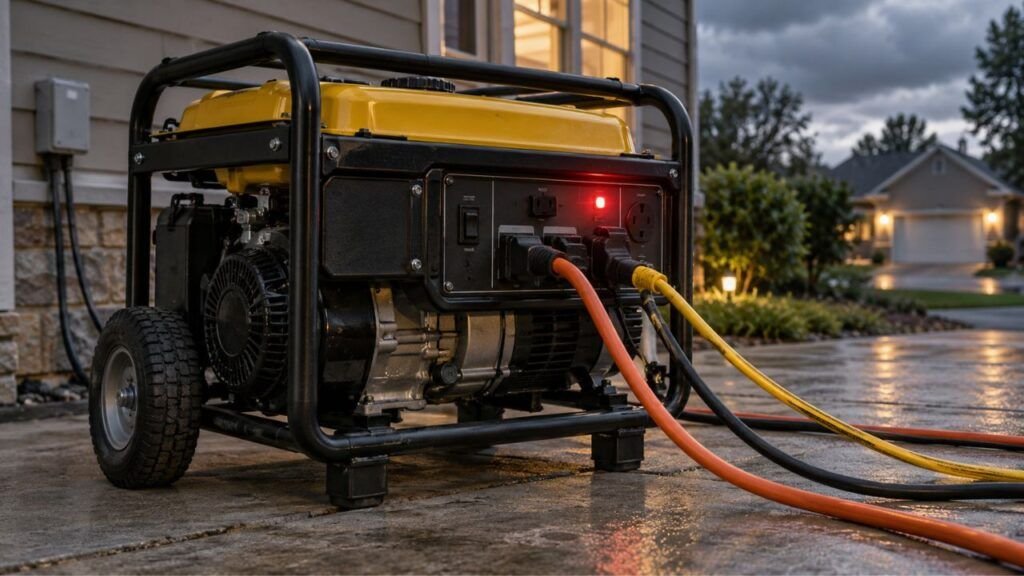
When a generator is overloaded, connected appliances demand more power than it can safely supply. The engine may bog down, voltage can become unstable, breakers may trip, or the generator may shut off to protect itself.
In this guide, I’ll explain what overload does to your generator. We’ll also cover warning signs, appliance risks, resets, strange overload faults, and practical ways to prevent another overload.
Key Takeaways
- A generator overload happens when electrical demand exceeds available capacity.
- Starting surges can overload a generator despite safe running wattage.
- Many generators trip breakers or disable power before serious damage occurs.
- Repeated overloads can overheat wiring, windings, outlets, and other components.
- An overload warning can sometimes indicate a short circuit instead.
- Overload warnings without connected loads may indicate an internal problem.
What Does It Mean When a Generator Is Overloaded?
A generator is overloaded when the electrical demand exceeds its available output. This can happen because too many appliances are running together.
It can also happen when one appliance needs high starting power.
Every generator normally has at least two important power ratings. Running watts describe the power it can continuously provide. Starting watts describe the temporary extra power available for startup surges.
For example, your refrigerator may use modest power while running. However, its compressor can demand considerably more power during startup.
That brief surge can exceed your generator’s available capacity.
You should also pay attention to individual outlet ratings. A large generator may have plenty of total capacity available. However, one receptacle or circuit can still become overloaded.
An overload warning also does not always mean excessive appliance wattage. Some generators use similar protection for overloads and short circuits.
That is why identifying the cause matters before repeatedly resetting anything.
What Happens When a Generator Is Overloaded?
Several things can happen once electrical demand exceeds generator capacity. The exact response depends on generator design and protection systems.
The Engine May Bog Down or Lose Speed
Electrical demand places a mechanical load on the generator’s engine.
As you connect more equipment, the engine must work harder. If demand becomes excessive, you may hear the engine noticeably slow down.
Conventional generators rely heavily on engine speed for proper frequency output. Therefore, falling engine speed can also affect electrical frequency.
You may notice a deeper engine sound or uneven operation. Sometimes the generator sounds normal until another large appliance starts.
That sudden startup demand can push it beyond its limits.
Voltage or Frequency May Become Unstable
An overloaded generator may struggle to maintain normal electrical output.
Lights may dim when a large appliance switches on. You might also notice flickering or motors behaving unusually.
These symptoms do not automatically mean permanent generator damage occurred. They indicate the generator may be struggling with its current load.
Continued unstable power is something you should take seriously.
Motor-driven appliances can particularly dislike prolonged low-voltage conditions. Sensitive electronics also benefit from stable voltage and frequency.
If output becomes noticeably unstable, reduce the load immediately.
The Breaker or Overload Protection May Trip
Modern generators commonly include protection against excessive electrical demand.
Depending on the generator, a circuit breaker may trip first. An inverter generator may electronically disable its AC outlets instead.
This creates a situation that often confuses homeowners.
The generator engine may continue running normally, yet the outlets stop supplying electricity.
That does not necessarily mean the alternator suddenly failed. Overload protection may simply have disconnected the electrical output.
Some models require a breaker reset afterward. Others use an electronic reset button or specific restart procedure.
Always follow the procedure listed in your owner’s manual.
Internal Components Begin Producing More Heat
Excessive electrical current creates additional heat inside generator components.
Alternator windings, wiring, connectors, breakers, and outlets may become hotter. Prolonged heat can gradually damage insulation surrounding electrical components.
A brief overload that immediately trips protection is less concerning.
Repeatedly forcing the generator beyond its limit is another matter.
Heat damage builds over time and can shorten component life. Severe overheating can also discolor or melt electrical connections.
If you smell burned plastic or electrical insulation, stop immediately.
The Generator May Shut Down Completely
Not every generator responds to overload in exactly the same way.
Some generators simply trip an individual outlet breaker. Others disconnect their entire AC output while leaving engines running.
Certain generators may shut the engine down completely.
You might also see an overload, underspeed, or fault indicator. Home standby generators may use additional load-management systems before shutting down.
The important point is that shutdown is often protective behavior.
Do not immediately assume your generator itself has failed.
Signs Your Generator Is Overloaded
Generator overload usually gives you several warning signs beforehand. Knowing them helps you reduce demand before bigger problems develop.
Common overload symptoms include:
- The overload warning light turns on.
- A circuit breaker repeatedly trips.
- The engine suddenly bogs down.
- Lights dim when another appliance starts.
- Lights flicker while the generator operates.
- AC outlets suddenly stop providing power.
- The generator shuts down under heavy load.
- A large appliance repeatedly fails to start.
- The generator becomes unusually hot.
- Plugs or outlets become excessively warm.
- You notice a burning electrical smell.
- An overload or fault code appears repeatedly.
Smoke, sparks, melted plugs, or strong burning odors are different. Shut the generator down instead of repeatedly resetting its breaker.
Generator Overload vs. Starting Surge vs. Short Circuit
Several electrical problems can look like generator overload at first. Understanding the difference helps you troubleshoot the correct problem.
| Condition | What Is Happening | Common Clue | Typical Result |
| True overload | Total demand exceeds generator capacity | Problem appears after adding several loads | Breaker trips or output stops |
| Starting-watt overload | Motor startup demand exceeds available surge power | Generator trips when a refrigerator, AC, or pump starts | Overload protection activates |
| Short circuit | Current flows through an unintended path | Generator trips immediately with one appliance or cord | Breaker trips very quickly |
| Internal generator fault | Generator detects an abnormal internal condition | Overload remains after external loads are removed | Further diagnosis may be needed |
| Normal startup surge | Generator briefly handles increased motor demand | Engine sound changes briefly before stabilizing | Generator continues operating |
A repeated breaker trip should therefore be investigated carefully.
Simply buying a larger generator may not solve a short circuit. Likewise, replacing electrical parts will not solve basic load overload.
Start by identifying exactly when the problem occurs.
Can Overloading a Generator Damage It?
Yes, repeated or severe overloads can damage a generator.
However, one brief overload does not automatically ruin your machine. Generator protection exists specifically to interrupt unsafe operating conditions.
The bigger concern is sustained or repeated excessive demand.
Too much load can increase heat inside alternator windings. That heat can gradually weaken the insulation protecting those windings.
Wiring and connectors can also become excessively hot.
The engine itself must work harder under heavy electrical demand. Repeatedly pushing it beyond its intended capability increases mechanical strain.
Over time, this can accelerate wear throughout the system.
You should therefore treat overload protection as a warning.
Resetting the generator repeatedly without reducing demand defeats its purpose.
Can an Overloaded Generator Damage Appliances?
Yes, an overloaded generator can potentially affect connected appliances. The actual risk depends on the generator and overload severity.
Motor-driven loads and sensitive electronics deserve particular attention.
Refrigerators, Air Conditioners, Pumps, and Other Motors
Motor-driven appliances often create the biggest generator overload problems.
Refrigerators, well pumps, sump pumps, freezers, and air conditioners need startup power. This temporary demand can be much higher than normal running wattage.
If generator voltage drops significantly, motors can struggle to start.
A motor that repeatedly struggles may generate excessive internal heat. Compressors can also cycle repeatedly during an unstable power condition.
The appliance itself may therefore suffer additional stress.
That is why startup wattage matters when sizing backup power.
TVs, Computers, and Other Electronics
Modern electronics generally work best with stable electrical input.
A correctly functioning generator should maintain acceptable voltage and frequency. However, severe overload may create unstable conditions before protection activates.
That does not mean every overload instantly damages electronics.
Still, you should avoid leaving sensitive devices connected while the generator repeatedly bogs, trips, or produces visibly unstable power.
Fix the load problem before reconnecting those devices.
Extension Cords, Plugs, and Outlets
The generator itself is only part of your electrical system.
An undersized extension cord can overheat under heavy current. Damaged plugs or loose connections can also generate considerable heat.
Check cords before using them during an outage.
They should be rated appropriately for the connected electrical load. Avoid using damaged cords, cracked plugs, or visibly burned connectors.
Warm connections deserve attention before they become dangerously hot.
What Causes a Generator to Overload?
Most overload problems come from excessive demand or unexpected startup loads. However, several other conditions can produce similar symptoms.
Common causes include:
- Running too many appliances simultaneously
- Exceeding the generator’s continuous wattage rating
- Forgetting appliance starting watts
- Starting several motors simultaneously
- A refrigerator compressor suddenly cycling on
- A well or sump pump starting unexpectedly
- An air conditioner creating a large starting surge
- Exceeding one receptacle’s amperage rating
- Using a damaged electrical appliance
- Using damaged extension cords
- A short circuit in connected equipment
- Reduced generator performance at higher elevations
- Very hot operating conditions
- Engine problems reducing available power
- Poor load management on whole-home backup systems
A generator may therefore overload below its advertised maximum wattage.
Advertised output assumes the generator can actually produce that power under current conditions. Altitude, temperature, maintenance, and engine performance can affect usable output.
Why Can a Generator Overload Even When the Wattage Looks Low?
Your wattage calculation can appear safe while overload protection still trips. Usually, one overlooked factor explains the difference.
Starting Watts Were Not Included
This is probably the most common reason.
Suppose your generator has plenty of power for running loads. Then your refrigerator compressor suddenly starts while other appliances remain connected.
That brief additional demand may exceed available surge capacity.
The same issue occurs with pumps and air conditioners.
Always account for startup demand when motor-driven appliances are involved.
Two Large Appliances Started Together
Sometimes each appliance works perfectly when tested individually.
Problems appear when two motors start at nearly the same time.
For example, your refrigerator may restart just as the sump pump activates. Individually, both loads may fit your generator.
Combined startup demand might not.
Staggering heavy loads can often prevent this situation.
Generator Output Is Reduced by Operating Conditions
Generators may produce less usable power under challenging operating conditions.
Higher elevations reduce available engine power because the air becomes thinner. Very high ambient temperatures can also affect generator performance.
Poor maintenance can reduce available performance further.
A dirty air filter, fuel problem, or engine issue may prevent the unit from handling a load it previously supported.
Do not assume nameplate wattage guarantees identical output everywhere.
One Outlet or Circuit Is Overloaded
Another common mistake is focusing only on total generator wattage.
Imagine your generator has 7,500 running watts available. That does not mean every individual outlet can provide all 7,500 watts.
Each receptacle has its own current limitation.
A connected circuit may therefore trip while total generator demand remains relatively low.
Check outlet amperage ratings as well as overall generator capacity.
What Should You Do When a Generator Overloads?
The correct reset procedure varies between generators, but the general recovery process is straightforward.
- Remove or reduce the electrical load. Disconnect appliances or switch off circuits that caused excessive demand.
- Shut down for serious warning signs. Stop immediately if you see sparks, smoke, melting, or burned wiring.
- Inspect your cords and appliances. Look for damaged plugs, loose connectors, discoloration, and other visible problems.
- Allow overheated protection to recover if necessary. Some thermal breakers need cooling before they reset properly.
- Reset the generator according to its manual. Your model may use a breaker, reset switch, or electronic procedure.
- Restore generator output without heavy loads connected. Confirm that normal output returns before reconnecting appliances.
- Reconnect appliances gradually. Add one load at a time instead of reconnecting everything simultaneously.
- Pause before adding large loads. Give the generator time to stabilize between high-demand appliances.
- Stop if overload immediately returns. An overload with no meaningful external load needs further troubleshooting.
Avoid repeatedly forcing a breaker back on.
If the protection keeps activating, something is still wrong.
Why Is My Generator Overload Light On With Nothing Plugged In?
An overload indicator with nothing connected can feel confusing. However, several conditions can make this happen without excessive household wattage.
The Previous Overload Has Not Fully Reset
Some protection systems remain activated after an overload event.
Simply unplugging everything may not immediately restore output. The generator may require a specific reset procedure before normal operation returns.
Thermal breakers may also remain open while still hot.
Allow the generator to recover as directed by its manufacturer.
Something Is Still Connected
Double-check before assuming the generator is completely unloaded.
Possible overlooked connections include:
- Extension cords
- RV shore-power cables
- Home generator inlet cables
- Transfer-switch circuits
- Parallel generator cables
- DC accessories
- USB charging devices
Disconnect external connections completely while troubleshooting.
This makes it easier to separate generator problems from load problems.
A Connected Circuit Has a Fault
An electrical fault can sometimes trigger overload protection immediately.
A damaged cord may have an internal short. Moisture inside an outlet or connector can also cause problems.
If one particular cord causes an immediate trip, stop using it.
The same applies to an appliance producing repeatable faults.
The Generator Has an Internal Electrical Problem
An overload indication can occasionally originate inside the generator itself.
Possible problem areas depend heavily on generator design. They may include the inverter module, sensing circuits, internal wiring, breakers, or alternator components.
Conventional generators may also use voltage-regulation components that can fail.
These are not parts you should replace based on guessing.
If overload returns with every external load removed, professional diagnosis becomes reasonable.
The Generator Is Running Abnormally
An engine problem can sometimes create symptoms resembling electrical overload.
If engine speed becomes unstable, electrical output can also become abnormal. Excessive heat may trigger additional protective systems as well.
Listen for unusual engine behavior while the generator is unloaded.
A generator that cannot run correctly unloaded needs attention first.
How to Calculate Generator Load Without Overloading It
Accurate load calculations help prevent most overload situations. You need to consider continuous demand and motor startup demand.
Add the Running Watts
Begin with appliances that will operate simultaneously.
Write down each appliance’s normal running wattage. Then add those numbers together.
Suppose you plan to run:
- Refrigerator
- Furnace blower
- Several lights
- Television
- Phone chargers
Their combined running demand should remain within generator capacity.
But your calculation is not finished yet.
Account for Starting Watts
Motor-driven appliances need temporary startup power.
Check manufacturer specifications rather than relying entirely on generic charts. Refrigerators, pumps, and air conditioners can vary considerably.
Pay particular attention to the largest motor load.
You need enough available capacity for that appliance to start while your other normal loads remain running.
If two motors could realistically start together, consider that scenario too.
Use Actual Appliance Specifications Whenever Possible
Online wattage charts are useful for rough planning.
However, your actual appliance data is much better.
Look at:
- Appliance nameplates
- Owner’s manuals
- Manufacturer specifications
- Energy labels where applicable
- Watt meters for suitable plug-in equipment
Actual information helps prevent both undersizing and unnecessary oversizing.
How to Prevent Generator Overload During a Power Outage
Preventing overload is easier than repeatedly resetting your generator. A little load planning makes emergency power much more predictable.
Prioritize Essential Loads
Do not automatically power every household circuit during an outage.
Start with equipment you genuinely need.
That may include your refrigerator, freezer, sump pump, furnace blower, basic lighting, and communication devices.
Optional high-demand equipment can wait.
This makes generator capacity easier to manage.
Stagger High-Starting-Watt Appliances
Avoid letting several motors start simultaneously whenever possible.
For example, start your refrigerator and allow it to stabilize. Then start the furnace blower or another larger appliance.
This reduces overlapping startup surges.
Load sequencing is especially important with smaller portable generators.
Add Loads One at a Time
Connect appliances gradually after starting your generator.
Adding everything simultaneously creates an unnecessary surge. You also lose the ability to identify which device causes trouble.
Reconnect one appliance and observe generator behavior.
If everything remains stable, move to the next load.
This simple habit makes troubleshooting much easier.
Leave Practical Power Headroom
Avoid designing your normal load around the absolute maximum rating.
Household demand changes constantly.
Refrigerators cycle. Pumps turn on unexpectedly. Furnace blowers start without warning.
Leaving unused capacity gives your generator room for those changes.
There is no universal percentage that fits every generator.
Instead, leave enough margin for the loads you expect.
Account for Operating Conditions
Your generator may not perform identically in every environment.
Elevation and hot weather can reduce available engine performance. Maintenance condition matters too.
Keep the generator serviced according to manufacturer recommendations.
A healthy engine has a better chance of handling rated loads reliably.
Use Load Management for Whole-Home Backup
Whole-home systems need more than basic appliance calculations.
Automatic load-management systems can temporarily delay lower-priority circuits. This helps prevent several large household loads from operating together.
For example, air conditioning may receive lower priority than essential circuits.
This approach allows a properly designed generator system to manage changing demand automatically.
When Should You Stop Resetting the Generator and Call for Service?
Most simple overloads disappear after reducing electrical demand. Repeated faults with no clear cause deserve more attention.
Consider professional service when:
- Overload returns with all external loads disconnected.
- The breaker immediately trips after every reset.
- AC output never returns after the correct procedure.
- The generator suddenly handles much less load than before.
- Outlets or plugs show signs of melting.
- Internal electrical odors remain after shutdown.
- Smoke or sparks appear.
- A cold unloaded generator repeatedly shows overload.
- A standby generator keeps reporting overload after load reduction.
- Troubleshooting points toward internal wiring or electronic components.
For permanently installed home systems, internal electrical work should generally be handled by a qualified professional.
Avoid opening energized generator components for DIY testing.
Final Verdict
When a generator is overloaded, it is being asked to provide more electrical power than it can safely deliver. The usual response is engine strain, unstable output, a tripped breaker, disabled AC power, or complete shutdown.
A brief overload usually does not mean your generator is ruined. Protection systems are designed to prevent that outcome. Repeatedly exceeding the generator’s capability, however, can create heat and shorten component life.
If your generator overloads, remove the load and identify the cause. Do not keep resetting protection without fixing the problem first.
Related FAQs
Will a Generator Automatically Shut Off If Overloaded?
Some generators shut the engine down during an overload, while others only trip a breaker or disable AC output. The exact response depends on the generator’s design and protection system.
How Do I Reset a Generator After an Overload?
Remove the excessive load first, then follow your generator’s specified reset procedure. Depending on the model, you may need to reset a breaker, press an overload button, or restart the generator.
Can One Overload Ruin a Generator?
One brief overload usually does not destroy a properly protected generator. However, a severe or prolonged overload can overheat electrical components and potentially cause permanent damage.
Why Does My Generator Overload When the Refrigerator Starts?
Your refrigerator compressor needs extra power during startup. That temporary surge may exceed the generator’s available starting capacity even when normal running wattage appears comfortably within limits.
Why Does My Generator Overload With Nothing Plugged In?
A retained overload fault, hidden connection, damaged outlet, short circuit, overheating condition, or internal electrical problem may cause the warning. Persistent no-load overloads should be professionally diagnosed.
Can a Generator Be Overloaded Below Its Advertised Wattage?
Yes. Starting surges, individual outlet limits, altitude, high temperatures, and reduced engine performance can trigger overload even when your calculated running wattage appears below the generator’s advertised maximum.
Does an Inverter Generator React Differently to an Overload?
Many inverter generators electronically disable AC output during an overload while allowing the engine to continue running. Conventional generators may rely more heavily on circuit breakers or other protection systems.
Can a Short Circuit Make a Generator Show an Overload Warning?
Yes. Some generator protection systems respond to excessive current from both overloads and short circuits. That is why an immediate trip with one particular appliance or cord deserves closer inspection.
Why Does My Generator Run but Produce No Power After an Overload?
The engine may continue running while overload protection disables AC output. Remove connected loads and follow the proper reset procedure. Persistent loss of output may require further diagnosis.

Brian Walker writes straightforward generator guides and reviews for homeowners and everyday users. His content focuses on solar, portable, and fuel-powered generators, with practical advice on choosing, using, and maintaining reliable backup power.















