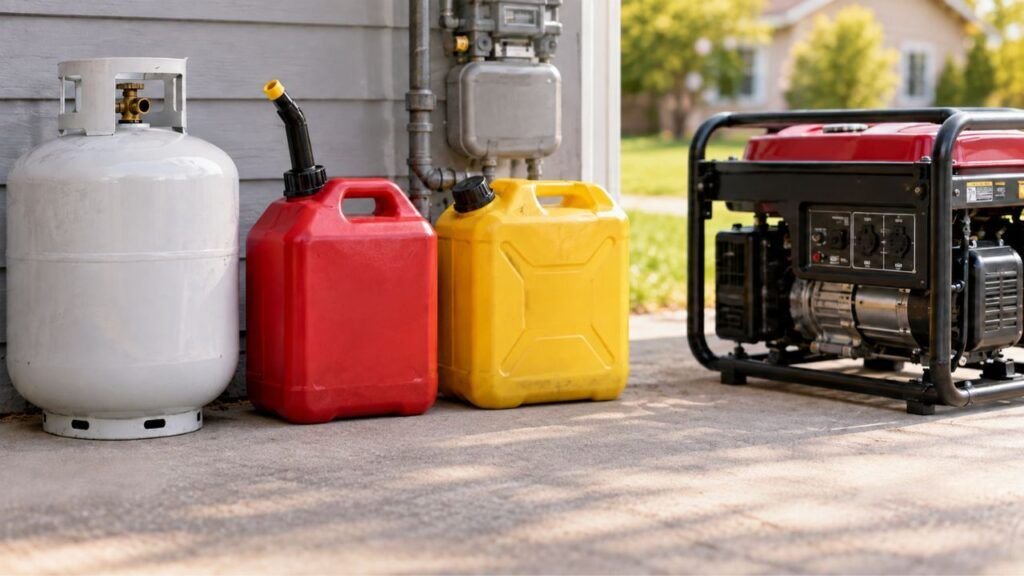
Propane vs gasoline generator for home backup comes down to priorities. Gasoline usually provides higher running and starting wattage. Propane is easier to store long-term and avoids stale-fuel problems. For many homeowners, a dual-fuel generator offers the best balance.
This guide compares propane and gasoline for real home outages. We will cover power, runtime, storage, costs, maintenance, cold weather, safety, and which fuel works best for different homes.
Key Takeaways
- Gasoline usually produces more running and starting wattage.
- Propane is easier to keep ready for long-term emergencies.
- Gasoline contains more energy per gallon than propane.
- Propane does not deteriorate like stored gasoline can.
- Runtime depends on load, generator efficiency, and available fuel.
- Propane often creates fewer fuel-system storage problems.
- Gasoline is easier to buy during normal conditions.
- Dual-fuel generators provide valuable flexibility during longer outages.
Propane vs Gasoline Generator for Home Backup: Quick Verdict
Choose gasoline when maximum generator output is your main concern. It works especially well when powering demanding motors, pumps, and larger appliances.
Choose propane when emergency storage and easier fuel management matter more. Propane can remain stored for long periods without becoming stale.
For many homeowners, I would consider a dual-fuel generator first. You can keep propane ready for emergencies and use gasoline when extra output becomes necessary.
Neither fuel wins every category. Your expected loads and outage duration should guide the final choice.
Propane vs Gasoline Generator at a Glance
There are several differences that matter during an actual outage. This table gives you the important ones before we examine them individually.
| Factor | Propane Generator | Gasoline Generator | Better Choice |
| Running wattage | Usually lower on comparable dual-fuel models | Usually higher | Gasoline |
| Starting wattage | Usually somewhat lower | Usually higher | Gasoline |
| Energy per gallon | Lower | Higher | Gasoline |
| Long-term fuel storage | Excellent | Requires more fuel management | Propane |
| Fuel deterioration | Does not become stale like gasoline | Can deteriorate during storage | Propane |
| Everyday fuel access | Widely available | Available almost everywhere | Gasoline |
| Emergency fuel reserve | Easy with stored cylinders or larger tank | Requires properly stored fuel cans | Propane |
| Fuel-system storage issues | Fewer stale-fuel problems | Carburetor deposits can develop | Propane |
| Cold-weather performance | Tank size and vaporization matter | Starting conditions matter | Depends |
| Operating cost | Depends on propane source and local prices | Depends on local gasoline prices | Depends |
| Emissions | Generally cleaner combustion | Generally higher emissions | Propane |
| Best use | Stored emergency backup | High-output or frequent use | Depends |
The important point is that fuel alone does not determine everything. Generator design, load, weather, and fuel supply still affect performance.
First, Compare the Same Type of Generator
You can easily make the wrong comparison between these fuels. A small gasoline portable generator differs greatly from a large propane standby system.
Portable gasoline generators are extremely common for temporary home backup. Propane can power portable generators and permanent standby generators.
That distinction matters.
A 7,000-watt gasoline portable generator should not be compared directly with a 20,000-watt propane standby unit. Their installation, engines, fuel supplies, and intended workloads are completely different.
The fairest comparison usually involves a dual-fuel generator. These machines run the same engine using gasoline or propane.
That lets you see how changing only the fuel affects output.
It also explains why manufacturer specifications matter more than general percentages.
Which Produces More Power: Propane or Gasoline?
Gasoline usually wins when you compare maximum electrical output. However, the actual difference depends on the generator you choose.
Why Gasoline Usually Produces More Running Watts
Gasoline contains more energy per gallon than propane. That allows the same engine to produce more power under similar conditions.
This is why dual-fuel generators usually publish separate wattage ratings.
You might see one rating for gasoline and another for propane. The gasoline numbers are normally higher.
For example, a dual-fuel generator might produce:
- 9,500 running watts on gasoline
- 8,500 running watts on propane
The exact difference varies between models.
Do not assume every generator loses exactly ten or twenty percent. Always check the manufacturer’s ratings for both fuels.
How Much Power Does a Generator Lose on Propane?
Many portable dual-fuel generators lose some available wattage on propane.
The difference may seem small when running basic household essentials. However, it matters more when the generator approaches maximum capacity.
Suppose your home needs 7,500 running watts during an outage. A generator rated for 8,500 watts on propane has reasonable headroom.
However, that headroom disappears quickly when another motor starts.
That is why fuel-specific wattage ratings matter during sizing.
When the Power Difference Actually Matters
Gasoline’s extra output becomes useful with high-demand equipment.
Common examples include:
- Central air conditioners
- Well pumps
- Sump pumps
- Large refrigerators and freezers
- Workshop tools
- Large window air conditioners
- Electric water heaters
- Multiple motor-driven appliances
Motors often draw considerably more power during startup.
A generator may handle their normal running load easily. Starting several motors together can still overload the machine.
If heavy loads matter, size your system using starting watts too.
Propane vs Gasoline Generator Runtime
Runtime comparisons can become misleading very quickly. You need to compare fuel quantity, electrical load, and generator efficiency together.
Gasoline Has More Energy Per Gallon
Gasoline contains more usable energy per gallon than propane.
So, if two identical engines consumed exactly one gallon each, gasoline could theoretically provide more available energy.
Real generator operation is more complicated.
Engine efficiency changes with load, speed, design, and operating conditions. That means energy content alone cannot predict exact runtime.
Why Propane Can Still Run Longer From One Container
This is where many comparisons become confusing.
Portable generators have fixed gasoline tanks. A generator may hold only four or five gallons of gasoline.
Propane connects to an external cylinder or tank.
A standard 20-pound propane cylinder holds roughly 4.6 gallons of propane. Larger cylinders provide much more fuel.
You can also connect compatible generators to properly sized larger tanks.
Therefore, propane may provide longer per-container runtime, even though gasoline contains more energy per gallon.
You are simply carrying or storing more usable fuel.
Never Compare Runtime Without Matching the Load
Generator load changes fuel consumption dramatically.
A runtime rating measured at 25% load cannot fairly compare with another rating measured at 50% load.
Always check the testing conditions.
If one generator runs ten hours at half load, that tells you much more than an unsupported claim about gallons alone.
Your own house also changes the calculation.
A refrigerator and several lights use far less power than an air conditioner, pump, microwave, and freezer running together.
The Better Way to Estimate Generator Runtime
Use your generator’s actual fuel-consumption information whenever possible.
A simple planning formula is:
Estimated runtime = usable fuel supply ÷ fuel consumption per hour
Suppose a generator consumes 0.6 gallons hourly at your expected load.
With six gallons available:
6 ÷ 0.6 = about 10 hours
This method works better than converting fuel BTUs directly into electrical output.
Your generator cannot convert every unit of fuel energy into electricity. Significant energy becomes engine heat, exhaust heat, friction, and other losses.
Manufacturer runtime data gives you a much better starting point.
How Much Fuel Do You Need for a Multi-Day Outage?
Planning fuel ahead of time matters more than choosing a theoretical winner. Start with your generator’s expected hourly fuel use.
The table below shows how quickly fuel needs increase during long outages.
| Outage Length | At 0.5 Gallon/Hour | At 0.75 Gallon/Hour | At 1 Gallon/Hour |
| 8 hours | 4 gallons | 6 gallons | 8 gallons |
| 24 hours | 12 gallons | 18 gallons | 24 gallons |
| 48 hours | 24 gallons | 36 gallons | 48 gallons |
| 72 hours | 36 gallons | 54 gallons | 72 gallons |
These numbers are examples only. Your generator may consume much more or much less fuel.
You can reduce consumption by powering only essential loads.
For example, you may not need every appliance continuously. Refrigerators, freezers, pumps, and other equipment often cycle.
Load management can stretch your fuel supply considerably.
Fuel Storage and Shelf Life
Fuel storage is one of propane’s biggest home-backup advantages. Gasoline requires more attention when sitting unused for long periods.
Propane Storage for Emergency Backup
Propane does not chemically degrade like gasoline does.
That makes it attractive for homeowners preparing months before an outage.
You can keep approved propane cylinders available without worrying about stale fuel inside a carburetor.
However, propane storage still requires proper care.
Check cylinders for corrosion, damaged valves, and physical damage. Portable cylinders also require periodic inspection or requalification.
Store propane cylinders upright and follow local safety requirements.
Do not assume that an old cylinder remains safe forever simply because the fuel itself remains usable.
Larger residential tanks can make propane especially practical.
If your property already uses propane for heating or cooking, generator fuel planning may become much easier.
Gasoline Storage for Generator Backup
Gasoline requires more active management.
Stored gasoline can oxidize and lose quality over time. Ethanol-blended gasoline may also create moisture-related fuel-system problems.
Old fuel can leave deposits inside carburetors and fuel lines.
That often creates the frustrating situation where a generator refuses to start exactly when you need it.
Use approved gasoline containers.
Keep fuel away from ignition sources and excessive heat. Follow the generator manufacturer’s storage instructions carefully.
Fuel stabilizer may help extend storage life when used correctly.
You should still rotate stored gasoline instead of forgetting about it.
Which Fuel Is Easier to Keep Storm-Ready?
For long-term emergency storage, I would give propane the advantage.
You can prepare your fuel supply well before hurricane or storm season.
Gasoline works perfectly well when managed properly. It simply requires more rotation and storage attention.
If your generator rarely runs, propane removes one major maintenance headache.
Which Fuel Is Easier to Find During an Outage?
Gasoline is easier to find during ordinary conditions. Emergency conditions can completely change that advantage.
- Gas stations are extremely common throughout the United States.
- Many stations cannot pump fuel when their electricity fails.
- Major storms can create long fuel lines quickly.
- Local gasoline supplies may temporarily run out.
- Propane exchange cages can also experience shortages.
- Propane refill stations are less common than gas stations.
- Stored propane provides fuel before the emergency begins.
- Bulk propane delivery may become delayed during widespread disasters.
- Having fuel beforehand is safer than depending on emergency resupply.
This is why outage planning should begin before bad weather arrives.
Do not assume your preferred fuel will remain available afterward.
Which Is Cheaper to Run: Propane or Gasoline?
Fuel cost deserves more attention than simply comparing pump prices. The cheapest gallon is not always the cheapest operating fuel.
Do Not Compare Fuel Prices Per Gallon Alone
Suppose gasoline and propane both cost the same per gallon.
Gasoline still contains more energy per gallon.
Your generator may therefore consume more propane while producing similar electrical output.
That can make gasoline cheaper per operating hour.
However, local fuel pricing changes the result.
Propane prices vary significantly between bulk delivery, refill stations, and cylinder exchanges.
Bulk Propane vs 20-Pound Cylinder Exchange
Propane purchased through a large residential tank can cost very differently from small exchanged cylinders.
Convenience often costs more.
A grill-cylinder exchange may be easy during everyday use. It might not provide the best fuel cost for extended generator operation.
A large stationary tank can improve both convenience and fuel availability.
That approach works especially well for homes already using propane.
Calculate Generator Cost Per Hour
Here is the easiest comparison:
Fuel cost per hour = hourly fuel consumption × fuel price
Suppose gasoline costs $3.50 per gallon.
If your generator consumes 0.6 gallons hourly:
0.6 × $3.50 = $2.10 per hour
Now perform the same calculation using propane consumption and local prices.
This gives you a much more useful number than gallon price alone.
You can also calculate electricity cost:
Cost per kWh = hourly fuel cost ÷ average electrical output
That helps when comparing two generators with different efficiencies.
Which Requires Less Maintenance?
Propane has a clear advantage when we focus specifically on fuel storage. However, both generator types still require regular engine maintenance.
Propane Avoids Stale-Gas Fuel-System Problems
Propane enters the engine as vapor.
It does not sit inside a carburetor bowl and deteriorate like gasoline.
That reduces one common storage problem with portable generators.
This advantage matters when the machine might sit unused for months.
It also makes seasonal storage easier for many homeowners.
Gasoline Requires More Fuel Management During Storage
Gasoline generators can remain extremely reliable with proper maintenance.
Problems usually appear when old fuel remains inside the system too long.
Good storage practices can include:
- Using fresh fuel
- Adding stabilizer when recommended
- Running or draining the fuel system correctly
- Keeping the carburetor clean
- Rotating stored gasoline
- Inspecting fuel lines and connections
Follow your owner’s manual instead of relying on one universal procedure.
Different engines have different storage requirements.
Both Generators Still Need Routine Engine Maintenance
Propane does not eliminate normal engine service.
You still need to monitor:
- Engine oil
- Spark plugs
- Air filters
- Starter batteries
- Fuel hoses and regulators
- Cooling airflow
- Exercise or test runs
Oil-change intervals still matter.
A generator burning propane can also wear out from poor maintenance.
Cleaner fuel should never become an excuse to ignore service schedules.
Propane vs Gasoline Generator in Cold Weather
Cold weather affects both fuels differently.
Propane needs to vaporize inside its storage container before reaching the engine. That process becomes harder as temperatures fall.
A nearly empty 20-pound cylinder may struggle to supply enough vapor for a large generator during extreme cold.
Using a properly sized tank can help.
Never improvise methods for warming propane cylinders. Follow the tank supplier’s and generator manufacturer’s instructions.
Gasoline does not have this same vaporization limitation.
However, gasoline generators can still struggle during cold starts.
Cold oil becomes thicker. Batteries lose cranking strength. Old gasoline may also make starting harder.
The correct winter fuel depends on your exact setup.
I would not choose gasoline or propane solely based on weather.
Instead, confirm the generator’s temperature requirements and fuel-system sizing.
Which Fuel Is Cleaner?
Propane generally burns cleaner than gasoline.
It usually creates fewer carbon deposits and lower amounts of several harmful emissions.
Propane also does not create a liquid gasoline spill.
That can make storage and cleanup easier.
However, cleaner combustion does not mean safe combustion.
A propane generator can still produce deadly carbon monoxide.
Never operate one inside your home, garage, basement, or enclosed porch.
The same rule applies to gasoline generators.
Is a Propane Generator Quieter Than a Gasoline Generator?
Fuel type alone does not determine generator noise.
A quiet propane generator can exist. So can a quiet gasoline generator.
The biggest noise factors usually include engine speed, generator design, enclosure, muffler, load, and operating distance.
Inverter generators often run quieter because engine speed can change with load.
Traditional generators may run at a more constant engine speed.
When noise matters, compare actual manufacturer dBA specifications.
Make sure the ratings use similar distances and load levels.
Do not assume propane automatically makes a generator noticeably quieter.
Generator Safety Matters More Than Fuel Choice
A fuel comparison means little if the generator is used unsafely. Both propane and gasoline generators require careful outdoor operation.
- Never run a generator inside your home.
- Never run one inside a basement or enclosed porch.
- Never use one inside an attached garage.
- Keep portable generators at least 20 feet from the home.
- Point exhaust away from doors, windows, and vents.
- Keep working carbon monoxide alarms inside your home.
- Never refuel gasoline equipment while the engine remains hot.
- Store fuel using approved containers and safe locations.
- Follow local fire codes for fuel storage quantities.
- Never backfeed electricity through a household outlet.
- Use proper transfer equipment for home-panel connections.
Backfeeding can seriously injure utility workers and damage equipment.
If you want panel-level backup, have the system configured correctly.
A qualified electrician can determine the proper transfer equipment for your home.
Propane or Gasoline for Different Home Backup Situations?
Different homeowners need different backup strategies. These common scenarios can help you decide which fuel fits your situation.
For Occasional Short Outages
Gasoline can work very well for short outages.
It is easy to buy and works with countless portable generators.
If you regularly rotate your stored fuel, maintenance remains manageable.
Gasoline also gives you maximum rated output on most dual-fuel units.
For Hurricane or Storm Preparedness
Propane becomes very appealing for seasonal emergency planning.
You can secure an adequate fuel supply before storms arrive.
The fuel can remain stored without becoming stale.
That means less concern about rotating emergency fuel every few months.
For Multi-Day Outages
Neither fuel automatically wins a multi-day outage.
The real question is how much fuel you already have available.
A generator consuming large amounts of gasoline becomes useless without resupply.
The same thing happens with propane once your tank empties.
Estimate total fuel requirements before buying your generator.
Also consider whether you can realistically store that much fuel.
For Running Central Air or Large Pumps
Gasoline often offers an advantage here.
The higher fuel-specific wattage can provide extra starting capacity.
That can matter when starting large compressor motors or well pumps.
However, generator sizing matters more than fuel alone.
A properly sized propane generator can still run large household loads.
For Homes That Already Use Propane
Propane becomes especially attractive when your property already has storage.
You may already use propane for cooking, heating, or hot water.
Adding a compatible generator can simplify your emergency fuel plan.
Make sure the tank and regulator can supply enough fuel.
A propane professional can verify the required flow rate.
For Frequent Generator Use
Gasoline can make sense when you use the generator regularly.
Frequent use naturally keeps fuel moving through the system.
That reduces the long-storage disadvantage.
Gasoline is also easy to buy almost anywhere during normal conditions.
For Rural Homes
Propane can work extremely well for remote properties.
A large on-site tank reduces dependence on nearby gas stations.
This can become important when storms block roads or disrupt services.
Still, schedule propane deliveries before severe weather reaches your area.
Is a Dual-Fuel Generator Better for Home Backup?
For many homeowners, dual fuel offers the most useful combination.
You can keep propane stored for emergency readiness.
Then you can switch to gasoline when higher output becomes necessary.
Having two fuels also reduces dependence on one supply chain.
Suppose gasoline becomes difficult to find after a storm.
Your stored propane gives you another option.
If propane eventually runs low, available gasoline may extend the outage coverage.
There is one important sizing rule.
Always size the generator using the fuel you expect to use most.
If propane will be your main backup fuel, use the propane wattage ratings.
Do not size your home loads using the generator’s higher gasoline rating.
Otherwise, you may discover that your planned loads exceed available propane output.
Also check the manufacturer’s fuel-switching procedure.
Some generators allow convenient fuel changes. Others require shutdown or specific steps.
Follow the owner’s manual before switching fuels.
How to Choose Between Propane and Gasoline Before Buying
You do not need to guess which fuel works better. Walk through these steps before spending your money.
- List your essential loads. Include refrigerators, pumps, lights, internet equipment, and heating equipment.
- Calculate running watts. Add the loads likely operating simultaneously.
- Check starting watts. Motors and compressors can create large temporary surges.
- Compare fuel-specific ratings. Check gasoline and propane wattage separately.
- Estimate outage duration. Plan differently for eight hours versus three days.
- Calculate expected fuel use. Use manufacturer consumption or runtime data.
- Check local fuel access. Find gasoline stations and propane suppliers nearby.
- Plan safe storage. Determine how much fuel you can realistically keep.
- Compare operating costs. Use cost per hour rather than gallon price.
- Consider dual fuel. Two fuel options can improve emergency flexibility.
I would put reliability ahead of tiny efficiency differences.
A generator with available fuel is far more useful than one producing slightly cheaper electricity without enough fuel to keep running.
Final Verdict
Gasoline is the better choice when you need maximum available wattage. It also works well for frequent use and quick everyday refueling.
Propane is usually better for long-term emergency fuel storage. It avoids stale-gas problems and can simplify seasonal outage preparation.
Neither fuel is automatically best for every homeowner.
Your generator size, outage duration, loads, climate, and fuel access matter.
For many U.S. homeowners buying a new portable backup generator, dual fuel provides the strongest overall flexibility.
Keep propane available for long-term preparedness. Use gasoline when extra output or convenient refueling becomes useful.
Most importantly, size your generator using the fuel rating you actually plan to use.
Related FAQs
Is Propane or Gasoline Better for a Home Generator?
Propane is usually better for long-term emergency storage, while gasoline usually provides higher output. Your best option depends on household loads, outage duration, fuel access, and how frequently the generator will run.
Does a Generator Produce Less Power on Propane?
Yes, many dual-fuel generators produce less running and starting wattage on propane. The exact reduction varies between models, so always compare the manufacturer’s gasoline and propane ratings before sizing your backup loads.
Does a Generator Run Longer on Propane or Gasoline?
There is no universal winner because runtime depends on fuel quantity, generator efficiency, and electrical load. Gasoline contains more energy per gallon, while propane systems can use much larger external tanks.
How Long Will a 20-Pound Propane Tank Run a Generator?
Runtime depends heavily on generator size and load. A lightly loaded inverter generator may run many hours, while a large home-backup generator can empty the same cylinder much faster. Check manufacturer consumption data for an accurate estimate.
Is Propane Cheaper Than Gasoline for a Generator?
Sometimes, but not always. Compare each fuel’s hourly consumption and local price. Bulk propane can cost much less than cylinder exchanges, while gasoline prices also vary significantly by location and season.
Can You Leave Gasoline in a Generator Between Outages?
You can, but long storage can create fuel-quality and carburetor problems. Follow your generator manufacturer’s storage procedure, use fresh fuel, add stabilizer when recommended, and rotate stored gasoline regularly.
Does Propane Go Bad While Stored?
Propane does not become stale like gasoline during proper storage. However, propane cylinders, valves, regulators, and tanks still require inspection, safe storage, and periodic maintenance or requalification.
Are Propane Generators Better in Cold Weather?
Not necessarily. Cold temperatures reduce propane vaporization, especially with small or nearly empty cylinders. Gasoline generators have different winter problems, including thick oil, weak batteries, and difficult starting.
Is Propane Safer to Store Than Gasoline?
Propane can be easier to store long-term because it remains inside sealed cylinders and does not deteriorate. However, both fuels are hazardous and must be stored according to container instructions and local safety rules.
Are Dual-Fuel Generators Worth It for Home Backup?
Yes, dual-fuel generators can be worthwhile for emergency backup. Propane provides convenient long-term storage, while gasoline gives you another fuel source and usually provides the generator’s highest available wattage.
Can a Propane Generator Run a Whole House?
Yes, a properly sized propane generator can power an entire house. You must calculate running and starting loads first, then select a generator with enough propane-rated output for those loads.
Can You Switch a Dual-Fuel Generator From Propane to Gasoline While Running?
It depends on the generator. Some models support certain fuel-switching procedures, while others require shutdown first. Always follow the owner’s manual instead of switching fuels based on a general rule.

Brian Walker writes straightforward generator guides and reviews for homeowners and everyday users. His content focuses on solar, portable, and fuel-powered generators, with practical advice on choosing, using, and maintaining reliable backup power.