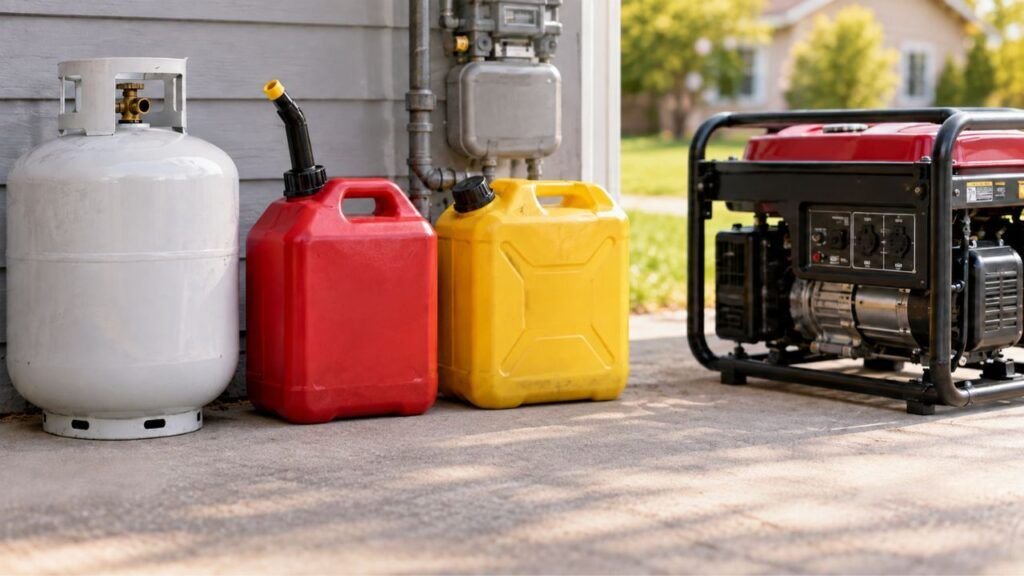
A dual fuel generator uses one engine that can run on two approved fuels, usually gasoline or propane. A fuel selector controls which fuel reaches the engine. The engine burns that fuel, spins an alternator, and produces electricity for connected appliances or home backup circuits.
The basic process is simple once you see each step. Below, I’ll explain the gasoline and propane fuel paths, switching process, power differences, important components, and safe operation.
Key Takeaways
- Most dual fuel generators run on gasoline or propane.
- They normally use only one fuel at a time.
- Gasoline comes from the generator’s built-in fuel tank.
- Propane usually comes from an external cylinder through a regulator.
- Both fuels power the same engine and alternator.
- Gasoline usually provides the generator’s highest rated wattage.
- Propane normally produces slightly lower starting and running wattage.
- Some generators allow fuel switching while running, but others do not.
- Dual fuel does not automatically mean natural gas compatibility.
- Always follow the manufacturer’s fuel switching instructions.
What Is a Dual Fuel Generator?
A dual fuel generator is an engine-powered generator designed for two fuel sources. Portable models sold in the United States most commonly use gasoline and propane.
The main advantage is fuel flexibility during an outage.
You can run gasoline when you need maximum available wattage. You can switch to propane when long-term fuel storage matters more.
That flexibility can become useful during hurricanes, winter storms, and grid failures. Gasoline stations may lose electricity or experience long lines.
Stored propane can give you another option during those situations.
However, dual fuel does not mean the generator automatically burns both fuels together. Most portable dual fuel generators use one selected fuel at a time.
A tri-fuel generator is different because it usually adds natural gas.
How Does a Dual Fuel Generator Work?
A dual fuel generator combines two fuel delivery systems with one engine. The selected fuel enters the engine, combustion produces mechanical movement, and the alternator converts that movement into electricity.
Here is what happens from fuel selection to usable electrical power.
1. You Select the Fuel Source
The process begins with the generator’s fuel selector.
Depending on the model, this may be a knob, dial, lever, or switch. You use it to select gasoline or propane operation.
The selector controls which fuel system supplies the engine.
When gasoline is selected, the generator uses its gasoline delivery components. When propane is selected, the engine receives fuel through the propane system.
The exact selector design varies between manufacturers.
Some generators mechanically close one fuel path while opening another. Others combine valves and controls to manage the selected supply.
Either way, the goal remains the same.
Only the correct fuel should reach the engine during normal operation.
2. Gasoline Travels From the Built-In Tank
Most portable dual fuel generators include an onboard gasoline tank.
When gasoline mode is selected, fuel travels from that tank toward the engine. The gasoline generally passes through a fuel valve, line, and carburetor.
On carbureted generators, gasoline enters the carburetor’s float bowl.
The carburetor meters the gasoline and mixes it with incoming air. That air-fuel mixture then travels toward the engine cylinder.
The simplified path looks like this:
Gasoline tank → fuel valve → fuel line → carburetor → engine
Some newer generators may use electronic fuel injection instead.
The delivery system changes, but the overall purpose stays similar. The system must provide the correct amount of gasoline for combustion.
3. Propane Travels Through a Regulated Fuel System
Propane reaches the generator differently because it is stored under pressure.
You normally connect a propane cylinder to the generator using an approved hose. Many portable generators are designed around common propane cylinders used for grills.
The propane does not simply flow directly into the engine.
A regulator reduces and controls the fuel pressure before combustion. This helps provide the engine with an appropriate amount of gaseous fuel.
The simplified propane path looks like this:
Propane cylinder → hose → regulator → mixer/carburetor → engine
Propane therefore does not depend on the gasoline float bowl.
That difference is useful when a generator spends long periods unused. There is no liquid propane sitting inside gasoline jets and passages.
However, gasoline remaining inside the carburetor can still cause problems. That is why proper gasoline storage procedures remain important.
4. Air and Fuel Enter the Engine
An engine cannot burn fuel without oxygen.
The generator’s air intake brings outside air into the engine system. The selected fuel then combines with the incoming air before combustion.
The exact air-to-fuel ratio matters for smooth engine operation.
Too much fuel can create a rich mixture. Too little fuel can create a lean mixture.
The generator’s carburetor, mixer, regulator, or injection system manages this process.
At this point, no useful electricity has been produced yet.
The generator is still converting stored fuel energy into mechanical movement.
5. Combustion Moves the Piston and Crankshaft
Most portable generators use a four-stroke internal combustion engine.
The engine repeatedly completes four basic stages:
- Intake
- Compression
- Power
- Exhaust
During intake, the engine draws in the air-fuel mixture.
The piston then compresses that mixture inside the cylinder. The spark plug ignites it at the proper moment.
Combustion rapidly increases pressure inside the cylinder.
That pressure pushes the piston downward and turns the crankshaft.
The crankshaft’s rotation provides the mechanical energy needed for electricity generation.
Whether you use gasoline or propane, this engine process remains similar.
The major difference is how the fuel reaches the engine.
6. The Crankshaft Spins the Alternator
The rotating crankshaft is connected to the generator’s alternator.
The alternator is the component that actually creates electrical energy.
Inside it, rotating magnetic fields interact with electrical windings. This process creates an electrical current through electromagnetic induction.
You do not need to understand advanced electrical theory here.
The important part is this:
Fuel runs the engine, and the engine spins the alternator.
The alternator then converts mechanical rotation into electrical power.
That same basic principle applies to gasoline-only and propane-only generators.
7. The Generator Regulates the Electrical Output
The raw electrical energy must stay within usable operating limits.
A conventional generator may use an automatic voltage regulator, often called an AVR. The AVR helps control voltage as electrical loads change.
An inverter generator processes the generated electricity differently.
Its electronics convert and condition the power before sending AC electricity outward. This design can provide stable output for sensitive electronics.
Once the electrical output is ready, power reaches the generator’s receptacles.
You can then connect approved cords, equipment, or home transfer equipment.
What Parts Make Dual Fuel Operation Possible?
Several components work together to make two-fuel operation possible. Understanding them makes troubleshooting and generator shopping much easier.
| Component | What It Does |
| Gasoline tank | Stores liquid gasoline inside the generator |
| Gasoline fuel valve | Starts or stops gasoline flow |
| Fuel line | Carries gasoline toward the engine |
| Propane inlet | Connects the generator to a propane supply |
| Propane hose | Carries propane from the cylinder |
| Propane regulator | Controls propane pressure before engine delivery |
| Carburetor or fuel mixer | Prepares fuel and air for combustion |
| Fuel selector | Chooses which fuel system supplies the engine |
| Air intake | Supplies oxygen needed for combustion |
| Choke | Helps certain engines start when cold |
| Engine | Converts fuel energy into mechanical motion |
| Crankshaft | Transfers engine rotation to the alternator |
| Alternator | Converts mechanical energy into electricity |
| AVR or inverter electronics | Helps regulate usable electrical output |
| Control panel | Provides outlets, breakers, switches, and monitoring |
Not every generator uses the exact same components.
For example, electronic fuel injection can replace a traditional carburetor. Inverter generators also use additional power electronics.
However, the overall fuel-to-electricity process remains very similar.
Does a Dual Fuel Generator Use Gasoline and Propane at the Same Time?
Most portable dual fuel generators do not use both fuels simultaneously.
You normally select either gasoline or propane before operation. The selected fuel powers the engine until you switch fuels or shut down.
This point causes plenty of confusion.
Some industrial engines use systems that intentionally combine multiple fuel types. Those systems operate differently from typical homeowner portable generators.
For the common gasoline-and-propane generator, think of dual fuel as two choices.
It does not usually mean a blended fuel mixture.
How Does a Dual Fuel Generator Run on Gasoline?
Gasoline operation works much like a standard portable generator.
You fill the onboard fuel tank with the recommended gasoline. The fuel then flows toward the carburetor or injection system.
On a carbureted generator, gasoline enters the float bowl.
Small internal passages meter the fuel before mixing it with air. The mixture enters the cylinder and is ignited by the spark plug.
The resulting combustion turns the crankshaft.
That rotation spins the alternator and generates electrical power.
Gasoline usually provides the generator’s highest available wattage.
That can make gasoline useful when powering high-starting-watt appliances.
Examples include:
- Central or window air conditioners
- Well pumps
- Sump pumps
- Refrigerators
- Freezers
- Power tools
- Furnace blowers
The exact loads depend on your generator’s rated output.
Never assume every generator can handle these appliances simultaneously.
How Does a Dual Fuel Generator Run on Propane?
Propane follows a separate delivery route into the engine.
You connect the approved propane hose to the generator and cylinder. The propane cylinder stores liquefied petroleum gas under pressure.
As propane leaves the cylinder, the fuel changes state and becomes gaseous.
The regulator lowers and controls its pressure before engine delivery.
The fuel then reaches the mixer or carburetor throat. There, propane combines with incoming air before entering the cylinder.
Combustion drives the same piston, crankshaft, and alternator used during gasoline operation.
That means propane changes the fuel delivery process.
It does not change the generator’s basic electricity-producing principle.
Propane also avoids several gasoline storage problems.
It does not become stale inside a gasoline tank or create varnish inside gasoline jets.
However, propane operation still requires proper maintenance.
Hoses, fittings, regulators, and connections should remain in good condition.
How Do You Switch a Dual Fuel Generator From Gasoline to Propane?
Fuel switching depends heavily on the generator’s design. Some models support switching while running, while others require shutdown first.
Always use your generator’s manual as the final instruction.
Switching From Gasoline to Propane
The general process involves connecting the propane supply properly.
You then open the appropriate propane valve and move the fuel selector.
Some generators can transition from gasoline to propane while operating.
During that transition, the engine may briefly run unevenly.
This can happen while remaining gasoline leaves the fuel system.
Once propane reaches the engine consistently, operation should stabilize.
However, do not assume your generator supports this procedure.
Some manufacturers require you to stop the engine before switching fuels.
Switching From Propane to Gasoline
Moving back to gasoline follows the same model-specific principle.
The gasoline supply must be available and properly selected.
The generator then transitions from gaseous propane to liquid gasoline operation.
Again, the exact valve sequence varies by manufacturer.
Never force a selector or improvise a switching process.
A mistake involving fuel systems can create fire or engine damage risks.
Can You Switch Fuels While the Generator Is Running?
Some dual fuel generators allow fuel changes while running.
Other generators specifically require the engine to stop first.
There is no single rule that applies to every model.
This is why I would not recommend copying a switching procedure online.
Check your exact generator manual instead.
The manufacturer’s procedure accounts for that model’s valves, regulator, carburetor, and safety controls.
Why Does a Dual Fuel Generator Produce Less Power on Propane?
Many dual fuel generators produce lower wattage on propane than gasoline.
This is normal and does not mean something is wrong.
The engine’s available power depends partly on fuel characteristics, combustion conditions, and engine calibration.
Manufacturers therefore provide separate gasoline and propane ratings.
For example, a generator might provide:
- 9,500 running watts on gasoline
- 8,500 running watts on propane
Those numbers are only an example.
Your generator may have a smaller or larger difference.
The important lesson is to check both fuel ratings.
Do not size your backup system using only the largest advertised number.
If propane will be your main emergency fuel, use the propane rating.
That becomes especially important with high-surge loads.
Air conditioners, pumps, and refrigerators require extra starting power.
A generator that handles them comfortably on gasoline may have less margin on propane.
Does a Dual Fuel Generator Produce Different Electricity on Propane?
Propane does not automatically create lower-quality electricity.
The fuel mainly changes engine performance and maximum available power.
A properly operating generator still aims to provide its designed voltage and frequency.
For example, a 120/240-volt generator remains designed around that electrical system.
What changes is the total amount of load it can support.
Suppose your generator provides fewer running watts on propane.
You may need to disconnect some appliances or stagger their operation.
That is a capacity issue, not necessarily a power-quality problem.
Power quality depends more on generator design and electrical regulation.
How Does a Dual Fuel Inverter Generator Work?
A dual fuel inverter generator still uses gasoline or propane. The biggest difference appears after the engine begins producing mechanical energy.
Conventional Dual Fuel Generator
A conventional dual fuel generator uses the selected fuel to run its engine.
The engine spins an alternator that creates AC electricity.
Its speed generally remains closely tied to the required electrical frequency.
An automatic voltage regulator may help control the electrical output.
These generators often provide high wattage at a reasonable price.
However, they may be louder than comparable inverter models.
Dual Fuel Inverter Generator
A dual fuel inverter generator also burns gasoline or propane.
Its electrical system then converts and conditions the generated electricity.
The inverter electronics create a stable AC output for connected equipment.
The engine may also adjust speed based on load demand.
That can reduce fuel consumption and noise under lighter loads.
Remember that “dual fuel” and “inverter” describe different features.
Dual fuel describes the available fuel choices.
Inverter describes how the generator processes electrical power.
A generator can have both features at the same time.
Gasoline vs. Propane Operation in a Dual Fuel Generator
Gasoline and propane run the same engine differently. Knowing those differences helps you choose the better fuel for each situation.
| Factor | Gasoline Mode | Propane Mode |
| Fuel source | Built-in gasoline tank | External propane cylinder or tank |
| Fuel form | Liquid | Stored as liquid, delivered to engine as gas |
| Fuel delivery | Fuel line and gasoline circuit | Hose, regulator, and propane circuit |
| Maximum wattage | Usually higher | Usually lower |
| Long-term storage | Requires careful rotation | Stores very well |
| Carburetor storage problems | Stale gasoline can create deposits | Does not leave stale gasoline deposits |
| Refueling | Requires pouring gasoline | Cylinder can be exchanged or refilled |
| Main advantage | Higher available output | Easier emergency fuel storage |
| Cold-weather concerns | Usually dependable when maintained | Cylinder pressure can decrease in extreme cold |
Neither fuel is automatically better in every situation.
I generally think of gasoline as the maximum-power option.
Propane is often the easier long-term emergency storage option.
Having both choices is the main value of dual fuel.
How Do You Start a Dual Fuel Generator?
The startup process changes slightly depending on your selected fuel. Always follow your generator’s exact sequence, especially when operating propane.
Starting on Gasoline
Place the generator outdoors in its safe operating location first.
Then check the engine oil and inspect the generator.
Make sure large electrical loads are disconnected.
Select gasoline operation and open the gasoline fuel valve.
If your generator uses a choke, set it correctly.
Start the engine using the recoil starter or electric start.
Let the engine stabilize before adding electrical loads.
Connect larger appliances carefully and watch the total wattage.
Starting on Propane
Start by inspecting the propane hose and connections.
Attach the proper hose to the generator and propane cylinder.
Make sure every connection is secure.
Slowly open the propane supply according to the manufacturer’s instructions.
Select propane mode on the generator.
Use the recommended choke or starting procedure for your model.
Start the engine without heavy loads connected.
Once the engine runs smoothly, begin adding electrical loads.
Why the Owner’s Manual Matters
Different generators use different propane regulators and fuel selectors.
Their cold-start procedures can also vary.
Some generators need a specific choke position on propane.
Others recommend slightly different steps.
That is why one online startup sequence cannot safely fit every generator.
Your owner’s manual should always override general advice.
How Does a Dual Fuel Generator Power a House?
A dual fuel generator can supply home appliances in two main ways.
The first option is powering individual equipment through generator receptacles.
You might run a refrigerator, freezer, lamps, router, and furnace blower.
Use properly rated outdoor extension cords when allowed.
The second option is connecting the generator to selected home circuits.
This requires approved transfer equipment.
The basic energy path becomes:
Fuel → engine → alternator → generator outlet → transfer equipment → home circuits
A transfer switch or approved interlock arrangement prevents dangerous backfeeding.
Backfeeding happens when generator electricity enters utility lines unexpectedly.
That can endanger utility workers and damage electrical equipment.
Never connect a portable generator directly into a household wall outlet.
A licensed electrician can help design a safe home connection.
Common Dual Fuel Generator Misunderstandings
Dual fuel generators are fairly simple, but several myths cause confusion.
- Dual fuel means both fuels burn together: Most homeowner models run gasoline or propane, not both simultaneously.
- Every generator switches fuels automatically: Most portable models require you to select the fuel yourself.
- Every model can switch fuels while running: Some can, while others require shutdown.
- Propane produces the same maximum wattage: Most dual fuel generators provide lower output on propane.
- Dual fuel automatically includes natural gas: Natural gas requires a compatible generator or approved system.
- Propane makes indoor generator use safe: Propane generators still produce deadly carbon monoxide.
- Dual fuel and tri-fuel are identical: Tri-fuel models normally support a third fuel, often natural gas.
- Fuel choice changes generator voltage: Fuel mainly affects engine output and capacity, not the intended voltage system.
Understanding these points makes generator operation much easier.
It also prevents you from buying a generator based on incorrect assumptions.
How to Operate a Dual Fuel Generator Safely
Dual fuel capability gives you flexibility, but safety rules remain unchanged. Gasoline and propane generators both produce carbon monoxide and require careful fuel handling.
- Run the generator outdoors only.
- Keep it at least 20 feet from occupied buildings when possible.
- Keep it away from doors, windows, vents, and garages.
- Point the exhaust away from your home and neighboring buildings.
- Never operate it inside a basement, garage, shed, or enclosed porch.
- Keep working carbon monoxide alarms inside your home.
- Allow the generator to cool before adding gasoline.
- Never refuel gasoline near flames or ignition sources.
- Keep propane cylinders upright and properly secured.
- Inspect propane hoses and fittings for damage.
- Never use a propane connection you suspect is leaking.
- Do not overload the generator’s rated wattage.
- Remember that propane may provide less available wattage.
- Keep the generator protected from rain without enclosing it.
- Never backfeed electricity through a household wall outlet.
- Follow the manufacturer’s exact fuel-switching instructions.
Safety should never become an afterthought during an outage.
Storm conditions often make people rush.
Setting up your generator correctly before an emergency can prevent mistakes.
Is a Dual Fuel Generator Worth It for Home Backup?
A dual fuel generator makes sense when fuel flexibility matters to you.
You are not depending entirely on one fuel during an outage.
Gasoline can provide higher output when you need maximum capacity.
Propane gives you a fuel that stores conveniently for emergencies.
That combination can be especially useful in storm-prone areas.
Gas stations may lose power or run short during major disasters.
If you already have propane stored safely, you still have another option.
A dual fuel generator also works well for occasional backup use.
You can operate mainly on propane and keep gasoline available when necessary.
However, dual fuel does not replace proper generator sizing.
You still need enough starting and running watts for your appliances.
If your home requires large 240-volt loads, carefully check the generator specifications.
Conclusion
A dual fuel generator works by giving one engine two fuel choices.
Gasoline travels from the built-in tank through its fuel system. Propane enters through a separate hose, regulator, and delivery path.
The selected fuel combines with air and burns inside the engine.
That combustion moves the piston and turns the crankshaft.
The crankshaft spins the alternator, which creates electrical power.
The process is basically the same on either fuel after combustion begins.
What changes is the fuel delivery method and available engine output.
Gasoline usually provides more wattage, while propane offers easier storage.
That flexibility is what makes dual fuel generators attractive for home backup.
Just remember that fuel switching procedures vary between models.
Follow your generator’s manual, respect its propane wattage rating, and operate it safely outdoors.
Related FAQs
Can a Dual Fuel Generator Run on Gasoline and Propane at the Same Time?
Most portable dual fuel generators cannot normally run gasoline and propane together. You select one fuel at a time using the generator’s selector. Industrial dual-fuel engines can operate differently, but they are not the same as common portable home backup generators.
Can You Switch a Dual Fuel Generator While It Is Running?
Some generators allow fuel switching while the engine remains running, but others require shutdown first. The correct method depends entirely on the manufacturer’s design, so check your generator’s operating manual before changing fuels.
Does a Dual Fuel Generator Automatically Switch Fuels?
Most portable dual fuel generators do not automatically switch between gasoline and propane. You usually select the desired fuel manually. Some specialized smart or standby systems can manage fuel transitions differently.
Why Does a Generator Make Less Power on Propane?
Propane usually produces slightly less available engine power because of its fuel characteristics and engine calibration. Manufacturers therefore publish separate gasoline and propane wattage ratings for dual fuel generators.
Does Propane Go Through the Carburetor on a Dual Fuel Generator?
Propane may enter through a mixer or carburetor throat, depending on the generator design. However, it does not normally travel through the gasoline float bowl and gasoline jets like liquid gasoline does.
Can a Dual Fuel Generator Run on Natural Gas?
Not unless the generator is specifically designed or approved for natural gas. A standard gasoline-and-propane dual fuel generator should not be connected to natural gas unless the manufacturer supports that configuration.
Is Dual Fuel the Same as Tri-Fuel?
No. Dual fuel generators support two fuel sources, usually gasoline and propane. Tri-fuel generators commonly support gasoline, propane, and natural gas, giving you a third fuel option.
Can You Leave Gasoline in a Dual Fuel Generator While Running Propane?
Some generators can physically contain gasoline while operating on propane, but storage procedures vary. Old gasoline can degrade and create carburetor problems, so follow the manufacturer’s storage instructions if gasoline will remain unused.
Is It Better to Start a Dual Fuel Generator on Gas or Propane?
Neither fuel is automatically better for every generator. Gasoline often provides easier starting and higher output, while propane offers convenient storage. Use the startup method recommended for your specific generator.
Does a Dual Fuel Generator Last Longer on Gasoline or Propane?
Runtime depends on generator load, fuel capacity, engine efficiency, and tank size. Propane can support long operation with larger cylinders, while gasoline runtime is limited by the built-in tank and fuel consumption.

Brian Walker writes straightforward generator guides and reviews for homeowners and everyday users. His content focuses on solar, portable, and fuel-powered generators, with practical advice on choosing, using, and maintaining reliable backup power.