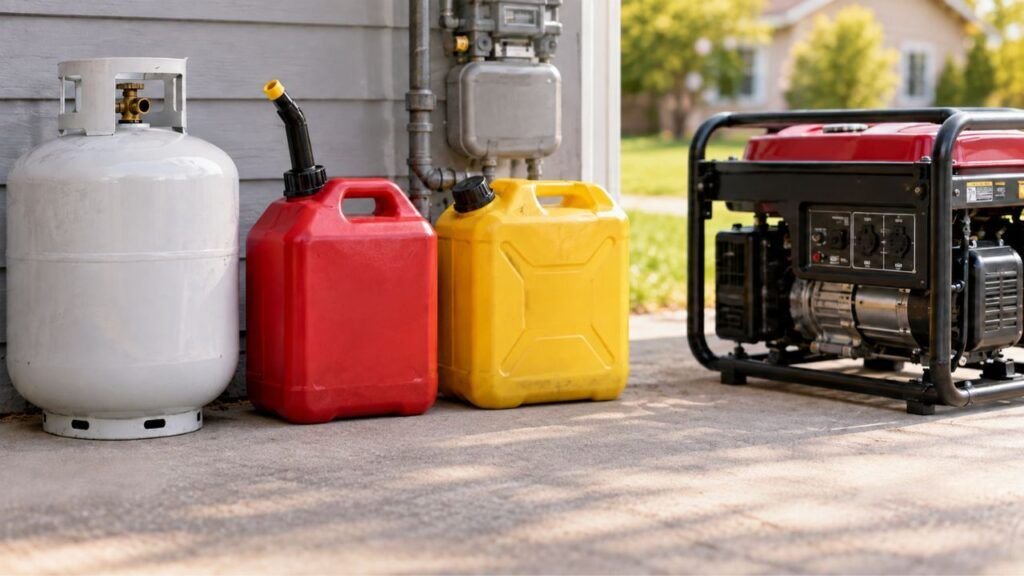
A standby generator is usually better for automatic whole-home backup, while a tri-fuel generator offers lower cost and greater fuel flexibility. If you are comfortable manually starting and managing your generator, a tri-fuel model can provide excellent home backup without the much higher standby installation cost.
In this guide, I’ll compare power output, fuel options, costs, transfer equipment, runtime, maintenance, noise, and installation. You’ll also see which option makes more sense for different homes and outage situations.
Key Takeaways
- Standby generators start automatically when utility power goes out.
- Tri-fuel generators use gasoline, propane, and natural gas.
- Large tri-fuel models can power many household circuits.
- Standby generators usually handle large simultaneous loads more easily.
- Tri-fuel generators cost considerably less to purchase and install.
- Your outage frequency, fuel access, and power needs matter most.
Tri Fuel vs Standby Generator for Home Backup: Quick Comparison
Both generator types can keep your home running during outages. However, their operating experience, installation, capacity, and price are quite different.
| Feature | Tri-Fuel Generator | Standby Generator |
| Generator type | Portable or wheeled | Permanently installed |
| Fuel options | Gasoline, propane, natural gas | Usually natural gas or propane |
| Starting process | Usually manual | Automatic |
| Transfer equipment | Manual transfer switch or interlock | Automatic transfer switch |
| Typical backup style | Selected loads or managed whole-panel backup | Partial or whole-home backup |
| Power capacity | Often lower | Usually higher |
| 120V/240V support | Depends on model | Common |
| Natural gas operation | Available | Common |
| Fuel flexibility | Excellent | More limited |
| Runtime | Fuel dependent | Long with available NG or LP |
| Works when nobody is home | Usually no | Yes |
| Portability | Yes | No |
| Installation complexity | Moderate | High |
| Upfront cost | Lower | Higher |
| Maintenance | Owner-managed | Scheduled maintenance |
| Best for | Affordable flexible backup | Automatic home backup |
The main difference is not simply portable versus permanent. It is really manual flexibility versus automatic convenience.
How a Tri-Fuel Generator and Standby Generator Work
Both systems generate electricity using an engine and fuel. However, they connect to your home very differently.
How a Tri-Fuel Generator Works
A tri-fuel generator can run on gasoline, propane, or natural gas. You choose whichever fuel is available during an outage.
Most home-backup tri-fuel generators sit on wheels or a portable frame. When the utility fails, you move or prepare the generator outdoors.
You then connect the selected fuel and generator cable. After starting the generator, you transfer household circuits to generator power.
A properly installed generator inlet, transfer switch, or approved interlock makes this process much safer.
You also decide which appliances should operate at the same time. That load management prevents the generator from becoming overloaded.
How a Standby Generator Works
A standby generator stays permanently installed outside your house. It connects directly to your electrical system and fuel supply.
An automatic transfer switch constantly monitors utility power. When utility electricity disappears, the system starts the generator automatically.
The transfer switch isolates your home from the utility grid. It then connects your selected circuits or electrical panel to generator power.
When utility service returns, the transfer switch switches back automatically. The generator then shuts down after its normal cooldown cycle.
You usually do not need to touch anything during this process.
Power Output: How Much Can Each Actually Run?
Generator size matters more than the label attached to it. A large tri-fuel generator may outperform a small standby generator.
Typical Tri-Fuel Generator Output
Tri-fuel portable generators now cover a wide power range. Many larger models offer around 8,000 to 12,000 running watts or more.
At that capacity, you may operate several important household loads together.
Common loads can include:
- Refrigerator and freezer
- Lights and outlets
- Wi-Fi equipment
- Gas furnace blower
- Sump pump
- Well pump
- Microwave
- Television
- Garage door opener
- Selected air-conditioning equipment
The exact combination depends on your generator’s actual running capacity.
Do not assume a 12,000-watt model provides 12,000 continuous watts. Generator names commonly advertise peak or starting wattage.
You should size home loads using the running-watt rating for your chosen fuel.
Typical Standby Generator Output
Residential standby generators commonly offer higher continuous output. Popular home systems often fall between roughly 10kW and 26kW.
Larger models can support central air conditioning and several appliances simultaneously.
A properly sized standby system might run:
- Central air conditioning
- Refrigerator and freezer
- Lighting circuits
- Well or sump pumps
- Furnace
- Kitchen appliances
- Entertainment equipment
- Home office equipment
However, even a standby generator has electrical limits.
A 14kW standby generator cannot magically support every electrical appliance simultaneously. Load calculations remain important.
Running Watts vs Starting Watts
Some appliances need additional power when their motors start.
An air conditioner, refrigerator compressor, well pump, or sump pump may temporarily demand much more power.
That temporary requirement is called starting or surge wattage.
Imagine your generator comfortably handles 8,000 running watts. Your central AC starts while several appliances are already operating.
That short startup surge may push generator demand above capacity.
This is why generator sizing should include both:
- Continuous running watts
- Largest expected starting surge
Leaving some unused generator capacity also improves reliability.
120V vs 240V Loads Matter
Wattage is not the only specification you need to check.
Many important household appliances use 240 volts instead of 120 volts.
These may include:
- Central air conditioners
- Well pumps
- Electric water heaters
- Clothes dryers
- Electric ranges
- Certain workshop equipment
A high-wattage 120V generator cannot operate a 240V appliance directly.
For serious panel-connected home backup, I would normally look for a generator offering proper 120/240V output.
Does a Tri-Fuel Generator Lose Power on Natural Gas?
Yes, many tri-fuel generators produce less power on natural gas. Propane output may also be slightly lower than gasoline output.
A generator might have ratings similar to this:
| Fuel | Example Running Output |
| Gasoline | 10,000 watts |
| Propane | 9,000 watts |
| Natural gas | 8,000 watts |
Those numbers are only an example, not universal ratings.
Every model is different, so check its fuel-specific specifications.
This matters when you plan to use natural gas permanently. Buying based only on gasoline wattage can leave you short during outages.
Suppose your calculated household demand reaches 8,500 watts. A generator providing 10,000 watts on gasoline may look sufficient.
If that same machine drops to 8,000 watts on natural gas, it becomes undersized.
Standby generator output may also change between propane and natural gas. However, the percentage difference is not identical across every generator.
Always size using the exact rating for your intended fuel.
Can a Tri-Fuel Generator Run a Whole House?
Yes, a large tri-fuel generator can power much of a house, especially when major loads are carefully managed. However, powering your electrical panel is different from running every appliance simultaneously.
Your actual capability depends on:
- Generator running watts
- Generator starting watts
- Fuel type
- 120V/240V capability
- 30A or 50A connection
- Central AC requirements
- Water-heating type
- Cooking appliances
- Heating system
- Well or sump pumps
- Simultaneous appliance use
This distinction is important.
A generator can be connected to a whole electrical panel without having enough capacity for everything inside that panel.
For example, you might temporarily avoid using your dryer while central air runs. You could also turn off the electric water heater during cooking.
That is called load management.
A standby generator provides the same basic limitation. The difference is that larger standby systems often provide enough capacity to make load management less noticeable.
Transfer Switch: One of the Biggest Differences
The transfer equipment changes how you actually use each generator. It also protects workers, your electrical system, and the generator.
Tri-Fuel Generator With a Manual Transfer Switch
A typical outage procedure may look like this:
- Position or prepare the generator safely outdoors.
- Connect gasoline, propane, or natural gas.
- Connect the generator to the home inlet.
- Start the generator.
- Disconnect the home from utility power.
- Transfer the panel to generator power.
- Turn selected circuits on gradually.
- Monitor generator load during operation.
A professionally installed manual transfer switch makes this process straightforward.
Some homes use an approved panel interlock instead. The correct option depends on your panel, local requirements, and installation.
Standby Generator With an Automatic Transfer Switch
A standby generator removes most manual steps.
The system normally handles:
- Detecting utility failure
- Starting the generator
- Isolating your house from utility power
- Transferring loads to generator power
- Monitoring utility restoration
- Transferring back to utility service
- Cooling down and shutting off
That automatic process is probably the biggest practical advantage.
Imagine an outage happens while you are sleeping, traveling, or working. The standby system can protect your refrigerator, sump pump, HVAC, and other circuits automatically.
Why Backfeeding Must Be Avoided
Never power your house by connecting a generator directly into a regular wall outlet.
This dangerous practice is commonly called backfeeding.
It can energize utility lines unexpectedly and endanger utility workers. It can also damage your electrical system or generator.
Use properly installed transfer equipment for panel-connected generator backup.
Natural Gas Backup: Tri-Fuel vs Standby Is Not the Same Experience
Natural gas can make either generator much easier to operate. However, using natural gas does not make a portable generator automatic.
Tri-Fuel Generator on Natural Gas
Natural gas removes much of the refueling work.
You do not need to refill gasoline repeatedly. You also avoid swapping propane cylinders every several hours.
As long as gas service remains available, runtime becomes much easier to manage.
However, you still normally need to:
- Prepare the generator outdoors
- Connect the gas supply correctly
- Connect the electrical cable
- Start the generator
- Transfer your house manually
- Manage electrical loads
Natural gas improves fuel convenience, not system automation.
Standby Generator on Natural Gas
A standby generator is permanently connected to its gas supply.
Once installed, there is no portable fuel hose to set up during each outage.
Utility electricity fails, and the system handles startup automatically.
This makes natural gas especially useful for homeowners wanting unattended backup.
Check Whether Your Gas Supply Can Support the Generator
Having natural gas service does not automatically mean your existing gas line can support a generator.
A large generator can demand substantial gas flow.
Gas-system capacity depends on several factors:
- Generator fuel consumption
- Gas meter capacity
- Pipe diameter
- Pipe length
- Gas pressure
- Furnace demand
- Water heater demand
- Stove or dryer demand
Your generator may share the supply with several household appliances.
An undersized gas line can cause poor generator performance or shutdowns.
Have a qualified professional confirm the required gas supply before installation.
Fuel Flexibility: Where the Tri-Fuel Generator Clearly Wins
Fuel flexibility is the main advantage of choosing tri-fuel. You can respond differently depending on fuel availability during each emergency.
Gasoline
Gasoline often provides the highest rated output from tri-fuel generators.
It is easy to obtain during normal conditions. You can also transport it in approved fuel containers.
Its disadvantages become obvious during extended outages.
Gasoline requires safe storage and eventually degrades. Storms can also close gas stations or interrupt fuel deliveries.
Propane
Propane is excellent for emergency fuel storage.
It stores for long periods when properly contained. You also avoid carburetor problems caused by leaving old gasoline inside.
However, propane output can be lower than gasoline output.
Small cylinders can also empty quickly under heavy generator loads.
For longer outages, larger properly installed propane storage makes more sense.
Natural Gas
Natural gas offers excellent convenience when your utility service remains available.
There is no portable tank to refill.
That makes natural gas attractive during outages lasting several days.
The tradeoff is typically lower output from many portable tri-fuel models.
A tri-fuel generator lets you choose among all three options. A typical standby system normally operates from natural gas or propane.
That gives tri-fuel generators a clear advantage in fuel flexibility.
Runtime During a Long Power Outage
Both generator types can handle long outages. The difference is how much work you want to do while keeping them running.
Tri-Fuel Generator Runtime
On gasoline, runtime depends on:
- Fuel-tank capacity
- Electrical load
- Engine efficiency
- Generator size
Higher electrical loads generally consume fuel faster.
Propane runtime depends heavily on cylinder size and generator load.
A common small propane tank may be convenient for testing. It may become frustrating during a long outage.
Natural gas changes the situation significantly.
If your utility gas supply continues operating, you are no longer limited by a portable fuel tank.
That makes a natural-gas-connected tri-fuel generator capable of supporting lengthy outages.
Standby Generator Runtime
A natural-gas standby system can also operate for extended periods.
Its practical runtime depends on continued gas service and proper maintenance.
Propane-powered standby systems depend on tank capacity.
A large stationary propane tank can provide considerably more runtime than small portable cylinders.
Which Is Better for Multi-Day Outages?
A standby generator is usually more convenient during multi-day outages.
It is permanently installed, automatically connected, and designed around long-term home backup.
But that does not mean a tri-fuel generator cannot handle extended outages.
A properly sized tri-fuel unit connected to adequate natural gas can be very practical.
You simply have more responsibility for operation and load management.
What Happens at 2 A.M. When the Power Goes Out?
This is where the comparison becomes much easier to understand.
With a tri-fuel generator, you may wake up and realize power has failed. You need to safely prepare the generator, connect fuel and electricity, start it, transfer your panel, and manage loads.
With a standby generator, you may only notice the outage because some lights briefly turn off. The generator starts automatically and begins supplying power without you going outside.
That convenience becomes more valuable during heavy rain, freezing conditions, nighttime outages, or travel.
Tri-Fuel vs Standby Generator Cost
A tri-fuel generator usually wins easily on upfront cost. Standby installation becomes expensive because you are buying an entire permanent backup system.
| Cost Factor | Tri-Fuel Generator | Standby Generator |
| Generator price | Lower | Higher |
| Transfer equipment | Usually manual | Automatic |
| Electrical installation | Moderate | More extensive |
| Gas connection | Optional | Usually required |
| Concrete/composite pad | Usually unnecessary | Common |
| Permits | Depends on installation | Often required |
| Fuel expenses | Yes | Yes |
| Routine service | Yes | Yes |
| Portability | Can move with you | Stays with property |
Installed prices vary enormously across the United States.
Labor rates, generator size, trenching, electrical upgrades, gas work, permits, and site conditions all affect the final cost.
Tri-Fuel Generator Upfront Cost
Do not budget only for the generator itself.
Your complete home-backup setup could include:
- Tri-fuel generator
- Generator inlet
- Heavy-duty generator cable
- Transfer switch or interlock
- Electrical labor
- Natural gas connection
- Correct gas hose and regulator
- Weather-safe operating setup
Even after adding those items, a portable tri-fuel setup is commonly much cheaper than a full standby installation.
Standby Generator Installed Cost
Standby installation has more moving pieces.
You may pay for:
- Standby generator
- Automatic transfer switch
- Electrical labor
- Gas piping
- Gas meter upgrades
- Generator pad
- Trenching
- Permits
- Inspection
- Load-management equipment
A straightforward installation costs much less than a complicated one.
For example, placing the generator close to the electrical panel and gas meter can reduce labor.
Long wire runs, trenching, or gas-system upgrades can significantly increase costs.
Long-Term Operating Cost
Both generators still burn fuel.
Your actual fuel expense depends on:
- Generator capacity
- Fuel type
- Electrical load
- Fuel prices
- Outage duration
Both also require maintenance.
A portable tri-fuel generator may cost less to service if you perform routine maintenance yourself.
A standby owner may choose annual professional servicing for convenience.
Maintenance and Readiness
Generators often spend months without experiencing a real outage. That makes maintenance especially important.
Tri-Fuel Generator Maintenance
Typical maintenance can include:
- Engine oil changes
- Spark-plug inspection
- Air-filter replacement
- Starter-battery maintenance
- Fuel-system inspection
- Carburetor care
- Fuel-hose inspection
- Periodic test runs
Gasoline deserves additional attention.
Leaving untreated gasoline inside a carburetor for long periods can create starting problems.
Propane and natural gas avoid that particular storage issue.
Standby Generator Maintenance
A standby generator also needs engine maintenance.
Typical service can include:
- Oil changes
- Oil-filter replacement
- Air-filter replacement
- Spark plugs
- Starter battery
- Cooling-system checks where applicable
- Transfer-switch inspection
- Scheduled exercise testing
Many standby systems automatically perform periodic exercise cycles.
That gives you regular confirmation that the system can start.
Which Is More Likely to Be Ready After Sitting for Months?
A properly maintained generator of either type can be dependable.
The standby system simply makes readiness easier to monitor.
It stays connected to fuel and electricity and performs scheduled testing.
A portable tri-fuel generator relies more heavily on owner preparation.
If you test it regularly and maintain it correctly, that difference becomes smaller.
Noise, Weather, and Placement
Generator placement affects safety, convenience, and how much noise reaches your living space. Portable and standby generators require different planning.
Noise
Both generator types use combustion engines, so neither is silent.
Noise depends on:
- Engine size
- Generator enclosure
- Inverter technology
- Electrical load
- Engine speed
- Measurement distance
Some inverter-style tri-fuel models operate noticeably quieter than traditional open-frame generators.
Standby generators use enclosed cabinets that help control operating noise.
Still, either generator may be noticeable to nearby neighbors.
Check local setback and noise requirements before buying.
Weather Exposure
Standby generators are permanently installed outdoors using enclosures designed for that purpose.
Portable generators require more planning during bad weather.
Never assume you can move a portable generator into a garage because rain starts.
Follow your manufacturer’s weather instructions and use an approved outdoor solution.
Carbon Monoxide Safety
Portable generator exhaust contains carbon monoxide, which can be deadly.
Operate portable generators outdoors and well away from your home.
Keep exhaust pointed away from:
- Windows
- Doors
- Vents
- Crawlspace openings
- Neighboring homes
Never operate a generator inside:
- A garage
- A basement
- A shed
- A carport
- An enclosed porch
- Any occupied structure
Opening garage doors does not make indoor generator operation safe.
Keep working carbon monoxide alarms inside your home as another safety layer.
Which Generator Handles Common Home Loads Better?
Both options can run ordinary household devices. The standby generator usually becomes more comfortable as electrical demand increases.
| Home Load | Large Tri-Fuel Generator | Standby Generator |
| Refrigerator | Easy when properly sized | Easy |
| Freezer | Easy when properly sized | Easy |
| Lights | Easy | Easy |
| Wi-Fi | Easy | Easy |
| Gas furnace blower | Usually | Yes |
| Sump pump | Usually | Yes |
| Well pump | Depends on voltage and surge | Usually |
| Window AC | Usually | Yes |
| Central AC | Depends on generator size | Common when sized correctly |
| Electric water heater | High demand | Better suited |
| Electric range | Heavy load | Better suited |
| Clothes dryer | Heavy load | Better suited |
| Multiple heavy appliances | Requires management | Easier |
| Nearly normal whole-home use | Less suitable | Better suited |
This does not mean every standby generator automatically runs everything.
Generator sizing should always match your actual appliances.
When a Tri-Fuel Generator Is the Better Choice
A tri-fuel generator makes the most sense when flexibility and value matter more than complete automation.
Consider a tri-fuel generator if you:
- Want lower upfront costs
- Experience occasional outages
- Are normally home during outages
- Want three fuel choices
- Already have natural gas service
- Can manually start your generator
- Are comfortable managing electrical loads
- Need essential or selected household circuits
- Want portable power for other uses
- May move to another house later
For many homeowners, this provides an excellent balance.
You get serious backup capability without committing to permanent standby-generator costs.
When a Standby Generator Is the Better Choice
A standby generator becomes more attractive when you want backup power without changing your routine.
Consider one if you:
- Experience frequent outages
- Want automatic startup
- Travel regularly
- Need power while nobody is home
- Have critical sump-pump needs
- Want central AC during outages
- Want multiple heavy appliances operating together
- Prefer minimal manual involvement
- Cannot physically set up a portable generator
- Value convenience over lowest upfront cost
This is especially useful for families experiencing repeated severe-weather outages.
The generator simply becomes part of the house.
Is a Tri-Fuel Generator a Good Alternative to a Standby Generator?
Yes, a large tri-fuel generator can be an excellent standby alternative for homeowners willing to operate it manually.
A quality 120/240V tri-fuel model connected through proper transfer equipment can power many important household circuits.
Natural gas can also eliminate much of the refueling inconvenience.
However, a portable tri-fuel generator does not provide the full standby experience.
You still generally manage:
- Startup
- Shutdown
- Fuel selection
- Electrical connection
- Load selection
- Weather conditions
- Periodic monitoring
A standby generator costs considerably more because it removes most of those responsibilities.
Tri-Fuel vs Standby Generator: Which Is Better for Different Homes?
Your house and outage pattern should determine the winner. Here are several common situations that make the decision easier.
For a Home With Natural Gas
Both options become attractive.
A tri-fuel generator gives you natural gas plus gasoline and propane backup.
A standby generator provides natural gas operation with automatic starting.
Choose tri-fuel when affordability matters most.
Choose standby when automatic operation matters more.
For Frequent Hurricane or Severe-Storm Outages
A standby generator generally provides the easier experience.
Extended outages already create enough work around the house. Automatic starting and permanent connections reduce additional hassle.
However, a large tri-fuel generator remains a strong budget option.
Natural gas can make longer storm outages much easier to manage.
For Rare Short Outages
A tri-fuel generator usually makes more financial sense.
Paying significantly more for standby equipment may be unnecessary when outages happen once every few years.
A portable generator also serves other purposes between emergencies.
For a Home With a Well and Sump Pump
Look closely at starting watts and voltage.
Well pumps commonly require substantial motor-starting power. Some also operate on 240 volts.
A sump pump may need to operate even while you are away.
If automatic operation is important, standby has a major advantage.
For an All-Electric Home
Standby generators become more attractive as electrical demand rises.
An all-electric house may include:
- Electric heat
- Electric water heating
- Electric cooking
- Clothes dryer
- Central AC
- Well pump
Running several of these loads can overwhelm many portable generators.
You can still use tri-fuel by prioritizing loads carefully.
However, larger standby capacity generally makes normal living easier.
For Someone Who Travels Often
Choose standby if protecting the house while away matters.
A portable generator cannot help when nobody is available to start it.
A standby generator can start automatically after utility failure.
That can protect refrigeration, heating, sump pumps, and other important systems.
For Someone Planning to Move
A tri-fuel generator offers an obvious advantage.
You can normally take the generator with you.
A standby generator becomes a permanent part of the property.
Before Choosing, Calculate These Five Things
Do not buy a generator based only on home square footage. Your actual electrical loads provide much better sizing information.
- Calculate continuous running watts. Add the appliances you expect to operate simultaneously.
- Identify the largest starting surge. Motors and compressors may temporarily require much more power.
- Check whether your loads use 120V or 240V. Make sure your generator provides the voltage you need.
- Decide which appliances must operate together. Separating heavy loads can dramatically reduce required generator capacity.
- Confirm your available fuel supply. Consider gasoline storage, propane capacity, and natural-gas flow.
Once you know these five things, the tri-fuel versus standby decision becomes much easier.
Final Verdict: Tri Fuel vs Standby Generator for Home Backup
A tri-fuel generator is the better value if you want flexible emergency power without paying for a permanent standby installation. It works especially well when you have natural gas available, proper home transfer equipment, and are comfortable managing loads manually.
A standby generator is the better overall experience if you want automatic backup, higher simultaneous capacity, and power even when nobody is home. You pay much more upfront, but you also remove most outage-day setup.
For many homeowners, a large 120/240V tri-fuel generator with a properly installed 50A home connection creates a practical middle ground. You get serious home-backup capability while keeping costs well below many standby installations.
If you want your backup system to behave almost like normal utility electricity, the standby generator remains the stronger choice.
Related FAQs
Is a Tri-Fuel Generator Better Than a Standby Generator?
A tri-fuel generator is better for lower cost, portability, and fuel flexibility. A standby generator is better for automatic starting, higher simultaneous loads, and hands-off home backup.
Can a Tri-Fuel Generator Power an Entire House?
A large tri-fuel generator can power many or most household circuits when properly sized. Running every high-demand appliance simultaneously may still require careful load management.
Can You Connect a Tri-Fuel Generator to a Home Electrical Panel?
Yes. A tri-fuel generator can supply a home panel through properly installed transfer equipment. Use a qualified electrician and never connect generators through unsafe backfeeding methods.
Can a Tri-Fuel Generator Run on Natural Gas Continuously?
A tri-fuel generator can operate for extended periods on natural gas if the utility supply remains available and properly sized. Follow the manufacturer’s required maintenance intervals during lengthy operation.
Does a Tri-Fuel Generator Produce Less Power on Natural Gas?
Usually, yes. Many tri-fuel generators produce their highest output on gasoline, slightly less on propane, and lower output on natural gas. Check your specific model’s ratings.
Is a 50-Amp Tri-Fuel Generator Enough for Home Backup?
A 50-amp 120/240V connection can support substantial home backup, but generator wattage remains the real limit. Large appliances may still need to be operated selectively.
Can a Tri-Fuel Generator Run Central Air Conditioning?
Some large tri-fuel generators can run central AC systems. You must account for compressor starting watts, operating watts, fuel-specific generator output, and other loads running simultaneously.
Do You Need a Transfer Switch for a Tri-Fuel Generator?
You need proper transfer equipment when connecting a generator to household circuits. A transfer switch or approved interlock safely isolates your home from the utility system.
Can You Use an Interlock Kit With a Tri-Fuel Generator?
Yes, an approved interlock may be suitable for some electrical panels. It must match the panel and comply with applicable electrical and local requirements.
Does a Standby Generator Run on Gasoline?
Most residential standby generators are designed for natural gas or propane rather than gasoline. Check the manufacturer’s fuel specifications before choosing a system.
Can a Standby Generator Run on Both Propane and Natural Gas?
Many residential standby generators can be configured for either natural gas or propane. Switching fuel types may require specific adjustments according to manufacturer instructions.
Which Is Cheaper: Tri-Fuel or Standby Generator?
A tri-fuel generator normally costs considerably less because the equipment and installation are simpler. Standby systems require permanent electrical, fuel, transfer, and site installation.
Which Generator Is Better for a Multi-Day Power Outage?
A standby generator is generally easier during multi-day outages because it operates automatically. A tri-fuel generator connected to natural gas can also provide excellent long-duration backup.
Is a Standby Generator Worth the Extra Cost?
A standby generator can be worth the additional cost when outages are frequent, automatic power matters, or you regularly leave home unattended. Occasional-outage households may get better value from tri-fuel.

Brian Walker writes straightforward generator guides and reviews for homeowners and everyday users. His content focuses on solar, portable, and fuel-powered generators, with practical advice on choosing, using, and maintaining reliable backup power.