
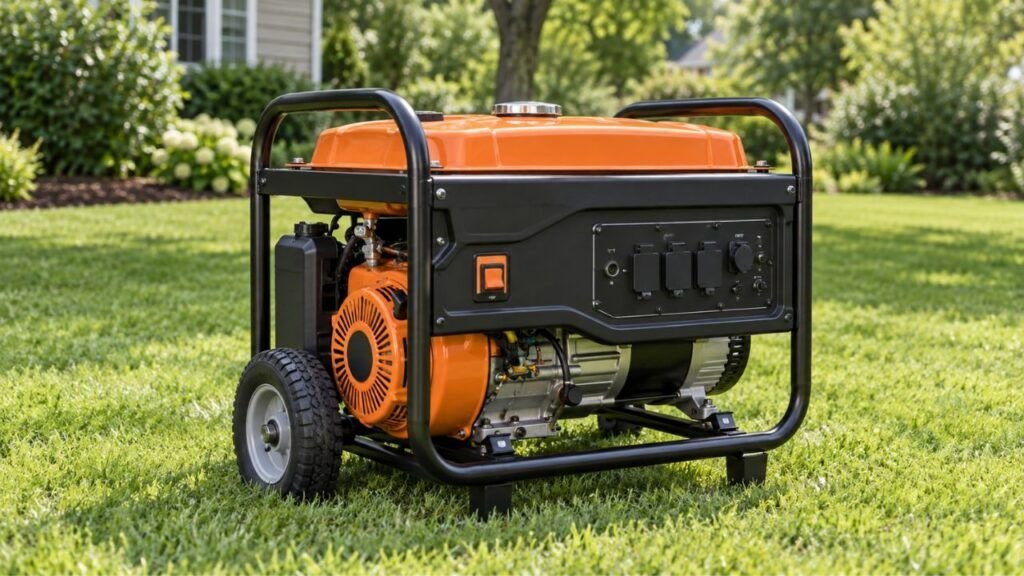
A 30-amp 120/240V generator connection can handle up to 7,200 watts, while a 50-amp connection can handle up to 12,000 watts. For most homes, 30 amps works well for essential circuits. A 50-amp setup gives you more capacity for HVAC, pumps, electric appliances, and several larger loads running together.
However, amperage alone does not tell you everything. Your generator’s running watts, starting capacity, voltage, outlet type, and household loads all matter. Below, I’ll help you compare both options and choose the right setup for your home backup needs.
Key Takeaways
- A 30-amp 120/240V connection supports up to 7,200 watts.
- A 50-amp 120/240V connection supports up to 12,000 watts.
- Your generator may produce less power than its outlet allows.
- A 30-amp setup usually works well for essential household circuits.
- A 50-amp setup gives larger appliances considerably more breathing room.
- Central air conditioners and pumps need careful starting-watt calculations.
- A 50-amp connection does not automatically provide whole-house power.
- Always match the generator, cord, inlet, breaker, and transfer equipment.
30-Amp vs 50-Amp Generator: Quick Comparison
The biggest difference is how much electrical power each connection can carry. That difference affects how many appliances you can operate together.
| Feature | 30-Amp Generator Setup | 50-Amp Generator Setup |
| Maximum at 240V | 7,200 watts | 12,000 watts |
| Typical Backup Goal | Essential household loads | Higher-demand home backup |
| Common Voltage | 120/240V | 120/240V |
| Common Generator Connection | L14-30 | 14-50 or other 50A connection |
| Refrigerator/Freezer | Usually easy | Usually easy |
| Furnace Blower | Usually practical | Usually practical |
| Sump Pump | Often practical | More headroom |
| Well Pump | Depends on startup load | More practical |
| Central Air | Depends heavily on system | More suitable, not guaranteed |
| Electric Water Heater | Requires load management | More practical |
| Electric Dryer/Range | Usually difficult with other loads | Possible with careful management |
| Load Management | Important | Still necessary |
| Generator Size | Usually smaller | Usually larger |
| Best For | Essentials-focused backup | More extensive home backup |
These figures describe connection capacity, not guaranteed generator output. Always check the generator’s actual rated and starting watts.
What Does 30 Amp or 50 Amp Actually Mean on a Generator?
Amp ratings tell you how much electrical current a connection handles. They do not automatically tell you how much power the generator produces.
Amps vs Watts
Electrical power is calculated using a simple formula:
Watts = Volts × Amps
For a typical 120/240V home backup connection:
30 amps × 240 volts = 7,200 watts
50 amps × 240 volts = 12,000 watts
That gives you the maximum theoretical capacity of each connection.
This is why the difference between them feels significant. Moving from 30 amps to 50 amps adds nearly 4,800 watts of possible connection capacity.
That extra capacity can make pumps, HVAC systems, and electric appliances easier to manage.
Connection Capacity vs Generator Running Watts
This distinction is extremely important.
Imagine your generator has a 30-amp L14-30 outlet. That outlet can theoretically carry 7,200 watts at 240 volts.
However, suppose the generator produces only 5,500 running watts.
You still have only 5,500 running watts available.
The 30-amp outlet does not magically increase generator output to 7,200 watts.
The same situation can happen with a 50-amp generator outlet. A generator might include a 50-amp receptacle while producing 9,500 running watts.
In that situation, 9,500 watts remains your real limit.
Always compare your appliances against the generator’s rated output first.
Starting Watts vs Running Watts
Some appliances require much more power during startup.
Refrigerators, air conditioners, furnace blowers, sump pumps, and well pumps all contain motors. Motors often draw extra power briefly when starting.
For example, a pump might use 1,500 watts while running. It could require several thousand watts during startup.
That short surge can overload an undersized generator.
When sizing your backup system, calculate your normal running load first. Then account for the largest likely motor-starting surge.
Do Not Confuse L14-30 With a 30-Amp RV Outlet
Not every 30-amp outlet provides the same type of power. This difference matters when connecting a generator to home circuits.
A common home-backup generator connection is the NEMA L14-30. It is a four-wire, 120/240V connection rated for 30 amps.
That configuration can supply both 120V and 240V loads when properly connected.
A common RV-style TT-30 connection is different. It supplies 120V rather than a 120/240V split-phase output.
Both may say “30 amp,” but they are not interchangeable.
This becomes especially important when your backup plan includes:
- A 240V well pump
- Certain central air conditioners
- Some heat pumps
- Other 240V household circuits
Before buying a cord or inlet, check the exact receptacle configuration. Never choose equipment based only on the amp number.
What Can a 30-Amp Generator Run During a Power Outage?
A 30-amp setup can cover surprisingly many household essentials. The main limitation appears when several large loads operate together.
Loads a 30-Amp Setup Commonly Handles Well
Depending on your generator’s actual output, a 30-amp system can often support:
- Refrigerator
- Freezer
- LED lighting
- Wi-Fi router
- Television
- Computers and phone chargers
- Gas furnace blower
- Garage door opener
- Selected household outlets
- Small kitchen appliances
- Sump pump
- Some well pumps
- Small window air conditioners
This can be more than enough during shorter outages.
Homes with gas heating, gas water heating, and gas cooking generally have lower emergency electrical demand. That makes a 30-amp system particularly practical.
Where 30 Amps Starts Getting Tight
Problems usually begin with larger electric appliances.
An electric water heater can consume several thousand watts. An electric dryer can use a large portion of available capacity. Central HVAC equipment can add both high running demand and compressor startup demand.
The real issue is often not one appliance.
It is several appliances running simultaneously.
Your refrigerator might start while the sump pump operates. Someone could then turn on a microwave or coffee maker.
Each appliance may look manageable individually.
Combined demand can quickly exceed generator capacity.
This is why load management becomes important with a 30-amp setup.
What Can a 50-Amp Generator Run During a Power Outage?
A 50-amp connection provides considerably more flexibility. You still need proper sizing, but you have more room for larger loads.
Loads That Become More Practical With 50 Amps
With enough actual generator output, a 50-amp setup can make these loads easier to support:
- Refrigerator and freezer
- Lighting and household outlets
- Furnace blower
- Large sump pump
- Well pump
- Central air conditioning
- Heat pump
- Electric water heater
- Microwave and kitchen appliances
- Multiple refrigerators or freezers
- Larger household electronics
- Selected electric cooking appliances
The biggest improvement is simultaneous operation.
You may be able to keep the refrigerator running while a pump starts. You can also operate more household circuits without constantly turning something off first.
Why 50 Amps Does Not Mean Unlimited Whole-House Power
This is where many homeowners get confused.
A 50-amp generator connection provides up to 12,000 watts at 240 volts. That sounds like plenty until you compare it with household utility service.
Many U.S. homes have 100-, 150-, or 200-amp electrical services.
Your normal utility connection can therefore support considerably larger loads than a 50-amp generator connection.
You might have central air, an electric dryer, water heater, range, well pump, and several kitchen appliances.
Running everything together could exceed your generator’s capacity.
A 50-amp generator can provide extensive home backup. It should not automatically be treated like full utility power.
Central AC, Heat Pumps, and Well Pumps: The Loads That Often Decide the Winner
Large motor-driven appliances frequently determine whether 30 amps feels comfortable. These loads deserve more attention than lights or electronics.
Central Air Conditioner
Central air conditioning is one major reason homeowners consider 50 amps.
The compressor creates the challenge.
An air conditioner might have a reasonable running load after startup. However, the compressor may briefly require much more power when starting.
That starting surge depends on the individual system.
You should consider:
- Air conditioner nameplate information
- Compressor starting requirements
- Generator running watts
- Generator surge watts
- Other appliances already operating
- Transfer equipment capacity
Do not assume every central air conditioner requires 50 amps.
Likewise, do not assume every 50-amp generator can start your air conditioner.
Some homeowners install an appropriately selected soft-start device. A soft starter can reduce compressor startup demand on compatible equipment.
That can make generator operation easier.
Still, the complete system should be evaluated rather than relying on one accessory.
Heat Pump and Electric Auxiliary Heat
A heat pump creates another sizing challenge.
The compressor itself might operate within your generator’s limits. However, many systems also include electric resistance backup heating.
Those auxiliary heat strips can require substantial power.
You could therefore have enough generator capacity for normal heat-pump operation but not enough for auxiliary electric heat.
Check the HVAC system’s electrical specifications before sizing your generator.
Well Pump
Well pumps are another important consideration.
Their power requirements vary according to:
- Pump horsepower
- Operating voltage
- Well depth
- Motor design
- Starting current
Some smaller pumps work comfortably with a 30-amp generator setup.
Larger pumps can consume much more starting power.
If your home depends entirely on a well, give the pump priority when calculating backup loads.
A 50-amp setup provides more starting headroom, but proper sizing remains necessary.
Electric Water Heater, Dryer, and Range
These appliances do not always have dramatic motor startup loads. Their high running demand creates the problem instead.
An electric water heater can consume several thousand watts.
Electric dryers and ranges can also draw substantial power.
A 30-amp generator might operate one large electric load temporarily. However, you may need to turn several other circuits off first.
A 50-amp generator gives you greater flexibility.
Even then, you may need to avoid running every major electric appliance simultaneously.
120V Loads, 240V Loads, and Why Load Balance Matters
Total wattage is only part of generator sizing. How your 120V loads are distributed can also affect performance.
How a 120/240V Generator Feeds Your Home
A typical 120/240V portable generator uses split-phase output.
You effectively have two 120V legs.
Standard household outlets use one 120V leg. A 240V appliance uses both legs together.
With a 30-amp 120/240V connection, each 120V leg can theoretically supply up to 30 amps.
At 120 volts, that equals about 3,600 watts per leg.
Together, both legs provide the familiar 7,200-watt maximum.
A 50-amp connection can theoretically provide about 6,000 watts per 120V leg, for 12,000 watts total.
Those numbers assume the generator itself can actually provide that output.
Why Total Watts Are Not the Whole Story
Imagine most of your operating appliances happen to be connected to one 120V leg.
That side of the generator could become overloaded while the other side remains lightly loaded.
Your overall wattage might still look reasonable.
This is called an unbalanced load.
A well-planned transfer-switch or interlock setup should consider how important 120V circuits are distributed.
This becomes especially useful when running several household circuits simultaneously.
If you notice one side of your system repeatedly tripping or struggling, load balance may deserve attention.
How to Calculate Whether You Need 30 Amps or 50 Amps
You do not need complicated engineering calculations for a useful estimate. Start with what you actually want during an outage.
Step 1: List Your Essential Appliances
Write down everything you genuinely expect to operate.
Start with necessities such as:
- Refrigerator
- Freezer
- Furnace blower
- Well pump
- Sump pump
- Lighting
- Internet equipment
- Medical or essential equipment
Then add comfort appliances such as air conditioning or cooking equipment.
Step 2: Identify Your 120V and 240V Loads
Look for appliances using 240V power.
Common examples include:
- Central air conditioner
- Well pump
- Electric water heater
- Electric dryer
- Electric range
- Heat pump
These loads can heavily influence generator sizing.
Step 3: Find Running Watts
Use appliance labels or manufacturer documentation whenever possible.
Generic online wattage charts can provide rough estimates.
However, your actual appliance may use substantially more or less power.
Add the running watts for appliances you expect to operate simultaneously.
Step 4: Find Starting Watts for Motor Loads
Next, identify motor-driven equipment.
Pay particular attention to:
- Refrigerator compressor
- Freezer compressor
- Air conditioner
- Well pump
- Sump pump
- Furnace blower
Find their starting requirements whenever possible.
The generator needs enough short-term capacity to handle those starts.
Step 5: Calculate Your Simultaneous Running Load
Do not add every appliance in your house automatically.
Ask what you realistically need running together.
For example, suppose your emergency running loads total 4,200 watts.
That could fit comfortably within many 30-amp generator setups.
If your normal backup load reaches 7,500 or 8,500 watts, a 50-amp setup becomes more practical.
Step 6: Add the Largest Likely Starting Surge
Suppose your loads require 4,000 running watts.
Your well pump adds another 2,000 watts above its normal running demand when starting.
Your generator needs enough temporary capacity to handle that event.
You normally do not need to assume every motor reaches maximum startup demand simultaneously.
Still, leave reasonable headroom.
Step 7: Compare the Result With Generator Ratings
Now look at the generator itself.
Check:
Running watts: What it can continuously produce.
Starting watts: What it can briefly produce during motor startup.
These numbers matter more than the outlet label alone.
Step 8: Check Your Connection Hardware
Finally, verify the complete electrical path.
That includes:
- Generator outlet
- Generator breaker
- Power cord
- Exterior inlet
- Home-side breaker
- Wiring
- Transfer switch or interlock equipment
The system is only as capable as its lowest-rated component.
30-Amp vs 50-Amp by Home Backup Scenario
Different homes have very different emergency needs. This table gives you a more practical way to compare both sizes.
| Home Backup Situation | 30 Amp | 50 Amp |
| Refrigerator, freezer, lights, electronics | Usually enough | Easily handled |
| Gas furnace with gas water heater | Usually enough | More capacity than necessary for many homes |
| Sump pump plus essentials | Often practical | More headroom |
| Well pump plus household loads | Depends on pump | Usually easier |
| Central air conditioning | Very system-dependent | More practical |
| Heat pump without backup strips | Depends on system | Usually better |
| Electric resistance heat | Usually inadequate | May still require careful management |
| Electric water heater plus essentials | Tight | More practical |
| Electric cooking | Limited | More practical |
| Electric dryer | Difficult with other loads | Possible with sufficient generator output |
| Minimal load management | Less suitable | Better |
| Essentials-only backup | Excellent fit | More capacity than required |
| Larger-home comfort backup | Limited | Better fit |
Your actual equipment always takes priority over these general guidelines.
When a 30-Amp Generator Makes More Sense
A 30-amp generator setup is often the smarter choice when:
- You only need critical circuits during outages.
- Your generator produces well under 7,200 running watts.
- Your home uses gas heating.
- Your water heater uses natural gas or propane.
- Your cooking appliances use gas.
- You do not need central air during outages.
- Your pump loads are relatively small.
- You are comfortable managing appliances manually.
- Storage space matters.
- Portability matters.
- Lower generator fuel consumption matters.
- You already own a suitable 30-amp generator.
You should not view 30 amps as automatically undersized.
For an essentials-focused backup plan, it can be a very practical solution.
When a 50-Amp Generator Makes More Sense
A 50-amp setup becomes more attractive when:
- Your generator produces more than a 30-amp connection can carry.
- You want more appliances operating simultaneously.
- Central air conditioning is important during outages.
- You have a large well pump.
- Your home uses several electric appliances.
- You want to operate an electric water heater.
- Your home has higher emergency electrical demand.
- You want less manual load management.
- You expect your backup needs to increase later.
- You want more flexibility from a larger portable generator.
The biggest benefit is not necessarily running everything.
It is having more headroom when several loads overlap.
Does a 50-Amp Generator Use More Fuel Than a 30-Amp Generator?
A 50-amp connection itself does not cause higher fuel consumption. Generator fuel use depends more heavily on engine size and actual electrical load.
Larger generators often burn more fuel because they use larger engines.
However, amp rating alone does not determine fuel consumption.
Two generators can produce similar output while having different efficiencies.
Load also makes a major difference.
A large generator running lightly usually consumes less fuel than when operating close to maximum output.
Fuel type matters as well.
Dual-fuel and tri-fuel generators may produce different wattage depending on fuel.
Gasoline often provides the generator’s highest advertised output.
Propane may provide somewhat less.
Natural gas can reduce available output further on certain models.
If you plan to use propane or natural gas during outages, size your home backup system using that fuel’s actual generator rating.
Do not calculate everything from the gasoline rating alone.
Generator Inlet, Cord, Breaker, and Transfer Equipment Must Work Together
Buying a larger generator solves only part of the problem. Every component between the generator and your electrical panel must be compatible.
Common 30-Amp Home Backup Connection
Many 30-amp portable generators use an L14-30 connection.
It provides:
- Two hot conductors
- One neutral conductor
- One equipment grounding conductor
- 120/240V capability
A matching generator cord and inlet are commonly used for home backup.
The home side then connects through suitable transfer equipment.
Common 50-Amp Home Backup Connections
A 50-amp generator can use different receptacle configurations.
One common style is a 14-50 connection. Some generators use other heavy-duty 50-amp connector types.
Do not assume every 50-amp generator uses identical plugs.
Check the generator before buying:
- Cord
- Inlet
- Adapter
- Transfer equipment
Everything should match the intended system design.
Transfer Switch vs Interlock
Both transfer switches and approved interlock systems can prevent generator power from feeding the utility lines when properly installed.
That isolation is critical.
Never connect a generator to household wiring without a safe method of separating generator power from utility power.
Backfeeding can create severe shock and fire hazards.
It can also endanger utility workers repairing nearby power lines.
Can You Use a 30-Amp Generator With a 50-Amp Inlet?
In some properly designed systems, a smaller generator can supply a higher-rated home inlet through compatible equipment.
However, installing a 50-amp inlet does not make a 30-amp generator more powerful.
Your generator still provides only its rated output.
Also, an adapter does not automatically regulate electrical current.
Protection still depends on the generator breaker and properly designed wiring.
Connector configuration also matters.
Neutral and grounding arrangements must match the installation correctly.
For that reason, have an electrician verify any mixed-rating setup before relying on it.
30-Amp vs 50-Amp Generator Installation Cost
A 50-amp home connection usually costs more because it requires heavier-duty components.
However, there is no reliable nationwide price difference.
Installation cost depends on:
- Distance from inlet to electrical panel
- Cable length
- Conduit requirements
- Wall construction
- Indoor or outdoor routing
- Breaker type
- Inlet hardware
- Transfer-switch choice
- Interlock compatibility
- Electrical panel condition
- Permit requirements
- Local labor prices
The distance between your panel and generator inlet can matter considerably.
A longer wiring run requires more material.
Larger conductors also generally cost more than smaller ones.
If your panel is near the outside generator location, the difference may be modest.
A long or difficult wiring route can increase that difference.
Do not choose 30 amps only because you assume 50 amps costs dramatically more.
Ask for both options when getting an installation estimate.
Common Mistakes When Choosing 30 Amp or 50 Amp
These mistakes can leave you with too little backup capacity or incompatible equipment.
- Assuming every 30-amp generator produces 7,200 running watts
- Assuming every 50-amp generator produces 12,000 running watts
- Confusing a TT-30 outlet with an L14-30 connection
- Ignoring the generator’s actual rated running watts
- Ignoring motor starting watts
- Assuming a 50-amp generator automatically runs the entire house
- Choosing generator size only from house square footage
- Using the home’s 200-amp service rating as generator size
- Ignoring lower output on propane or natural gas
- Forgetting about 120V load balance
- Assuming central AC works because the generator has 50 amps
- Treating an adapter like a current-limiting device
- Using mismatched cords or connectors
- Connecting a generator without proper transfer equipment
Avoiding these mistakes makes the final system safer and more useful.
Generator Safety for Home Backup
Portable generators can provide reliable emergency power, but installation and placement matter just as much as generator size.
Keep these safety basics in mind:
- Never backfeed power through a household receptacle.
- Use properly installed transfer equipment.
- Follow the generator manufacturer’s grounding instructions.
- Keep the generator protected from rain and standing water.
- Never operate a fuel-burning generator indoors.
- Never run it inside an attached or detached garage.
- Keep generator exhaust well away from occupied buildings.
- Point the exhaust away from doors and windows.
- Keep working carbon monoxide alarms inside your home.
- Allow the generator to cool before refueling.
- Never modify electrical plugs to force incompatible connections.
- Have permanent household wiring installed by a qualified electrician.
A generator should protect your household during an outage, not create another hazard.
Final Verdict: Should You Choose a 30-Amp or 50-Amp Generator?
A 30-amp 120/240V generator setup is usually enough when your goal is essential backup. It can comfortably support refrigerators, freezers, lights, electronics, a gas furnace blower, and carefully selected pump loads when the generator has adequate output.
A 50-amp generator setup makes more sense when you want additional simultaneous loads. It gives you more room for central HVAC, larger pumps, electric water heating, and other demanding appliances.
Neither option should be selected from amperage alone.
Start by calculating the running and starting requirements of the appliances you actually need.
Then compare those numbers with the generator’s real rated output.
Finally, make sure the generator outlet, cord, inlet, breaker, wiring, and transfer equipment all match.
For a smaller essentials-focused home backup system, I would be comfortable choosing 30 amps.
For a larger generator or a home where HVAC, pumps, and major electric appliances matter, I would lean toward 50 amps.
The right choice is the one that handles your real outage loads without forcing the generator to operate at its limit.
Related FAQs
Is a 30-Amp Generator Enough for a House?
A 30-amp generator can be enough for essential home backup, especially when heating, cooking, and water heating use gas. You will usually need to prioritize important circuits instead of running the entire house normally.
How Many Watts Can a 30-Amp Generator Supply at 240V?
A 30-amp 240V connection has a theoretical capacity of 7,200 watts. However, your usable power cannot exceed the generator’s actual rated running output.
How Many Watts Can a 50-Amp Generator Supply at 240V?
A 50-amp 240V connection has a theoretical capacity of 12,000 watts. The generator must also be rated to produce that much continuous power.
Can a 30-Amp Generator Run Central Air Conditioning?
It can in some situations, but there is no universal answer. Central AC compatibility depends on compressor startup requirements, generator surge capacity, other active loads, and the specific HVAC system.
Can a 50-Amp Generator Run a Whole House?
A 50-amp generator can run many household circuits, but it may not operate every appliance simultaneously. Large HVAC systems, dryers, ranges, water heaters, and electric heat can still exceed available capacity.
Can I Run a Well Pump on a 30-Amp Generator?
Some well pumps work well on a 30-amp generator, while larger pumps may not. Check pump voltage, horsepower, running current, and starting requirements before sizing the generator.
Can I Connect a 30-Amp Generator to a 50-Amp Inlet?
A smaller generator can work with some properly designed higher-rated inlet systems, but the connection must be electrically compatible. The 50-amp inlet does not increase the generator’s available output.
What Is the Difference Between L14-30 and TT-30?
An L14-30 connection is commonly a four-wire 120/240V generator connection. A TT-30 is normally a three-wire 120V RV connection, so the two serve different purposes.
Does a 50-Amp Generator Use More Fuel?
Not simply because it has a 50-amp connection. Fuel consumption depends on generator size, engine efficiency, fuel type, and the amount of electrical load being supplied.
Do I Need a 30-Amp or 50-Amp Transfer Switch?
The transfer equipment should match your generator system, household wiring, and intended loads. A 30-amp system is usually suited to essential circuits, while 50 amps provides more capacity for larger backup loads.
Is a 50-Amp Generator Worth It for Home Backup?
A 50-amp generator is often worth considering when you need central HVAC, larger pumps, electric appliances, or less load management. For essential backup only, a 30-amp setup can be more practical.

Brian Walker writes straightforward generator guides and reviews for homeowners and everyday users. His content focuses on solar, portable, and fuel-powered generators, with practical advice on choosing, using, and maintaining reliable backup power.















