
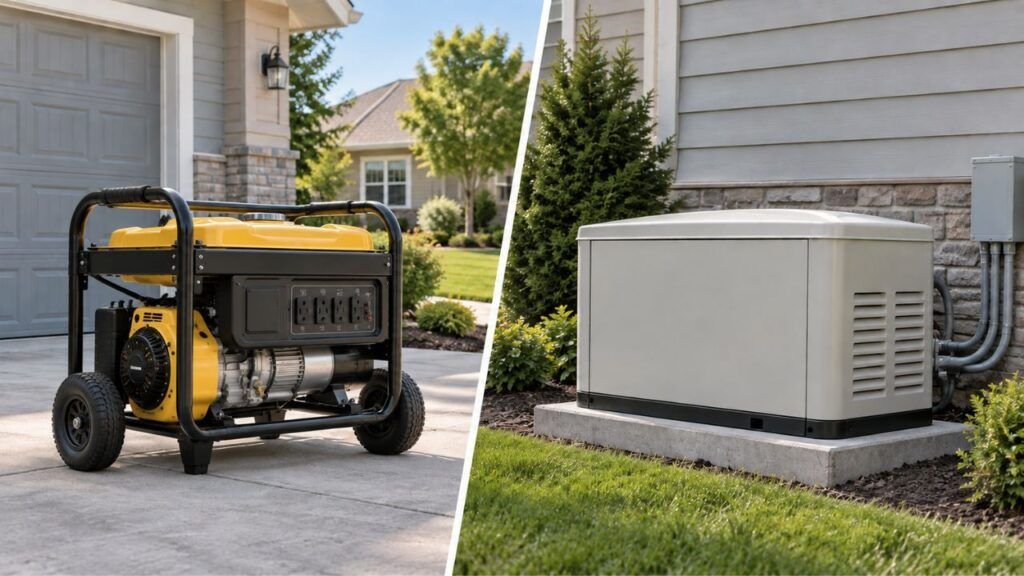
A portable generator is usually better for affordable, occasional home backup. A standby generator is better for automatic, higher-capacity, long-term outage protection. Your best choice depends on required loads, outage frequency, fuel access, budget, and how much manual setup you accept.
In this guide, I’ll compare both options in practical terms. We’ll look at power, costs, fuel, installation, runtime, safety, maintenance, and which generator suits different homes.
Key Takeaways
- Portable generators cost much less than installed standby systems.
- Standby generators automatically start when utility power fails.
- Large portable generators can power several household circuits safely.
- Standby generators better support large and frequent household loads.
- Portable generators require more setup, monitoring, and fuel management.
- Standby systems commonly use natural gas or bulk propane.
- Your required appliances matter more than your home’s square footage.
Portable Generator vs Standby Generator: Quick Comparison
The biggest differences involve automation, capacity, installation, and cost. This quick table gives you the basic picture before we go deeper.
| Feature | Portable Generator | Standby Generator |
| Installation | Minimal unless connected to home panel | Permanent professional installation |
| Starting | Manual | Automatic |
| Transfer equipment | Manual transfer switch or compatible interlock | Automatic transfer switch |
| Typical backup coverage | Essential or selected circuits | Selected circuits or whole-home backup |
| Common fuels | Gasoline, propane, dual-fuel, tri-fuel | Natural gas or propane |
| Refueling | Usually required | Usually supplied from gas line or bulk tank |
| 120V loads | Yes | Yes |
| 240V loads | Available on suitable larger models | Commonly supported |
| Central AC | Possible with proper sizing | Usually easier to support |
| Well pump | Possible with correct voltage and capacity | Common application |
| Automatic operation | Usually no | Yes |
| Portability | High | None |
| Initial cost | Lower | Much higher |
| Maintenance | Mostly owner-managed | Regular scheduled maintenance |
| Best for | Occasional outages and essential loads | Frequent outages and automatic backup |
A portable generator wins on affordability and flexibility. A standby system wins when convenience and automatic coverage matter most.
What Is a Portable Generator?
A portable generator is a movable engine-driven power source. You bring it outside, start it manually, and connect your selected loads.
Most portable generators use gasoline, propane, or both fuels. Some larger tri-fuel models can also operate on natural gas.
Smaller models may power individual appliances through properly rated cords. Larger units can connect to household circuits through approved transfer equipment.
Many home-backup portable generators include 30-amp or 50-amp outlets. That makes them much more capable than basic recreational generators.
A portable generator does not necessarily mean limited appliance backup. A properly sized unit can support several essential household circuits simultaneously.
However, you still need someone to deploy and operate it. That difference becomes important during severe storms or overnight outages.
What Is a Standby Generator?
A standby generator is permanently installed outside your house. It connects directly to your home’s electrical system and fuel supply.
Most systems use an automatic transfer switch. The switch detects utility failure and transfers selected loads automatically.
When grid power returns, the system transfers back automatically. The generator then shuts down after its programmed cooldown process.
Standby generators commonly operate on natural gas or propane. They eliminate gasoline cans and frequent manual refueling during outages.
These units are commonly called whole-house generators. However, that description can sometimes create unrealistic expectations.
Not every standby generator powers every household appliance simultaneously. The system must still match your home’s actual electrical demands.
Some installations also use load-management controls. These controls prevent several large appliances from starting together.
Portable vs Standby Generator: The Differences That Matter Most
Specifications matter, but daily usability matters just as much. Here’s how both systems behave during an actual home power outage.
Automatic vs Manual Operation
With a portable generator, you handle most steps yourself.
You normally move the unit outdoors and position it safely. Then you connect it, start it, and manage your household loads.
You may also need to refuel several times. Longer outages require more active monitoring and fuel planning.
A standby generator handles much of that process automatically. When power fails, the system detects the outage and starts.
The automatic transfer switch disconnects utility power before supplying generator power. This happens without you moving equipment or connecting extension cords.
That difference becomes valuable during nighttime outages. It also matters when nobody is currently home.
Power Output and Home Coverage
Portable generators range from small recreational models to powerful home-backup units. Therefore, you should not judge them as one category.
A smaller portable generator might handle refrigeration, lighting, and electronics. A larger model may support pumps, furnaces, and multiple household circuits.
Standby generators generally offer more convenient high-capacity backup. They are often designed around larger portions of the electrical panel.
Think about backup coverage in three levels:
- Essential-load backup
- Partial-home backup
- Whole-home backup
Either generator type can sometimes serve the first two levels. Whole-home convenience usually favors a properly sized standby system.
Starting Watts and Running Watts
Running watts show how much electricity equipment needs continuously. Starting watts cover temporary power surges during startup.
Motor-driven appliances often require extra startup power. Examples include refrigerators, pumps, compressors, and furnace blowers.
Suppose your appliances need 5,000 watts while operating. That does not necessarily mean a 5,000-watt generator works.
Your well pump or air conditioner might briefly demand much more. The generator must handle that temporary surge without overloading.
Always calculate both running and starting requirements before choosing capacity.
120V vs 240V Capability
Generator wattage tells only part of the story. You also need the correct output voltage for your appliances.
Common 120V loads include:
- Refrigerators
- Freezers
- Lamps
- Televisions
- Internet equipment
- Many small appliances
Common 240V household loads may include:
- Central air conditioners
- Well pumps
- Electric water heaters
- Clothes dryers
- Electric ranges
Not every portable generator provides suitable 240V output. Check this carefully before planning whole-panel backup.
Large standby generators normally support both voltages through the home’s electrical system.
Fuel Supply and Refueling
Fuel management is one of the clearest differences.
Portable generators commonly run on gasoline or propane. Dual-fuel and tri-fuel models give homeowners additional flexibility.
Gasoline is easy to obtain under normal conditions. However, outages may create fuel shortages or long station lines.
Propane stores longer and avoids some gasoline storage concerns. However, cylinder capacity still limits your operating time.
Standby generators often connect directly to natural gas service. Others use a large permanently installed propane tank.
Natural gas eliminates manual tank refilling while service remains available. Still, no fuel source should be treated as absolutely guaranteed.
Propane is stored onsite but remains a finite resource. Long outages can eventually empty the tank.
Runtime During Long Outages
Portable generator runtime depends on several factors:
- Fuel tank size
- Generator load
- Engine efficiency
- Fuel availability
- Refueling schedule
A listed runtime does not mean unlimited continuous operation. The machine also needs appropriate maintenance during extended use.
Standby generator runtime works differently.
Natural-gas models can continue while gas service remains available. Propane models depend on stored tank capacity.
Large loads also increase fuel consumption significantly. Running multiple HVAC systems can change runtime substantially.
Neither generator should simply run unattended forever. Follow maintenance intervals specified for your particular equipment.
Noise
Both generator types create noticeable sound during operation.
Portable generators often use exposed engines. Conventional models can sound louder than enclosed or inverter-style units.
Standby generators usually have weather-resistant acoustic enclosures. However, large standby units still produce significant operating noise.
Actual sound depends on:
- Generator size
- Engine speed
- Load level
- Enclosure design
- Installation location
- Distance from your house
Check local noise restrictions before selecting an installation location.
Can a Portable Generator Really Power a House?
Yes, a portable generator can power significant portions of a house. The important question is which loads you expect to operate together.
Essential-Circuit Backup
Many homeowners do not actually need every circuit during outages.
You might only need:
- Refrigerator
- Freezer
- Furnace blower
- Sump pump
- Well pump
- Several lights
- Internet equipment
- Selected outlets
A properly sized portable generator can often cover these essentials. You simply need to manage simultaneous loads carefully.
This approach keeps generator size and fuel consumption more manageable.
Partial-Home Backup
Larger portable generators can supply several household circuits through proper transfer equipment.
For example, you may run refrigeration, heating equipment, pumps, lighting, and selected receptacles from one larger portable generator.
The exact combination depends on generator capacity. It also depends heavily on startup surges from motor-driven appliances.
This setup can provide excellent value for homeowners. You get broader home backup without purchasing a permanent standby system.
Whole-Home Backup
Some high-output portable generators offer substantial power. However, powering an entire house comfortably involves more than maximum wattage.
Large electric loads add up quickly.
Central air conditioning, water heating, cooking, clothes drying, and pumps can create very high simultaneous demand.
You may technically have enough generator output for many loads. Still, manually managing them can become inconvenient.
This is where a standby generator often becomes more practical.
How Much Generator Power Does Your Home Actually Need?
Generator sizing should begin with appliances, not house square footage. A smaller home can sometimes have higher electrical demands than a larger one.
Step 1: Decide What Must Stay On
Start by listing appliances you consider essential.
Common priorities include:
- Refrigerator
- Freezer
- Furnace
- Sump pump
- Well pump
- Lights
- Internet equipment
- Medical equipment
- Air conditioning
- Selected wall outlets
Avoid automatically including every appliance in your house. Backup power becomes easier when you prioritize actual needs.
Step 2: Add Running Watts
Find the normal operating wattage for each required appliance.
Add those numbers together for your expected simultaneous load.
Do not assume everything will operate continuously. However, calculate conservatively enough to avoid repeated overloads.
Step 3: Account for the Largest Starting Load
Now identify appliances with motors or compressors.
These may briefly require substantially more power when starting. Your generator needs enough surge capacity for those moments.
Central air conditioning and well pumps deserve particular attention. Their startup requirements can change generator sizing considerably.
Step 4: Check Your 240V Loads
Next, identify required 240V equipment.
A generator might have plenty of wattage but lack suitable output. That would still prevent it from powering certain equipment.
Confirm voltage, outlet, transfer equipment, and generator compatibility together.
Step 5: Leave Reasonable Capacity Headroom
Avoid planning to operate your generator constantly at maximum capacity.
Some headroom makes load changes easier to manage. It can also reduce nuisance overloads when appliances start unexpectedly.
The exact amount depends on generator design and manufacturer recommendations.
Portable Generator Pros and Cons for Home Backup
Portable generators offer strong value, especially for occasional outages. Their main compromises involve manual work, fuel handling, and limited automation.
Portable Generator Advantages
- Lower purchase cost than most standby systems
- No permanent outdoor generator installation required
- Can move with you when relocating
- Useful for camping, projects, and other applications
- Gasoline, propane, and multi-fuel choices are available
- Practical choice for occasional outages
- Larger models can support multiple household circuits
- Easier to replace or upgrade later
Portable Generator Disadvantages
- Requires manual setup during an outage
- Usually requires manual starting
- Needs careful fuel storage and management
- Must be operated safely outside
- Requires more active load monitoring
- Setup can be difficult during severe weather
- May not support every appliance simultaneously
- Someone must normally be present to operate it
Standby Generator Pros and Cons for Home Backup
Standby generators prioritize convenience and automatic protection. Their biggest downside is the much higher overall investment.
Standby Generator Advantages
- Automatically starts after utility failure
- Can operate while nobody is home
- Permanently connected to household circuits
- High-capacity options are widely available
- Better suited to large residential loads
- Eliminates gasoline cans during normal operation
- Convenient during overnight power failures
- Excellent for frequent or prolonged outages
- Automatic transfer reduces manual outage setup
Standby Generator Disadvantages
- Much higher upfront cost
- Requires professional installation
- Permits and inspections may be necessary
- Fuel-system work may increase installation costs
- Generator remains permanently attached to the property
- Regular maintenance is still required
- Propane supplies can eventually run out
- Installation location must meet applicable requirements
A standby generator may improve a home’s appeal. However, do not assume you will recover every installation dollar during resale.
Portable vs Standby Generator Cost
Purchase price tells only part of the cost difference. You should compare the complete backup system you actually need.
Portable Generator Costs
With a portable generator, possible expenses include:
- Generator itself
- Generator inlet
- Manual transfer equipment
- Electrical installation
- Heavy-duty extension cords
- Fuel containers
- Stored fuel
- Engine oil
- Replacement filters
- Starting battery on equipped models
The generator itself may be relatively affordable. A proper home-panel connection can increase your total investment.
Even then, portable setups generally remain much cheaper than standby installations.
Standby Generator Costs
A standby installation can include:
- Generator unit
- Automatic transfer switch
- Electrical labor
- Natural gas or propane work
- Concrete or composite mounting pad
- Permits
- Inspections
- Electrical upgrades
- Gas-meter upgrades where necessary
- Ongoing service and maintenance
Installation complexity varies significantly between houses.
A simple installation near existing electrical and gas equipment costs less. Longer wiring runs or major gas upgrades can raise expenses considerably.
Which Costs Less Over Time?
A portable generator usually costs much less initially.
Standby systems do not generally win because they produce cheaper outage electricity. Their value comes from automation, capacity, and convenience.
Think about how frequently you expect to use backup power.
If outages happen once every few years, standby installation may feel excessive. If outages repeatedly last days, the convenience becomes easier to justify.
How Each Generator Connects to Your Home
Both generator types can power household equipment safely. However, their connection methods are very different.
Extension Cords With a Portable Generator
You can sometimes power individual appliances directly from a portable generator.
This method works best for a small number of loads. Use properly rated cords and follow your generator manufacturer’s requirements.
Running many cords throughout the home quickly becomes inconvenient. It can also make load management more difficult.
Manual Transfer Switch or Interlock
A larger portable generator can supply home circuits through approved transfer equipment.
The setup commonly includes an outdoor generator inlet. Power then reaches selected circuits or the electrical panel.
A transfer switch or compatible interlock prevents utility power and generator power from feeding the same system improperly.
Have appropriate electrical equipment installed according to applicable requirements. Avoid improvised generator-to-panel connections.
Automatic Transfer Switch With a Standby Generator
A standby generator usually uses an automatic transfer switch.
The process generally works like this:
- Utility power fails.
- The system detects the outage.
- Utility power becomes isolated.
- The generator starts.
- Selected home loads receive backup electricity.
- Utility service eventually returns.
- The system transfers the home back.
- The generator shuts down afterward.
You normally do not need to perform these steps manually.
Which Generator Is Better for Different Homeowners?
The best generator depends on how you actually live. Your outage pattern and household equipment should guide the decision.
Choose a Portable Generator If…
A portable generator usually makes more sense when:
- Your outages are relatively infrequent.
- Your backup-power budget is limited.
- You mainly need essential appliances.
- Someone is usually home during outages.
- You are comfortable storing and managing fuel.
- You can safely move the generator outside.
- You want to use it away from home.
- You do not want permanent equipment installed.
Choose a Standby Generator If…
A standby generator becomes more attractive when:
- Power outages happen frequently.
- Your outages often last several days.
- Keeping central HVAC running matters.
- Your home depends on a well pump.
- You regularly travel away from home.
- Nobody may be available during an outage.
- Manual setup would be physically difficult.
- Automatic backup is a priority.
- Your budget allows permanent installation.
What About Hurricane-Prone Areas?
Long outages make fuel planning especially important.
Portable generators can provide excellent storm backup. However, you need adequate fuel and a safe operating location.
A standby generator eliminates much of the manual setup. This can be valuable when outages continue for several days.
Still, standby fuel requirements matter.
Natural gas availability and propane tank capacity should be considered before storm season.
What About Cold-Weather Areas?
Winter outages create different priorities.
Your furnace blower may require electricity even when heating uses gas. Well pumps and sump pumps may also remain essential.
Deploying a portable generator during snow or freezing rain can be unpleasant. Safe outdoor operation must still be maintained.
A standby generator removes much of that manual winter setup.
What About Rural Homes With Well Pumps?
Well pumps often change generator requirements significantly.
Many residential well pumps use 240V power. Their motors can also require substantial starting current.
A portable generator can power a well pump when properly sized. Confirm both voltage and startup capacity before buying.
Standby systems work well for homes relying heavily on wells. Their automatic operation keeps water service more consistently available.
What About Homes With Medical Equipment?
Reliable backup may be especially important for essential medical equipment.
A standby generator provides automatic protection when utility power disappears. This eliminates the delay required to deploy a portable unit.
However, critical equipment may need additional battery backup. Do not depend on a single generator as your only contingency.
Portable vs Standby Generator for Central Air Conditioning
Central air conditioning can quickly change your generator decision.
Air conditioners use substantial power while running. Their compressors can demand even more electricity briefly during startup.
A properly sized large portable generator may run certain central AC systems. The generator must support the required voltage and surge power.
Some installations use compatible soft-start equipment to reduce compressor starting demand. However, every system should be evaluated individually.
Standby generators generally make whole-home cooling easier to manage. They are commonly sized around larger household loads from installation.
Still, even a standby generator has limits.
Multiple HVAC systems and electric appliances can exceed generator capacity. Proper sizing and load management remain important.
Fuel Storage and Outage Preparedness
Backup power works best when you prepare before the outage. A generator without usable fuel or maintenance supplies offers little help.
- Keep approved fuel containers stored safely.
- Rotate stored gasoline when appropriate.
- Check propane levels before major storms.
- Understand your generator’s expected fuel consumption.
- Keep suitable engine oil available.
- Maintain replacement filters when recommended.
- Test the generator periodically.
- Know your connection procedure before emergencies.
- Keep operating instructions accessible.
- Schedule standby maintenance before severe-weather seasons.
Preparing early also helps you spot problems before electricity disappears.
Generator Safety: The Difference You Should Not Ignore
Portable generators require especially careful placement because their engines produce carbon monoxide. Never trade convenience for unsafe operation.
- Never operate a portable generator inside your home.
- Never run one inside an attached or detached garage.
- An open garage door does not make indoor operation safe.
- Never run generators inside basements, sheds, or crawlspaces.
- Keep portable generators well away from occupied buildings.
- Direct generator exhaust away from doors and windows.
- Keep exhaust away from vents and other openings.
- Maintain working carbon monoxide alarms inside your home.
- Protect the generator appropriately during wet conditions.
- Never improvise connections into household wiring.
- Prevent generator power from backfeeding utility lines.
- Use properly installed transfer equipment for panel connections.
Standby generators reduce some manual safety concerns. However, placement, exhaust clearance, electrical connections, and fuel installation still matter.
Professional installation helps address these requirements correctly.
Maintenance: Which Generator Requires More Attention?
Every engine-driven generator requires maintenance eventually. Automatic operation does not make a standby generator maintenance-free.
Portable Generator Maintenance
Portable generator maintenance commonly includes:
- Checking engine oil
- Changing oil when required
- Maintaining fuel quality
- Inspecting the air filter
- Checking spark plugs
- Testing the generator periodically
- Maintaining the starting battery when equipped
- Preparing the fuel system for storage
And also, portable generators sometimes sit unused for months. Storage-related fuel problems can therefore become a major reliability issue.
Standby Generator Maintenance
Standby generators commonly perform automatic exercise cycles.
However, they still need periodic attention.
Typical maintenance includes:
- Engine oil changes
- Oil-filter replacement
- Air-filter inspection
- Spark-plug service
- Starting-battery checks
- Fuel-system inspection
- Transfer-switch inspection
- General system testing
A standby generator should be ready before the outage begins. Regular maintenance is what helps make that possible.
Portable Generator vs Standby Generator: Which Is More Reliable?
Both generator types can provide dependable backup when maintained correctly.
Portable generator reliability depends heavily on preparation. You need fresh fuel, working equipment, safe placement, and someone available to operate it.
Standby generators remove many of those manual steps. That usually makes them more dependable for automatic outage response.
However, standby systems can still fail.
Battery problems, neglected maintenance, fuel interruptions, or mechanical faults can prevent operation.
Therefore, reliability depends on several factors:
- Correct generator sizing
- Regular maintenance
- Fuel availability
- Installation quality
- Battery condition
- Environmental conditions
- Load management
For hands-free reliability, standby has the advantage. For simple and affordable backup, portable generators remain highly practical.
So, Is a Standby Generator Worth It Over a Portable Generator?
A standby generator is worth considering when power outages create serious disruptions for your household.
It makes particular sense when you need automatic operation, frequent backup, central air conditioning, well pumps, or other significant loads.
It also makes sense if nobody may be home. Your generator can respond without waiting for someone to start it.
However, many homeowners simply do not need that level of automation.
If your main priorities are refrigeration, heating equipment, lighting, internet, and several essential circuits, a properly sized portable generator may offer much better value.
You can also invest in a transfer setup. This makes portable home backup easier without purchasing a permanent standby generator.
A Simple Decision Checklist
Still unsure? Ask yourself these questions before choosing either system.
- How frequently does my home lose electricity?
- How long do local outages usually last?
- Which appliances absolutely must remain operational?
- Do I need central air conditioning during outages?
- Does my home have a well pump?
- Do I rely on a sump pump?
- Which required appliances use 240V power?
- Will someone normally be home during outages?
- Can I safely move a portable generator?
- Am I comfortable starting it during severe weather?
- Can I safely maintain adequate fuel supplies?
- Do I want automatic backup while traveling?
- What total installed budget can I realistically afford?
If affordability and essential-load backup matter most, choose portable.
If automatic operation and broader coverage matter most, choose standby.
Final Verdict
For most homeowners dealing with occasional power outages, a portable generator provides excellent value. It costs considerably less and can power many important household loads when properly sized.
A standby generator becomes the better choice when outages happen frequently. It also makes sense when automatic operation and higher capacity are important.
Neither option is automatically better for every house.
Focus on your essential appliances, outage duration, fuel availability, and budget. Then choose the system that matches those real needs.
Most importantly, do not size a generator by house square footage alone. Calculate the loads you actually plan to operate during an outage.
Related FAQs
Is a Standby Generator Better Than a Portable Generator?
A standby generator is better for automatic and frequent home backup. A portable generator is usually better when affordability and flexibility matter more.
Can a Portable Generator Power an Entire House?
A large portable generator can power substantial household loads. Running everything simultaneously depends on generator capacity, appliance demand, voltage requirements, and load management.
Can a Portable Generator Run Central Air Conditioning?
Some larger portable generators can run central air conditioning. The generator must support the required voltage, running wattage, and compressor starting surge.
What Size Portable Generator Do I Need for Home Backup?
Add the running wattage of your essential appliances first. Then account for the largest motor or compressor starting surge when selecting capacity.
What Size Standby Generator Do I Need for My House?
Standby generator size depends on the circuits and appliances you want backed up. HVAC systems, pumps, electric heating, and other large loads significantly increase capacity requirements.
Does a Portable Generator Need a Transfer Switch?
Not when directly powering individual compatible appliances through proper cords. A safe home-panel connection requires suitable transfer or isolation equipment.
Can You Connect a Portable Generator to a Breaker Panel?
Yes, many portable generators can supply household panels through properly installed generator inlets and approved transfer equipment. Never use an improvised backfeeding connection.
How Long Can a Portable Generator Run During an Outage?
Runtime depends on fuel capacity, load, engine efficiency, and refueling. Extended outages also require following the generator’s maintenance requirements.
How Long Can a Standby Generator Run Continuously?
A standby generator can support extended outages when fuel remains available. However, maintenance intervals still apply, especially during prolonged continuous operation.
Is Natural Gas or Propane Better for a Standby Generator?
Natural gas provides convenient continuous fuel while service remains available. Propane stores fuel onsite but requires enough tank capacity for your expected outage duration.
Can a Standby Generator Run If Nobody Is Home?
Yes. Automatic standby systems can detect utility failure, start the generator, transfer loads, and later return the home to utility power automatically.
Are Standby Generators Quieter Than Portable Generators?
Standby generators often use enclosed designs that reduce perceived noise. However, actual sound varies by generator size, load, placement, and individual model.

Brian Walker writes straightforward generator guides and reviews for homeowners and everyday users. His content focuses on solar, portable, and fuel-powered generators, with practical advice on choosing, using, and maintaining reliable backup power.















