
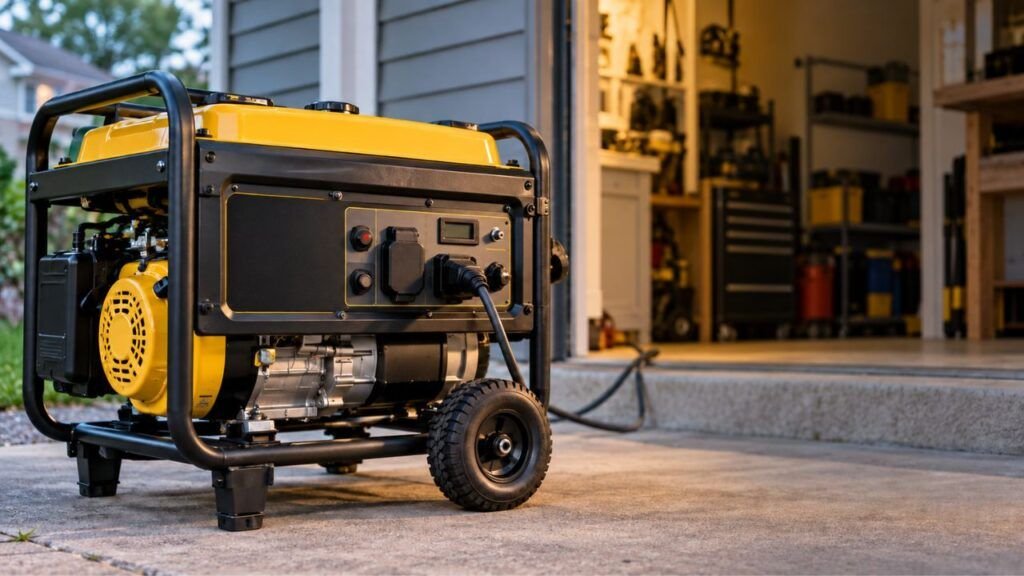
Starting watts are the temporary extra power a generator provides when motor-driven appliances start. Running watts are the continuous power it can supply while appliances operate normally. Your generator needs enough running watts for your total load and enough starting watts for short startup surges.
Knowing both numbers helps you avoid overloads and undersized generators. Below, I’ll explain how each rating works, how to calculate your needs, and how to choose enough generator capacity.
Key Takeaways
- Running watts represent the generator’s continuous usable power output.
- Starting watts provide temporary power for appliance startup surges.
- Refrigerators, pumps, compressors, and air conditioners often need starting watts.
- Add the running watts of appliances operating at the same time.
- Then account for the largest additional startup surge.
- Do not automatically add every appliance’s starting watts together.
- Generator output can change when using propane or natural gas.
- Check voltage and outlet limits along with total generator wattage.
- Use appliance specifications whenever available instead of generic estimates.
Starting Watts vs Running Watts at a Glance
Starting and running watts describe two different generator capabilities. This table shows the main differences before we get deeper into sizing.
| Comparison | Running Watts | Starting Watts |
| Also called | Rated or continuous watts | Surge or peak watts |
| Main purpose | Keeps appliances operating | Helps certain appliances start |
| Duration | Continuous | Temporary |
| Loads affected | Every connected appliance | Mainly motors and compressors |
| Generator use | Normal operating capacity | Short-term maximum capacity |
| Used for sizing | Total simultaneous load | Startup demand |
| Continuous use allowed? | Yes, within generator limits | No |
The biggest mistake is treating these ratings as interchangeable. They tell you two different things about generator performance.
What Are Running Watts on a Generator?
Running watts are the amount of power a generator can continuously provide during normal operation. You may also see them called rated watts or continuous watts.
Suppose a generator produces 5,000 running watts. Your connected appliances should remain within that continuous capacity during operation.
Appliances also have their own running watt requirements. A refrigerator, television, furnace blower, and several lights all contribute to your total continuous load.
For example, imagine your connected appliances require 3,200 running watts altogether. Your generator must continuously provide at least that much usable power.
Running wattage is usually the better number for comparing generator size. It shows how much equipment the generator can actually keep operating.
The larger number printed prominently on a generator is not always running wattage. It may represent its temporary starting or peak capacity instead.
What Are Starting Watts on a Generator?
Starting watts are the temporary extra watts available when certain appliances first switch on. You may also see them called surge watts or peak watts.
Many electrical motors need considerably more power during startup. Once the motor reaches operating speed, its power requirement falls.
A refrigerator is a good everyday example. Its compressor may require a substantial surge when starting. Afterward, it settles into a much lower operating load.
Your generator must absorb that sudden demand without becoming overloaded.
However, starting watts are not continuous usable power. A generator rated for 7,000 starting watts and 5,500 running watts cannot continuously support a 7,000-watt load.
The exact length of a startup surge also varies. Do not assume every appliance or generator holds peak wattage equally long.
Why Do Some Appliances Need More Power When Starting?
Motor-driven appliances behave differently from simple electrical loads. Understanding why makes generator sizing much easier.
Motors Draw More Current at Startup
A motor needs extra electrical energy while beginning to turn. This creates a brief increase in power demand.
Once the motor reaches normal operating speed, its electrical demand usually drops.
You commonly see this behavior with pumps, fans, refrigerators, and power tools.
Compressors Can Create Large Startup Surges
Compressors are another major reason starting wattage matters.
Common examples include:
- Refrigerators
- Freezers
- Window air conditioners
- Central air-conditioning equipment
- Heat pumps
- Air compressors
A compressor may operate comfortably once running but demand much more power when restarting.
That is why a generator can appear large enough on paper yet struggle when an air conditioner or refrigerator cycles back on.
Resistive Loads Usually Have Little Startup Surge
Many heating appliances behave differently.
A basic space heater, toaster, or electric heating element generally does not have the same motor-starting surge.
Its power demand may rise immediately to normal operating wattage instead.
That makes these loads easier to calculate, although their continuous wattage can still be high.
Which Appliances Need Starting Watts?
Motor and compressor loads usually create the largest startup demand. The figures below are only general planning ranges because appliance designs vary considerably.
| Appliance | Typical Running Watts | Possible Starting Watts | Startup Surge? |
| Refrigerator/freezer | 300-800W | 1,000-2,200W | Yes |
| Sump pump | 800-1,500W | 2,000-4,000W+ | High |
| Well pump | 750-2,000W+ | 1,500-5,000W+ | High |
| Furnace blower | 400-800W | 800-1,600W+ | Yes |
| Window air conditioner | 500-1,500W | 1,000-3,000W+ | High |
| RV air conditioner | 1,200-1,800W | 2,500-3,500W+ | High |
| Air compressor | 1,000-2,000W+ | 2,000-5,000W+ | Very high |
| Circular saw | 1,200-1,800W | 2,000-3,000W+ | Yes |
| Microwave | 1,000-1,500W | Often near operating load | Usually low |
| Space heater | 1,500W | Around 1,500W | Usually minimal |
| LED lights | 5-20W each | Near operating load | Minimal |
These numbers should only help with early planning. Always check the appliance label, manual, or manufacturer specifications whenever possible.
Two refrigerators of similar size can have very different startup requirements.
How to Calculate Starting and Running Watts for a Generator
You need to perform two separate checks when sizing a generator. First, calculate the continuous load. Then calculate the highest likely startup demand.
Step 1: List Everything You Want to Run
Start with appliances you actually expect to operate simultaneously.
Your list might include:
- Refrigerator
- Freezer
- Sump pump
- Furnace blower
- Television
- Internet equipment
- Microwave
- Well pump
- Lights
Be realistic instead of listing everything inside your home.
You may not need the microwave, coffee maker, heater, and hair dryer running simultaneously during an outage.
Step 2: Find the Running and Starting Watts
Look at each appliance’s electrical information.
Check the:
- Appliance data label
- Owner’s manual
- Manufacturer specifications
Use those numbers before relying on online wattage charts.
Generic charts cannot account for different motor sizes, compressor designs, or appliance generations.
Step 3: Convert Volts and Amps to Watts When Needed
Sometimes an appliance label gives volts and amps instead of watts.
You can estimate wattage using:
Watts = Volts × Amps
For example:
120 volts × 5 amps = 600 watts
However, this simple formula does not automatically tell you motor starting wattage.
A motor may briefly draw substantially more current during startup.
Step 4: Add All Running Watts
Now add the running wattage of everything operating simultaneously.
Use:
Total Running Watts = Running Watts of All Simultaneous Loads
Suppose your essential equipment totals 3,000 running watts.
Your generator needs enough rated output to continuously carry that load.
Do not compare the 3,000 watts only with the generator’s larger starting-watt number.
Compare it with the generator’s running-watt rating.
Step 5: Calculate the Largest Additional Starting Surge
This is where generator calculations often become confusing.
An appliance’s stated starting wattage may already include its normal running requirement.
For example:
- Running watts: 700W
- Starting watts: 2,100W
The additional startup demand is:
2,100W − 700W = 1,400W additional starting watts
Now use:
Peak Required Watts = Total Running Watts + Largest Additional Starting Surge
This avoids counting the same appliance’s running watts twice.
Another way to calculate the same requirement is:
Largest Appliance Starting Watts + Running Watts of Everything Else
Both approaches can produce the same result when used correctly.
Step 6: Leave Practical Headroom
Avoid choosing a generator that barely matches your calculation.
Real electrical loads can vary during operation. Generator output may also change with operating conditions and fuel choice.
Some appliances may cycle unexpectedly while another motor starts.
Leaving additional capacity gives the generator more room to handle those changes.
You also avoid operating continuously at the absolute limit.
Generator Wattage Calculation Example
A realistic home-outage example makes the calculation easier to understand. Suppose you want to power these essential loads.
| Appliance | Running Watts | Starting Watts | Additional Starting Watts |
| Refrigerator | 700W | 2,100W | 1,400W |
| Sump pump | 800W | 2,200W | 1,400W |
| Furnace blower | 600W | 1,200W | 600W |
| TV | 120W | 120W | 0W |
| LED lights | 100W | 100W | 0W |
First, calculate the continuous load:
700 + 800 + 600 + 120 + 100 = 2,320 running watts
Next, find the largest additional startup surge:
1,400 watts
Now combine them:
2,320 + 1,400 = 3,720 watts
Your expected peak requirement is therefore about 3,720 watts.
You would want a generator with more than 2,320 running watts and enough surge capacity to handle roughly 3,720 watts.
I would not choose a generator matching those figures exactly. Giving yourself additional capacity makes load management easier.
Do You Add All Starting Watts Together?
Usually, you do not need to add every appliance’s full starting wattage together.
Most household motors do not start at exactly the same moment.
Instead, calculate all simultaneous running loads and account for the largest additional startup surge expected while those loads operate.
There is one important exception.
Two large motors can sometimes start together.
Imagine your refrigerator compressor starts just as the sump pump activates. Those surges can overlap briefly.
The same thing could happen with a well pump, furnace blower, freezer, or air-conditioning equipment.
You have several ways to manage this situation.
You can choose a larger generator, control appliance startup manually, or use load-management equipment where appropriate.
Starting large loads one at a time is often the simplest approach with portable generators.
What Do the Watt Numbers on a Generator Actually Mean?
Generator labels can look straightforward while still creating confusion. Before buying, make sure you know exactly what each published number represents.
Do Not Assume the Biggest Number Is Running Watts
A generator might be promoted as a “7,500-watt generator.”
That number could represent starting watts rather than continuous output.
Its actual rating might look more like:
- 7,500 starting watts
- 6,000 running watts
That means 6,000 watts is your continuous power limit.
Always find the running-watt specification before making your decision.
Starting Watt Duration Is Not the Same on Every Generator
Peak output is temporary.
However, manufacturers may define and manage that temporary capacity differently.
A generator should not be selected under the assumption that its peak wattage behaves like extra continuous capacity.
Use the specific generator’s published operating limits.
Fuel Type Can Change Generator Wattage
This matters especially with dual-fuel and tri-fuel generators.
A generator may produce its highest output on gasoline but less on propane.
Natural gas can reduce available output further on some models.
For example, one generator could hypothetically have these ratings:
- Gasoline: 5,000 running watts
- Propane: 4,500 running watts
- Natural gas: 4,000 running watts
If you plan to use natural gas during outages, size the generator using its natural-gas rating.
Do not calculate your home’s needs using gasoline specifications instead.
Starting Watts vs Running Watts: Which Number Matters More?
Both ratings matter, but they answer different questions.
Running watts tell you how much equipment the generator can continuously operate.
Starting watts tell you whether equipment with motors or compressors can successfully start.
For general generator comparison, I usually pay close attention to running watts first.
That number gives you the clearest picture of continuous usable output.
Then check starting watts against refrigerators, pumps, air conditioners, compressors, furnace blowers, and other motor-driven loads.
A generator can have enough continuous power and still fail during startup.
The opposite can happen too.
A generator may have impressive peak wattage but insufficient running capacity for your total continuous load.
You need both numbers to work.
Wattage Is Not the Only Generator Limit
A generator can technically have enough watts and still be unsuitable for your equipment. Check these additional limits before connecting large loads.
- Voltage: A 240V appliance needs a generator capable of supplying the correct 240V output.
- Outlet amperage: Individual generator receptacles have their own current limits.
- Breaker capacity: A circuit breaker can limit available power from one outlet.
- Transfer equipment: Home inlet boxes and transfer switches have electrical limits too.
- Fuel choice: Propane and natural gas may produce lower wattage on some generators.
- Surge capability: Not every generator handles the same startup surge equally.
- Load distribution: A generator’s total wattage does not mean every outlet can deliver that entire amount.
This becomes especially important with well pumps, central HVAC equipment, larger RV loads, and home transfer-switch installations.
What Happens If Starting Watts Are Too High?
Insufficient surge capacity usually becomes obvious when a large appliance tries starting.
You may notice:
- The generator engine suddenly bogging down
- An overload indicator turning on
- A generator breaker tripping
- Temporary voltage drops
- A compressor or motor failing to start
- Generator output shutting down
- Other connected equipment briefly losing power
If this repeatedly happens when one particular appliance starts, that appliance’s surge requirement deserves attention.
Do not simply keep resetting the breaker and trying again.
Check the appliance requirement and your generator’s actual surge rating first.
What Happens If You Exceed Running Watts?
Exceeding running wattage is different from experiencing a short startup surge.
Running watts represent the load your generator must continuously carry.
If your connected equipment continually demands more than the generator’s rated capacity, overload protection may activate.
You could experience breaker trips, unstable operation, excessive generator load, or shutdown.
The solution is normally straightforward.
Turn off unnecessary equipment or use a larger generator.
Remember that starting watts are not reserve power you can continuously borrow.
A generator rated for 6,500 running watts and 8,000 starting watts should not operate continuously at 7,500 watts.
Its sustainable limit remains around the stated 6,500 running watts.
How to Reduce Starting Watt Demand
You can often operate more effectively without immediately buying a larger generator. Better load management can reduce overlapping startup surges.
- Start large appliances one at a time.
- Connect the largest motor-driven load before smaller equipment.
- Wait for one appliance to stabilize before starting another.
- Turn off unnecessary loads before starting a large motor.
- Avoid restoring every backed-up circuit simultaneously.
- Consider compatible soft-start equipment for certain air conditioners.
- Use proper load-management systems with larger backup installations.
- Check appliance specifications before assuming its startup demand.
Staggering appliances can make a noticeable difference.
For example, let the sump pump finish before intentionally starting another large motor whenever possible.
Common Starting-Watts and Running-Watts Mistakes
Most generator-sizing problems come from a few predictable mistakes. Avoiding them makes your wattage calculation considerably more reliable.
- Buying based only on the largest advertised number: That number may represent temporary starting watts.
- Ignoring running watts: Continuous loads must remain within rated output.
- Adding every starting watt together: Those appliances may never start simultaneously.
- Double-counting startup demand: Full starting watts may already include normal running watts.
- Assuming every motor needs exactly twice its running wattage: Startup requirements vary significantly.
- Treating generic wattage charts as exact: Actual appliances can differ substantially.
- Ignoring simultaneous motor starts: Some startup surges can overlap.
- Ignoring 240V requirements: Sufficient wattage does not guarantee proper voltage.
- Ignoring individual outlet limits: One receptacle cannot necessarily supply the generator’s total output.
- Using gasoline ratings for propane operation: Fuel type can affect available power.
- Using gasoline ratings for natural gas: The difference may be even larger.
- Treating peak watts as continuous watts: Surge capacity is only temporary.
Final Words
The difference between starting watts and running watts becomes simple once you separate continuous demand from startup demand.
Add the running watts of everything you expect to operate together. Then account for the largest additional startup surge likely to occur.
Remember this basic formula:
Required Running Watts = Total Simultaneous Running Watts
Required Peak Watts = Total Running Watts + Largest Additional Starting Surge
That calculation gives you a much more useful starting point than simply choosing the generator with the biggest number on its box.
Finally, verify appliance specifications and generator ratings before buying. A little extra checking now can prevent overload problems when the power actually goes out.
Related FAQs
Are Starting Watts the Same as Surge Watts?
Yes, starting watts and surge watts usually describe the generator’s temporary extra output for starting motor-driven equipment. Some manufacturers also use terms such as peak watts, so check how your specific generator defines its ratings.
Are Running Watts the Same as Rated Watts?
Usually, yes. Running watts and rated watts normally refer to the generator’s continuous usable power output. You may also see manufacturers call this continuous wattage or rated output.
Do You Add Starting Watts and Running Watts Together?
Do not automatically add an appliance’s full starting watts to your total running watts. Instead, calculate its additional startup demand by subtracting its running watts from its starting watts, then add the largest relevant additional surge to your combined running load.
How Long Does a Generator Provide Starting Watts?
Starting wattage is available only temporarily while a motor or compressor starts. The exact duration depends on the generator and connected load, so check the manufacturer’s specifications rather than assuming one fixed number.
Do All Appliances Have Starting Watts?
No. Appliances containing motors and compressors generally have the most noticeable startup surge. Basic resistive loads, such as many electric heaters, typically start much closer to their normal operating wattage.
Does a Refrigerator Need Starting Watts?
Yes, most refrigerators need extra startup power when the compressor switches on. The compressor cycles throughout normal operation, so your generator must handle that surge even after the refrigerator has already been running for hours.
Do Inverter Generators Have Starting Watts?
Yes. Inverter generators normally have both continuous and surge output limits. Their exact starting capability varies by model, so compare both ratings against the appliances you plan to operate.
Can Propane or Natural Gas Change Starting and Running Watts?
Yes. Many dual-fuel and tri-fuel generators produce different output levels depending on fuel type. Gasoline often provides the highest rating, while propane or natural gas may reduce available starting and running wattage.
Can a Generator Run Continuously at Its Starting Watt Rating?
No. Starting wattage represents temporary surge capacity, not continuous power. Your sustained electrical load should stay within the generator’s published running or rated wattage.
Should I Use Starting Watts or Running Watts When Buying a Generator?
Use both. Your total continuous appliance load must fit within the generator’s running-watt capacity, while the largest expected startup demand must remain within its starting-watt capability.

Brian Walker writes straightforward generator guides and reviews for homeowners and everyday users. His content focuses on solar, portable, and fuel-powered generators, with practical advice on choosing, using, and maintaining reliable backup power.















