
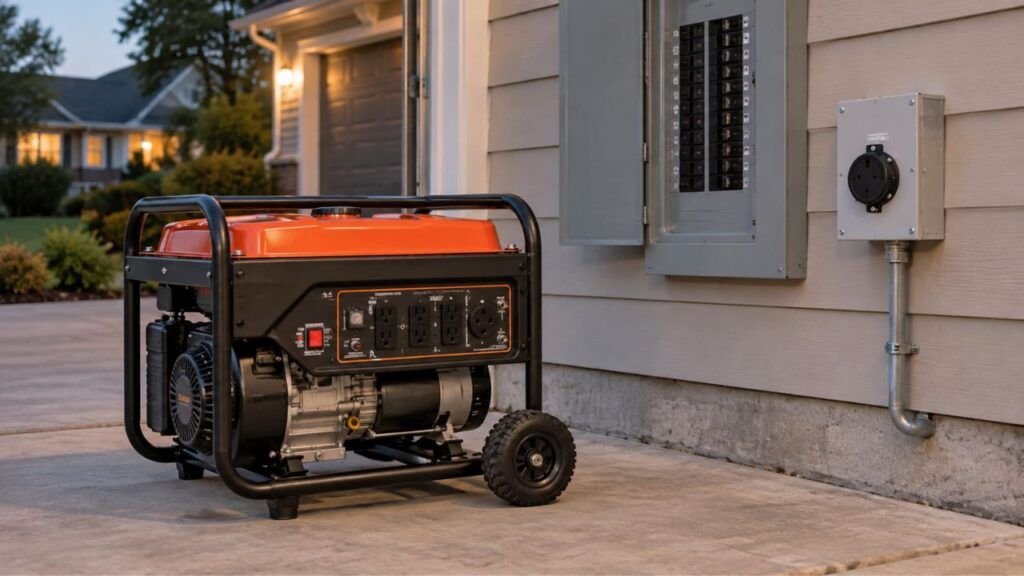
You do not need a transfer switch if you only plug appliances directly into a portable generator. However, you need approved transfer equipment when connecting generator power to your home’s electrical panel or household wiring.
In this guide, I’ll explain when a transfer switch is necessary. We’ll also cover interlock kits, hardwired appliances, sizing, safety, and installation.
Key Takeaways
- You can run plug-in appliances without using a transfer switch.
- Connecting a generator to household wiring requires approved transfer equipment.
- A compatible interlock kit may replace a manual transfer switch.
- Standby generators normally use an automatic transfer switch.
- Generator wattage alone does not determine transfer switch requirements.
- Never backfeed generator power through a regular household receptacle.
- Transfer equipment must match your generator and electrical system.
- Local electrical codes and permit requirements can affect installation.
Do I Need a Transfer Switch? Quick Answer
The answer depends mainly on how you use your generator. Running appliances directly is different from powering your home’s electrical circuits.
| Generator Setup | Do You Need Transfer Equipment? | Recommended Method |
| Portable generator powering appliances directly | No | Properly rated extension cords |
| Portable generator connected to breaker panel | Yes | Transfer switch or approved interlock |
| Generator powering a hardwired furnace | Yes | Approved transfer equipment |
| Generator powering a hardwired well pump | Yes | Approved transfer equipment |
| Generator powering household lighting circuits | Yes | Transfer switch or interlock |
| Permanent standby generator | Yes | Usually an automatic transfer switch |
| Generator powering isolated standalone equipment | Usually no | Direct generator connection |
Here’s the simplest way I like to explain it.
If electricity stays between your generator and the connected appliance, you usually don’t need a transfer switch.
Once generator electricity enters your home’s permanent wiring, proper transfer equipment becomes necessary.
That equipment keeps generator power separated from utility power.
What Does a Generator Transfer Switch Actually Do?
A generator transfer switch controls where your home’s electricity comes from. It allows selected circuits to receive utility power or generator power.
During normal conditions, your home receives electricity from the utility grid.
During an outage, the transfer equipment disconnects that utility source. Your generator can then supply the appropriate household circuits.
The important part is electrical isolation between the two sources.
Without proper isolation, generator electricity could travel backward toward utility lines. This dangerous condition is commonly called backfeeding.
A transfer switch does not increase your generator’s output. It also does not create additional voltage or battery capacity.
It is not a surge protector or voltage regulator either.
Its main job is safely controlling which power source supplies your home.
Why Do You Need Transfer Equipment When Connecting a Generator to Your House?
Connecting a generator to household wiring creates several important safety considerations. Proper transfer equipment controls that connection and keeps both sources separated.
It Prevents Dangerous Backfeeding
Backfeeding happens when generator electricity flows backward through your home’s wiring.
That power may eventually reach utility equipment outside your property.
Utility crews may believe nearby power lines are de-energized during repairs. Generator backfeeding can unexpectedly energize those lines and create electrocution hazards.
This is why you should never improvise a panel connection.
A proper transfer switch or approved interlock prevents both sources operating together.
It Keeps Utility and Generator Power Separated
Your home normally receives power through the main utility service.
During generator operation, that utility connection must remain properly isolated.
A transfer system creates a controlled method for changing power sources.
When utility power returns, the system lets you safely switch back.
This protects your electrical system and prevents an unintended connection between sources.
It Lets You Power Hardwired Equipment
Extension cords work well for ordinary plug-in appliances.
However, many important household systems do not have standard plugs.
Examples include:
- Hardwired furnace equipment
- Certain well pumps
- Hardwired lighting circuits
- Some water heaters
- Central HVAC equipment
- Other permanently wired appliances
Transfer equipment allows these circuits to receive generator power properly.
Your generator still needs enough capacity to operate each connected load.
It Makes Circuit Management Easier
Running several extension cords during every outage becomes inconvenient quickly.
A transfer setup lets you use your home’s existing circuits instead.
You might power the refrigerator, furnace, lights, and essential outlets.
You can then control those loads through your normal breaker panel.
However, remember one important limitation.
A transfer switch does not mean your generator can run everything.
You still need to manage total running and starting wattage.
Can You Run a Portable Generator Without a Transfer Switch?
Yes. You can safely operate many portable generators without a transfer switch. The generator simply needs to remain separate from your home’s permanent electrical wiring.
You can:
- Plug compatible appliances directly into generator receptacles.
- Use properly rated outdoor extension cords.
- Keep total electrical demand within generator capacity.
- Use separate cords for appliances with larger electrical loads.
- Keep the generator outdoors during operation.
- Follow your generator manufacturer’s operating instructions.
You should not connect generator power into household receptacles.
And, you also should not improvise a connection into your breaker panel.
That means no homemade backfeed cords or similar shortcuts.
If you only need a refrigerator, freezer, lamp, or television, extension cords may be enough.
For several household circuits, transfer equipment becomes much more practical.
Does Generator Wattage Determine Whether You Need a Transfer Switch?
No. Generator wattage alone does not determine whether you need one.
You may sometimes see claims that generators above 5,000 watts automatically require transfer switches.
That is an oversimplification.
What matters most is where the electricity goes.
Imagine you own a 7,500-watt portable generator.
If you connect appliances directly using appropriate cords, the generator remains separate from household wiring. A transfer switch is not automatically required simply because the generator exceeds 5,000 watts.
Now imagine a smaller generator connected to household circuits.
That installation still needs an approved method of isolating generator power from utility power.
Larger portable generators often include 120/240V outlets for home backup connections.
That is one reason certain wattage numbers appear frequently online.
However, don’t choose your safety equipment based only on wattage.
Base your decision on the connection method and electrical configuration.
Transfer Switch vs Interlock Kit: Do You Have to Use a Transfer Switch?
A traditional transfer switch is not always your only option. Some homes can use an approved breaker interlock system instead.
| Feature | Manual Transfer Switch | Breaker Interlock Kit |
| Prevents utility-generator connection | Yes | Yes, when correctly installed |
| Common with portable generators | Yes | Yes |
| Uses existing main panel | Sometimes | Yes |
| Circuit flexibility | Usually limited to selected circuits | Usually higher |
| Manual operation | Yes | Yes |
| Panel compatibility important | Yes | Extremely important |
| Typical equipment cost | Higher | Usually lower |
| Suitable for automatic standby operation | No | No |
| Professional installation recommended | Yes | Yes |
An interlock kit uses a mechanical arrangement on your breaker panel.
It prevents the generator breaker and main utility breaker operating simultaneously.
This allows generator power to enter the panel while utility power remains disconnected.
One advantage is circuit flexibility.
You can often choose different breakers depending on your immediate needs.
However, total generator capacity still limits what you can operate.
An interlock should also be designed and approved for your specific panel.
Do not buy a random metal interlock simply because it appears to fit.
Your electrician can determine whether your panel supports this option.
Manual vs Automatic Transfer Switch: Which One Do You Need?
Manual and automatic switches perform similar safety functions. The main difference is how the change between power sources happens.
Manual Transfer Switch for Portable Generators
Manual transfer switches commonly pair with portable generators.
When an outage occurs, you start the generator yourself.
You then connect the generator through the approved inlet arrangement.
After that, you manually move selected circuits to generator power.
When utility electricity returns, you reverse the process safely.
This setup works well when you are home during outages.
Automatic Transfer Switch for Standby Generators
Permanent standby generators normally use automatic transfer switches, commonly called ATS units.
The system monitors incoming utility power.
When an outage occurs, the standby generator starts automatically.
The transfer switch then isolates utility power and transfers the home’s load.
When normal electricity returns, the system switches back automatically.
The generator then shuts down after its programmed process completes.
This automatic operation is one major advantage of standby generators.
Whole-Panel vs Selected-Circuit Transfer Equipment
Not every transfer setup powers the same part of your home.
Some systems supply only designated essential circuits.
For example, you might choose:
- Refrigerator
- Furnace
- Well pump
- Kitchen outlets
- Lighting
- Internet equipment
Other systems can feed your main breaker panel.
That provides more flexibility over which circuits receive generator power.
However, panel access does not increase generator capacity.
You may still need to turn large loads off manually.
Some standby systems also use automatic load-management equipment.
What Can You Power With and Without a Transfer Switch?
What you can operate depends on how the appliance connects. Hardwired appliances generally require access through your home’s electrical system.
| Home Load | Direct Generator Connection | Through Transfer Equipment |
| Refrigerator | Yes | Yes |
| Freezer | Yes | Yes |
| Television | Yes | Yes |
| Internet router | Yes | Yes |
| Table lamp | Yes | Yes |
| Plug-in sump pump | Yes | Yes |
| Hardwired furnace | Usually no | Yes |
| Hardwired well pump | Usually no | Yes |
| Hardwired lighting | No | Yes |
| Household wall outlets | No | Yes |
| Central air conditioner | No direct cord connection | Potentially |
| Electric water heater | Usually no | Potentially |
Notice that I used potentially for several large appliances.
That’s important.
A transfer switch makes the electrical connection possible.
It does not guarantee your generator can handle that appliance.
Central air conditioners and electric water heaters can require substantial power.
Always compare appliance demand with generator capacity before operating them.
How Do I Choose the Right Transfer Setup for My Generator?
Choosing transfer equipment requires more than matching one wattage number. Your generator, loads, panel, voltage, and grounding arrangement all matter.
Decide Which Appliances and Circuits You Actually Need
Start by making a realistic outage plan.
Ask yourself what truly needs electricity during a blackout.
For many homes, essential loads include:
- Refrigerator
- Freezer
- Furnace
- Well pump
- Sump pump
- Several lights
- Internet equipment
- Selected receptacles
You may discover that you don’t need whole-house generator coverage.
Prioritizing essential loads can reduce required generator capacity.
It can also make your backup setup easier to manage.
Check Whether You Need 120V, 240V, or Both
This part is easy to overlook.
Many household appliances use standard 120V power.
Other equipment may require 240V.
Examples can include:
- Well pumps
- Central air conditioners
- Electric water heaters
- Electric ranges
- Electric dryers
A 120V-only generator cannot suddenly produce 240V through a transfer switch.
Your generator needs the correct output configuration first.
Check the appliance requirements and generator specifications carefully.
Match the Generator Connection and Amperage
Portable home-backup generators commonly use higher-capacity generator outlets.
Depending on the model, you may see 30-amp or 50-amp connections.
The inlet, cable, breaker, and transfer equipment must work together properly.
A larger connector also does not create additional generator capacity.
The generator’s rated output remains the limiting factor.
Check Transfer Equipment and Panel Compatibility
Electrical panels are not universally interchangeable.
Breakers, interlocks, transfer devices, and related hardware have specific compatibility requirements.
This becomes especially important with interlock kits.
The correct equipment should match your panel and installation.
A licensed electrician can confirm the proper combination.
Check Generator Neutral and Grounding Compatibility
This is one area where generator installations become more technical.
Portable generators may use different neutral configurations.
Some have a bonded neutral, while others use a floating neutral.
Transfer equipment can also handle the neutral differently.
Certain systems switch the neutral, while others leave it connected.
That configuration affects grounding and system behavior.
You should not change generator bonding arrangements through guesswork.
Have a qualified electrician verify:
- Generator manufacturer’s instructions
- Transfer equipment requirements
- Neutral configuration
- Grounding arrangement
- Local electrical requirements
This prevents subtle installation problems that may not be obvious.
Check Local Permit and Inspection Requirements
Electrical requirements vary by location across the United States.
Your state or municipality may require permits and inspections.
The local Authority Having Jurisdiction, or AHJ, determines what is accepted locally.
An electrician familiar with your area can handle these requirements.
This is another reason professional installation is worth considering.
What Does the NEC Say About Generator Transfer Equipment?
The National Electrical Code addresses optional standby systems used for backup power. The main safety principle is preventing unintended connections between separate power sources.
When an optional standby generator connects to premises wiring, approved transfer or interconnection equipment must prevent generator power and utility power from being inadvertently connected together.
That does not mean every portable generator requires a transfer switch.
If a generator powers independent appliances through extension cords, those appliances are not being supplied through your home’s normal premises wiring.
The situation changes when generator electricity enters the home’s electrical distribution system.
That’s when proper transfer or interconnection equipment becomes essential.
Local code adoption can vary between jurisdictions.
Your municipality may also have additional permit or inspection requirements.
For that reason, your electrician and local AHJ should confirm compliance.
What Happens If You Connect a Generator to Your Panel Without Proper Transfer Equipment?
Improvised panel connections can create serious electrical hazards. Proper transfer equipment exists specifically to prevent these unsafe conditions.
Possible problems include:
- Generator electricity backfeeding onto utility conductors.
- Utility workers encountering unexpectedly energized power lines.
- Shock hazards around electrical equipment.
- Electrical fires caused by improper connections.
- Damage to household appliances or generator equipment.
- Code violations or failed electrical inspections.
- Unsafe interaction when utility power returns.
Simply remembering to turn the main breaker off is not the same thing.
Approved equipment creates a physical or electrical means of source isolation.
That removes reliance on memory during stressful outage conditions.
Can I Plug My Generator Into a Dryer Outlet Instead?
No. You should not plug a portable generator into a dryer outlet or ordinary household receptacle to energize your home.
That practice is commonly called backfeeding.
It bypasses the proper transfer equipment designed for generator connections.
Some homemade setups use cords with male plugs on both ends.
These arrangements can expose energized metal prongs and create electrocution hazards.
They can also energize household wiring in unintended ways.
Turning off the main breaker manually does not make such a setup appropriate.
If you want generator power through your breaker panel, install proper equipment.
That normally means a generator inlet combined with approved transfer equipment.
How Much Does a Generator Transfer Switch Cost?
Installation prices vary significantly across the United States. Equipment type, panel condition, labor, amperage, and permits all affect the total.
| Transfer Setup | Relative Cost | Common Application |
| Panel interlock | Lowest | Portable generator |
| Manual transfer switch | Moderate | Portable generator |
| Whole-panel manual transfer equipment | Moderate to high | Larger portable generator |
| Automatic transfer switch | Higher | Standby generator |
A simple interlock arrangement is usually less expensive.
Manual transfer switches generally cost more because additional equipment is involved.
Automatic transfer equipment can cost considerably more.
The final price may increase when an electrician must:
- Replace outdated panel equipment
- Run a long generator inlet circuit
- Upgrade electrical components
- Install larger-amperage equipment
- Complete permit requirements
- Perform additional service work
Instead of choosing only by price, compare the complete installation.
The cheapest option is not useful if it doesn’t match your panel.
Can You Install a Generator Transfer Switch Yourself?
Working inside a home’s electrical panel can expose you to dangerous voltage. I recommend having generator transfer equipment installed by a qualified electrician.
The electrician should verify:
- Generator voltage
- Generator rated output
- Generator receptacle type
- Transfer equipment amperage
- Panel compatibility
- Neutral configuration
- Grounding requirements
- Breaker sizing
- Generator inlet requirements
- Essential load demand
- Permit requirements
- Local inspection requirements
Correct installation matters even when the hardware looks simple.
An interlock, for example, may appear like a basic metal plate.
Its safety depends on proper panel compatibility and installation.
A transfer switch also needs correct conductor and system configuration.
This is one area where professional installation provides real value.
A Transfer Switch Does Not Make Indoor Generator Use Safe
A transfer switch makes the electrical connection safer. It does not eliminate carbon monoxide dangers from a fuel-burning generator.
Remember these basic rules:
- Never operate a portable generator inside your home or garage.
- Keep the generator at least 20 feet from your home.
- Point generator exhaust away from windows, doors, and vents.
A garage with the door open is still not safe.
Carbon monoxide can accumulate or enter your living space unexpectedly.
Follow the generator manufacturer’s placement and operating instructions as well.
Final Verdict
You do not automatically need a transfer switch simply because you own a generator.
If your portable generator only powers appliances connected directly with proper extension cords, you can operate without one.
However, the answer changes when generator electricity enters your home’s electrical system.
If you want to power breaker-panel circuits, hardwired appliances, built-in lighting, or normal household receptacles, you need approved equipment that prevents generator and utility power from being connected together.
That equipment may be a manual transfer switch, automatic transfer switch, or compatible interlock system.
The most important thing to remember is simple.
Don’t base the decision only on generator wattage. Base it on how the generator connects to your home.
Related FAQs
Can I Run a Generator Without a Transfer Switch?
Yes. You can run a portable generator without a transfer switch when appliances connect directly to the generator using properly rated cords and the generator remains separate from your home’s electrical wiring.
Do Portable Generators Need a Transfer Switch?
Not always. A portable generator needs approved transfer equipment when you connect it to household circuits or the breaker panel, but direct appliance connections normally do not require one.
Does a 5,000-Watt Generator Need a Transfer Switch?
Not automatically. A 5,000-watt generator can power appliances directly without one, but connecting it to your home’s electrical system requires approved transfer or interconnection equipment.
Does a 30-Amp Generator Need a Transfer Switch?
A 30-amp rating alone does not determine the requirement. You need transfer equipment when using that generator connection to supply circuits through your home’s electrical system.
Does a 50-Amp Generator Need a Transfer Switch?
Not because it is 50 amps specifically. However, a 50-amp generator commonly powers household circuits, and that type of installation requires proper transfer or interlock equipment.
Is an Interlock Kit as Safe as a Transfer Switch?
A correctly selected and properly installed approved interlock can provide safe source isolation for suitable installations. It must match your electrical panel and meet local requirements.
Can I Connect a Generator Directly to My Breaker Panel?
You should only connect generator power to a breaker panel through approved transfer or interconnection equipment. Never make an improvised direct connection to the panel.
Can I Plug a Generator Into a Wall or Dryer Outlet?
No. Plugging a generator into a wall or dryer outlet can backfeed household wiring and utility lines. Use a proper generator inlet and approved transfer equipment instead.
Do I Need a Transfer Switch for a Standby Generator?
Yes. A permanent standby generator requires transfer equipment because it connects directly to your home’s electrical system. Most residential standby installations use an automatic transfer switch.
Can a Transfer Switch Run My Whole House?
A transfer switch can provide generator power to a whole-panel arrangement, but your generator must still have enough capacity for the loads you operate during the outage.
Do I Need a Permit for a Generator Transfer Switch?
Many U.S. jurisdictions require permits or electrical inspections for transfer switch installations. Requirements vary locally, so check with your electrician or local building authority.
What Size Transfer Switch Do I Need for My Generator?
The correct size depends on your generator output, electrical service, connection amperage, selected loads, voltage, and installation design. A qualified electrician can properly size the equipment.

Brian Walker writes straightforward generator guides and reviews for homeowners and everyday users. His content focuses on solar, portable, and fuel-powered generators, with practical advice on choosing, using, and maintaining reliable backup power.















