
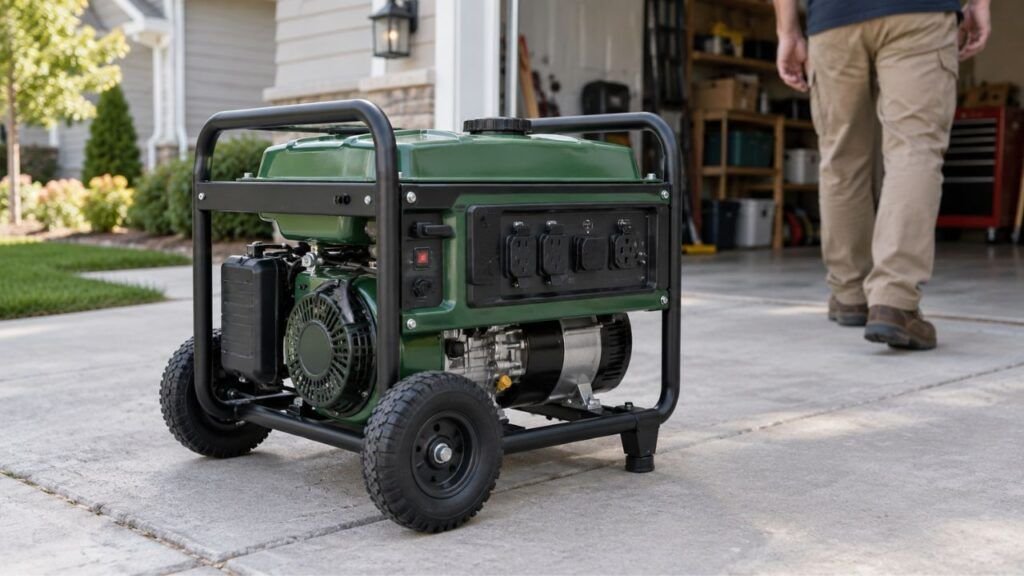
A transfer switch ready generator has an electrical output designed for connection to compatible transfer equipment. On portable generators, this usually means a suitable 30-amp or 50-amp receptacle. However, it does not necessarily mean the generator includes a transfer switch or automatic-start controls.
That distinction can become confusing when you’re planning home backup power. So, I’ll explain what transfer switch ready really means, how the connection works, what equipment you still need, and what to check before connecting a generator to your home.
Key Takeaways
- Transfer switch ready means the generator can support compatible transfer equipment.
- The actual transfer switch is normally purchased and installed separately.
- Transfer switch ready does not automatically mean automatic generator starting.
- Common connections include 30-amp and 50-amp generator receptacles.
- Generator voltage and receptacle type must match your backup system.
- Proper transfer equipment prevents dangerous backfeeding into utility power lines.
- The label does not determine how much of your house you can power.
What Does Transfer Switch Ready Mean on a Generator?
When manufacturers call a generator transfer switch ready, they’re telling you the generator has an electrical connection suitable for supplying compatible home transfer equipment.
Think about it as a connection feature rather than complete automation.
Instead of running several extension cords into your house, you can potentially connect the generator to an approved home backup setup. Generator power can then reach selected circuits through your electrical panel.
A typical setup may look something like this:
Generator → Generator Cord → Power Inlet → Transfer Equipment → Electrical Panel
However, the exact arrangement depends on your generator and electrical system.
Many portable generators use a 120/240-volt, 30-amp L14-30R receptacle. Larger units may include a 50-amp 14-50R connection instead.
Some transfer-switch-ready generators use different outlet configurations. Therefore, you should never assume the phrase describes one universal connection standard.
The owner’s manual and generator control panel provide the specifications that matter.
What Transfer Switch Ready Does Not Mean
The word “ready” can make the generator sound more complete than it actually is. Knowing what isn’t included can prevent expensive compatibility problems.
- It does not mean a transfer switch is built in.
- It does not mean a transfer switch comes with the generator.
- It does not guarantee automatic generator starting.
- It does not guarantee compatibility with every transfer switch.
- It does not mean the generator can power your entire house.
- It does not eliminate the need for proper electrical installation.
- It does not mean you can safely backfeed a household receptacle.
- It does not automatically mean the generator provides 240 volts.
The safest approach is simple. Treat “transfer switch ready” as a starting point, not a complete installation.
Transfer Switch Ready vs ATS Ready
These two terms sound similar, but they describe different capabilities. This distinction becomes particularly important when you want automatic backup power.
What Transfer Switch Ready Means
Transfer switch ready normally refers to the generator’s power connection capability.
For example, a portable generator may provide a 30-amp or 50-amp receptacle intended for connecting transfer equipment.
You may still need to:
- Start the generator manually.
- Connect or verify the generator cord.
- Operate a manual transfer switch.
- Select which circuits receive generator power.
- Shut the generator down after utility power returns.
That setup can still provide excellent home backup power.
It simply isn’t automatic.
What ATS Ready Means
ATS means automatic transfer switch.
An automatic system monitors utility power and changes power sources when necessary. Compatible systems may also start and stop the generator automatically.
That requires more than a high-amperage electrical receptacle.
The setup may require:
- Automatic-start circuitry
- Low-voltage control wiring
- A dedicated communication connection
- Utility power monitoring
- Generator battery support
- Compatible automatic transfer equipment
Portable generators do not automatically provide those functions just because they’re transfer switch ready.
Transfer Switch Ready vs Automatic Transfer Ready
| Feature | Transfer Switch Ready | ATS/Automatic-Ready System |
| Home backup connection | Usually supported | Supported |
| Transfer switch included | Usually no | Depends on system |
| Automatic generator start | Usually no | Often available |
| Utility outage detection | Usually no | Yes |
| Control wiring required | Not always | Usually |
| Manual operation | Usually required | Reduced or eliminated |
| Common on portable generators | Yes | Less common |
| Standby-style operation | Limited | Possible |
If you want fully automatic backup power, check for automatic-start compatibility specifically. Don’t rely only on a “transfer switch ready” label.
What Outlet Makes a Generator Transfer Switch Ready?
There isn’t one outlet that defines every transfer-switch-ready generator. Manufacturers use several receptacle configurations depending on generator capacity and voltage.
| Receptacle | Typical Rating | Voltage | Common Application |
| NEMA L14-30R | 30 amps | 120/240V | Portable generator home backup |
| NEMA 14-50R | 50 amps | 120/240V | Larger portable generators |
| NEMA L5-30R | 30 amps | 120V | Certain 120V transfer systems |
| NEMA 5-20R | 20 amps | 120V | Individual plug-in appliances |
The L14-30R is particularly common on mid-sized portable generators.
It provides four conductors for 120/240-volt service when the generator supports that output. You’ll often see it labeled as a 30-amp locking receptacle.
Larger generators frequently include a 14-50R 50-amp outlet.
However, don’t assume a 50-amp receptacle means your generator continuously produces 12,000 watts. The generator’s rated running wattage still determines its usable output.
The receptacle is only one part of the system.
How Does a Transfer Switch Work With a Portable Generator?
A transfer setup creates a controlled path between the generator and your home. More importantly, it keeps generator power separated from utility power.
1. The Generator Produces Backup Electricity
You operate the portable generator outdoors in an appropriate location.
The generator then produces electricity through its available receptacles.
For a home connection, you’ll normally use the high-amperage receptacle intended for the backup system.
2. A Generator Cord Carries the Power
A properly rated generator cord connects the generator to your home’s power inlet or transfer equipment.
The cord must match the required:
- Voltage
- Amperage
- Plug configuration
- Inlet configuration
Avoid choosing a cord simply because the plugs appear similar.
3. Power Enters Through the Backup Connection
Many installations use an outdoor power inlet box.
That inlet provides a convenient connection point while keeping the portable generator outside.
Wiring behind the inlet carries generator power toward the transfer equipment.
4. The Transfer Equipment Separates Utility Power
This is the most important part.
Proper transfer equipment prevents generator power from feeding back toward the utility grid.
Without that isolation, electricity can travel beyond your house and create a serious electrocution hazard for utility workers.
It can also damage electrical equipment when utility service returns.
5. Generator Power Feeds Your Selected Circuits
After transferring to generator power, selected household circuits can operate from your generator.
Depending on generator capacity, that might include:
- Refrigerator
- Freezer
- Furnace blower
- Sump pump
- Well pump
- Lighting
- Internet equipment
- Selected wall outlets
You still need to manage the total electrical load carefully.
Why Is a Transfer Switch Important?
A transfer switch does much more than make generator operation convenient. It creates a controlled and safer way to supply household circuits.
- Prevents backfeeding: Generator electricity cannot improperly energize utility lines.
- Separates power sources: Utility and generator power stay properly isolated.
- Powers hardwired equipment: Furnaces and pumps can receive backup power.
- Reduces extension cords: You can operate circuits through your electrical panel.
- Simplifies load management: Selected circuits can be controlled from one location.
- Creates a cleaner setup: You avoid cords running throughout your home.
For many homeowners, powering hardwired equipment is the biggest advantage.
You cannot simply plug a furnace or well pump into an extension cord. A properly designed panel-connected backup system solves that problem.
Does Transfer Switch Ready Mean the Generator Can Power Your Whole House?
No. Transfer switch ready does not mean whole-house capable.
The label describes how the generator can connect to compatible equipment. It doesn’t tell you how much electrical load the generator can handle.
Whole-house capability depends on several factors:
- Generator running watts
- Generator starting watts
- 120V versus 120/240V output
- Maximum available amperage
- Appliance starting loads
- Transfer equipment capacity
- Your home’s total demand
For example, imagine you have a 5,000-watt transfer-switch-ready generator.
It might comfortably support your refrigerator, furnace blower, lights, television, internet equipment, and several outlets.
That same generator probably cannot operate everything simultaneously.
Your electric water heater, range, dryer, central air conditioner, and other large loads could quickly exceed available power.
A transfer connection gives you access to household circuits. Generator capacity determines how many you can actually use.
How Can You Tell If Your Generator Is Transfer Switch Ready?
Before buying equipment, check the actual generator specifications. A few minutes of verification can prevent mismatched components later.
Check the Generator Control Panel
Look closely at the larger receptacles.
Common labels include:
- L14-30R
- 14-50R
- 120/240V
- 30A
- 50A
- Transfer Switch Ready
Don’t focus only on the marketing label.
The receptacle specifications tell you much more about compatibility.
Read the Owner’s Manual
Your owner’s manual should provide the generator’s voltage, amperage, receptacle types, grounding information, and connection requirements.
It may also identify compatible accessories or transfer equipment.
Follow the generator manufacturer’s instructions before buying additional equipment.
Confirm the Generator Voltage
Many home backup installations use 120/240-volt generator output.
This allows the system to support both 120V circuits and compatible 240V loads.
However, some transfer-switch-ready generators only produce 120 volts.
That’s why the phrase alone doesn’t guarantee 240V capability.
Confirm the Available Amperage
A 30-amp connection and 50-amp connection require different equipment.
Your:
- Generator outlet
- Generator cord
- Power inlet
- Wiring
- Breaker
- Transfer equipment
must work together correctly.
Check the Neutral Configuration
You may see generators described as having either a bonded neutral or floating neutral.
This detail can affect transfer equipment compatibility.
Certain electrical systems switch the neutral conductor while others don’t. The correct setup depends on the generator and transfer equipment design.
I wouldn’t recommend changing a generator’s neutral connection yourself.
Have a qualified electrician verify the arrangement when connecting the generator to home wiring.
What Do You Still Need With a Transfer-Switch-Ready Generator?
The generator is only one part of a complete home backup system. Your exact equipment depends on the generator and electrical panel.
You may need:
- Compatible transfer equipment
- Correct generator power cord
- Exterior power inlet box
- Appropriate wiring
- Proper circuit protection
- Correctly sized breakers
- Compatible grounding and neutral arrangement
- Required permits or inspections
- Professional electrical installation
In other words, transfer switch ready means connection capable, not installation complete.
Manual Transfer Switch vs Automatic Transfer Switch
Both systems separate generator power from utility power. The main difference is how much work happens automatically.
Manual Transfer Switch
A manual transfer switch requires you to control the changeover.
During an outage, you generally:
- Place the generator safely outdoors.
- Start the generator.
- Connect or verify the generator connection.
- Transfer the selected circuits.
- Manage electrical loads.
- Transfer back after utility power returns.
It’s straightforward and commonly paired with portable generators.
Automatic Transfer Switch
An automatic transfer switch monitors the normal utility supply.
When utility power fails, the ATS transfers the electrical load to a backup source.
With a properly compatible generator, the system may also command the generator to start automatically.
When utility power returns, the system can transfer back and shut down the generator.
That’s much closer to traditional standby-generator operation.
| Feature | Manual Transfer Switch | Automatic Transfer Switch |
| User involvement | High | Low |
| Portable generator use | Very common | Less common |
| Detects utility outage | No | Yes |
| Generator starts automatically | No | Possible |
| System complexity | Lower | Higher |
| Typical cost | Lower | Higher |
Don’t assume any portable generator supports automatic operation.
Check the manufacturer’s specifications first.
Transfer Switch vs Interlock Kit
A transfer switch isn’t the only approved approach used for portable generators. Some homes use a properly designed generator interlock instead.
| Feature | Transfer Switch | Interlock Kit |
| Uses home electrical panel | Yes | Yes |
| Prevents simultaneous utility/generator connection | Yes | Yes, when properly installed |
| Circuit selection | Often predetermined | Controlled using panel breakers |
| Works with every panel | No | No |
| Installation required | Yes | Yes |
| Typical cost | Usually higher | Often lower |
A transfer switch often controls predetermined circuits or a defined electrical load.
An interlock works differently.
It mechanically prevents the generator breaker and main utility breaker from being on simultaneously.
This lets you decide which branch circuits remain active while running the generator.
However, an interlock must be specifically compatible with your electrical panel and permitted for the installation.
Don’t treat an improvised breaker arrangement as an interlock.
Can You Connect a Transfer-Switch-Ready Generator Directly to Your House?
Not simply because the generator says transfer switch ready.
If you’re feeding power into your home’s electrical wiring, you need approved equipment that prevents generator power and utility power from being connected improperly.
That usually means an appropriate:
- Transfer switch
- Panel interlock system
- Other approved transfer equipment
Never connect generator power to your home using a male-to-male cord.
You may hear these called “suicide cords.” They can leave exposed energized prongs and create severe shock hazards.
You also shouldn’t backfeed through a dryer, range, or ordinary household receptacle.
Transfer-switch-ready means the generator supports a proper connection method. It does not make unsafe connection methods acceptable.
Does a Transfer-Switch-Ready Generator Start Automatically During an Outage?
Usually, no.
Most transfer-switch-ready portable generators still require manual starting.
The transfer connection handles the generator’s electrical output. It doesn’t automatically give the transfer switch control over the generator’s engine.
Automatic starting requires additional compatible controls.
Those controls might include a dedicated start circuit, communications connection, remote-start system, or manufacturer-specific automatic transfer technology.
The easiest rule to remember is:
Transfer switch ready does not automatically mean automatic-start ready.
If automatic operation matters to you, confirm that feature before buying.
Is a Transfer Switch Required for a Portable Generator?
It depends on how you’re using the generator.
If you’re powering individual appliances directly from generator receptacles using properly rated extension cords, you’re not connecting the generator into your home’s electrical panel.
That’s different from powering household circuits through existing wiring.
Once generator power enters premises wiring, appropriate transfer equipment becomes essential for properly separating the generator from utility service.
Requirements can also vary depending on locally adopted electrical codes and your authority having jurisdiction.
That’s why I don’t recommend relying on statements such as:
“Every generator over 5,000 watts requires a transfer switch.”
Generator wattage alone doesn’t explain the entire installation requirement.
How you’re connecting and using the generator matters more.
Transfer Switch Ready vs RV Ready
You’ll often see both phrases advertised on portable generators. They describe different connection features, so don’t treat them interchangeably.
What Transfer Switch Ready Means
Transfer switch ready generally describes a generator designed for connection to compatible home transfer equipment.
Common home backup receptacles include:
- L14-30R
- 14-50R
- Certain L5-30R configurations
The exact setup depends on the generator.
What RV Ready Means
RV ready usually means the generator includes a receptacle commonly used by recreational vehicles.
For example, some portable generators include a TT-30R RV receptacle.
That’s convenient when you want to connect an RV directly.
However, an RV outlet doesn’t automatically make the generator suitable for every home transfer system.
Likewise, a transfer-switch-ready generator isn’t automatically RV ready.
Always check the actual receptacles.
What Should You Check Before Buying a Transfer-Switch-Ready Generator?
Don’t choose a generator based only on the “transfer switch ready” badge. Check the electrical details that determine whether the setup works for your home.
- Running watts: Determine your generator’s sustainable output.
- Starting watts: Check available power for motors and compressors.
- Voltage: Confirm whether you need 120V or 120/240V.
- Amperage: Decide whether 30A or 50A suits your needs.
- Receptacle type: Verify the exact NEMA connection.
- Transfer compatibility: Confirm compatibility before buying equipment.
- Neutral configuration: Make sure the electrical design works properly.
- Automatic-start capability: Check separately if automation matters.
- Fuel type: Consider gasoline, propane, or natural gas availability.
- Runtime: Estimate how long the generator can support your loads.
- Safety features: Look for CO shutoff and overload protection.
I would start by calculating your essential loads first.
Once you know what you actually need to power, selecting the generator becomes much easier.
Is a Transfer-Switch-Ready Generator Worth It for Home Backup?
For many homeowners, yes.
A transfer-switch-ready generator makes much more sense when you want to power household circuits instead of running extension cords everywhere.
It can be particularly useful for:
- Refrigerator circuits
- Furnace blowers
- Well pumps
- Sump pumps
- Lighting circuits
- Kitchen outlets
- Internet equipment
- Selected bedroom outlets
It also gives you a cleaner way to manage backup power.
However, you may not need a panel-connected system if your requirements are very small.
Someone powering only a refrigerator, phone chargers, and several lamps could use properly rated cords directly from a generator.
Your backup goals should determine the setup.
Conclusion
A transfer switch ready generator has an electrical output designed for connection to compatible transfer equipment. It can make home backup power safer and far more convenient than relying entirely on extension cords.
Just remember that “ready” doesn’t mean everything is included. You’ll still need compatible transfer equipment, wiring, cords, and possibly a power inlet.
Most importantly, don’t confuse transfer-switch compatibility with automatic operation. A portable generator may be completely transfer switch ready while still requiring you to start and operate it manually.
Check the generator’s voltage, receptacle, amperage, wattage, neutral configuration, and transfer requirements before building your backup system. For anything connected to your home’s electrical panel, have the final setup verified and installed as required by a qualified electrician.
Related FAQs
Does Transfer Switch Ready Mean a Transfer Switch Is Included?
No. Transfer switch ready normally means the generator can connect to compatible transfer equipment. The transfer switch, inlet, cord, wiring, and installation are usually separate unless the manufacturer specifically includes them.
Can a 30-Amp Generator Use a Transfer Switch?
Yes. Many portable generators use a 30-amp transfer connection. The generator receptacle, voltage, cord, inlet, transfer equipment, and wiring must all be compatible with the system.
Can a 50-Amp Generator Connect to a 30-Amp Transfer Switch?
It may be possible with an appropriately designed system, but the 30-amp equipment limits available current. Don’t assume adapters automatically make two systems electrically compatible.
Is L14-30R the Same as Transfer Switch Ready?
No. L14-30R is a specific 30-amp, 120/240-volt receptacle commonly used for portable-generator transfer connections. Other receptacle types can also appear on transfer-switch-ready generators.
Does Transfer Switch Ready Mean 240 Volts?
No. Many transfer-switch-ready generators provide 120/240V output, but the term doesn’t guarantee it. Some generators marketed for transfer applications provide only 120V output.
Can a Transfer-Switch-Ready Generator Run a Furnace?
Yes, provided your furnace circuit is included in the backup system and the generator provides enough starting and running power for the furnace equipment.
Can You Use an Interlock With a Transfer-Switch-Ready Generator?
Often, yes. However, the interlock must be designed for your electrical panel, and the generator connection must meet the system’s electrical and local installation requirements.
Does a Transfer Switch Prevent Backfeeding?
Yes. Properly installed transfer equipment isolates generator power from utility power, preventing the generator from unintentionally energizing utility lines during an outage.
Do Transfer-Switch-Ready Generators Start Automatically?
Usually not. Most portable generators still require manual starting. Automatic operation requires compatible controls and transfer equipment specifically designed to start and stop the generator.
Can I Install a Generator Transfer Switch Myself?
Generator transfer equipment connects directly to household electrical wiring and the service panel. Because mistakes can create shock, fire, and backfeeding hazards, professional installation is the safer choice and may be required locally.
What Size Transfer Switch Do I Need for My Generator?
The transfer equipment should match the electrical design, generator capacity, voltage, and intended loads. A 30-amp generator commonly uses appropriately rated 30-amp equipment, while larger systems may require 50 amps or more.
Is a 50-Amp Generator Better Than a 30-Amp Generator for Home Backup?
Not automatically. A 50-amp connection can support more available current when the generator has enough output, but a properly sized 30-amp generator may easily handle essential household loads.

Brian Walker writes straightforward generator guides and reviews for homeowners and everyday users. His content focuses on solar, portable, and fuel-powered generators, with practical advice on choosing, using, and maintaining reliable backup power.















