
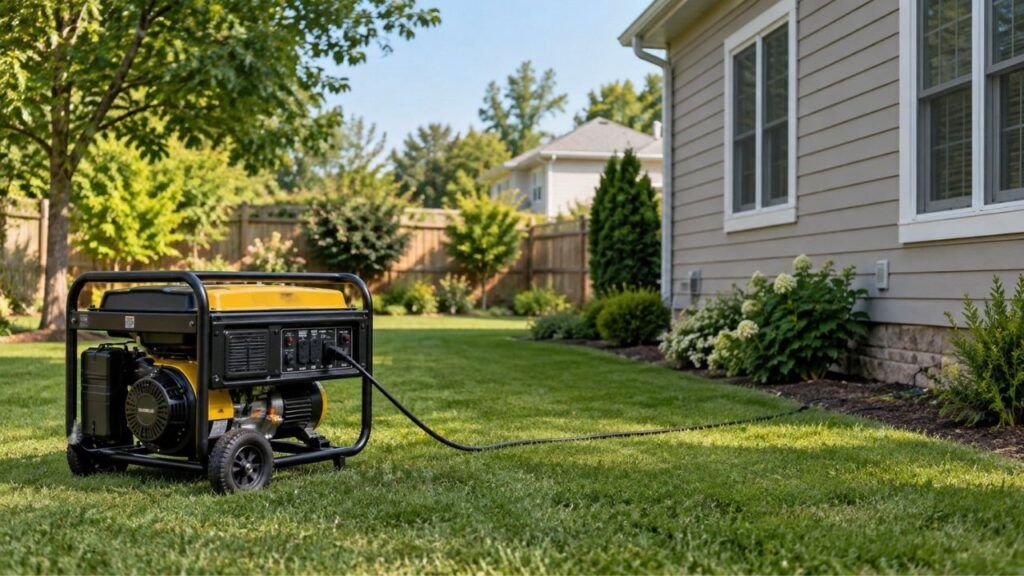
A portable generator should generally stay at least 20 feet from your house, running outdoors with the exhaust pointed away from windows, doors, vents, and other openings. More distance can provide an additional safety margin when your property allows it.
That sounds simple, but generator placement involves more than measuring 20 feet. I’ll show you where to measure, which locations to avoid, how wind affects placement, and why standby generators follow different rules.
Key Takeaways
- Keep portable generators at least 20 feet from homes and buildings.
- Point the generator exhaust completely away from your house.
- Keep exhaust away from windows, doors, vents, and air intakes.
- Never run a portable generator inside garages, sheds, or carports.
- Twenty feet is a minimum guideline, not a maximum distance.
- Standby-generator clearances depend on the model and installation requirements.
- CO shutoff technology does not replace proper generator placement.
- Keep working carbon monoxide alarms inside your home during generator use.
How Far Should a Portable Generator Be From the House?
A portable generator should normally operate at least 20 feet away from your house or other occupied buildings. It must also remain completely outdoors in an area with unrestricted airflow.
I recommend thinking of that 20 feet as your starting point.
Don’t place the generator exactly 20 feet away simply because you can. If you have space for 25 feet or more, additional separation can help.
The exhaust direction matters just as much as the measurement.
Position the generator so its exhaust travels away from your house. Check nearby windows, exterior doors, vents, and air-conditioning intakes before starting it.
You should also consider neighboring homes.
A generator placed safely away from your house can still create problems when its exhaust points toward your neighbor’s bedroom window.
Your goal is simple: create plenty of open space around the generator while keeping exhaust away from occupied areas.
Portable vs. Standby Generator Distance From the House
Portable and permanently installed generators follow different placement rules. Don’t apply one generator’s clearance requirements to another type.
| Generator Type | Typical Placement Approach | Main Consideration |
| Portable gasoline generator | At least 20 feet from buildings | CO exhaust and open airflow |
| Portable propane generator | At least 20 feet from buildings | CO exhaust and open airflow |
| Portable diesel generator | Use conservative outdoor separation | Exhaust, heat, and manufacturer guidance |
| Standby generator | Model-specific clearance | Installation manual, openings, exhaust, and codes |
| Battery power station | No combustion setback during battery operation | Electrical and ventilation requirements |
A portable generator moves from place to place. Its placement depends largely on safe outdoor operating practices.
A standby generator is different.
It is permanently installed and designed around specific enclosure clearances, airflow requirements, fuel connections, and exhaust locations.
That’s why you might occasionally see a standby generator installed much closer than 20 feet from a wall.
That does not mean your portable generator belongs there.
What Does “20 Feet Away” Actually Mean?
People often hear the 20-foot rule without knowing exactly how to apply it. Here’s how I recommend looking at the measurement.
Measure From the Generator to the Building
Measure the separation between the generator and the closest part of the building.
Don’t measure only from the muffler.
Don’t choose a convenient window or doorway that makes the distance appear larger.
Treat the generator itself as the source you are separating from your home.
Your owner’s manual may require additional clearances around particular sides. Those instructions should always take priority when they are more restrictive.
Check Windows, Doors, and Vents Separately
Distance from the wall isn’t your only concern.
Generator exhaust can potentially reach the house through openings you might overlook.
Check for:
- Bedroom windows
- Exterior doors
- Basement windows
- Crawl-space vents
- Soffit vents
- Bathroom vents
- Dryer vents
- HVAC fresh-air intakes
- Window air conditioners
Pay special attention to fresh-air intakes.
An intake can actively draw outdoor air into your HVAC system. You don’t want generator exhaust anywhere near that airflow.
Consider Your Neighbor’s House Too
Your property line doesn’t stop carbon monoxide or exhaust gases.
Look beyond your own house before choosing the generator location.
Avoid pointing exhaust toward nearby:
- Windows
- Doors
- Patios
- Decks
- Garages
- Outdoor sitting areas
- Neighboring homes
This becomes especially important in suburban neighborhoods with smaller lots.
You may need to test several locations before finding a suitable spot.
Why Do Some Sources Say 20 Feet and Others Say 25 Feet?
Twenty feet is the most widely recognized minimum recommendation for portable generators. However, you may also see safety guidance recommending around 25 feet.
The difference doesn’t mean one distance suddenly makes exhaust harmless.
Carbon monoxide movement depends on several factors, including:
- Wind direction
- Wind speed
- House layout
- Generator orientation
- Nearby walls
- Windows and vents
- Air pressure around the house
Testing has shown that shorter distances, including around 15 feet, may still allow generator exhaust to enter a building under certain conditions.
So I wouldn’t treat 20 feet like a precise invisible barrier.
Think of it as the minimum separation you should establish.
If your yard safely allows 25 or 30 feet, moving the generator farther away can provide additional separation.
Just make sure greater distance doesn’t create another problem, such as pointing exhaust directly toward your neighbor’s home.
Why Generator Distance From the House Matters
Portable generators burn fuel while producing electricity. That process creates exhaust, heat, and several risks you need to manage simultaneously.
Carbon Monoxide Can Enter the House
Carbon monoxide, commonly called CO, is produced when fuel burns.
You cannot see or smell it.
That makes generator exhaust particularly dangerous because you may not recognize exposure until symptoms begin.
CO can enter through obvious openings like doors and windows.
It may also reach the home through vents, cracks, crawl spaces, air intakes, and other openings.
Possible carbon monoxide poisoning symptoms include:
- Headache
- Dizziness
- Nausea
- Weakness
- Confusion
- Unusual tiredness
- Shortness of breath
Severe exposure can cause unconsciousness or death.
That’s why I would never rely on your ability to smell exhaust.
Proper placement and working CO alarms provide much better protection.
Exhaust Direction Changes the Risk
Imagine two generators sitting the same distance from a house.
One exhaust faces toward the building.
The other faces directly away.
Those situations aren’t equally desirable.
Pointing the exhaust away gives fumes a better opportunity to disperse before approaching the house.
Never aim generator exhaust toward:
- Windows
- Doors
- Vents
- People
- Pets
- Patios
- Neighboring houses
Also remember that wind can change direction during a long outage.
Your placement should remain sensible even after the breeze changes.
Generators Also Create Heat and Fire Hazards
Carbon monoxide isn’t the only reason generators need space.
Engines, mufflers, and exhaust components become extremely hot during operation.
Keep the generator away from materials that can burn.
That includes:
- Dry leaves
- Tall grass
- Cardboard
- Firewood
- Gasoline containers
- Outdoor furniture covers
- Wood scraps
- Household debris
Never refuel a generator while its engine remains hot.
Turn it off and give the unit time to cool first.
Where Should You Place a Generator Outside?
The safest location combines adequate distance, good airflow, proper exhaust direction, and stable ground.
Before starting your generator, look for a location that is:
- At least 20 feet from occupied buildings
- Completely outdoors
- Open on all sides
- Away from doors and windows
- Away from vents and air intakes
- Positioned with exhaust facing away from buildings
- Level and stable
- Clear of standing water
- Away from flood-prone areas
- Free from dry leaves and combustible debris
- Away from stored fuel
- Away from children and pets
- Not directing exhaust toward neighboring homes
A flat concrete surface can work well when correctly located.
A stable outdoor pad can also work.
Grass may be acceptable when the manufacturer permits it, but keep the area clear and make sure the generator stays level.
Where Should You Never Run a Portable Generator?
Some locations look protected and convenient during an outage. Unfortunately, those same areas can trap dangerous exhaust.
Inside a Garage, Even With the Door Open
Never run a portable generator inside your garage.
That rule still applies when the main garage door remains completely open.
Exhaust can accumulate inside or travel through connecting doors, gaps, or vents into your living space.
An attached garage creates an especially serious concern.
Move the generator outdoors instead.
Inside a Shed or Other Enclosure
A shed isn’t a safe generator room simply because nobody lives inside.
Walls and a roof can limit airflow and allow exhaust to accumulate.
Don’t assume adding a fan or opening the shed door solves the problem.
Portable generators need genuinely open outdoor airflow.
Under a Covered Porch or Carport
A porch or carport can feel like the obvious solution during rain.
It isn’t a good location for portable generator operation.
The roof, walls, railings, and nearby house can affect airflow and redirect exhaust.
Move the generator to a proper outdoor location instead.
Beneath a Deck or Low Overhang
Avoid placing a portable generator underneath decks or low building overhangs.
These structures can interfere with exhaust dispersion and trap heat.
They also place combustible materials unnecessarily close to hot equipment.
Does Wind Direction Change Generator Placement?
Wind direction matters, but it should never become an excuse for moving your generator closer.
You might have strong wind blowing away from the house when starting the generator.
Two hours later, the wind could change.
That’s why the basic distance remains important regardless of today’s breeze.
You should still point the generator exhaust away from your house whenever possible.
Also watch for walls and fences.
A tall fence can block airflow and push generator exhaust in an unexpected direction.
Calm weather deserves attention too.
When very little wind exists, exhaust may remain around the generator instead of dispersing quickly.
This is another reason open outdoor space is so important.
Can You Run a Generator 20 Feet Away in Rain or Snow?
Bad weather creates one of the biggest generator-placement problems. You need weather protection without creating an enclosed exhaust trap.
Do Not Move the Generator Into the Garage
Rain doesn’t make indoor generator operation safer.
Neither does snow.
If your safe outdoor location gets wet, moving the generator into your garage, porch, or shed creates a different and potentially more serious hazard.
Plan for bad weather before the outage arrives.
Use Only Appropriate Generator Weather Protection
Never throw a regular tarp directly over a running generator.
You can block ventilation, trap heat, restrict exhaust, and create fire risks.
Instead, follow your generator manufacturer’s instructions for operating during wet weather.
Some generators can be used with specially designed operating shelters or generator covers that maintain appropriate ventilation.
The shelter must not turn the generator into an enclosed unit.
It should protect electrical components while allowing heat and exhaust to escape properly.
If your manufacturer does not permit operation in current weather conditions, shut the generator down.
How Far Should a Standby Generator Be From the House?
Standby generators require a different approach because their installations are permanently engineered. There isn’t one universal house-clearance number that applies to every standby model.
There Is No Universal Standby Generator Distance
The acceptable location depends on several factors.
These can include:
- Generator manufacturer
- Specific model
- Enclosure design
- Exhaust location
- Nearby walls
- Wall construction
- Windows and doors
- Air intakes
- Service clearances
- Fuel connections
- Local building codes
- Fire requirements
That is why standby-generator placement should normally involve a qualified installer.
The installer can evaluate the property and match the location to the manufacturer’s approved installation requirements.
Why You Sometimes See an 18-Inch Clearance
You may have seen standby-generator guides mentioning an 18-inch wall clearance.
That number can apply to certain listed generators under specific installation conditions.
It does not mean:
“Every standby generator can sit 18 inches from any house.”
The allowed distance may apply only to a particular side of the enclosure.
Other sides can require considerably more clearance.
Nearby doors, windows, vents, and combustible materials can create additional requirements.
Always follow the instructions for your exact generator.
The Common 5-Foot Rule Needs Context
You’ll also encounter standby-generator recommendations mentioning five feet from windows, doors, or ventilation openings.
Again, don’t treat that number as universal.
Stationary generators still produce carbon monoxide.
Real-world investigations have shown that standby-generator exhaust can sometimes enter homes despite commonly used opening clearances.
That makes generator orientation, airflow, nearby openings, and manufacturer instructions important parts of installation planning.
Standby Generators Still Produce Carbon Monoxide
Automatic operation doesn’t make standby-generator exhaust harmless.
The engine still burns fuel.
That means it still produces combustion gases, including carbon monoxide.
Keep working CO alarms inside the home even after installing a professionally designed standby system.
Do New Generators With CO Shutoff Sensors Still Need 20 Feet?
Yes. A CO shutoff system does not replace proper generator placement.
Modern portable generators increasingly include sensors designed to shut down the engine when elevated carbon monoxide concentrations develop around the unit.
That’s useful backup protection.
However, the sensor cannot guarantee that CO isn’t entering your house.
Exhaust could travel toward an opening while conditions around the generator remain different.
A CO sensor also doesn’t make these locations acceptable:
- Garages
- Sheds
- Porches
- Carports
- Basements
- Partially enclosed areas
Keep following normal outdoor placement guidelines even when your generator has automatic CO shutoff technology.
Think of the sensor as another safety layer, not your primary protection.
How Far Should the Generator Be From Windows, Doors, and Vents?
Openings deserve their own inspection because generator exhaust can enter through places homeowners often overlook.
Pay particular attention to:
- Open windows
- Closed but poorly sealed windows
- Exterior doors
- Garage doors
- Basement windows
- Crawl-space openings
- Dryer vents
- Bathroom vents
- Soffit vents
- HVAC fresh-air intakes
- Window air conditioners
For a portable generator, keep the unit at least 20 feet from the home while directing exhaust away from these openings.
Don’t place a generator 20 feet from one wall while leaving it only a short distance from another part of the building.
Look at the entire house before settling on the operating location.
What If You Cannot Keep the Generator 20 Feet Away?
Small lots, townhomes, and closely spaced houses can make generator placement difficult. However, limited space doesn’t make unsafe operation acceptable.
Do Not Compromise With a Garage or Porch
Your garage isn’t a backup generator location when the yard is too small.
Neither is your covered porch.
If you cannot operate the generator with appropriate outdoor separation, don’t reduce the distance simply to make the generator fit.
Look for Another Open Location
Walk around the property before deciding that you have no suitable space.
Another side of the house may provide:
- Better separation
- Fewer windows
- Better airflow
- More stable ground
- Greater distance from neighbors
Remember to consider how you will safely connect the generator to your loads.
Don’t create electrical hazards simply to gain more generator distance.
Consider a Professionally Installed Standby System
A professionally installed standby generator may work where portable-generator placement becomes difficult.
Its location can be planned around:
- Approved clearances
- Permanent wiring
- Fuel supply
- Exhaust orientation
- Local requirements
Don’t install one based solely on measurements found online.
Your exact model and property conditions matter.
Consider Battery Backup for Tight Properties
A battery backup system doesn’t create combustion exhaust while supplying stored battery power.
That can make battery storage useful where portable fuel-burning generators cannot be safely positioned.
Battery systems have their own output, capacity, installation, and charging considerations.
However, they remove the carbon monoxide problem associated with running a combustion engine.
Generator Placement Checklist Before You Start It
A short inspection before every generator run can prevent serious mistakes.
Check these items first:
- Generator is at least 20 feet from the house.
- Generator is completely outdoors.
- Exhaust points away from the building.
- Exhaust isn’t aimed toward neighbors.
- Windows near the operating area are closed.
- Doors aren’t located in the exhaust path.
- HVAC air intakes are well away from exhaust.
- Generator sits on stable, level ground.
- Operating area isn’t flooded or covered with standing water.
- Dry leaves and combustible materials are cleared away.
- Fuel containers are stored safely away.
- Appropriate weather protection is being used.
- Extension cords are properly rated and undamaged.
- CO alarms inside the home are working.
- Children and pets cannot approach the generator.
If anything looks questionable, correct it before starting the engine.
Generator placement is much easier to fix before exhaust starts flowing.
Final Words
So, how far should a generator be from the house? For a portable fuel-burning generator, use at least 20 feet of separation, operate it completely outdoors, and point its exhaust away from your home.
Don’t treat 20 feet as a magic line where carbon monoxide suddenly disappears. Greater separation can provide another safety margin when your property allows it.
Also remember that standby generators are different. Their placement depends on the exact model, installation instructions, nearby openings, local requirements, and professional site planning.
Most importantly, never trade safe generator placement for convenience. A garage, porch, carport, or shed may look convenient during an outage, but your generator belongs outdoors with plenty of open air around it.
Related FAQs
Is 10 Feet Far Enough for a Generator?
No. Ten feet is generally too close for a portable generator operating beside a home. Keep it at least 20 feet from the house while pointing the exhaust away from windows, doors, vents, and occupied areas.
Is 15 Feet Far Enough for a Generator?
Fifteen feet is still shorter than the commonly recommended minimum for portable generators. Testing has also shown that generator exhaust can reach indoor spaces from this distance under unfavorable airflow conditions.
Is 20 Feet Far Enough for a Generator?
Twenty feet is the widely recommended minimum separation for portable generators. The generator must still remain outdoors with its exhaust directed away from the house, openings, people, and neighboring buildings.
Is 25 Feet Better Than 20 Feet for a Generator?
Yes, additional separation can provide a greater safety margin when your property allows it. Twenty feet should generally be considered the minimum rather than the ideal maximum distance.
Can I Put a Generator Beside My House if the Exhaust Faces Away?
No. Pointing the exhaust away does not replace the recommended separation distance. A portable generator should still remain at least 20 feet from your house in an open outdoor location.
Can I Run a Generator in a Garage With the Door Fully Open?
No. A fully opened garage door cannot guarantee safe carbon monoxide ventilation. Always move a portable generator completely outdoors and maintain proper separation from the house.
Can I Run a Generator Under a Carport?
You should not operate a portable generator under a carport. The roof and surrounding structures can restrict airflow or redirect exhaust toward your home.
Can I Run a Generator Under a Covered Patio?
No. A covered patio can restrict exhaust movement and place the generator too close to the building. Use a fully outdoor location with appropriate separation instead.
How Far Should a Generator Be From a Neighbor’s House?
Use the same conservative approach around neighboring occupied buildings. Keep portable generators at least 20 feet away whenever possible and never direct exhaust toward another home’s doors, windows, vents, or occupied areas.
How Far Should a Generator Be From a Window?
Keep a portable generator at least 20 feet from the home and away from windows, doors, vents, and air intakes. Directing the exhaust away from those openings is equally important.
How Close Can a Standby Generator Be to a House?
There isn’t one universal standby-generator distance. Approved clearance depends on the specific generator model, enclosure, exhaust position, nearby openings, manufacturer instructions, local regulations, and installation conditions.
Does a Generator With a CO Sensor Still Need to Be 20 Feet Away?
Yes. CO shutoff technology provides additional protection but does not replace proper placement. Keep the portable generator outdoors at least 20 feet away and point its exhaust away from the house.

Brian Walker writes straightforward generator guides and reviews for homeowners and everyday users. His content focuses on solar, portable, and fuel-powered generators, with practical advice on choosing, using, and maintaining reliable backup power.















