
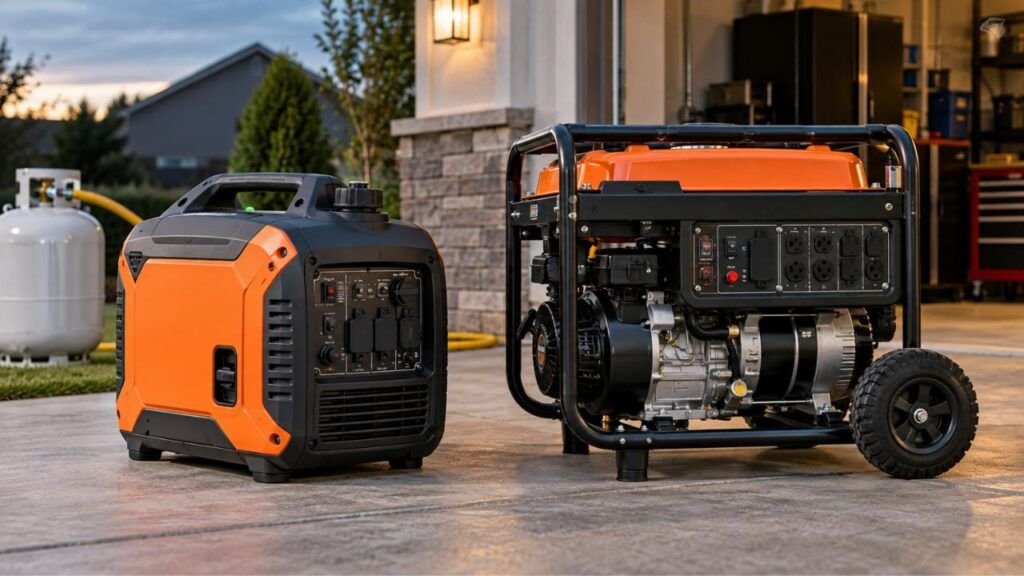
A tri-fuel inverter generator is usually better for clean power, quieter operation, and improved fuel efficiency. A tri-fuel conventional generator often gives you more raw wattage for less money. Both can run on gasoline, propane, and natural gas, but they produce and manage electricity differently.
That difference can affect everything from your fuel bill to appliance compatibility. Below, I’ll compare power quality, noise, output, efficiency, cost, home backup use, maintenance, and more.
Key Takeaways
- Both generator types run on gasoline, propane, and natural gas.
- Inverter generators usually produce cleaner and more stable electricity.
- Conventional generators often provide more wattage for your money.
- Inverter models are most efficient under light or changing loads.
- Natural gas normally reduces output on both generator types.
- Open-frame inverter generators can still be fairly loud.
- Check actual THD, voltage, outlets, and fuel-specific wattage before buying.
- Your intended loads matter more than the generator label.
Tri Fuel Inverter vs Tri Fuel Conventional Generator: Quick Comparison
The two generator types share the same three-fuel flexibility. Their biggest differences involve how electricity gets produced and managed.
| Feature | Tri-Fuel Inverter Generator | Tri-Fuel Conventional Generator |
| Fuel options | Gasoline, propane, natural gas | Gasoline, propane, natural gas |
| Power production | Electronically converts and conditions power | Alternator produces AC directly |
| Engine speed | Usually changes with load | Usually stays near fixed operating speed |
| Power quality | Usually very low THD | Varies by generator |
| Sensitive electronics | Usually excellent | Check published THD |
| Fuel efficiency | Better at partial loads | Usually lower at light loads |
| Noise | Usually quieter | Usually louder |
| Maximum wattage | High-output models available | Often higher for the price |
| Cost per watt | Usually higher | Usually lower |
| 120/240V output | Model-dependent | Common on larger units |
| Natural gas output | Lower than gasoline | Lower than gasoline |
| Repair complexity | More electronics involved | Generally simpler |
| Best use | Electronics, changing loads, quieter backup | Heavy loads, large output, lower budget |
Neither design automatically wins every category. Your loads, fuel choice, and budget should decide.
What Is the Actual Difference Between the Two?
The word “tri-fuel” only tells you which fuels work. The real comparison begins with how each generator creates usable electricity.
How a Tri-Fuel Inverter Generator Produces Power
An inverter generator does not send raw alternator output directly to your devices.
Instead, the generator produces electrical power and electronically processes it. The inverter system then creates stable AC electricity at the required frequency.
This design separates engine speed from output frequency more effectively. The engine can therefore slow down when electrical demand falls.
Suppose you are only running a refrigerator, router, and lights. The generator does not necessarily need maximum engine speed.
When your air conditioner or pump starts, engine speed can increase. This load-following operation is one major inverter advantage.
How a Conventional Tri-Fuel Generator Produces Power
A conventional portable generator uses a more direct design.
Its engine turns an alternator that creates AC electricity. Engine speed is closely connected with maintaining the required electrical frequency.
Many conventional portable generators operate close to 3,600 RPM. They generally maintain this speed even when the electrical load becomes relatively small.
Modern conventional generators may still include voltage regulation. Some also produce surprisingly clean electricity.
That is why I would never judge power quality by appearance alone.
Why This Difference Matters
The design influences several things you notice during actual use.
These include:
- Fuel consumption
- Engine noise
- Electrical stability
- Purchase price
- Repair complexity
- Performance under changing loads
The fuel options remain the same. Electricity management is what separates these technologies.
Which Produces Cleaner Power?
Power quality matters when your backup plan includes modern electronics. However, the usual inverter-versus-conventional explanation can become oversimplified.
THD and Sensitive Electronics
Total harmonic distortion, or THD, measures distortion in electrical output.
Lower THD generally means the electricity more closely resembles utility power. Many inverter generators produce power at around 3% THD or less.
That makes them attractive for equipment containing sensitive electronics.
Examples include:
- Laptops
- Desktop computers
- Televisions
- Internet equipment
- Battery chargers
- Modern furnace controls
- CPAP machines
- Electronic refrigerator controls
- Variable-speed appliances
If your backup setup includes expensive electronics, inverter power provides extra reassurance.
Still, check the manufacturer’s published THD instead of assuming anything.
Does a Conventional Generator Have Dirty Power?
Not necessarily.
You may hear that every conventional generator produces “dirty power.” That statement is too broad.
Some modern conventional generators include automatic voltage regulation and improved alternator designs. Certain models publish THD figures below 5%.
Others may produce noticeably higher distortion, especially when loads change suddenly.
So the correct question is not simply:
“Is this a conventional generator?”
Ask:
“What THD does this specific generator produce?”
That specification gives you much more useful information.
Which Is Better for Sensitive Electronics?
An inverter generator is usually the safer default for electronics-heavy backup.
Its output is specifically processed for greater electrical stability. That removes much of the uncertainty around sensitive equipment.
However, a well-designed conventional generator with verified low THD can also work well.
Always judge the actual generator specification, not just the category.
Which Gives You More Usable Power?
Maximum advertised wattage gets plenty of attention. Usable power matters much more during an outage.
Running Watts vs Starting Watts
Running watts tell you how much continuous power the generator supplies.
Starting watts describe the short burst available when motor-driven equipment starts.
That distinction becomes important with appliances such as:
- Refrigerators
- Freezers
- Well pumps
- Sump pumps
- Window air conditioners
- Central air conditioners
- Furnace blowers
- Large power tools
A refrigerator might use modest power once running. Its compressor can demand considerably more power during startup.
Your generator needs enough capacity for both situations.
Do not buy based only on the largest number printed on the box.
Gasoline vs Propane vs Natural Gas Output
Tri-fuel generators usually produce their highest output on gasoline.
Output normally decreases somewhat on propane. It often drops further when running on natural gas.
For example, a generator rated around 7,000 running watts on gasoline might deliver substantially less on natural gas.
The exact reduction varies by generator.
This matters because many homeowners specifically buy tri-fuel units for permanent natural gas availability.
If you plan to run primarily on natural gas, size your generator using its natural gas rating.
Do not size your home backup using the gasoline wattage.
That one mistake can leave you short on power during an outage.
Which Handles Large Motor Loads Better?
Neither technology automatically handles motors better.
What matters is whether the generator has enough starting capacity.
A large inverter generator can start demanding motors successfully. A smaller conventional generator may struggle with the same load.
Check:
- Running watts
- Starting watts
- 120V or 240V requirements
- Fuel-specific output
- Generator breaker capacity
- Motor startup requirements
For large air conditioners, a compatible soft-start device can sometimes reduce startup demand.
However, electrical modifications should be handled appropriately for your equipment.
Fuel Efficiency: How Much Does the Inverter Actually Save?
Fuel efficiency is one of the strongest inverter advantages. But the benefit changes depending on how you use the generator.
Why Variable Engine Speed Helps
Imagine buying a large generator for emergency home backup.
During part of the night, you may only need:
- One refrigerator
- A freezer
- Several lights
- Your internet equipment
- A few chargers
A conventional generator may still maintain nearly full engine speed.
An inverter generator can often reduce speed because demand remains low.
Lower engine speed can mean:
- Lower fuel consumption
- Reduced noise
- Less unnecessary engine operation
The advantage becomes especially noticeable with changing loads.
Where the Fuel-Efficiency Advantage Is Greatest
Inverter generators tend to offer their strongest efficiency advantage with:
- Overnight emergency loads
- Refrigerators cycling on and off
- Light household electrical use
- RV electrical systems
- Electronics and lighting
- Loads far below generator capacity
- Backup situations with frequent demand changes
If you regularly use only half the generator’s capacity, inverter technology becomes attractive.
When the Advantage Gets Smaller
The difference becomes less dramatic near maximum output.
An inverter generator supplying a heavy load still needs substantial engine power.
Suppose both generators spend hours powering several demanding appliances. Their engines must work hard regardless of electrical design.
You should therefore avoid assuming an inverter always uses dramatically less fuel.
Load percentage matters.
Which Is Quieter?
Inverter generators have a strong reputation for quiet operation. That reputation is deserved, but generator design also matters greatly.
Inverter Technology Can Reduce Engine Noise
Variable engine speed helps reduce noise during light electrical demand.
When the load falls, engine speed can fall with it.
This makes a noticeable difference during overnight operation or light household backup.
You may hear the engine increase speed when a refrigerator starts. It can slow again after electrical demand falls.
Enclosed vs Open-Frame Design Matters Just as Much
This is where generator comparisons often become misleading.
A compact enclosed inverter generator may be extremely quiet.
A large open-frame inverter generator can be much louder.
Three designs commonly appear:
- Enclosed inverter generator
- Open-frame inverter generator
- Open-frame conventional generator
The enclosed design provides additional sound insulation.
An open-frame inverter still benefits from variable engine speed. However, it does not have the same sound-dampening enclosure.
Therefore, never assume every inverter generator operates around 50 dBA.
Some large open-frame models operate above 70 dBA.
Real-World Noise Differences Can Be Small
Large inverter and conventional generators sometimes have surprisingly similar published noise ratings.
An open-frame tri-fuel inverter might operate around the low 70-dBA range. A comparable conventional generator could be only a few decibels louder.
The inverter may still become quieter under lighter loads.
However, it will not necessarily sound like a compact camping generator.
Check the actual dBA specification before buying.
Also check the stated testing distance and load percentage.
Which Costs More?
A tri-fuel inverter generator generally costs more than a similarly sized conventional model.
That higher price comes partly from the additional electronics used to process electricity and control operation.
Conventional generators often give you more rated wattage for every dollar spent.
This makes them attractive when your priorities include large loads.
For example, you might need enough power for:
- A well pump
- Refrigerator
- Freezer
- Gas furnace
- Lighting
- Sump pump
- Selected 240V equipment
A conventional model may reach the required capacity for less money.
However, purchase price is not the only cost.
An inverter may recover part of its higher cost through reduced fuel consumption during frequent light-load operation.
Think about how you will actually use your generator.
Maintenance and Repair Differences
Both generator types have internal combustion engines. Their basic engine maintenance therefore remains fairly similar.
Engine Maintenance Is Mostly Similar
Both types may require:
- Regular oil changes
- Air-filter inspection
- Spark-plug maintenance
- Battery maintenance
- Fuel-system care
- Periodic test runs
- Cooling-system inspection
- Proper long-term storage
Gasoline deserves extra attention because old fuel can create carburetor problems.
Propane and natural gas avoid some gasoline storage issues.
Inverter Electronics Add Complexity
An inverter generator contains additional power electronics.
These electronics help create stable electricity and control engine behavior.
The downside appears when an inverter module or control component fails.
Electrical troubleshooting can become more complicated. Replacement parts may also cost more than simple conventional components.
That does not mean inverter generators are unreliable.
It simply means their electrical architecture contains more sophisticated components.
Is a Conventional Generator Easier to Repair?
Generally, yes, at least from an electrical-design standpoint.
Conventional generators use a simpler electrical arrangement.
That can make certain faults easier for an experienced technician to diagnose.
However, modern conventional generators also contain control boards, safety systems, electric-start circuits, and electronic components.
So “simple” does not always mean easy DIY repair.
Portability and Generator Size
Inverter generators are often described as lightweight and portable. That applies mainly to smaller enclosed units.
Large tri-fuel inverter generators can be very heavy.
Once you move into home-backup power levels, you may get:
- Larger engines
- Bigger frames
- Heavy batteries
- Larger alternator sections
- Wheels and folding handles
Conventional generators can be equally heavy or heavier.
Instead of choosing by generator type, compare actual specifications.
Look at:
- Dry weight
- Dimensions
- Wheel size
- Handle design
- Lifting requirements
- Storage space
If you need to move the generator regularly, those details matter.
Which Is Better for Home Backup?
Home backup changes this comparison because you may need several different loads running together. Your electrical connection requirements also become more important.
For Refrigerators, Freezers, Lights, Internet, and Electronics
An inverter generator usually makes excellent sense here.
These loads frequently cycle on and off. Their total demand may stay well below generator capacity for long periods.
You get several advantages:
- Cleaner power
- Reduced light-load fuel consumption
- Quieter operation
- Better electronics compatibility
This setup works especially well for essential-load backup.
You may not need an enormous generator.
For Central AC, Well Pumps, and Other Heavy Loads
Here, raw capacity becomes more important.
Your generator may need enough power for:
- 240V well pumps
- Central air conditioning
- Electric water equipment
- Large sump pumps
- Multiple refrigerators
- Furnace systems
A conventional tri-fuel generator may provide the required output at a lower purchase price.
However, a sufficiently large inverter can work equally well.
Do not choose by technology first.
Calculate your load first.
For Natural-Gas Home Backup
Natural gas is one of the biggest reasons homeowners choose tri-fuel generators.
You avoid storing large amounts of gasoline. You can also continue running as long as gas service remains available.
However, there are two important issues.
First, generator output drops on natural gas.
Second, the gas supply must support the generator’s demand.
You should verify:
- Natural gas running watts
- Natural gas starting watts
- Required gas pressure
- Required gas flow
- Hose diameter
- Maximum permitted hose length
- Gas-meter capacity
A large generator can require considerable fuel flow.
Having a natural gas connection does not automatically mean your existing gas system can supply any generator.
A qualified professional can verify the setup.
For a Transfer Switch or Interlock Setup
If you plan to power household circuits, check generator electrical compatibility before buying.
Important specifications include:
- 120/240V output
- L14-30R receptacle
- 14-50R receptacle
- Maximum output amperage
- Neutral configuration
- Breaker capacity
Your transfer equipment must also match the intended installation.
Never connect a portable generator directly to household wiring without proper transfer equipment.
Never backfeed your home through a normal outlet.
A properly designed setup protects you, your appliances, and utility workers.
30-Amp vs 50-Amp Output: Do Not Choose by Wattage Alone
A high wattage rating does not automatically tell you how much power reaches your home connection.
Check the actual receptacles and electrical limits.
Important details include:
- L14-30R outlet availability
- 14-50R outlet availability
- 120V capability
- 240V capability
- Breaker rating
- Continuous output
- Fuel-specific output
- Home inlet compatibility
A 30-amp, 240V connection theoretically supports up to 7,200 watts.
However, actual usable output may be lower based on generator ratings.
Likewise, seeing a 14-50 outlet does not mean the generator continuously provides 50 amps at 240V.
Fifty amps at 240V would equal 12,000 watts.
The generator must actually be rated to provide that much power.
Always check the rated output instead of judging the outlet alone.
Tri-Fuel Inverter Generator Pros and Cons
A tri-fuel inverter gives you fuel flexibility without giving up inverter power quality. However, the extra technology also brings a few disadvantages.
Pros
- Usually provides very clean electrical output
- Excellent choice for sensitive electronics
- Adjusts engine operation according to load
- Can save fuel during lighter operation
- Often quieter under partial load
- Offers gasoline, propane, and natural gas flexibility
- Increasingly available with 120/240V output
- Works well for changing household loads
Cons
- Usually costs more upfront
- Power electronics increase repair complexity
- Large units can still be heavy
- Open-frame versions may still be noisy
- Natural gas reduces available wattage
- High-output models can become expensive
- Maximum watts per dollar may be lower
Tri-Fuel Conventional Generator Pros and Cons
A conventional tri-fuel generator focuses more heavily on straightforward high-output backup. That makes it attractive for larger loads and tighter budgets.
Pros
- Usually provides excellent wattage for the price
- High-output models are widely available
- Strong 120/240V options are common
- Large surge capacities are widely available
- Electrical design is generally simpler
- Gasoline, propane, and natural gas provide fuel flexibility
- Works well for demanding backup applications
Cons
- Usually operates at higher constant engine speed
- Often consumes more fuel under light loads
- Usually produces more noise
- Power quality varies between models
- THD should be checked for sensitive equipment
- Large units can be extremely heavy
- Natural gas still reduces available output
Tri Fuel Inverter vs Conventional Generator for Different Uses
There is no single winner for every situation. I would choose based on what you actually expect the generator to power.
Home Emergency Backup
For essential appliances and electronics, I would lean toward an inverter generator.
You get clean power while benefiting from variable-speed operation.
For heavy whole-home-style backup loads, a conventional generator may offer more affordable capacity.
Calculate the load before making the choice.
Long Outages Using Natural Gas
Both generator types work well with natural gas when properly sized.
The major advantage is avoiding repeated gasoline refueling.
However, natural gas output can be significantly lower.
Choose your generator based on its natural gas rating.
Also confirm your home’s gas supply can support it.
RV and Camping
An inverter model is normally the stronger option here.
Noise matters more around campgrounds and RV sites.
You may also run:
- Televisions
- Laptops
- Chargers
- RV electronics
- Small appliances
Cleaner power and lower partial-load noise become worthwhile.
Always follow campground generator-hour rules.
Jobsite and Power Tools
A conventional generator can make excellent sense on a jobsite.
You may care more about:
- High surge wattage
- Large running capacity
- Lower purchase cost
- Rugged construction
However, modern electronically controlled tools may benefit from cleaner power.
Check the requirements of your equipment.
Sensitive Electronics and Home Office Equipment
I would favor an inverter generator.
Computers, monitors, networking equipment, and chargers benefit from stable electricity.
A conventional unit can still work if its published THD is sufficiently low.
The actual THD specification remains more useful than assumptions.
High-Wattage Backup on a Limited Budget
A conventional tri-fuel generator usually wins here.
You can often get more starting and running power without entering the price range of very large inverter units.
That extra capacity may matter more than fuel savings.
When Should You Choose a Tri-Fuel Inverter Generator?
A tri-fuel inverter makes the most sense when power quality and changing loads matter.
Consider one when:
- Your backup plan includes sensitive electronics.
- You regularly operate below maximum generator capacity.
- Fuel efficiency matters during long outages.
- Lower partial-load noise matters to you.
- You want natural gas with cleaner inverter power.
- Your home backup needs fit available inverter wattage.
- You are comfortable paying more upfront.
- You want one generator for home and recreational use.
For many modern homes, this is the more refined option.
When Should You Choose a Conventional Tri-Fuel Generator?
A conventional model makes more sense when capacity and price dominate your decision.
Consider one when:
- You need maximum wattage for your budget.
- Your backup plan contains large 240V loads.
- You need substantial motor-starting capacity.
- Noise is not your biggest concern.
- You expect frequent heavy electrical loads.
- You want simpler electrical architecture.
- You found a low-THD conventional model.
- You primarily care about reliable high-output backup.
For demanding home loads, the value can be difficult to ignore.
How to Choose Between Them Before Buying
The easiest approach is to forget marketing labels initially. Start with your electrical requirements and work backward.
- List everything you want to power. Include essential and optional loads separately.
- Find each appliance’s running wattage. Use appliance labels or manufacturer information.
- Identify startup loads. Pumps, refrigerators, and air conditioners deserve special attention.
- Check whether anything requires 240V. Many larger pumps and HVAC systems do.
- Choose your primary fuel. Decide whether you expect gasoline, propane, or natural gas.
- Use that fuel’s wattage rating. Never size natural-gas backup using gasoline output.
- Check published THD. This matters when sensitive electronics are involved.
- Check the noise specification. Look at distance and test conditions.
- Check the available outlets. Confirm they match your intended connection.
- Verify gas requirements. Natural gas pressure and flow must be adequate.
- Compare weight and dimensions. Make sure you can move and store it.
- Compare warranty and service support. Good service matters during generator ownership.
- Plan your home connection safely. Transfer equipment should be addressed before an outage.
Doing these steps will usually make the correct choice obvious.
Safety Matters With Both Generator Types
Inverter technology improves power quality. It does not make engine exhaust safer.
Keep these rules in mind:
- Never operate a portable generator indoors.
- Never run one inside a garage or enclosed porch.
- Keep generators well away from doors and windows.
- Position the exhaust away from occupied buildings.
- Use working carbon monoxide alarms inside your home.
- Never backfeed electricity through a household outlet.
- Use approved transfer equipment for home circuits.
- Protect the generator from unsafe rain exposure.
- Let the generator cool before gasoline refueling.
- Follow the manufacturer’s operating instructions.
Carbon monoxide can build quickly without obvious warning.
Treat every fuel-burning portable generator with the same caution.
Tri Fuel Inverter vs Tri Fuel Conventional Generator: Which Is Better?
A tri-fuel inverter generator is generally better for clean power, lighter changing loads, fuel efficiency, electronics, and quieter operation. A tri-fuel conventional generator is generally better when you need maximum wattage at a lower purchase price.
For a home running refrigerators, electronics, a furnace, lighting, and similar essentials, I would strongly consider an inverter model.
If you need to support a large well pump, heavy HVAC equipment, and several demanding loads, a larger conventional unit may make better financial sense.
However, I would not make the decision from those labels alone.
Compare these specifications first:
- Running watts on your chosen fuel
- Starting watts
- 120/240V support
- THD
- Output amperage
- Receptacles
- Noise level
- Natural gas requirements
The generator meeting those requirements is usually the better generator for you.
Final Words
Tri-fuel inverter and conventional generators solve slightly different problems. One prioritizes refined power management, while the other often prioritizes affordable high output.
Start by deciding what you need to power during an outage. Once you know your wattage, voltage, fuel, and connection requirements, choosing between these two designs becomes much easier.
Related FAQs
Is a Tri-Fuel Inverter Generator Worth the Extra Money?
Yes, it can be worth paying more when you value clean power, variable engine speed, lower partial-load fuel use, and reduced noise. If maximum wattage matters more, a conventional model may offer better value.
Is an Inverter Generator Better Than a Regular Generator for Home Backup?
An inverter generator is often better for electronics and variable household loads. A conventional generator may be better when your home requires much higher wattage and your budget is limited.
Can a Conventional Tri-Fuel Generator Damage Electronics?
A conventional generator does not automatically damage electronics. Check its THD rating and voltage regulation. A modern low-THD conventional model can safely support many electronic devices.
Does a Tri-Fuel Inverter Generator Produce More Power?
Not necessarily. Conventional generators often provide more wattage at similar prices. However, large tri-fuel inverter generators are now available with substantial home-backup capacity.
Why Does a Generator Produce Less Power on Natural Gas?
Natural gas contains less usable energy for the engine than gasoline under comparable operating conditions. The generator therefore usually produces lower running and starting wattage.
Can a Tri-Fuel Inverter Generator Run a Whole House?
A sufficiently large model can support many household loads, but “whole house” depends on actual demand. Central HVAC, electric heating, water heaters, and large pumps can require substantial capacity.
Are Tri-Fuel Inverter Generators Really Quieter?
Usually, especially under lighter loads. However, large open-frame inverter generators can still exceed 70 dBA. Enclosed design plays a major role in overall noise.
Does an Inverter Generator Use Less Natural Gas?
It can use less fuel during light or changing loads because engine speed can adjust to demand. The actual savings depend on generator size and electrical load.
Do Tri-Fuel Inverter Generators Produce 240 Volts?
Some do, while smaller models may provide only 120V. Always check the voltage specification before buying for home backup, well pumps, or other 240V equipment.
Can You Connect a Tri-Fuel Generator to a Home Electrical Panel?
Yes, when the generator supports the required output and proper transfer equipment is installed. Never connect a portable generator directly to household wiring without approved transfer equipment.
Is an Open-Frame Inverter Generator Still Quiet?
It can be quieter than a comparable conventional generator under partial load, but it may still be loud. Open frames lack the sound insulation found on enclosed inverter generators.
Which Lasts Longer, an Inverter or Conventional Generator?
Neither type automatically lasts longer. Engine quality, maintenance, operating load, storage conditions, and service history usually have a greater effect on generator lifespan.

Brian Walker writes straightforward generator guides and reviews for homeowners and everyday users. His content focuses on solar, portable, and fuel-powered generators, with practical advice on choosing, using, and maintaining reliable backup power.















