
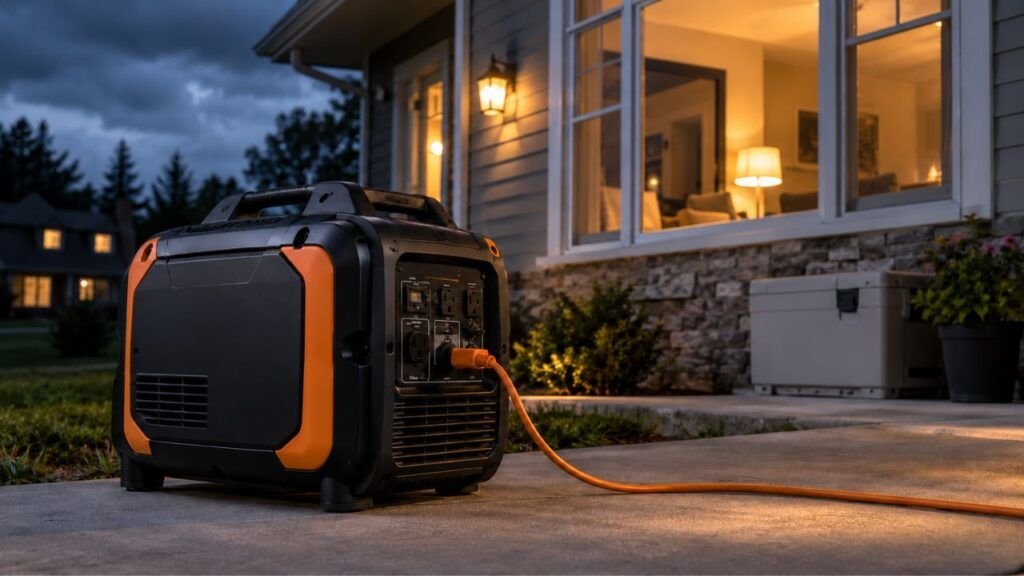
Yes, inverter generators are good for home backup. They provide clean power, quieter operation, and better fuel efficiency. However, the right model depends on your appliances, starting watts, voltage needs, and outage duration.
In this guide, I’ll explain where inverter generators perform best. You’ll also learn about sizing, 120/240V power, fuel choices, home connections, safety, and important limitations.
Key Takeaways
- Inverter generators are excellent for essential home backup loads.
- They provide stable power for electronics and modern appliances.
- Variable engine speed can reduce fuel use at lighter loads.
- Smaller models may provide only 120V electrical output.
- Larger 120/240V models can support heavier household circuits.
- Starting watts matter when powering compressors, pumps, and motors.
- A transfer switch provides safer access to household circuits.
- Fuel-burning generators must always operate outdoors, away from openings.
Are Inverter Generators Actually Good for Home Backup?
For many homeowners, an inverter generator is an excellent backup choice. It combines portable power with quieter and more efficient operation.
You can use one for refrigerators, freezers, lights, internet equipment, televisions, and electronics. A properly sized model may also support pumps and furnace blowers.
The biggest advantage is flexibility. You do not necessarily need a permanent generator installation.
You can store the generator until an outage happens. Then, you can set it up outside and power selected essentials.
However, inverter generators are not automatically ideal for every house. Smaller models cannot support large air conditioners or numerous appliances together.
Whole-house backup also requires more than simply buying more watts. Voltage, surge capacity, outlets, and connection equipment all matter.
For moderate backup requirements, inverter generators make a lot of sense. For very heavy loads, another generator type may offer better value.
Why Inverter Generators Work Well for Home Backup
Several features make inverter generators particularly useful around modern homes. Their advantages become more noticeable when you run lighter or changing loads.
They Produce Clean, Stable Power
An inverter generator manages electricity differently from a conventional generator.
The generator first creates electrical power through its alternator. Its electronics then regulate and convert that electricity before supplying your appliances.
This process creates a smooth and stable AC output.
That stability matters because modern homes contain many electronic components. Laptops, televisions, routers, chargers, and smart appliances all use sensitive electronics.
Many modern furnaces and refrigerators also contain electronic control boards.
A quality inverter generator typically produces very low total harmonic distortion. You may see this written as THD in generator specifications.
Lower THD means the electrical waveform stays closer to utility power. That makes inverter generators particularly attractive for sensitive equipment.
This does not mean every conventional generator will damage electronics. Some conventional models also provide reasonably stable electrical output.
Still, inverter models generally provide excellent power quality by design.
They Use Less Fuel at Partial Loads
A conventional portable generator usually maintains a relatively constant engine speed. An inverter generator can adjust engine speed according to demand.
Imagine your generator can produce 5,000 running watts.
You might only need 1,500 watts during the night. Your refrigerator, router, lights, and several chargers may be running.
The inverter generator can reduce engine speed during lighter demand. That can lower fuel consumption and extend runtime.
Fuel savings become particularly valuable during extended outages.
Gas stations may be closed during widespread grid failures. Lines can also become long when power finally returns.
Using less fuel gives you more flexibility during these situations.
However, fuel savings depend on the actual electrical load. Running near maximum output reduces the efficiency advantage.
They Are Usually Quieter
Noise matters more than many homeowners expect.
A generator may run for eight hours or longer. Constant engine noise can quickly become frustrating for your household.
It may also disturb nearby neighbors.
Inverter generators are usually quieter than comparable traditional generators. Their enclosed housings can help reduce mechanical and exhaust noise.
Variable engine speed also helps during lighter loads.
However, do not assume every inverter generator runs quietly. Large home-backup models can still produce significant noise.
A small 2,000-watt inverter may sound relatively quiet. A high-output 10,000-watt model is a very different machine.
Always compare actual noise specifications for the models you consider.
They Can Be Easier to Store and Move
Many inverter generators use compact enclosed designs.
Smaller models often include carrying handles and relatively lightweight frames. Larger models may include wheels and folding handles.
This makes setup easier during a sudden outage.
You can move the generator outside, connect your equipment, and start power production.
Storage can also be easier compared with larger open-frame machines.
However, portability decreases as output increases.
A large 120/240V inverter generator can still weigh hundreds of pounds. Wheels become important once you reach these higher power classes.
Dual-Fuel and Tri-Fuel Models Add Flexibility
Gasoline is no longer your only inverter generator option.
Many current models can run on gasoline and propane. Some larger units can also operate on natural gas.
Fuel flexibility can be extremely useful during emergencies.
Gasoline provides strong power output and widespread availability. Propane stores much longer without becoming stale like gasoline.
Natural gas can provide extended runtime when utility service remains available.
However, generator output often changes between different fuels.
Always check running and starting watts for each fuel type. Do not assume the maximum gasoline rating applies to propane.
What Are the Downsides of Using an Inverter Generator for Home Backup?
Inverter generators offer many advantages, but they also have limitations. Consider these drawbacks before choosing one for your house.
- Higher purchase price: Inverter technology usually costs more per watt.
- Lower output on smaller models: Compact units mainly suit essential loads.
- Possible 120V limitation: Many smaller generators cannot supply 240V circuits.
- Reduced portability at higher outputs: Large inverter generators become heavy.
- Fuel is still required: Gasoline and propane supplies need planning.
- Regular maintenance remains necessary: Engines still need oil and filter service.
- Carbon monoxide remains dangerous: Inverter generators are not safe indoors.
- Electronic repairs may cost more: Inverter components add technical complexity.
- Maximum watts can be expensive: Conventional generators often offer cheaper wattage.
The higher initial price is probably the biggest concern.
If your only priority is obtaining maximum emergency wattage cheaply, a conventional generator may provide better value.
However, many homeowners consider the extra cost worthwhile. Quieter operation and efficient fuel use can matter greatly during outages.
Can an Inverter Generator Power a Whole House?
Some inverter generators can power substantial portions of a house. Whether one can handle your entire home depends on wattage, voltage, surge requirements, and your electrical setup.
Essentials Backup vs. Whole-House Backup
First, decide what you actually mean by home backup.
You may only want several critical appliances running. That requires far less power than maintaining normal household operation.
Essential backup may include:
- Refrigerator
- Freezer
- Internet modem and router
- LED lighting
- Television
- Phone and laptop chargers
- Gas furnace blower
- Sump pump
- Selected kitchen appliance
This can often be handled by a moderately sized inverter generator.
Whole-house backup creates a much different challenge.
You may want central air conditioning, a well pump, cooking appliances, electric water heating, and multiple household circuits.
These loads can quickly push requirements above smaller generator capacities.
Therefore, do not size your generator using house size alone.
A 3,000-square-foot home using natural gas appliances may require less backup power than a smaller all-electric house.
Running Watts and Starting Watts Both Matter
Generator sizing requires two important numbers.
Running watts are the watts an appliance needs while operating normally.
Starting watts are temporary extra watts required when motors start.
Refrigerators are a simple example.
The compressor may use moderate electricity while running. However, starting that compressor can require a much larger surge.
The same issue applies to:
- Freezers
- Sump pumps
- Well pumps
- Furnace blowers
- Window air conditioners
- Central air conditioners
- Other motor-driven equipment
Your generator must handle both requirements.
Suppose your household appliances total 3,500 running watts. That does not automatically mean a 3,500-watt generator works.
A pump might start while your refrigerator already operates. The brief combined surge can overload an undersized generator.
I recommend identifying your largest starting load first. Then calculate what other appliances could be running simultaneously.
120V vs. 120/240V Can Be the Deciding Factor
This is one of the most overlooked generator specifications.
Many small inverter generators produce only 120V power.
That works perfectly for common household devices, including:
- Refrigerators
- Televisions
- Routers
- Lights
- Computers
- Small kitchen appliances
However, American homes also contain 240V circuits.
Common examples can include:
- Central air conditioners
- Electric dryers
- Electric ranges
- Electric water heaters
- Certain well pumps
- Some larger shop equipment
A 120V-only generator cannot directly operate those 240V loads.
This remains true even if its wattage seems sufficient.
For broader home backup, look for a generator providing 120/240V output. Also check whether it includes appropriate 30-amp or 50-amp connections.
Parallel Capability Helps, but Check the Details
Some inverter generators support parallel operation.
This allows two compatible generators to work together. Their combined system can supply more usable power.
Parallel capability can provide valuable flexibility.
You might use one generator for normal backup needs. During larger outages, you could connect the second compatible generator.
However, paralleling two generators does not automatically create 240V power.
Two small 120V generators may still provide a 120V parallel output. The exact configuration depends on the manufacturer and parallel kit.
Check these specifications before planning a household panel connection:
- Combined running watts
- Combined starting watts
- Output voltage
- Maximum amperage
- Available receptacles
- Approved generator combinations
- Parallel equipment requirements
Do not assume that doubling generators doubles every capability.
Inverter Generator Size by Backup Goal
| Backup Goal | Generator Class | Typical Loads | Important Check |
| Minimal essentials | 2,000–3,000W | Fridge, router, lights, chargers | Starting watts |
| Several essentials | 3,500–5,000W | Fridge, freezer, electronics, selected appliances | Combined surge |
| Larger essential backup | 5,000–7,500W | More circuits, furnace, pumps | 120/240V needs |
| Heavy partial-home backup | 7,500–10,000W+ | Several circuits and larger appliances | 240V and surge |
| Whole-home-style backup | Load-specific | Depends on HVAC and electric appliances | Detailed load calculation |
These ranges are only planning examples.
Always use appliance specifications when calculating your generator size. Your home’s exact electrical demand determines the correct capacity.
What Can a Typical Inverter Generator Run During an Outage?
What you can power depends heavily on generator size. Smaller models work best when you carefully prioritize essential appliances.
A typical inverter generator may power combinations involving:
- Refrigerator
- Chest or upright freezer
- Wi-Fi router and modem
- LED lights
- Television
- Phone chargers
- Laptop computers
- Gas furnace blower
- Sump pump
- Microwave
- Coffee maker
- Window air conditioner
Some larger models can also support heavier equipment.
A well pump may require 240V and substantial startup wattage. Central air conditioning can place even higher demands on the generator.
Do not simply add every appliance’s running watts.
Think about which appliances will operate simultaneously. Then account for temporary starting loads from motors and compressors.
You can also manage loads manually during an outage.
For example, avoid running a microwave while a large pump starts. That can help a smaller generator cover more household needs.
Inverter Generator vs. Conventional Generator for Home Backup
Both generator types can provide dependable emergency power. The better choice depends on your budget, loads, noise concerns, and fuel priorities.
| Feature | Inverter Generator | Conventional Generator |
| Power quality | Usually very low THD | Depends on generator design |
| Sensitive electronics | Excellent option | Check manufacturer specifications |
| Fuel efficiency | Better under lighter loads | Usually less efficient |
| Noise | Generally quieter | Usually louder |
| Purchase price | Higher per watt | Often lower per watt |
| High-output value | Usually more expensive | Often better |
| Small-unit portability | Usually excellent | Depends on design |
| Home backup | Excellent for appropriate loads | Excellent for high-wattage needs |
I would lean toward an inverter generator when electronics matter. They are also attractive when noise and fuel consumption concern you.
A conventional generator makes more sense when budget matters most.
You can often get considerably more watts for your money. That can matter when you have pumps, tools, or large appliances.
Neither design is automatically better for every homeowner.
The correct decision comes from matching generator capabilities with your actual loads.
How Do You Connect an Inverter Generator to a House?
You generally have two practical connection methods. Your choice depends on whether you are powering individual appliances or household circuits.
Extension Cords for Individual Appliances
The simplest method is powering appliances directly.
You place the generator safely outdoors. Then you connect selected appliances using properly rated extension cords.
This approach works well for:
- Refrigerator
- Freezer
- Router
- Television
- Lamps
- Chargers
- Other plug-in equipment
Use cords rated for the required electrical load.
Long or undersized extension cords can create excessive voltage drop. They may also become dangerously hot under heavy loads.
Inspect cords before every use.
Do not use damaged cords with exposed conductors or loose connections.
Transfer Equipment for Household Circuits
A transfer switch or other approved transfer equipment provides another option.
It allows selected home circuits to receive generator power without running numerous extension cords through the house.
This can be particularly useful for:
- Furnace circuits
- Well pumps
- Sump pumps
- Refrigerators
- Lighting circuits
- Selected kitchen circuits
Your generator must still provide compatible electrical output.
A 120V-only generator cannot suddenly provide 240V circuits because you installed a transfer switch.
Large backup setups may need 120/240V output plus an appropriate generator connection.
Have home transfer equipment installed according to applicable electrical requirements. A qualified electrician can also confirm generator compatibility.
Never Backfeed the House Through a Wall Outlet
Never connect a portable generator to your house through a regular receptacle.
This unsafe practice is commonly called backfeeding.
It can energize wiring in ways the electrical system was never designed to handle. More importantly, it can send generator power toward utility equipment.
That can endanger utility workers and people nearby.
Use approved transfer equipment whenever supplying household circuits.
Is an Inverter Generator Safe for Home Backup?
An inverter generator can provide reliable emergency power. However, it still contains a fuel-burning engine producing carbon monoxide.
Follow these basic precautions:
- Always operate the generator outdoors.
- Keep it at least 20 feet from the home.
- Point exhaust away from windows and doors.
- Keep exhaust away from vents and other openings.
- Never operate one inside a garage.
- Never use one inside a basement or shed.
- Keep working carbon monoxide alarms inside your home.
- Consider models with automatic CO shutoff protection.
- Keep the generator protected from unsafe wet conditions.
- Never overload the generator beyond its rating.
- Let the engine cool before adding gasoline.
- Never backfeed your home’s electrical system.
Quiet operation does not make an inverter generator safe indoors.
You may barely hear a small inverter generator running. Carbon monoxide can still accumulate rapidly and create life-threatening conditions.
Treat every combustion generator with the same ventilation precautions.
What Should You Look for in an Inverter Generator for Home Backup?
A good home-backup generator needs more than an attractive wattage number. Check the specifications that actually affect your planned household loads.
Running and Starting Wattage
Start by calculating your expected operating load.
Add the running watts of appliances you expect to use together. Then identify the highest starting requirement among motor-driven equipment.
Leave some extra capacity whenever possible.
Running a generator continuously at its absolute maximum rating provides little room for another appliance to start.
120V or 120/240V Output
For basic plug-in appliances, 120V may be enough.
If you plan to power household circuits, check your appliances carefully. Some pumps, HVAC equipment, and larger appliances require 240V.
For broader home backup, 120/240V capability provides much greater flexibility.
30-Amp or 50-Amp Home Backup Connection
Larger generators often include 30-amp or 50-amp receptacles.
These connections are useful when supplying a compatible transfer setup. They can carry considerably more power than common household outlets.
Do not judge compatibility by plug appearance alone.
Check voltage, amperage, outlet type, and generator capacity together.
Gasoline, Dual-Fuel, or Tri-Fuel Operation
Think about fuel before the outage happens.
Gasoline is easy to find during normal conditions. However, it requires careful storage and eventually becomes stale.
Propane stores extremely well in properly maintained cylinders or tanks.
A dual-fuel generator gives you both choices.
Tri-fuel inverter generators add natural gas capability. This can be valuable when your home already has suitable gas service.
Remember that power output often decreases on propane or natural gas.
Size the generator using the fuel you actually expect to use.
Runtime at Realistic Loads
Manufacturers often advertise impressive runtime numbers.
However, always check the load percentage used during testing.
One generator might advertise runtime at 25% load. Another manufacturer may provide runtime at 50% load.
Those numbers cannot be compared directly.
Estimate how heavily you will actually load your generator. Then compare models using similar conditions whenever possible.
THD Rating
Inverter generators are known for clean power.
Even so, checking the manufacturer’s THD specification gives you additional confidence.
Low THD is particularly valuable when powering:
- Computers
- Televisions
- Networking equipment
- Chargers
- Modern appliance control boards
- Other sensitive electronics
Do not rely only on marketing terms such as “clean power.”
Look for actual electrical specifications whenever available.
Noise Rating and Test Conditions
Noise ratings can help you compare generators.
However, check how those numbers were measured.
Generator noise changes with load, engine speed, distance, and surroundings.
A small generator at 25% load may sound completely different from a large model operating near full capacity.
Use advertised decibel ratings as comparison tools rather than guarantees.
CO Shutoff and Other Safety Features
Modern generators can include several useful protections.
Look for features such as:
- Automatic carbon monoxide shutoff
- Low-oil shutdown
- Overload protection
- Circuit breakers
- Fuel shutoff
- Automatic voltage protection
Safety systems provide extra protection.
They do not replace proper outdoor placement and safe operation.
Electric Start, Remote Start, Wheels, and Storage
Convenience matters during a storm.
Electric start can make a larger generator much easier to use. Remote start provides additional convenience with compatible models.
Wheels matter once generator weight increases.
Also consider where you will store your generator between outages.
Make sure you can move it safely from storage to its outdoor operating location.
Transfer-Switch or Home-Backup Readiness
Do not assume every large inverter generator works equally well for home backup.
Check whether the model provides the connections your setup requires.
For panel-based backup, examine:
- 120/240V capability
- 30A or 50A output
- Receptacle type
- Running wattage
- Starting wattage
- Neutral configuration
- Manufacturer instructions
- Transfer-equipment compatibility
Planning this before buying can prevent an expensive mistake.
Who Should Choose an Inverter Generator for Home Backup?
An inverter generator makes the most sense when your priorities match its strengths.
Consider one if you:
- Mainly want to keep essential appliances operating.
- Regularly power computers and modern electronics.
- Value lower generator noise around your property.
- Want better fuel efficiency during lighter loads.
- Prefer portable backup over permanent installation.
- Experience occasional or moderate-length outages.
- Want gasoline and propane flexibility.
- Need clean power for electronic control systems.
- Can find a 120/240V model for heavier household loads.
For many suburban homes, that combination works extremely well.
You get enough power for important circuits without maintaining a permanently installed standby system.
When Is an Inverter Generator Not the Best Choice?
Inverter technology is useful, but it does not solve every backup problem.
Another solution may work better when:
- You need maximum wattage for the lowest purchase price.
- Your house relies heavily on electric heating equipment.
- You expect multiple large 240V loads simultaneously.
- You want automatic backup without manually starting anything.
- You experience frequent multi-day outages.
- You do not want to store or handle generator fuel.
- Engine noise and exhaust are unacceptable.
- You want completely automatic whole-home operation.
A larger conventional generator can provide better value for heavy loads.
A permanently installed standby generator may suit frequent outages. It can also start automatically when utility power disappears.
Battery backup provides another option for smaller or quieter applications.
The best solution depends on what you expect during an outage.
Inverter Generator vs. Portable Power Station vs. Standby Generator
An inverter generator offers a useful middle ground. It provides substantial portable power without requiring permanent installation.
A portable power station uses batteries instead of an engine. It operates silently and produces no combustion exhaust while supplying electricity. However, its runtime depends on stored battery capacity and recharging options.
A standby generator is designed for more permanent backup. It can automatically detect an outage and supply household circuits without manual setup. However, installation and purchase costs are considerably higher.
For occasional outages, an inverter generator is often practical.
For short outages and light loads, battery power may be simpler.
For frequent outages requiring automatic whole-home coverage, a standby generator can make more sense.
Final Verdict
Yes, inverter generators are very good for home backup. They are especially useful when you want efficient fuel use, stable electricity, and quieter operation.
A smaller model can keep essential appliances operating during an outage. Larger 120/240V inverter generators can support much more substantial household loads.
However, do not buy one simply because it says “inverter.”
Start with the appliances you need during an outage. Calculate their running watts and starting watts carefully.
Then check whether any important equipment requires 240V power.
Finally, consider fuel, runtime, home connections, noise, and safety.
If those specifications match your needs, an inverter generator can provide dependable home backup for many years.
Related FAQs
Are Inverter Generators Better for Home Backup?
Inverter generators are often better when clean power, lower noise, and fuel efficiency matter. Conventional generators may offer more wattage for less money, making them attractive for larger emergency loads.
Can an Inverter Generator Power a Whole House?
A large inverter generator can power substantial household loads, but whole-house capability depends on demand. You must consider running watts, startup surge, 120/240V requirements, and simultaneous appliance use.
What Size Inverter Generator Do I Need for Home Backup?
Around 2,000 to 5,000 watts may cover basic household essentials. Larger setups can require 5,000 to 10,000 watts or more, particularly when pumps, air conditioning, or additional circuits are involved.
Can an Inverter Generator Run a Refrigerator and Freezer Together?
Yes, many inverter generators can run a refrigerator and freezer together. Make sure the generator can handle their combined running watts and the temporary starting surge when either compressor starts.
Can an Inverter Generator Run a Central Air Conditioner?
Some large 120/240V inverter generators can run central air conditioners. Generator capacity must cover both normal running demand and the compressor’s much higher starting requirement.
Can I Connect an Inverter Generator to My Electrical Panel?
Yes, a compatible inverter generator can supply household circuits through properly installed transfer equipment. The generator must provide suitable voltage, amperage, outlets, and capacity for your planned backup loads.
Are Inverter Generators Safe for Sensitive Electronics?
Yes, quality inverter generators generally produce stable, low-distortion electricity suitable for sensitive electronics. Computers, televisions, routers, chargers, and modern appliance controls can benefit from this cleaner electrical output.
Are Inverter Generators Quieter Than Regular Generators?
Inverter generators are generally quieter, especially during lighter electrical loads. However, large high-output inverter models can still create significant noise when operating under heavy demand.
How Long Can an Inverter Generator Run During an Outage?
Runtime depends on generator size, fuel tank capacity, fuel type, electrical load, and maintenance requirements. Many units can operate for several hours before needing refueling, but specifications vary considerably.
Is a Dual-Fuel Inverter Generator Better for Home Backup?
A dual-fuel inverter generator can be better for emergencies because it offers gasoline and propane options. Having two fuel choices provides more flexibility when one fuel becomes unavailable during an extended outage.

Brian Walker writes straightforward generator guides and reviews for homeowners and everyday users. His content focuses on solar, portable, and fuel-powered generators, with practical advice on choosing, using, and maintaining reliable backup power.















