
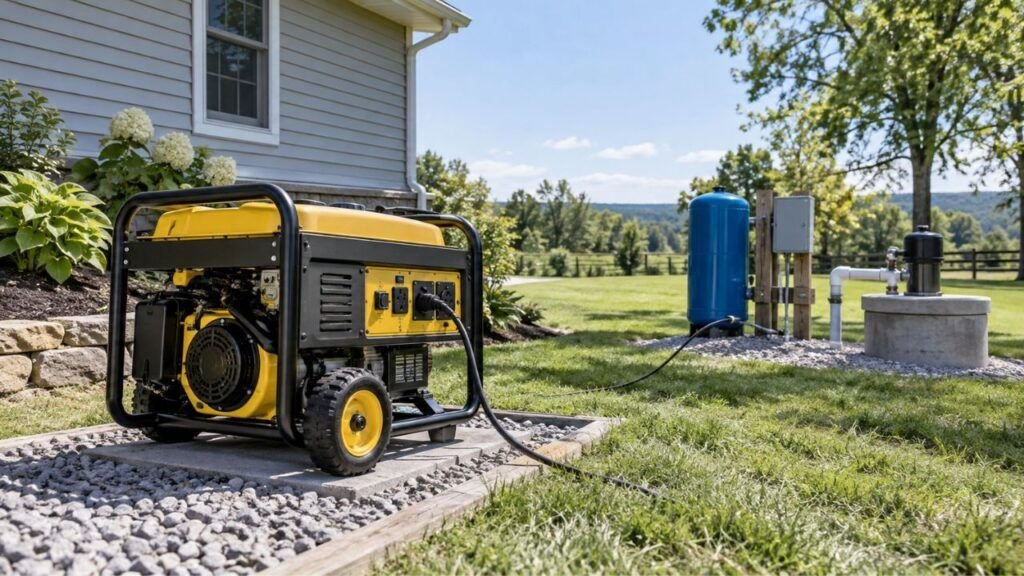
A typical residential well pump may need a 2,000- to 7,500-watt generator, depending on the pump’s horsepower, voltage, motor design, and starting demand. A 1 HP well pump, for example, may need around a 4,000-watt minimum generator, while some 2-wire versions can require considerably more starting capacity.
Choosing the right size is not only about pump horsepower. You also need to check voltage, startup demand, motor wiring, and other appliances. I’ll walk you through each step so you can size your generator confidently.
Key Takeaways
- A well pump usually needs more power during startup.
- Many residential well pumps operate on 240 volts.
- Pump horsepower alone does not determine generator size.
- A 1 HP pump may need around 4,000 watts minimum.
- Some 2-wire motors may need roughly 50% more capacity.
- Other household appliances increase your total generator requirement.
- Always check the pump manufacturer’s sizing recommendations when available.
What Size Generator Runs a Well Pump?
The table below gives you a practical starting point. These numbers should not replace your pump manufacturer’s specific generator recommendations.
| Well Pump Size | Base Generator Reference | Possible 2-Wire Reference | General Planning Range |
| 1/3 HP | About 1,500W | About 2,250W | 2,000-3,000W |
| 1/2 HP | About 2,000W | About 3,000W | 2,500-3,500W |
| 3/4 HP | About 3,000W | About 4,500W | 3,500-5,000W |
| 1 HP | About 4,000W | About 6,000W | 4,500-6,500W |
| 1.5 HP | About 5,000W | About 7,500W | 6,000-8,000W |
| 2 HP | About 7,500W | About 11,250W | 8,000-12,000W |
| 3 HP | About 10,000W | About 15,000W | 10,000-15,000W+ |
These numbers assume the generator is primarily supplying the well pump. If you also want refrigerators, furnaces, freezers, or other equipment running, you will need additional capacity.
I also recommend choosing the next practical generator size above your minimum. Running a generator at its absolute limit leaves little room for starting surges.
Why Does a Well Pump Need a Larger Generator to Start?
Well pumps contain electric motors, and motors behave differently from simple electrical loads. The generator must handle both normal operation and the brief starting demand.
Running Watts vs Starting Power
Running watts describe the electricity needed after the pump starts operating. Starting power refers to the brief increase needed when the motor begins turning.
That short startup period creates the biggest challenge for generators.
A generator may have enough continuous wattage to run your pump. However, it can still overload when the pump tries starting.
This is why generator surge capacity matters so much.
Why Horsepower Alone Does Not Tell the Whole Story
Horsepower gives you useful information about the pump’s mechanical output. However, two pumps with identical horsepower can have different electrical requirements.
Several things affect generator sizing:
- Motor efficiency
- Operating voltage
- Motor design
- Starting current
- 2-wire or 3-wire construction
- Pump controller type
- Pressure and operating conditions
So, do not buy a generator based only on horsepower.
Why You Should Not Simply Multiply Horsepower by 746
You may see people calculate pump wattage using this formula:
1 HP = 746 watts
That conversion is correct for mechanical horsepower, but it does not tell you how large your generator should be.
An electric motor loses some energy through heat and other inefficiencies. It also has power-factor considerations and much higher startup demand.
Therefore, a 1 HP well pump does not mean a 746-watt generator can run it.
In reality, that generator would normally be far too small.
Check These Pump Specifications Before Choosing a Generator
Before shopping for a generator, gather as much pump information as possible. A few minutes checking the system can prevent an expensive sizing mistake.
Look for these specifications:
- Pump horsepower
- Pump voltage
- Running or full-load amps
- Starting or locked-rotor amps, if listed
- 2-wire or 3-wire motor design
- Pump model number
- Control box information
- Standard or variable-speed controller
You may find this information on the pump documentation or control box.
For above-ground pumps, check the motor’s data plate.
If you cannot locate this information, contact your well installer. An electrician or pump technician can also identify the motor.
Does Your Well Pump Need 120V or 240V?
Generator wattage means very little if the voltage does not match.
Many smaller well pumps operate at 120V. However, many residential submersible pumps, especially larger units, operate at 240V.
That means your generator must provide the correct voltage.
For example, imagine your pump requires 240V and 3,000 starting watts. A 4,000-watt generator offering only 120V still cannot properly power that pump circuit.
This is a common mistake when homeowners buy smaller inverter generators.
Always check generator voltage before comparing wattage ratings.
2-Wire vs 3-Wire Well Pumps: Why It Changes Generator Size
Two pumps with identical horsepower can need different generator sizes. One important reason is whether the motor uses a 2-wire or 3-wire design.
2-Wire Well Pump
A 2-wire submersible pump keeps its starting components inside the motor assembly.
Because of the motor’s starting characteristics, some manufacturer guidance recommends additional generator capacity for these systems.
A useful planning rule is allowing approximately 50% more generator capacity when applicable.
For example, if your base reference calls for 4,000 watts, a 2-wire application might require something closer to 6,000 watts.
Always check your specific motor manufacturer’s instructions before applying this rule.
3-Wire Well Pump
A 3-wire well pump usually has an external control box.
That box contains starting components that help manage the motor during startup.
Generator sizing may follow the manufacturer’s standard reference chart more closely.
However, you still need enough starting capacity and proper voltage.
How Do I Know Which Type I Have?
Look near your pressure tank or electrical equipment for a pump control box.
An external control box often suggests a 3-wire system.
However, this is not something I recommend guessing about. Check the model information or ask a well technician if you are uncertain.
How to Calculate Generator Size for Your Well Pump
You do not need complicated electrical math for most residential systems. The safest approach is using actual pump information and manufacturer recommendations.
Step 1: Find the Pump Horsepower and Voltage
Start by identifying your pump’s horsepower.
Common residential sizes include:
- 1/3 HP
- 1/2 HP
- 3/4 HP
- 1 HP
- 1.5 HP
- 2 HP
Next, identify whether the motor uses 120V or 240V.
Do not assume well depth tells you the pump horsepower. Two similarly deep wells can use very different pumps.
Step 2: Find the Manufacturer’s Generator Recommendation
This should be your preferred sizing method.
Pump manufacturers know their motors’ actual starting characteristics. Their generator charts are more dependable than generic wattage calculators.
Look for recommendations covering:
- Motor horsepower
- Motor voltage
- Motor type
- Generator kW rating
- 2-wire or 3-wire requirements
If your manufacturer publishes specific information, follow that first.
Step 3: Check Running and Starting Current
Look for the pump’s full-load amps and starting current.
The motor may use a modest amount of electricity while running. However, startup current can briefly become much higher.
That difference explains why a seemingly powerful generator sometimes stalls.
Avoid assuming volts multiplied by amps gives perfect motor wattage. AC motor calculations can involve power factor and other electrical characteristics.
When possible, use manufacturer generator requirements instead.
Step 4: Add Everything Else the Generator Will Power
Now decide what else will operate during the outage.
Common loads include:
- Refrigerator
- Freezer
- Furnace blower
- Sump pump
- Lights
- Microwave
- Internet equipment
- Television
- Small kitchen appliances
Add their running requirements to your overall load.
You also need to consider whether another motor could start while the well pump operates.
Step 5: Choose the Next Suitable Generator Size
Avoid choosing a generator whose limit exactly matches your calculation.
A little extra capacity gives you breathing room during motor starts.
It also reduces the chance of overloads when another appliance starts unexpectedly.
Remember that some generators produce less power on propane or natural gas than gasoline.
Check the generator’s rating for the fuel you actually plan to use.
What Size Generator for a 1 HP Well Pump?
A 1 HP well pump may need around a 4,000-watt minimum generator under common manufacturer reference guidance. However, motor design and starting requirements can push that number higher.
Suppose your pump is a 2-wire model.
Using the 50% additional-capacity guideline:
4,000W × 1.5 = 6,000W
In that situation, a generator around 6,000 watts may be a better starting point.
If your refrigerator, furnace, or other appliances also need backup power, increase the generator size further.
For many homeowners, this makes the 5,000- to 7,500-watt class worth considering for a 1 HP pump and essential household loads.
What Size Generator for a 1/2 HP Well Pump?
A 1/2 HP well pump may use a base generator reference around 2,000 watts.
However, I would usually avoid buying a generator exactly at that rating.
A generator around 2,500 to 3,500 watts provides more practical starting room for many systems.
If the pump uses a 2-wire motor, your requirement might move toward 3,000 watts or higher.
Again, voltage matters. Make sure the generator provides 240V if your pump requires it.
What Size Generator for a 3/4 HP Well Pump?
A 3/4 HP well pump may have a base generator reference around 3,000 watts.
A practical generator range might be approximately 3,500 to 5,000 watts, depending on the motor and additional loads.
A 2-wire version may require closer to 4,500 watts before adding household appliances.
This is why checking the exact motor becomes important.
What Size Generator for a 1.5 HP or 2 HP Well Pump?
Larger residential well pumps create significantly higher startup demands. You should pay close attention to manufacturer recommendations before buying the generator.
1.5 HP Well Pump
A 1.5 HP pump may have a base generator requirement around 5,000 watts.
A practical generator may fall somewhere around 6,000 to 8,000 watts once you allow additional capacity.
Some 2-wire configurations could require around 7,500 watts before including other household loads.
2 HP Well Pump
A 2 HP well pump may require around 7,500 watts under certain manufacturer reference charts.
For a 2-wire motor, the requirement could rise considerably.
A generator in the 8,000- to 12,000-watt range may make more sense for many installations.
If your home also has large electrical loads, you may need something larger.
Does Well Depth Change the Generator Size?
Well depth can affect pump selection, but depth does not directly determine generator size.
A deeper well may need a larger motor because the pump must move water farther. However, factors like water level, pressure, flow rate, and total dynamic head also matter.
Once the pump is installed, generator sizing should focus on its actual electrical specifications.
So, avoid rules like:
“A 300-foot well always needs a 7,500-watt generator.”
That statement ignores the pump actually installed inside the well.
Check the motor rather than estimating from depth.
How Much Generator Power Do You Need With Other Appliances?
Most homeowners want more than water during an outage. You may also need refrigeration, lighting, heating controls, or other equipment.
| Household Load | Typical Consideration | Starting Surge? | Include in Total? |
| Well pump | Use actual motor information | Yes | Yes |
| Refrigerator | Check appliance label | Yes | Yes |
| Freezer | Check appliance label | Yes | Yes |
| Furnace blower | Check motor information | Yes | Yes |
| Sump pump | Check pump rating | Yes | Yes |
| LED lights | Usually small load | Usually no | Yes |
| Microwave | Moderate to high load | Usually small concern | Yes |
| Internet equipment | Usually low load | No | Yes |
Do not assume every appliance operates at the same wattage shown in generic charts. Your actual equipment may use more or less power.
Example: Well Pump + Refrigerator + Lights
Suppose your generator must support:
- Well pump requiring 4,000 watts during startup
- Refrigerator using 700 running watts
- Lights using 200 watts
Your generator must support the refrigerator and lights while still allowing the pump to start.
In this example, choosing exactly 4,000 watts would leave almost no room.
Moving toward a 5,000- or 6,000-watt generator could provide more practical capacity.
What If Two Pumps Can Start at Once?
Some homes have more than one water-related pump.
You might have:
- Submersible well pump
- Booster pump
- Sump pump
If two motors can start together, your surge requirement can become much higher.
Try to avoid simultaneous starts when possible.
If simultaneous operation is necessary, size the generator for that condition.
Can a 3,500-Watt Generator Run a Well Pump?
Yes, a 3,500-watt generator can run some well pumps.
It may work well with certain 1/2 HP or 3/4 HP systems. However, the exact answer depends on starting demand and voltage.
Check whether the generator provides 240V if required.
A 3,500-watt generator may struggle with larger pumps or demanding 2-wire motors.
It may also become insufficient once additional appliances are connected.
Can a 5,000-Watt Generator Run a Well Pump?
Yes, a 5,000-watt generator can run many residential well pumps.
It may handle many 1 HP 3-wire systems when the generator has sufficient surge capacity and proper voltage.
However, a 5,000-watt model is not automatically enough for every 1 HP pump.
Some 2-wire motors may require more starting capacity.
The same problem occurs when refrigerators, furnaces, or other motor loads run simultaneously.
Can a 7,500-Watt Generator Run a Well Pump?
A 7,500-watt generator can run many residential well pumps.
It provides more startup capacity for larger pumps and additional household loads.
It may also match the base generator requirement for certain 2 HP systems.
However, you should still verify voltage and motor requirements.
Large 2-wire motors or multiple simultaneous loads may require more capacity.
Can an Inverter Generator Run a Well Pump?
Yes, an inverter generator can run a well pump if its voltage, continuous output, and surge capacity match the pump’s requirements.
The challenge is finding an inverter generator with suitable 240V output and enough motor-starting capability.
Check the 240V Output First
Many small inverter generators only provide 120V power.
That makes them unsuitable for a 240V well pump, regardless of wattage.
Check the receptacles and voltage specifications before buying.
Check the Starting Capacity
Next, compare the generator’s surge rating with the pump’s starting requirement.
A generator may provide enough continuous watts but still overload during startup.
This is especially important with submersible well pumps.
Constant-Pressure and VFD Well Pumps Need Special Attention
Some modern well systems use variable-frequency drives or constant-pressure controllers.
These systems should not automatically use the same generator chart as standard motors.
Controller manufacturers may publish separate generator requirements.
Follow those instructions rather than relying only on horsepower.
Portable Generator vs Standby Generator for a Well Pump
Both portable and standby generators can power well pumps. Your best choice depends on outage frequency, budget, and how much convenience you want.
| Feature | Portable Generator | Standby Generator |
| Initial Cost | Lower | Higher |
| Startup | Manual | Automatic |
| 240V Availability | Depends on model | Common |
| Fuel Options | Gas, propane, dual, or tri-fuel | Usually propane or natural gas |
| Setup During Outage | Required | Automatic |
| Well-Pump-Only Backup | Good option | Often more than necessary |
| Whole-Home Backup | Possible with larger models | Better suited |
| Installation | Simpler, but proper connection still needed | Professional installation |
A portable generator makes sense if outages are occasional.
A standby generator becomes more attractive when uninterrupted water is important.
It also makes sense when you want automatic whole-home backup.
How to Connect a Generator to a Well Pump Safely
Connecting the generator correctly matters just as much as generator size. An unsafe connection can create fire, shock, and backfeeding hazards.
Use a Transfer Switch or Approved Interlock
A transfer switch isolates your home from utility power.
An approved interlock can provide similar protection when correctly installed.
These systems prevent generator electricity from feeding backward into utility lines.
Have the installation handled by a qualified electrician.
Local electrical requirements may also affect the installation method.
Consider a Dedicated Well-Pump Connection
Some homeowners install a dedicated generator connection for the well pump.
This can work well when water is the main backup priority.
The connection still needs proper wiring, grounding, voltage, and overcurrent protection.
Have an electrician design the connection for your pump.
Never Backfeed Through a Household Outlet
Never power your electrical panel through an ordinary household receptacle.
Backfeeding can energize utility lines unexpectedly.
It can seriously injure utility workers, homeowners, and neighbors.
Use proper transfer equipment instead.
Generator Safety When Powering a Well Pump
Portable generators produce deadly carbon monoxide and considerable heat. Always treat generator placement as a major safety issue.
- Run portable generators outdoors only.
- Keep them at least 20 feet from your home.
- Keep exhaust pointed away from doors and windows.
- Never operate one inside a garage or basement.
- Do not run one inside a shed.
- Install working carbon monoxide alarms inside your home.
- Keep generators protected from rain as manufacturers instruct.
- Never refuel a hot or running generator.
- Keep fuel containers away from generator heat.
- Follow your generator manufacturer’s operating instructions.
Even an open garage door does not make indoor generator operation safe.
Common Well Pump Generator Sizing Mistakes
Generator problems often happen because one important detail gets overlooked. Avoid these common mistakes before spending money.
- Looking only at the pump’s running watts.
- Assuming 1 HP equals only 746 electrical watts.
- Buying enough wattage but choosing the wrong voltage.
- Ignoring whether the motor is 2-wire or 3-wire.
- Forgetting the generator’s starting or surge capacity.
- Using only a generic wattage calculator.
- Ignoring the pump manufacturer’s recommendations.
- Forgetting refrigerators, freezers, or furnace blowers.
- Assuming deeper wells always need larger generators.
- Using standard motor charts for VFD systems.
- Selecting a generator using only advertised peak watts.
- Forgetting fuel type can affect generator output.
- Running the generator at its absolute maximum capacity.
If you avoid these mistakes, sizing becomes much easier.
Final Words
The right generator size depends on more than well pump horsepower.
Start with the pump manufacturer’s specifications. Then check horsepower, voltage, motor type, and starting demand.
After that, add any household appliances you want running simultaneously.
For many homes, a 1/2 HP pump may work with roughly 2,500 to 3,500 watts, while a 1 HP pump may need around 4,500 to 6,500 watts. Larger 1.5 HP and 2 HP pumps often require substantially more capacity.
If you cannot identify your pump or motor type, avoid guessing.
A well technician or electrician can identify the system before you buy the generator. That small step could save you from purchasing an undersized or unnecessarily expensive unit.
Related FAQs
Will a 5,500-Watt Generator Run a Well Pump?
Yes, a 5,500-watt generator can run many residential well pumps, including many 1 HP systems. However, check the pump’s voltage, starting requirements, and motor type before relying on that size.
What Size Generator Do I Need for a 1 HP Well Pump?
A 1 HP well pump may require around 4,000 watts minimum under common manufacturer reference guidance. A 2-wire system or additional household loads may push the requirement closer to 6,000 watts or more.
What Size Generator Do I Need for a 1/2 HP Well Pump?
A 1/2 HP well pump may have a base generator requirement around 2,000 watts. A 2,500- to 3,500-watt generator often provides more useful startup headroom.
Do I Need a 240V Generator for a Well Pump?
You need a 240V generator if your well pump operates on 240V. Many residential submersible pumps use 240V, so always check the motor or control box before choosing a generator.
Can a 3,500-Watt Generator Run a Well Pump?
A 3,500-watt generator can run many smaller well pumps, including some 1/2 HP and 3/4 HP systems. Larger motors and some 2-wire pumps may need more starting capacity.
Can a Portable Generator Run a Submersible Well Pump?
Yes, a portable generator can run a submersible well pump when it provides the correct voltage and enough starting power. Proper transfer equipment or a professionally installed connection is also important.
Does a 2-Wire Well Pump Need a Bigger Generator?
It often can. Some manufacturer guidance recommends approximately 50% additional generator capacity for certain 2-wire motors because their starting characteristics can be more demanding.
Does Well Depth Affect Generator Size?
Well depth can influence which pump gets installed, but it does not directly determine generator size. The motor’s horsepower, voltage, and starting requirements provide much better sizing information.
Can I Run a Refrigerator and Well Pump on the Same Generator?
Yes, provided the generator can handle both running loads and the pump’s startup demand. Add the refrigerator’s power requirement before selecting your final generator size.
Can a Solar Generator or Power Station Run a Well Pump?
Yes, some large power stations can run well pumps when they provide the required 120V or 240V output and enough starting surge. Smaller 120V-only models cannot run most 240V well pumps.

Brian Walker writes straightforward generator guides and reviews for homeowners and everyday users. His content focuses on solar, portable, and fuel-powered generators, with practical advice on choosing, using, and maintaining reliable backup power.















