
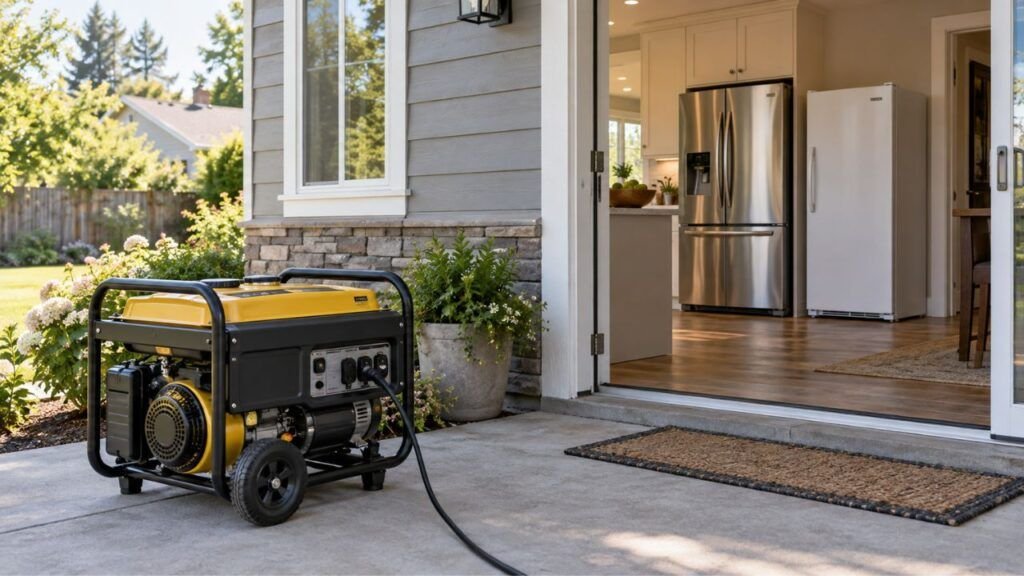
Yes, a generator can run a refrigerator and freezer together. For many homes, a 2,200- to 3,500-watt generator provides enough capacity. A 3,500- to 4,500-watt generator offers more comfortable headroom for additional essential devices.
The exact size depends on each appliance’s running and starting watts. I’ll show you how to calculate both correctly below.
Key Takeaways
- A generator can power a refrigerator and separate freezer together.
- A 2,200- to 3,500-watt generator suits many typical combinations.
- A 3,500- to 4,500-watt unit provides useful extra capacity.
- Compressor startup requires much more power than normal operation.
- A 2,000-watt generator may work with carefully verified appliances.
- Always check actual appliance wattage before choosing generator size.
- Fuel-powered generators must always operate outside your home.
Can a Generator Run a Refrigerator and Freezer at the Same Time?
Yes, you can normally power both appliances from one generator. The main issue is not their everyday running power.
The bigger concern is what happens when compressors start.
A refrigerator might only consume a few hundred watts normally. A freezer may use even less during regular operation.
However, each compressor briefly needs considerably more starting power. Your generator needs enough surge capacity for those short spikes.
This becomes especially important with two separate appliances. Their compressors operate independently and may occasionally start close together.
A refrigerator with a built-in freezer is slightly different. That appliance generally uses one refrigeration system rather than two independent appliances.
For a separate refrigerator and standalone freezer, I would usually compare generators between 2,200 and 3,500 watts first.
Moving toward 3,500 watts gives you better operating flexibility. It also leaves room for several smaller household essentials.
How Many Watts Does a Refrigerator and Freezer Use?
Refrigerators and freezers do not consume one fixed wattage continuously. Their compressors cycle, while fans, heaters, and controls operate separately.
Here are reasonable planning ranges for common household appliances.
| Appliance | Typical Running Watts | Possible Starting Watts | Main Concern |
| Mini refrigerator | 50–100W | 300–600W | Compressor startup |
| Standard refrigerator | 100–250W | 600–1,200W | Compressor startup |
| Large refrigerator | 150–400W | 800–1,500W+ | Size and extra features |
| Small chest freezer | 50–150W | 300–800W | Compressor startup |
| Large chest freezer | 100–250W | 500–1,200W+ | Size and temperature |
| Upright freezer | 100–300W | 600–1,500W+ | Compressor and defrost cycle |
These are general planning figures rather than guaranteed appliance specifications. Always prioritize the information provided for your particular refrigerator and freezer.
Running Watts
Running watts describe the power needed during normal appliance operation.
Suppose your refrigerator consumes 180 watts while its compressor runs. Your freezer might consume another 140 watts during its running cycle.
That produces a combined running load around 320 watts.
A generator rated for 320 watts would still be unsuitable. It would leave almost no capacity for compressor startup.
That is why running wattage is only half the calculation.
Starting or Surge Watts
Starting watts are the short power spike needed during compressor startup.
An appliance drawing 180 running watts might briefly need 800 watts. Another refrigerator could require 1,000 watts or considerably more.
The exact relationship is not identical for every compressor.
You may hear advice recommending two or three times running wattage. That can provide a rough estimate, but it is not universal.
Use manufacturer startup specifications whenever those numbers are available.
Also pay attention to your generator’s two different ratings:
- Running watts: power available continuously during normal operation.
- Starting watts: temporary extra output available for short surges.
A generator advertised as 3,500 watts may not provide 3,500 continuous watts. That number could represent its short-term peak rating instead.
Check both ratings before making your decision.
Why Refrigerator Wattage Is Not Constant
Your refrigerator does not keep its compressor running every minute.
It starts, cools the cabinet, stops, and starts again later. The same general process happens inside a standalone freezer.
Other components can also affect consumption throughout the day.
These can include:
- Condenser and evaporator fans
- Automatic defrost heaters
- Ice makers
- Door heaters
- Interior lighting
- Electronic controls
Room temperature also makes a noticeable difference.
A freezer sitting inside a hot garage may work harder. A refrigerator with frequently opened doors also cycles more often.
So, a watt meter may show very different readings throughout one day.
What Size Generator Do You Need for a Refrigerator and Freezer?
You do not need a huge whole-house generator for refrigeration alone. However, choosing the smallest possible generator can create unnecessary overload problems.
This table provides a practical starting point.
| Generator Size | Refrigerator | Separate Freezer | Both Together | Extra Loads |
| 1,500W | Often possible | Often possible | Usually restrictive | Very limited |
| 2,000W | Good for many models | Good for many models | Possible after verification | Limited |
| 2,200–3,500W | Yes | Yes | Practical range for many homes | Some essentials |
| 3,500–4,500W | Yes | Yes | Comfortable range | Lights, router, TV, fans |
| 5,000W+ | Yes | Yes | Plenty of capacity | Broader selected loads |
For most people powering only these two appliances, I would start comparing models around 2,200 to 3,500 watts.
That does not mean 2,200 watts always works.
An older refrigerator, large freezer, or unusually high compressor surge could require more.
Likewise, an efficient refrigerator and compact freezer may operate comfortably below 2,200 watts.
Your actual appliance ratings always matter more than generic charts.
If you want to run several additional devices, consider 3,500 to 4,500 watts. That extra room makes load management considerably easier.
How Do You Calculate the Exact Generator Size?
You can get much closer to the correct generator size yourself. The process only requires identifying normal loads and compressor startup requirements.
Here is the method I recommend using.
Step 1: Find the Running Watts
Start by checking the labels on both appliances.
You may find wattage directly on the label. The owner’s manual may also provide electrical specifications.
If only voltage and amperage appear, you may estimate input using:
Volts × Amps = VA
For a simple planning calculation, people sometimes treat that result similarly to watts. However, motor loads can make the relationship less straightforward.
Use an actual wattage specification whenever possible.
A plug-in watt meter can also show real operating consumption. Just make sure it can capture short startup peaks when needed.
Step 2: Find the Starting Watts
Now identify each appliance’s compressor startup requirement.
Manufacturer information is the best place to begin. A meter capable of capturing startup peaks can provide another useful measurement.
Do not automatically multiply running watts by three and stop there.
That shortcut can overestimate some appliances and underestimate others.
Actual compressor behavior provides a much better sizing number.
Step 3: Add the Loads Correctly
Suppose you have this setup:
Refrigerator
- Running watts: 180W
- Starting requirement: 1,100W
Freezer
- Running watts: 150W
- Starting requirement: 800W
Your combined normal running load is:
180W + 150W = 330W
Now imagine the refrigerator starts while the freezer already runs.
The temporary requirement becomes approximately:
1,100W + 150W = 1,250W
That does not automatically mean a 1,250-watt generator is ideal.
Your appliances may occasionally start closer together. Other small devices may also remain connected.
The generator’s real continuous and surge ratings also matter.
That is why moving toward the 2,200- to 3,500-watt class creates much better operating margin.
Step 4: Leave Some Generator Headroom
I would avoid planning around 100% generator output continuously.
Extra headroom helps accommodate unpredictable compressor cycling and temporary loads.
It also gives you room for essentials such as:
- LED lighting
- Wi-Fi router
- Phone chargers
- Television
- Laptop
- Small fan
You may eventually appreciate that unused capacity during an outage.
Can Both Compressors Start at the Same Time?
Yes, they can start at or near the same time.
Your refrigerator and freezer use independent thermostats and compressors. Their normal cycles will often start at different moments.
However, nothing guarantees that they always stay separated.
This is especially important immediately after an outage.
If you reconnect both appliances together, both may demand cooling immediately. That can bring their startup events unusually close together.
A generator with comfortable surge capacity handles this more easily.
With a smaller generator, connect the refrigerator first. Let its compressor settle before connecting the freezer.
This simple approach can prevent unnecessary overload trips.
Will a 2,000-Watt Generator Run a Refrigerator and Freezer?
A 2,000-watt generator may run both appliances successfully. However, I would not assume it works without checking their specifications.
One modern refrigerator usually presents a much easier load.
Adding a separate freezer changes the situation because another compressor enters the equation.
A 2,000-watt generator becomes more realistic when:
- Both appliances have modest startup requirements.
- The generator has sufficient peak output.
- Few other devices are connected.
- You stagger the initial appliance startups.
- You have verified actual appliance consumption.
It becomes less attractive with older appliances or large freezers.
Also check what “2,000 watts” means on the generator.
A generator advertised as 2,000 watts may provide something like 1,600 to 1,800 running watts, depending on its design.
For both appliances, I prefer having more reserve capacity.
Is a 3,500-Watt Generator Enough for a Refrigerator and Freezer?
For many typical homes, yes, a 3,500-watt generator is enough.
It usually provides considerably more startup room than a 2,000-watt unit. You can also power several lower-watt essentials without constantly watching capacity.
A setup might include:
- Refrigerator
- Standalone freezer
- Wi-Fi router
- Several LED lights
- Phone chargers
- Laptop
- Television
- Small fan
However, do not automatically add every kitchen appliance.
A microwave or coffee maker can consume around 1,000 watts or more. A sump pump may also have substantial startup requirements.
Space heaters and air conditioners create even larger loads.
If those devices matter during outages, calculate them separately.
What Other Appliances Can You Run at the Same Time?
Once refrigeration is covered, you may have generator capacity remaining. How much depends on your generator and actual refrigerator loads.
Here is a general way to think about common additions.
| Additional Load | Power Impact | What I Would Do |
| Wi-Fi router | Low | Usually leave connected |
| LED lights | Low | Usually easy to support |
| Phone chargers | Very low | Usually insignificant |
| Laptop | Low | Usually manageable |
| Television | Low to moderate | Usually manageable |
| Small fan | Low to moderate | Usually manageable |
| Coffee maker | High | Run when capacity allows |
| Microwave | High | Consider running separately |
| Sump pump | High startup | Recalculate generator size |
| Window AC | High startup | Recalculate generator size |
| Space heater | High continuous load | Avoid unless generator supports it |
A 3,500- or 4,500-watt generator provides much more flexibility here.
Still, I recommend prioritizing essentials during an outage.
Your refrigerator, freezer, lighting, communications, and medical equipment usually deserve priority over convenience appliances.
Should You Start the Refrigerator and Freezer Together?
If generator capacity is limited, stagger their initial startups.
You can follow this simple process:
- Start your generator with major appliance loads disconnected.
- Allow the generator to stabilize normally.
- Connect your refrigerator and let it begin operating.
- Wait until its initial compressor surge settles.
- Connect the freezer afterward.
- Add smaller household loads one at a time.
This prevents both appliances from hitting the generator immediately.
It also makes troubleshooting easier if the generator overloads.
Once both appliances settle into normal cycling, they can usually remain connected.
Their compressors will then start and stop automatically as temperatures change.
Does a Generator Need to Run Continuously?
Not necessarily, but there is no universal safe on-and-off schedule.
Refrigerators and freezers retain cold for some time after power disappears. Keeping their doors closed helps them maintain temperature longer.
However, room temperature, appliance insulation, food quantity, and door openings all matter.
Instead of guessing, place appliance thermometers inside both units.
Your refrigerator should generally remain at 40°F or below. Your freezer should remain around 0°F for normal frozen-food storage.
During outages, temperature should guide your generator strategy.
Avoid following a fixed rule like running two hours every six hours. That schedule could work under one condition and fail badly under another.
Monitor temperatures and keep doors closed whenever possible.
How Long Can a Generator Run a Refrigerator and Freezer?
Generator runtime depends more on available energy than generator wattage alone. Fuel generators and battery power stations therefore need different calculations.
Here’s how I would approach each type.
Fuel-Powered Generator Runtime
A gasoline or propane generator can operate while fuel remains available.
Its actual runtime depends on:
- Fuel-tank capacity
- Generator efficiency
- Total electrical load
- Engine size
- Gasoline or propane use
- Eco-mode operation
- Weather conditions
A generator rated at 3,500 watts does not consume maximum fuel continuously.
If your refrigerator and freezer only place a light average load, runtime may improve considerably.
Check the manufacturer’s runtime specification at different load percentages.
Remember that those published runtimes are still estimates.
Battery Power Station Runtime
Battery backup works differently.
Here, watts determine whether the power station can run your appliances. Watt-hours help determine how long the battery can keep them operating.
A simple estimate is:
Usable battery capacity ÷ average load = approximate runtime
Suppose a power station provides 2,000Wh of usable energy.
If your refrigerator and freezer average 200 watts together:
2,000Wh ÷ 200W = about 10 hours
Real runtime will usually be lower because of inverter losses and other factors.
The refrigerators also cycle, so determining their true average consumption improves accuracy.
This is why you should never choose a battery backup using output watts alone.
Fuel Generator vs Battery Power Station for Refrigerator Backup
Both options can protect refrigerated food during outages. The better choice depends on runtime needs, noise, storage, and recharging options.
Here is the basic comparison.
| Feature | Fuel Generator | Battery Power Station |
| Long outage potential | Excellent with available fuel | Depends on stored capacity |
| Indoor use | No | Usually yes |
| Noise | Noticeable | Very quiet |
| Exhaust | Produces exhaust | No exhaust during use |
| Refueling | Gasoline or propane | Requires charging |
| Surge handling | Depends on generator | Depends on inverter |
| Maintenance | More maintenance | Less routine maintenance |
| Best fit | Longer outages | Quiet indoor backup |
A fuel generator makes sense when extended outages are common.
You can continue operating as long as you safely refuel it.
A large battery power station is excellent for quiet overnight backup. It can operate indoors without engine exhaust.
Solar panels can extend battery runtime during longer outages. However, recharge speed depends heavily on sunlight and panel capacity.
Some households combine both systems.
They use battery power overnight and recharge it later. A fuel generator can provide backup when solar charging becomes insufficient.
What Can Increase Refrigerator or Freezer Power Use?
Actual consumption changes according to appliance condition and environment.
Several factors can increase how hard your appliances must work:
- Hot garage or room temperatures
- Older refrigeration equipment
- Poorly sealing door gaskets
- Frequent door opening
- Large amounts of warm food
- Automatic defrost cycles
- Ice-maker operation
- Dirty condenser coils where applicable
- Blocked airflow around the appliance
- Recovery after a long outage
Garage freezers deserve special attention during hot summers.
High surrounding temperatures make the compressor run longer. That increases daily energy consumption even if startup wattage remains similar.
Keeping doors closed is one of your easiest improvements.
Every opening releases cold air and forces additional cooling afterward.
Can a Generator Damage a Refrigerator or Freezer?
A properly sized generator should not damage a refrigerator simply because it is generator-powered.
Problems are more likely when the setup is overloaded, incorrectly connected, or producing unsuitable voltage.
Pay attention to the entire electrical setup.
Overload and Voltage Problems
If a generator cannot handle compressor startup, voltage may drop noticeably.
The generator might also trip its overload protection.
Repeatedly trying to operate beyond the generator’s limits is not something I recommend.
Choose a generator with enough startup capacity instead.
Also avoid connecting more appliances than its running output supports.
Inverter Generator vs Conventional Generator
An inverter generator can be a particularly convenient option for home backup.
It usually adjusts engine speed with load and provides stable electrical output. Many models are also quieter than traditional open-frame generators.
That can be useful when your refrigerator contains modern electronic controls.
It also helps when powering routers, laptops, televisions, or similar electronics.
This does not mean every conventional generator harms refrigerators.
A properly functioning generator used within specifications can power household refrigeration successfully.
Extension Cord Size Matters
Do not overlook the cord between your generator and appliance.
Use a heavy-duty outdoor extension cord rated for the required load.
The cord should also be appropriate for its length.
Long, undersized cords can create excessive voltage drop and heat.
Avoid damaged cords, loose plugs, and improvised connections.
For longer distances or higher currents, heavier wire becomes increasingly important.
How to Run a Refrigerator and Freezer Safely
Generator wattage matters, but safe placement matters even more. A correctly sized generator can still become dangerous when operated improperly.
Follow these basic precautions every time you use it.
- Run fuel-powered portable generators outdoors only.
- Keep the generator well away from your home.
- About 20 feet of separation provides useful safety distance.
- Point engine exhaust away from doors, windows, and vents.
- Never run generators inside garages, basements, or enclosed porches.
- Do not rely on an open garage door for ventilation.
- Keep working carbon monoxide alarms inside your home.
- Use properly rated heavy-duty outdoor extension cords.
- Keep electrical connections protected from wet conditions.
- Never feed generator power through a normal wall outlet.
- Use approved transfer equipment for connected home circuits.
- Let gasoline generators cool before adding more fuel.
- Follow your generator manufacturer’s operating instructions.
Carbon monoxide has no color or smell.
That makes indoor generator operation particularly dangerous.
If you want backup equipment operating inside your home, use an appropriately rated battery power station instead.
How Long Will Food Stay Safe If the Generator Stops?
Knowing food-storage limits helps you manage generator runtime efficiently. Door openings should be minimized whenever grid power is unavailable.
Use these general outage guidelines.
| Appliance | Approximate Cold-Holding Time With Door Closed |
| Refrigerator | About 4 hours |
| Full freezer | About 48 hours |
| Half-full freezer | About 24 hours |
These times assume you keep appliance doors closed.
A full freezer stays cold longer because frozen food adds thermal mass.
Your refrigerator loses safe temperatures much faster.
Keep appliance thermometers inside both units when possible.
Do not judge questionable food only by appearance or smell.
If refrigerated perishable food has remained above safe temperatures too long, replacing it is safer than taking unnecessary risks.
Final Words
Yes, a generator can comfortably run a refrigerator and freezer together. The important part is giving both compressors enough startup capacity without overloading your generator.
For many typical homes, I would begin around 2,200 to 3,500 watts. That range gives many refrigerator-and-freezer combinations practical operating room.
Move toward 3,500 to 4,500 watts if you also want lighting, Wi-Fi, chargers, fans, or other small outage essentials.
Most importantly, check your own appliances before buying anything.
A generic wattage chart gives you a useful starting point. Your refrigerator label, freezer specifications, and actual startup measurements give you the better answer.
Size for the compressor surge, leave sensible headroom, and use the generator safely.
Related FAQs
Can a 2,000-Watt Generator Run a Refrigerator and Freezer?
A 2,000-watt generator can run some refrigerator-and-freezer combinations, but capacity may be tight. Check both appliance startup requirements and the generator’s actual continuous and peak ratings before relying on it.
Will a 3,500-Watt Generator Run a Refrigerator and Freezer?
Yes, a 3,500-watt generator can handle many standard refrigerators and standalone freezers together. It also provides useful capacity for several low-watt household essentials during an outage.
How Many Starting Watts Does a Refrigerator Need?
Many household refrigerators can require several hundred to more than 1,000 starting watts. Actual compressor surge varies considerably, so your appliance specifications should determine the final generator size.
Does a Freezer Use More Generator Power Than a Refrigerator?
Not necessarily. Appliance size, age, compressor design, insulation, and surrounding temperature affect consumption more than whether the appliance is specifically called a refrigerator or freezer.
Can a Refrigerator and Freezer Start at the Same Time?
Yes. Their compressors operate independently, so startup events can occasionally overlap. A generator with adequate surge capacity or staggered initial startup helps prevent overload problems.
Should I Unplug My Refrigerator Before Starting the Generator?
It is usually better to start and stabilize your generator before adding major appliance loads. Then connect your refrigerator, followed by the freezer and smaller devices.
Can I Use an Extension Cord From a Generator to My Refrigerator?
Yes, when the generator and appliance instructions allow it. Use a heavy-duty outdoor-rated cord with sufficient amperage capacity and an appropriate wire gauge for its length.
Can a Battery Power Station Run a Refrigerator and Freezer Overnight?
Yes, if its inverter handles compressor startup and its battery stores enough watt-hours. Calculate runtime from actual average consumption rather than relying only on advertised output watts.
Do I Need an Inverter Generator for a Refrigerator?
You do not always need an inverter generator for refrigeration. However, inverter models provide stable output and can be convenient when simultaneously powering modern electronics and other sensitive devices.
How Long Is Food Safe in a Refrigerator During an Outage?
An unopened refrigerator generally keeps food cold for about four hours. A full freezer can hold temperature around 48 hours, while a half-full freezer lasts about 24 hours.

Brian Walker writes straightforward generator guides and reviews for homeowners and everyday users. His content focuses on solar, portable, and fuel-powered generators, with practical advice on choosing, using, and maintaining reliable backup power.















