
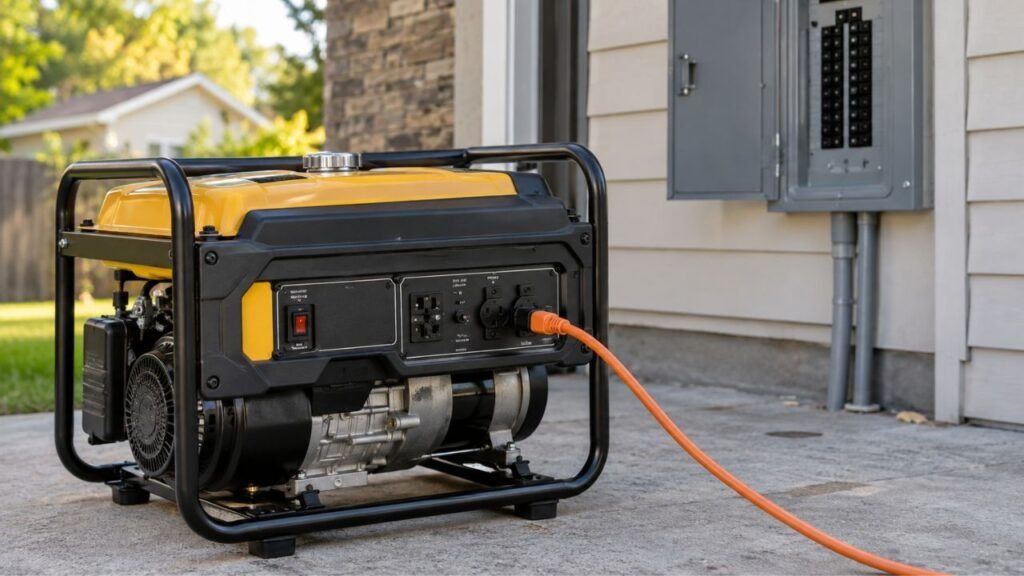
Your generator keeps tripping the breaker because something is demanding unsafe electrical current. Common causes include overloads, startup surges, short circuits, ground faults, damaged cords, overheating, or a failing breaker.
The timing of the trip often reveals where the problem starts. Below, I’ll help you narrow down the cause safely. We’ll also cover what you can fix yourself and when professional help makes sense.
Key Takeaways
- Generator breakers commonly trip because of excessive electrical load.
- Refrigerators, pumps, and air conditioners create large startup surges.
- A GFCI trip usually points toward current leakage or grounding issues.
- One outlet can overload before reaching the generator’s total wattage.
- Tripping with everything disconnected may indicate an internal generator problem.
- Never bypass a breaker or replace it with a larger one.
First, Find Out Which Breaker Is Actually Tripping
Before changing anything, identify exactly what protection device keeps shutting off. Different breakers respond to different problems, so this step can save considerable troubleshooting time.
Generator Main Breaker
The main breaker protects the generator’s overall electrical output from excessive current.
If your total connected load becomes too high, this breaker may open. It can also trip during a major electrical fault.
Look at your generator’s control panel and owner’s manual. Confirm which switch or breaker controls the main AC output.
Individual Outlet Circuit Breaker
Many generators divide their available power between several protected outlets.
For example, your generator might produce thousands of total watts. However, one receptacle could still have a 20-amp or 30-amp breaker.
That means one outlet can become overloaded first. Your generator may still have unused capacity elsewhere.
This situation commonly confuses people because the generator itself seems large enough.
GFCI Outlet or GFCI Breaker
A GFCI responds differently from a standard overcurrent breaker.
It watches for electricity taking an unintended path toward ground. Moisture, damaged insulation, faulty appliances, and electrical leakage can cause trips.
Therefore, reducing the generator’s wattage load may not solve GFCI problems.
Breaker in Your Home Electrical Panel
Sometimes the generator breaker is not actually opening.
Instead, a breaker inside your home’s electrical panel may trip. This can happen when a connected circuit becomes overloaded or develops a fault.
Pay close attention to which breaker requires resetting.
Inverter Generator Overload Protection
Some inverter generators use electronic overload protection instead of traditional breakers.
The engine may continue running while the generator stops providing AC power. An overload warning light may also appear.
Consult your specific generator manual before attempting a reset.
What Does the Timing of the Breaker Trip Tell You?
When the breaker trips can provide one of your strongest diagnostic clues. You do not need advanced electrical knowledge to notice these patterns.
| When the Breaker Trips | Possible Cause | What to Check First |
| Immediately with nothing connected | Internal fault, weak breaker, wiring problem, GFCI issue | Test the generator completely unloaded |
| Immediately after connecting one device | Faulty appliance, damaged cord, short circuit | Disconnect that device and inspect it |
| When a refrigerator, pump, or AC starts | High startup surge | Compare starting watts with generator capacity |
| After adding several appliances | Generator overload | Calculate your combined running load |
| After 10 to 40 minutes | Sustained overload, heat, poor airflow, loose connection | Reduce the load and inspect after shutdown |
| During rain or damp conditions | Moisture or ground leakage | Inspect cords and receptacles after drying |
| Only when connected to the house | Transfer equipment, circuit loading, neutral setup | Check the home connection professionally |
Use this table as a starting point rather than a final diagnosis.
Several problems can create similar symptoms. The next sections will help you separate them.
Why Does My Generator Keep Tripping the Breaker?
Most repeated breaker trips come from excessive current, a downstream electrical fault, or a generator-side problem. Start with the common causes before assuming your generator needs major repairs.
1. The Generator Is Overloaded
Generator overload happens when connected equipment demands more power than available.
Suppose your generator provides 5,000 running watts. Your refrigerator, freezer, furnace blower, lights, microwave, and pump could exceed that rating together.
The breaker trips to stop excessive current from damaging electrical components.
Start by disconnecting nonessential equipment. Run only your most important appliances first.
Add other loads gradually after the generator becomes stable.
Also remember that fuel type can affect available output. Many dual-fuel and tri-fuel generators produce less power on propane or natural gas.
Always use the correct output rating for your current fuel.
2. An Appliance Has a High Startup Surge
Motor-driven equipment requires extra power when the motor initially starts.
This temporary demand is called starting wattage or surge wattage.
Common high-surge appliances include:
- Refrigerators and freezers
- Sump pumps
- Well pumps
- Window air conditioners
- Central air conditioning equipment
- Furnace blower motors
- Air compressors
- Power tools
Your normal running load might appear perfectly acceptable. However, one compressor starting can temporarily push demand above the breaker’s limit.
Try starting larger appliances separately.
Allow one motor to reach normal speed before starting another.
This simple load sequencing can prevent many nuisance trips.
3. One Appliance Has an Electrical Fault
Sometimes the generator is working properly, but an appliance is not.
A damaged motor, failing compressor, internal short, or worn insulation can create excessive current.
Notice whether the breaker trips whenever one particular appliance starts.
Disconnect everything first. Then reconnect your appliances individually.
If one device repeatedly causes the trip, stop using it.
Have that appliance inspected before connecting it again.
4. An Extension Cord Is Damaged, Wet, or Unsuitable
Extension cords become part of your generator’s electrical system.
A damaged cord can create shorts, ground faults, voltage drop, and overheating.
Inspect the entire cord before using it.
Look for:
- Cut or cracked insulation
- Exposed conductors
- Bent plug blades
- Missing ground pins
- Loose connectors
- Burn marks
- Melted plastic
- Moisture around plugs
- Crushed or flattened sections
Cord length and wire size also matter.
A very long, undersized cord can create excessive voltage drop. Connections may become hot when carrying heavy loads.
If a plug feels unusually hot, stop using the setup.
Choose a properly rated outdoor extension cord for your load.
5. The GFCI Is Detecting a Ground Fault
A GFCI trip does not automatically mean generator overload.
GFCI protection watches for differences between outgoing and returning current.
A small amount of electricity leaking somewhere unintended can trigger it.
Possible causes include wet plugs, damaged cords, appliance leakage, or insulation problems.
Start by unplugging everything connected to that GFCI.
Reset it with no load attached.
Then reconnect your equipment one item at a time.
If one device repeatedly trips the GFCI, disconnect that device.
Do not bypass GFCI protection just to keep equipment running.
6. The Generator and Home Wiring Have a Neutral-Ground Configuration Problem
This becomes important when connecting portable generators to residential electrical systems.
Some portable generators use a bonded neutral. Others use a floating neutral configuration.
Your home’s transfer equipment determines which arrangement may be appropriate.
A mismatched setup can sometimes contribute to GFCI tripping.
However, do not simply remove the generator’s neutral-ground bond yourself.
The correct configuration depends on your generator and transfer equipment.
If tripping happens only through your home’s generator inlet, get professional help.
A qualified electrician can verify the neutral arrangement safely.
7. You Are Overloading One Outlet or One Side of the Generator
Generator total wattage and individual outlet capacity are different limits.
Imagine your generator can supply 7,000 watts overall.
That does not mean every single receptacle can provide 7,000 watts.
A 120-volt, 20-amp circuit has a much lower current limit.
Its breaker may trip while the generator still has capacity available.
This issue is especially important with larger portable generators.
Some 120/240-volt generators also divide loads across different output legs.
Poor load distribution can create problems even below total rated wattage.
Check the generator’s outlet ratings and manual carefully.
8. The Breaker Is Tripping From Heat
Does your generator run normally before suddenly tripping later?
Heat may be contributing to the problem.
A sustained heavy load increases electrical and mechanical temperatures.
Blocked cooling vents can make matters worse.
Loose electrical connections may also heat significantly under load.
Shut the generator down before inspecting anything.
Allow it to cool completely.
Check for clogged vents, debris, burned plugs, or melted connectors.
Then restart with a lighter electrical load.
If the problem disappears, excessive loading may have contributed.
If delayed trips continue, professional inspection is a good idea.
9. The Circuit Breaker May Be Weak or Faulty
Breakers can wear out after repeated trips and years of service.
A failing breaker may open below its intended current rating.
However, do not assume the breaker itself is automatically defective.
First eliminate generator overload, bad cords, and faulty appliances.
Replacing a breaker without finding the real problem can hide danger.
Never install a larger breaker to stop repeated tripping.
The breaker size protects the wiring and generator components.
10. The Generator Has an Internal Electrical Fault
Repeated trips can occasionally originate inside the generator itself.
Possible issues include damaged wiring, loose connections, failed outlets, alternator problems, or inverter electronics faults.
Internal insulation may also become damaged over time.
These faults are more likely when tripping happens completely unloaded.
Burning smells, smoke, arcing, or melted components are serious warning signs.
Shut the generator down immediately if you notice them.
Internal electrical troubleshooting should generally be handled professionally.
How to Troubleshoot a Generator That Keeps Tripping the Breaker
The safest troubleshooting approach removes variables one step at a time. Do not keep resetting the breaker without identifying what causes each trip.
- Turn off all connected appliances before touching the generator.
- Unplug every extension cord and electrical device.
- Identify exactly which breaker or protection device opened.
- Inspect generator outlets, cords, plugs, and adapters for damage.
- Start the generator outdoors with nothing electrically connected.
- Let the generator stabilize before resetting AC output.
- See whether the breaker remains on with no load.
- Connect one small, known-good device directly to the generator.
- Add additional appliances individually rather than simultaneously.
- Watch carefully when refrigerators, pumps, and compressors start.
- Compare running and starting wattage with generator ratings.
- Check the specific outlet’s amperage and breaker rating.
- Stop testing if the breaker trips completely unloaded.
- Stop immediately if you notice smoke, arcing, or melting.
The key idea is isolation.
If the generator runs unloaded, start looking downstream.
If it still trips unloaded, the generator deserves closer inspection.
How Do I Know If I Am Overloading My Generator?
Overloading becomes easier to diagnose once you separate running watts from startup demand. You should also check individual outlet limits rather than relying only on advertised generator wattage.
Check Running Watts
Running watts represent the continuous power an appliance normally requires.
Look at appliance labels, manuals, or manufacturer specifications.
Add the running wattage of everything operating simultaneously.
Keep the combined demand within your generator’s rated output.
Do not rely only on the generator’s larger starting-watt number.
Check Starting Watts
Motors and compressors commonly need extra power during startup.
This temporary surge can be substantially higher than normal consumption.
Your refrigerator might run comfortably after starting.
However, its compressor startup could briefly overload your generator.
The same applies to pumps, air conditioners, and power tools.
Account for the largest likely startup surge in your calculation.
Check the Breaker Rating for the Outlet You Are Using
The basic relationship is:
Watts = Volts × Amps
For example, a 120-volt circuit carrying 20 amps equals 2,400 watts mathematically.
However, that does not mean you should automatically plan continuous operation at that exact amount.
Your generator manual and equipment ratings should guide your actual load.
The important point is that each outlet has its own limits.
Avoid Starting Large Motor Loads Together
You can often prevent trips without buying a larger generator.
Start your largest motor-driven appliances separately.
For example, start the refrigerator first.
Wait until its compressor settles into normal operation.
Then start your sump pump or furnace blower.
This reduces the chance of multiple startup surges overlapping.
Why Does My Generator Breaker Trip With Nothing Plugged In?
A breaker that trips with everything disconnected deserves closer attention.
Your appliances and extension cords are no longer part of the circuit. That narrows the problem toward the generator or its protection system.
Possible causes include a weak breaker, failed GFCI, damaged receptacle, internal short, wiring fault, or another electrical component problem.
Start the generator with every external load disconnected. Follow the manufacturer’s normal reset procedure.
If the breaker immediately opens again, stop repeatedly resetting it.
Repeated resetting can expose already damaged electrical components to additional stress.
At this point, a qualified generator technician should inspect the unit.
This is especially important if you notice unusual smells, visible damage, arcing, or signs of overheating.
Why Does the Breaker Trip After the Generator Runs for a While?
Delayed tripping often points toward heat buildup or sustained loading.
Your generator may start normally because the breaker and wiring are cool. After operating under a heavy load, electrical components begin warming.
A marginal overload can eventually cause thermal protection to open.
Loose plugs and poor connections can also generate significant heat.
Blocked generator airflow may contribute by raising operating temperatures.
Reduce the connected load and restart after everything cools.
Check whether plugs, adapters, or outlets show discoloration.
Also make sure nothing blocks the generator’s ventilation openings.
If the breaker repeatedly trips after similar operating periods, schedule an inspection.
A failing breaker or internal connection should not be ignored.
Why Does My Generator Trip When the Refrigerator, AC, or Pump Starts?
Large motors often create their highest electrical demand during startup. That is why your generator may operate normally until a compressor or pump suddenly switches on.
Common high-surge equipment includes:
- Refrigerator compressors
- Freezer compressors
- Sump pumps
- Well pumps
- Window air conditioners
- Central AC equipment
- Furnace blower motors
- Air compressors
- Larger workshop tools
Suppose your connected appliances use 3,500 running watts.
Your generator may comfortably handle that normal load.
Then your well pump starts and briefly demands additional surge power.
That momentary increase could exceed the generator’s output or breaker limit.
Try reducing other loads before starting the large appliance.
You can also stagger startup times whenever possible.
If one appliance still trips the breaker alone, investigate that appliance too.
Why Does the GFCI Trip Even When the Generator Is Not Overloaded?
GFCI protection responds mainly to electrical leakage rather than total wattage.
That is why a lightly loaded generator can still experience GFCI trips.
Moisture is a common cause around portable generator setups.
Wet plugs, damp extension cords, and exposed outdoor connections can create leakage paths.
Damaged appliance insulation can create similar problems.
Disconnect everything from the affected GFCI outlet.
Allow wet equipment to dry completely before further testing.
Reconnect devices individually after conditions are safe.
If GFCI problems appear only when connected to home wiring, stop experimenting with neutral modifications.
Have the transfer equipment and generator configuration inspected professionally.
Why Does the Generator Breaker Trip When Connected to My House?
Connecting a generator to residential wiring introduces additional electrical factors. If the generator works normally by itself, focus on the home connection, connected circuits, and transfer equipment.
Check Your Generator Inlet and Transfer Equipment
A portable generator should connect through equipment designed for generator backup.
This may include a power inlet, transfer switch, or approved interlock system.
Never connect generator power through an ordinary household receptacle.
Improvised connections can create serious shock and backfeeding hazards.
Check the Generator’s Neutral Configuration
Your generator may use either bonded-neutral or floating-neutral construction.
Your home backup equipment must work correctly with that arrangement.
Problems can occur when the generator and transfer system are mismatched.
Do not remove bonding connections based on internet instructions alone.
Have an electrician confirm the correct configuration for your installation.
Check Which Home Circuits Are Being Powered
Turning on several major household circuits simultaneously can overload your generator.
Central air conditioning, well pumps, electric water heaters, cooking appliances, and other large loads add up quickly.
Prioritize essential circuits during an outage.
Keep unnecessary high-wattage loads switched off.
Turn Backup Circuits On Gradually
After the generator reaches stable operating speed, add circuits gradually.
Start with lighting and smaller essential loads.
Then bring refrigerators, freezers, and other motors online individually.
This approach reduces overlapping startup surges.
Can a Long Extension Cord Make a Generator Breaker Trip?
A long extension cord can contribute to generator problems when improperly sized.
Electrical resistance increases with cord length.
An undersized cord may create excessive voltage drop under heavy load.
The appliance can then operate poorly or draw abnormal current.
Cord connectors may also become hot.
Damage, corrosion, moisture, and loose plugs make the situation worse.
Use extension cords designed for outdoor generator use.
Choose the wire size based on load and distance.
Avoid combining several light-duty cords to reach farther.
If a cord or connector becomes unusually warm, disconnect it.
Replace damaged cords rather than trying temporary repairs.
What Should You Never Do When a Generator Breaker Keeps Tripping?
Breaker protection exists because something may be unsafe. Avoid shortcuts that remove protection without correcting the actual electrical problem.
- Never hold a breaker in the ON position.
- Never bypass generator overload protection.
- Never bypass a GFCI to prevent tripping.
- Never replace the breaker with a larger amperage model.
- Never continue using burned or damaged extension cords.
- Never keep resetting a breaker during an obvious short circuit.
- Never modify neutral-ground bonding without proper technical guidance.
- Never connect generator power through a regular wall outlet.
- Never use a male-to-male cord for generator backfeeding.
- Never assume repeated trips are harmless nuisance trips.
- Never operate the generator indoors, including inside garages.
Treat repeated breaker trips as warnings rather than inconveniences.
When Should You Call an Electrician or Generator Technician?
Many overload problems can be corrected through basic load management. However, electrical faults inside the generator or home wiring require qualified help.
Consider professional service when:
- The generator trips with absolutely nothing connected.
- A small known-good load still causes repeated trips.
- You smell burned insulation or electrical components.
- Plugs or generator outlets show melting or discoloration.
- The breaker refuses to remain reset.
- The GFCI repeatedly trips with no equipment connected.
- You see damaged wiring inside the generator.
- The problem happens only through your home backup connection.
- You are unsure about neutral-ground bonding.
- Your transfer switch or interlock behaves unexpectedly.
- The same problem returns after reducing the electrical load.
An electrician should generally inspect home wiring and transfer equipment.
A generator technician should handle faults inside the generator itself.
Sometimes both professionals may be needed for connected home backup systems.
Final Words
A generator breaker usually trips because it is protecting something.
If it trips under heavy demand, reduce your electrical load.
If it trips when a motor starts, investigate startup surge requirements.
If one appliance causes the trip, isolate that appliance and its cord.
If the GFCI trips, look for leakage, moisture, or grounding issues.
Most importantly, pay attention when the breaker trips with nothing connected. That pattern can point toward a generator-side electrical problem requiring professional attention.
Avoid bypassing protective devices just to keep power flowing. Finding the actual cause is safer for your generator, appliances, and home.
Related FAQs
Why Does My Generator Breaker Trip as Soon as I Plug Something In?
The connected appliance, extension cord, or outlet may have a short circuit, excessive load, or electrical fault. Disconnect that device and test the generator with another known-good load.
Why Does My Generator Trip When the Refrigerator Starts?
Refrigerator compressors require higher startup power than normal running power. That temporary surge may exceed your generator’s available capacity or the individual outlet breaker’s limit.
Why Does My Generator Trip When the Air Conditioner Starts?
Air conditioners often create large startup surges when their compressors start. Reduce other connected loads and compare the AC’s startup requirements with your generator’s surge rating.
Why Does My Generator Breaker Trip After 20 or 30 Minutes?
Delayed trips can indicate sustained overload, electrical heating, blocked cooling airflow, loose connections, or a weakening breaker. Reduce the load and inspect for overheating after shutdown.
Why Does My Generator GFCI Keep Tripping?
A generator GFCI usually trips because it detects current leakage. Wet cords, damaged insulation, faulty appliances, or certain home wiring configurations can cause repeated GFCI trips.
Why Does My Generator Trip With Nothing Plugged In?
Tripping with nothing connected may indicate a faulty breaker, damaged receptacle, failed GFCI, internal wiring problem, or another generator-side electrical fault requiring professional inspection.
Can a Bad Extension Cord Trip a Generator Breaker?
Yes. Damaged insulation, shorted conductors, wet connectors, undersized wiring, or overheated plugs can cause breaker or GFCI trips when connected to your generator.
Can I Replace My Generator Breaker With a Larger One?
No. Installing a larger breaker can allow wiring and generator components to carry unsafe current. Always replace breakers with the manufacturer-specified type and amperage rating.
Why Does My House Breaker Trip When Running on Generator Power?
The household circuit may be overloaded, a connected appliance may have a fault, or your transfer setup may need inspection. Turn circuits on gradually and investigate repeated trips.
Should I Reset a Generator Breaker Immediately After It Trips?
First remove or switch off connected loads and inspect for obvious problems. Resetting immediately without identifying the cause can expose equipment to the same unsafe condition again.
Can a Bad Appliance Trip the Generator Breaker?
Yes. A failing motor, compressor, heating element, or damaged internal wiring can create excessive current. Disconnect suspected appliances and test them separately before continued generator use.
Is a GFCI Trip the Same as an Overload?
No. A standard breaker usually responds to excessive current, while a GFCI detects current escaping its intended electrical path. The troubleshooting process is therefore different.
Can Overheating Cause a Generator Breaker to Trip?
Yes. Sustained heavy loading, poor airflow, loose electrical connections, or a hot breaker can contribute to delayed trips after the generator has operated for some time.
Can an Unbalanced Generator Load Trip a Breaker?
It can on some 120/240-volt generator setups. One output leg or protected circuit may become overloaded even when the generator’s total combined wattage remains below its maximum rating.
Does a Low-Oil Condition Trip the Generator’s Electrical Breaker?
Usually not. Low-oil protection normally shuts down the engine rather than opening the AC circuit breaker. Check your generator manual because protection systems vary by model.

Brian Walker writes straightforward generator guides and reviews for homeowners and everyday users. His content focuses on solar, portable, and fuel-powered generators, with practical advice on choosing, using, and maintaining reliable backup power.















