
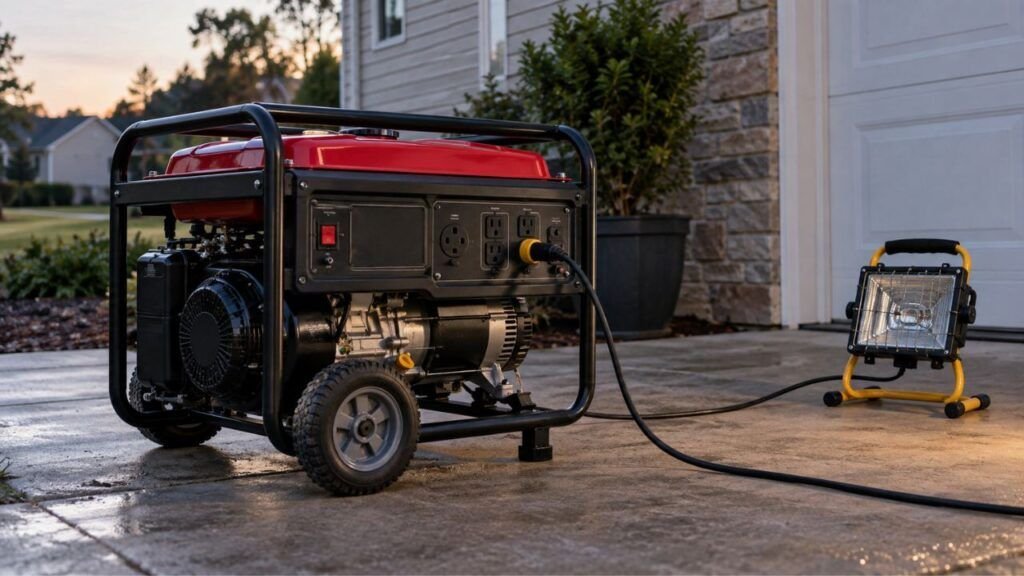
A generator that starts and then shuts off usually has a fuel, oil, airflow, choke, overload, ignition, or safety-sensor problem. The exact cause often becomes easier to identify by noticing how long the generator runs before stopping.
I’ll walk you through the easiest checks first. Then, we’ll narrow the problem down using shutdown timing, warning lights, connected loads, and other clues.
Key Takeaways
- Check the oil and fuel before taking anything apart.
- Run the generator without appliances connected during initial troubleshooting.
- A generator dying within seconds often points toward oil, choke, or safety systems.
- Running only with the choke on often suggests restricted fuel delivery.
- Shutting down under load can indicate overload or excessive startup surge.
- Some CO-equipped generators intentionally stop when carbon monoxide accumulates.
- Never permanently bypass low-oil, CO, or other safety protections.
Why Does My Generator Start and Then Shut Off?
When your generator starts successfully, several important things are already happening correctly. The engine is receiving enough fuel and air to fire initially.
Something changes shortly afterward and causes the engine to stop.
The problem may be interrupted fuel flow, incorrect air-fuel mixture, low oil, ignition trouble, overheating, or a protective shutdown.
The timing gives us one of our best clues.
A generator that stops after five seconds usually has different problems than one running for twenty minutes.
Also pay attention to whether the engine actually stops.
Sometimes the generator engine continues running while its electrical output shuts down. That points toward an electrical or overload problem rather than an engine problem.
How Long Does the Generator Run Before Shutting Off?
The amount of time your generator runs can narrow your search considerably. Timing alone cannot confirm a failure, but it provides an excellent starting point.
| Shutdown Pattern | Likely Areas to Check | Start With |
| Dies within a few seconds | Low oil, safety sensor, choke, control fault | Oil level and warning lights |
| Dies when choke moves to RUN | Carburetor restriction, lean fuel mixture | Fuel condition and carburetor |
| Runs briefly and slowly fades out | Fuel starvation, blocked vent, fuel filter | Fuel valve and tank vent |
| Runs several minutes before stopping | Fuel restriction, heat, ignition problem | Fuel flow and cooling airflow |
| Dies when an appliance starts | Overload or high startup surge | Disconnect all loads |
| Engine runs but outlets lose power | Breaker, overload, inverter or output fault | Generator breaker and load |
| Runs until hot, then stops | Overheating, ignition coil, sensor issue | Cooling airflow and fault indicators |
One pattern may overlap another, so don’t replace parts immediately.
Start with simple checks and work toward more involved repairs.
Check These Things Before Taking the Generator Apart
You can eliminate several common problems without removing the carburetor or opening electrical components.
Start with these basic checks:
- Disconnect every appliance and extension cord.
- Place the generator on firm, level ground.
- Check the engine oil correctly.
- Confirm there is enough fresh fuel.
- Make sure the fuel valve is fully open.
- Check that the selected fuel matches your fuel source.
- Confirm the choke is positioned correctly.
- Open the fuel-cap vent if your model requires it.
- Check warning lights or displayed fault codes.
- Restart the generator without any electrical load.
Always run a portable generator outdoors.
Keep it at least 20 feet from your home when possible. Point the exhaust away from windows, doors, vents, and occupied areas.
Never troubleshoot a running generator inside a garage or shed.
Common Reasons a Generator Starts and Then Shuts Off
Several problems can create almost identical symptoms. Let’s work through them from the most common and easiest checks toward deeper mechanical issues.
The Engine Oil Is Low
Low oil should be one of your first checks.
Many modern generators have automatic low-oil protection. The system shuts down the engine before insufficient lubrication causes expensive internal damage.
Put the generator on level ground before checking the oil.
Follow your manufacturer’s procedure because dipstick instructions vary. Some engines require the dipstick to rest against the threads rather than being screwed completely in.
If the level is low, add the correct oil gradually.
Avoid overfilling it.
Also look underneath the generator for fresh oil spots. A low level that keeps returning may indicate a leak.
The Low-Oil Sensor Is Triggering Incorrectly
Sometimes the oil level looks correct, but the generator still reports low oil.
Uneven ground can sometimes affect the sensor reading. Old or contaminated oil may also contribute to inconsistent operation on certain engines.
First, recheck the level on flat ground.
Then look for a low-oil indicator on the control panel.
If the warning remains active despite the proper level, consult your exact owner’s manual. The sensor or its wiring may need professional testing.
Don’t permanently disconnect the low-oil sensor.
Keeping the engine running without working protection could turn a small problem into major engine damage.
The Generator Is Running Out of Fuel
This sounds obvious, but don’t skip it.
Fuel gauges are not always perfectly accurate. The generator may also sit at an angle that moves fuel away from the pickup.
Look inside the tank when it is safe to do so.
If the tank is almost empty, add fresh fuel recommended by the manufacturer.
For propane models, check the cylinder level as well.
For dual-fuel or tri-fuel generators, verify that the selector matches the fuel you are actually supplying.
The Fuel Valve Is Closed or Fuel Flow Is Restricted
Your generator may receive enough fuel to start but not enough to continue running.
That’s why restricted fuel flow can be confusing.
The carburetor bowl may contain enough gasoline for startup. Once that small amount gets consumed, restricted flow cannot refill it quickly enough.
Check that the fuel valve is fully open.
Then inspect accessible fuel lines for:
- Kinks
- Damage
- Pinching
- Loose connections
- Visible contamination
A clogged fuel filter can create the same behavior.
If the engine gradually weakens, surges, and then dies, fuel starvation becomes even more likely.
The Fuel Tank Vent Is Closed or Blocked
Fuel leaving the tank needs air to replace it.
Without that airflow, vacuum gradually develops inside the fuel tank. Eventually, fuel flow slows enough for the engine to stall.
Some generators use a manual vent built into the fuel cap.
Make sure that vent is in its operating position when required.
Other generators use automatic venting systems that can become blocked.
Don’t use a loose fuel cap as a permanent solution.
If you suspect a vent problem, inspect and service the vent according to your manufacturer’s instructions.
Old Gas Has Restricted the Carburetor
A generator that sat unused for several months deserves extra attention here.
Old gasoline can leave deposits throughout small carburetor passages. Those tiny passages determine how much fuel reaches the engine.
The generator may still start because the choke enriches the mixture.
Once you move the choke toward RUN, the engine suddenly becomes too lean and stalls.
Other clues include:
- Surging
- Hunting RPM
- Hard restarting
- Rough operation
- Running only with partial choke
Fresh fuel may help when the problem is mild.
A badly restricted carburetor may need proper cleaning or replacement.
Avoid randomly adjusting carburetor screws without knowing their intended settings.
The Choke Is in the Wrong Position
The choke helps a cold engine start by creating a richer fuel mixture.
After the engine warms slightly, the choke normally moves toward RUN.
Leaving the choke fully engaged can make the mixture too rich. The engine may run roughly, smoke, lose power, and eventually stall.
The opposite symptom is even more informative.
If your generator only stays running with the choke partly closed, the engine may not be receiving enough fuel through its normal circuit.
That often points toward:
- Carburetor restriction
- Dirty jet
- Fuel-flow restriction
- Intake leak
Don’t treat permanent partial choke operation as the actual repair.
It is usually telling you another problem still exists.
The Air Filter Is Dirty
Your generator needs enough air for proper combustion.
A heavily restricted air filter can reduce airflow and make the fuel mixture too rich.
Remove the filter according to the owner’s manual.
Look for:
- Heavy dust
- Oil saturation
- Damage
- Debris
- Deteriorated foam
Clean reusable filters using the recommended procedure. Replace disposable filters when they become excessively dirty.
Don’t run the generator without its air filter as a permanent fix.
The Spark Plug or Ignition System Is Failing
A spark plug can work well enough for startup yet struggle afterward.
Inspect the plug when the generator is cool.
Problems may include:
- Heavy carbon deposits
- Fuel fouling
- Incorrect gap
- Damaged electrode
- Cracked insulation
A loose spark-plug boot can also cause intermittent shutdowns.
Another clue is a generator that runs normally when cold but stops after warming.
An ignition coil can sometimes fail as its temperature rises. After cooling down, it may work again temporarily.
Repeated hot shutdowns deserve proper ignition-system testing.
The Spark Arrestor Is Restricted
Many portable generators have a spark arrestor inside or near the muffler.
Carbon buildup can gradually restrict exhaust flow.
The engine may lose power, run poorly, and stall under heavier operating conditions.
Check your manual for the correct inspection procedure.
Let the exhaust system cool completely before touching it.
Mufflers and spark arrestors become extremely hot during normal operation.
Can the Carbon Monoxide Sensor Make a Generator Shut Off?
Yes. Some modern portable generators use carbon monoxide monitoring systems that intentionally shut the engine down when dangerous CO buildup is detected.
Carbon Monoxide Was Actually Detected
A CO shutdown should always be treated seriously.
Carbon monoxide is colorless and odorless. You cannot reliably detect it without proper equipment.
If the generator displays a CO warning, don’t simply restart it in the same location.
Move everyone away from the suspected exposure area.
Place the generator farther from buildings and direct its exhaust away from windows, doors, vents, and occupied spaces.
Never operate a portable generator inside:
- A house
- A basement
- A garage
- A shed
- A carport
- An enclosed porch
Opening doors or windows does not make indoor generator use safe.
The CO Safety System Has a Fault
Some generators use different indicator patterns for actual CO detection and sensor-system faults.
Read the owner’s manual before assuming the sensor itself failed.
If the system repeatedly reports a fault outdoors in proper operating conditions, professional diagnosis may be needed.
Don’t unplug, cover, disable, or bypass the CO sensor.
Its job is to stop the generator before dangerous exposure becomes worse.
Move the Generator Before Restarting It
Placement matters even when the generator is already outside.
Exhaust can collect beside walls, under decks, near open windows, and around partially enclosed spaces.
Keep portable generators well away from buildings.
As a practical safety guideline, aim for at least 20 feet of separation. Point the exhaust away from your house and other occupied areas.
Why Does My Generator Shut Off When I Plug Something In?
If your generator runs normally without appliances but fails once something starts drawing power, focus on load-related problems first.
The Generator Is Overloaded
Every generator has a maximum amount of electrical power it can provide.
Exceeding that limit can activate overload protection.
For example, your generator may handle several smaller loads individually. Running all of them together can push demand beyond its capacity.
Turn everything off and disconnect the loads.
Restart the generator and let it stabilize.
Reconnect essential appliances individually.
If it shuts down after a particular combination, your total demand may be too high.
An Appliance Has a High Starting Surge
Motor-driven appliances can require considerably more power during startup than during normal operation.
Common examples include:
- Refrigerators
- Freezers
- Air conditioners
- Sump pumps
- Well pumps
- Air compressors
- Power tools
Suppose your generator seems large enough based only on running watts.
A pump or compressor starting suddenly may still exceed the available surge capacity.
Check both the appliance’s running requirement and its startup requirement.
Don’t assume every appliance uses the same startup multiplier.
Actual starting demand varies by equipment design.
Too Many Appliances Start Together
Timing matters even when total running watts look acceptable.
Imagine your refrigerator compressor and sump pump starting almost simultaneously.
Each can create a brief surge.
Those surges stacking together may exceed the generator’s short-term capability.
Connect important loads one at a time.
Give each motor-driven appliance time to stabilize before adding another.
A Connected Appliance or Cord Has a Fault
Don’t automatically blame the generator.
A damaged extension cord or faulty appliance can cause abnormal electrical demand.
Disconnect everything and restart the generator.
Then reconnect loads individually.
If shutdown consistently happens with the same appliance or cord, stop using that equipment until it is inspected.
Look for warning signs such as:
- Melted plugs
- Burn marks
- Damaged insulation
- Loose connections
- Electrical odor
Don’t continue testing visibly damaged electrical equipment.
The Engine Runs but Electrical Output Stops
This distinction can save you considerable troubleshooting time.
Sometimes the generator does not actually shut down.
The engine keeps running, but its outlets stop supplying power.
That may happen because:
- The output breaker tripped
- Overload protection activated
- GFCI protection tripped
- The inverter section detected a problem
- An electrical fault interrupted output
Watch the engine carefully when the failure occurs.
If it keeps running normally, troubleshoot the electrical output rather than fuel or ignition.
Why Does My Generator Run for Several Minutes and Then Shut Off?
A generator that runs normally for several minutes often has different problems than one dying immediately. Heat and gradual fuel starvation become more important clues here.
Fuel Is Not Reaching the Carburetor Fast Enough
Restricted fuel flow often takes time to show itself.
The carburetor initially contains enough gasoline.
The engine runs normally until it consumes fuel faster than the system replenishes it.
Possible causes include:
- Partially clogged fuel filter
- Restricted tank vent
- Kinked fuel line
- Dirty fuel system
- Weak fuel pump on applicable models
The engine may begin surging before it stops completely.
The Generator Is Overheating
Generators produce considerable heat during operation.
Cooling becomes harder when vents become blocked or airflow is restricted.
Possible overheating causes include:
- Dirt around cooling openings
- Heavy electrical load
- Poor ventilation
- Debris around the engine
- Cooling-system problems on liquid-cooled generators
Don’t place the generator against a wall just to protect it from weather.
It needs safe clearance and unrestricted airflow.
Also avoid placing it inside an enclosure not specifically designed for generator operation.
An Ignition Component Fails When Hot
Heat-related ignition failures can produce a distinctive pattern.
The generator:
- Starts normally.
- Runs well when cold.
- Stops after warming.
- Refuses to restart immediately.
- Starts again after cooling.
That pattern may indicate an ignition coil or another heat-sensitive component.
It is worth having the ignition system properly tested before replacing parts randomly.
A Temperature or Safety Sensor Is Triggering
Some generators monitor operating temperature and other engine conditions.
A real fault may trigger protection.
A faulty sensor or damaged connection can sometimes create an incorrect shutdown signal.
Check warning indicators immediately after the generator stops.
Don’t reset everything before noting the displayed code.
That code may be the best clue you have.
Does the Fuel Type Change the Diagnosis?
Yes. Gasoline, propane, natural gas, and diesel systems can fail differently. Start with troubleshooting steps that match the fuel your generator actually uses.
Gasoline Generator
Gasoline models are especially sensitive to storage-related fuel problems.
Common areas include:
- Stale fuel
- Carburetor deposits
- Fuel filters
- Tank vents
- Choke position
- Fuel lines
If a gasoline generator sat unused for months and only runs with choke, start by investigating fuel delivery.
Propane Generator
Propane eliminates carburetor varnish caused by old gasoline, but other fuel problems remain possible.
Check:
- Propane cylinder level
- Cylinder valve
- Regulator
- Hose connections
- Fuel selector
- Cold-weather fuel supply
A heavily loaded generator may demand more propane than a small or nearly empty cylinder can reliably supply.
Do not modify propane regulators or fittings casually.
Gas leaks require immediate attention.
Natural Gas or Standby Generator
Natural gas standby systems add another level of complexity.
Potential shutdown causes include:
- Inadequate gas supply
- Incorrect gas pressure
- Controller alarms
- Low oil pressure
- Battery issues
- Charging-system problems
- Output-voltage faults
- Temperature faults
Home gas-system pressure testing belongs with a qualified technician.
Don’t adjust gas regulators without proper equipment and training.
Diesel Generator
Diesel generators can experience:
- Clogged fuel filters
- Contaminated fuel
- Air entering fuel lines
- Restricted fuel flow
- Injector problems
Diesel fuel systems may require bleeding after air enters them.
Follow the manufacturer’s exact procedure rather than applying gasoline-engine troubleshooting steps.
Portable Generator vs. Standby Generator Shutdown Problems
Portable generators and standby generators share several basic problems. Fuel supply, oil protection, electrical overloads, and sensor faults can affect both.
However, their troubleshooting paths quickly become different.
Portable generators commonly involve:
- Carburetor problems
- Fuel-cap venting
- Choke settings
- Low-oil shutdown
- CO protection
- Connected appliance loads
Standby generators may add:
- Battery charging systems
- Automatic controllers
- Gas-pressure monitoring
- Transfer equipment
- Output-voltage monitoring
- Temperature sensors
- Stored fault codes
For a standby generator, always check its controller before resetting faults.
Write down the exact code first.
Repeated fault codes provide much better information than simply knowing the engine stopped.
Step-by-Step Troubleshooting a Generator That Won’t Stay Running
You don’t need to attack every possible cause at once. Follow this order and let each result guide your next step.
- Check warning lights first. Note any oil, overload, CO, temperature, or fault indicators.
- Disconnect all electrical loads. This immediately separates engine problems from load problems.
- Place the generator on level ground. This helps ensure accurate oil readings and normal operation.
- Check the engine oil. Correct a low level before restarting.
- Check the fuel. Make sure there is enough fresh, correct fuel.
- Open the fuel valve fully. Also confirm the fuel selector matches your fuel source.
- Check the fuel-cap vent. Open it if your generator uses a manual vent.
- Verify the choke position. Follow the starting and running positions listed in your manual.
- Inspect the air filter. Clean or replace a heavily restricted element.
- Check accessible fuel lines. Look for kinks, leaks, or visible damage.
- Restart without any load. Note exactly how long the generator runs.
- Watch how it stops. Does it suddenly cut off, gradually fade, surge, or display a warning?
- Reconnect appliances one at a time. Do this only if it runs correctly unloaded.
- Stop if the fault continues. Persistent unexplained shutdowns deserve proper diagnosis.
The goal isn’t just making the generator run again.
You want to identify why it stopped so the problem doesn’t return during the next outage.
What Not to Do When a Generator Keeps Shutting Off
Some shortcuts can create much larger safety problems. Avoid these approaches even when you urgently need backup power.
- Don’t permanently bypass the low-oil shutdown.
- Don’t disable or cover a CO sensor.
- Don’t run the generator indoors for easier troubleshooting.
- Don’t permanently operate with a loose fuel cap.
- Don’t force the generator to run indefinitely with the choke closed.
- Don’t keep reconnecting a load that repeatedly causes shutdowns.
- Don’t touch hot exhaust components immediately after operation.
- Don’t open high-voltage generator sections without proper training.
- Don’t ignore fuel or propane leaks.
- Don’t repeatedly reset unexplained protection faults.
Safety systems can sometimes be frustrating.
They are also protecting the engine, connected equipment, and people nearby.
When Should You Stop Troubleshooting and Call a Technician?
Basic owner maintenance solves many generator shutdown problems. Some symptoms, however, should move the job beyond simple home troubleshooting.
Consider professional service when you notice:
- Repeated CO-system fault indicators
- Correct oil level but repeated low-oil shutdowns
- Gasoline or propane leaks
- Burning electrical smells
- Melted wiring or connectors
- Visible sparks
- Severe engine knocking
- Unstable electrical output
- Repeated shutdown after warming
- Persistent controller fault codes
- Natural gas pressure problems
- Suspected alternator or inverter failure
- Ignition problems requiring electrical testing
The same applies when troubleshooting requires safety-system bypassing.
At that point, professional diagnosis is the better choice.
How Can You Prevent the Generator From Shutting Off Again?
Most shutdown problems become easier to avoid with basic maintenance. A generator that sits unused still needs attention before the next outage.
Use and Store Fuel Correctly
Don’t forget about gasoline simply because the generator isn’t running.
Fuel quality changes during storage.
Follow the manufacturer’s storage instructions and use stabilizer when recommended.
Avoid filling the generator with questionable fuel before an emergency.
For dual-fuel and tri-fuel generators, periodically verify that alternate fuel systems also work correctly.
Follow the Oil and Filter Maintenance Schedule
Check the engine oil regularly.
Change it at the interval specified for your exact generator.
Service the air filter and other filters according to the same maintenance schedule.
Don’t rely on one universal maintenance interval.
A small portable generator may have very different requirements than a large standby unit.
Exercise the Generator as Recommended
Occasional operation can help reveal problems before an actual outage.
Standby generators may exercise automatically.
Portable generators may require manual testing.
Follow your manufacturer’s recommended schedule rather than choosing an arbitrary runtime.
During a test run, pay attention to:
- Starting behavior
- Engine sound
- Warning lights
- Fuel leaks
- Electrical output
Finding a problem during a planned test is much easier than finding it during a storm.
Keep Cooling and Airflow Areas Clear
Clean leaves, dirt, insects, and debris from cooling openings.
Inspect the air filter regularly.
Keep appropriate clearance around the generator during operation.
Good airflow supports both combustion and engine cooling.
Know Your Generator’s Load Limit Before an Outage
Don’t wait for a blackout to calculate your power needs.
Write down the important loads you expect to run.
Include both running watts and startup requirements.
Prioritize essentials such as:
- Refrigerator
- Freezer
- Furnace blower
- Sump pump
- Well pump
- Lights
- Communications equipment
Leave some operating headroom rather than planning to run permanently at maximum capacity.
Final Words
If your generator starts and then shuts off, begin with oil, fuel, choke position, airflow, warning indicators, and connected loads. Those simple checks resolve or narrow down many common problems.
Pay particular attention to when the engine stops.
A generator dying immediately suggests a different problem than one stopping after twenty minutes. A generator that only dies when appliances start points you toward load or surge demand.
Also determine whether the engine actually stops.
If the engine continues running while the outlets lose power, you are likely dealing with the generator’s electrical output or protection system instead.
And if a CO warning appears, treat it as a safety issue first.
Don’t defeat a protective system simply because the generator keeps stopping. Find the reason it is stopping and correct that problem properly.
Related FAQs
Why Does My Generator Start and Shut Off After 5 Seconds?
A generator shutting off within five seconds may have low oil, an active safety sensor, an incorrect choke setting, or a control-system fault. Check the oil level, warning lights, fuel supply, and choke before investigating deeper mechanical problems.
Why Does My Generator Start but Won’t Stay Running?
Fuel starvation is one of the most common reasons a generator starts but won’t stay running. Low oil, dirty carburetor passages, incorrect choke position, restricted airflow, ignition problems, or safety systems can create the same symptom.
Why Does My Generator Only Run With the Choke On?
If your generator only runs with the choke partly closed, the normal fuel mixture may be too lean. A clogged carburetor jet, restricted fuel flow, or intake leak is often responsible.
Why Does My Generator Shut Off After a Few Minutes?
A generator that runs several minutes before stopping may have restricted fuel flow, a blocked tank vent, overheating, a heat-sensitive ignition problem, or a protective sensor activating.
Why Does My Generator Shut Off When I Plug Something In?
The connected appliance may push the generator beyond its available wattage or startup capacity. Disconnect all loads, restart the generator, and reconnect appliances individually to identify which load causes the problem.
Can Low Oil Make a Generator Shut Off Immediately?
Yes. Generators equipped with low-oil protection can stop the engine quickly when the oil falls below a safe level. Always check oil on level ground using the procedure specified by your manufacturer.
Can Too Much Oil Make a Generator Run Poorly?
Yes. Overfilling an engine with oil can create operating problems, including smoking and poor performance. Keep the oil within the manufacturer’s recommended range rather than filling beyond the specified level.
Can a Bad Spark Plug Cause a Generator to Start and Die?
Yes. A fouled, damaged, incorrectly gapped, or loose spark plug can create weak or intermittent ignition. The engine may start initially and then misfire, run roughly, or stall.
Can a Clogged Fuel-Cap Vent Make a Generator Stop Running?
Yes. A blocked tank vent can create vacuum as fuel leaves the tank. Fuel flow eventually slows, which can make the engine lose power and stop after running briefly.
Will a Carbon Monoxide Sensor Shut a Generator Off?
Yes. Generators equipped with automatic CO detection can shut down when dangerous carbon monoxide accumulation is detected. Move the generator to a safer outdoor location instead of bypassing the sensor.
Why Does My Generator Shut Off Even With a Full Tank?
A full tank doesn’t guarantee proper fuel delivery. A clogged filter, blocked tank vent, closed fuel valve, carburetor restriction, low oil, overheating, ignition fault, or safety system can still stop the engine.
Why Does My Generator Run Again After It Cools Down?
A generator that restarts after cooling may have an overheating problem or a heat-sensitive ignition component. Restricted airflow, heavy loads, ignition-coil problems, or temperature-related sensor faults should be investigated.

Brian Walker writes straightforward generator guides and reviews for homeowners and everyday users. His content focuses on solar, portable, and fuel-powered generators, with practical advice on choosing, using, and maintaining reliable backup power.















