
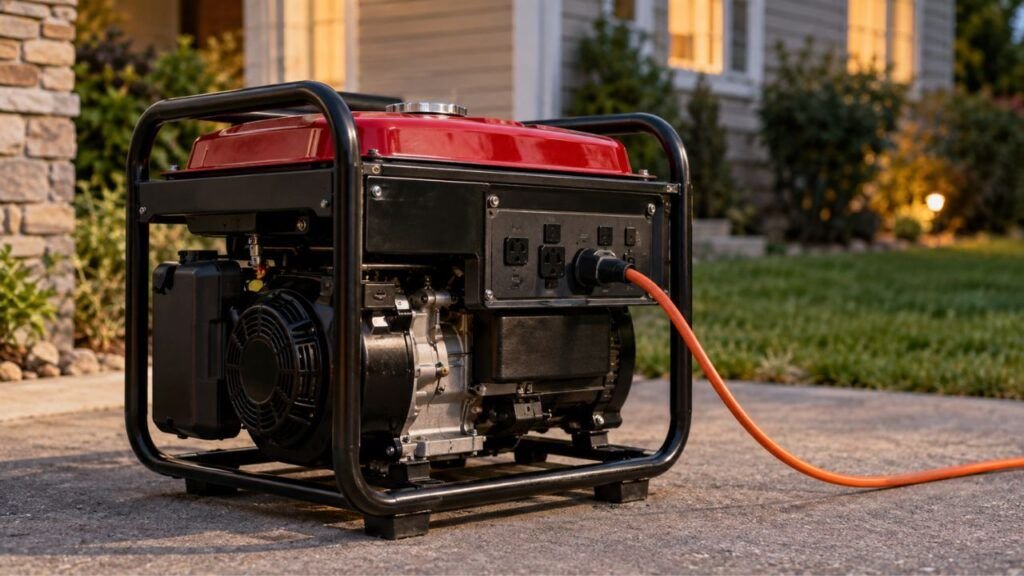
A generator can start and run normally but produce no power because the engine and electrical system work separately. Common causes include a tripped breaker, GFCI protection, bad connections, lost residual magnetism, a failed AVR, worn brushes, or alternator damage.
I’ll help you start with the simplest checks first. Then, we’ll narrow the problem down before you replace anything unnecessarily.
Key Takeaways
- A running engine does not guarantee electrical power is being produced.
- Start by disconnecting every load and checking breakers and GFCI outlets.
- Test several outlets using a simple, known-working appliance.
- Long storage can sometimes cause a loss of residual magnetism.
- AVR, brushes, capacitors, and windings are later-stage possibilities.
- Inverter generators require different troubleshooting than conventional models.
- Stop troubleshooting if you find burnt wiring or unstable voltage.
What Does It Mean When a Generator Runs but Has No Power?
Your generator actually performs two separate jobs. The engine creates mechanical power, while the electrical system converts that movement into usable electricity.
Because those systems are separate, the engine can run perfectly normally while the outlets remain completely dead.
This is why listening to the engine alone does not tell you much. A smooth-running engine mainly tells you the fuel and ignition systems are working.
The next question is whether electricity is being generated and delivered properly.
It is also important to separate two different problems.
Your generator may truly be producing no electricity at its outlets. Or, the generator may be producing power correctly, but that electricity is not reaching your house or appliance.
Finding where the power stops makes troubleshooting much easier.
Start With These Quick Checks Before Taking Anything Apart
Before opening the generator or testing internal parts, work through these simple checks. Many no-power problems are solved right here.
- Turn off the generator and disconnect every connected appliance.
- Remove extension cords, adapters, and transfer cords.
- Restart the generator with nothing connected.
- Let the engine stabilize for a minute or two.
- Confirm the main AC breaker is switched on.
- Reset any GFCI receptacles on the control panel.
- Check for an overload or reset button.
- Look for warning lights or error indicators.
- Test another outlet on the generator.
- Connect one simple, known-working appliance.
- Try another extension cord if one is required.
- Check that locking plugs are fully inserted and twisted securely.
I would avoid testing with an air conditioner, refrigerator, well pump, or other motor load initially.
Instead, use something simple that requires relatively little starting power.
If that appliance works, your generator may be fine. The original appliance, cord, or connection may be causing the problem.
Generator Runs but Produces No Power: Quick Diagnosis Table
The exact symptom can tell you where to start looking. Use this table before assuming that an expensive internal component has failed.
| What You Notice | Possible Cause | What to Check First |
| Every outlet is dead | Breaker, GFCI, excitation problem | Reset protection devices |
| Only one outlet is dead | Outlet, breaker, or wiring issue | Test another outlet |
| Generator worked before long storage | Lost residual magnetism | Check model-specific guidance |
| Voltage is present but very low | AVR, excitation, engine-speed issue | Disconnect all loads |
| Voltage rises and falls | AVR, brushes, loose connection | Stop using appliances |
| Power disappears under load | Overload or startup surge | Remove loads and restart |
| Generator works but house stays dark | Cord, inlet, transfer switch | Check connection path |
| Inverter generator shows overload | Electronic protection | Remove load and reset |
| Electrical burning smell appears | Wiring or alternator damage | Shut generator down |
Do not keep sensitive electronics connected while generator voltage is abnormal.
Common Reasons Your Generator Starts but Produces No Power
Once the easy external checks are complete, you can start narrowing down the actual cause. Some faults are simple, while others require electrical testing or professional repair.
The Circuit Breaker Has Tripped
A tripped breaker is one of the first things I would check.
The breaker protects your generator against excessive current. If the generator was overloaded or an appliance shorted, the breaker may trip while the engine keeps running.
Disconnect everything before resetting it.
Then restart the generator and test it without a heavy load.
If the breaker immediately trips again with nothing connected, stop resetting it repeatedly. You may have an internal electrical problem or faulty breaker.
The GFCI Outlet Has Tripped
Many portable generators sold in the United States include GFCI-protected receptacles.
A ground fault can trip the GFCI without stopping the engine. That can make the generator appear completely normal except for dead outlets.
Look for TEST and RESET buttons on the receptacle.
Press RESET after disconnecting all loads.
If the GFCI refuses to reset, inspect the connected equipment and cords. A faulty appliance, wet connection, or generator problem could be triggering it.
The Cord, Plug, or Appliance Is Actually the Problem
Sometimes the generator is producing electricity normally.
The problem simply happens farther down the line.
A damaged extension cord can have broken internal conductors. A twist-lock plug may also look connected without being fully seated.
Inspect the entire connection path.
Look for:
- Loose plugs
- Damaged insulation
- Burnt terminals
- Bent prongs
- Melted connectors
- Corrosion
- Damaged adapters
- Faulty appliances
Try plugging a known-working device directly into the generator.
If that works, the generator itself probably is not your main problem.
The Generator Has Lost Residual Magnetism
Conventional generators need a small amount of existing magnetism to begin producing electricity.
This remaining magnetic field is called residual magnetism.
If the generator sits unused for a long period, that magnetic field can sometimes weaken enough to prevent voltage buildup.
The engine may still start and run normally.
You may notice:
- No voltage at the outlets
- Very low output voltage
- No obvious breaker problem
- Normal engine operation
- The issue appeared after long storage
Loss of residual magnetism is possible, but do not automatically assume it is the cause.
Several electrical failures can create very similar symptoms.
The Automatic Voltage Regulator Has Failed
Many conventional generators use an Automatic Voltage Regulator, commonly called an AVR.
The AVR helps control the generator’s output voltage.
If it fails, the generator may produce no voltage, low voltage, or unstable voltage.
Possible signs include:
- Dead outlets despite normal engine operation
- Voltage that rises and falls
- Output significantly below normal
- Power that disappears unexpectedly
Before replacing an AVR, confirm your generator actually uses one.
Not every generator has a traditional AVR.
Inverter generators, capacitor-regulated models, and other designs use different electrical systems.
The Carbon Brushes Are Worn or Stuck
Some conventional generators use carbon brushes to transfer excitation current to the rotating part of the alternator.
Those brushes wear down over time.
They can also stick in their holders or lose proper contact.
Possible causes include:
- Worn brush material
- Weak brush springs
- Dirty slip rings
- Oxidation
- Loose electrical connections
- Damaged brush holders
If your generator does not use brushes, this diagnosis obviously does not apply.
Check your model design before ordering replacement parts.
The Excitation Capacitor Has Failed
Some generator designs use a capacitor as part of the voltage-building or regulation system.
If that capacitor fails, the generator may run normally but produce little or no electrical output.
A failed capacitor may sometimes look:
- Swollen
- Cracked
- Leaking
- Burnt
However, a capacitor can also fail without visible damage.
Testing usually requires the correct meter and safe capacitor-discharge procedures.
Do not assume every brushless generator uses the same capacitor arrangement.
Generator electrical designs vary significantly between manufacturers.
A Wire or Electrical Connection Is Loose
Generators vibrate constantly while operating.
Over time, that vibration can loosen connectors, terminals, and wiring.
Heat and corrosion can create similar problems.
You may have an intermittent connection if power appears and disappears when the generator vibrates or warms up.
Possible problem areas include:
- Outlet terminals
- Alternator wiring
- Control-panel connections
- Brush wiring
- AVR connections
- Neutral connections
- Breaker terminals
Do not reach into the generator while it is running.
Internal electrical testing should only be done by someone who understands the system.
The Rotor, Stator, or Excitation Winding Is Damaged
The alternator contains electrical windings that actually generate the power.
Those windings can fail after severe overheating, overloading, insulation breakdown, or an electrical short.
Possible signs include:
- Burnt electrical smell
- Visible darkened windings
- No voltage despite normal excitation components
- Repeated breaker trips
- Extremely unstable output
This is generally not a beginner repair.
Testing windings correctly may require resistance and insulation measurements.
If you suspect alternator damage, professional service usually makes more sense.
Is the Problem Different on an Inverter Generator?
Yes. Inverter generators produce electricity differently from traditional conventional generators. That changes both the possible causes and the troubleshooting process.
Check the Overload Indicator First
An inverter generator may continue running after its electronic protection stops AC output.
This commonly happens after an excessive load or large startup surge.
Disconnect every appliance.
Then follow the manufacturer’s reset or restart procedure.
Do not immediately assume the inverter module has failed.
Check the Output or Ready Indicator
Many inverter generators have an indicator showing whether normal AC output is available.
If the engine runs but the output indicator remains off, the electronic system may be protecting itself or detecting a fault.
Different brands use different light colors and patterns.
Use your owner’s manual rather than assuming every indicator works identically.
A Failed Inverter Module Can Stop AC Output
Instead of delivering raw alternator output directly to the receptacles, an inverter generator processes the electricity electronically.
If the inverter or control electronics fail, the engine may still run normally while the outlets remain dead.
This is why conventional troubleshooting advice does not always apply.
Replacing an AVR or flashing the field may be completely irrelevant on certain inverter generators.
How Can I Tell Whether the Generator Is Actually Producing Voltage?
Before assuming the alternator has failed, confirm whether electricity is actually reaching the generator’s receptacles. Start with the safest testing method available.
Test With a Known-Working Appliance First
This is the easiest test.
Use a simple appliance or tool that you already know works properly.
Plug it directly into the generator without a long extension cord.
If it runs normally, your original cord or appliance may be the problem.
Check the Built-In Voltage Display
Some generators have a digital meter showing output voltage.
Others show voltage, frequency, runtime, and load percentage.
If your display shows normal output but an appliance receives no power, focus on the outlet, breaker, cord, or appliance.
A zero or abnormal reading points more toward the generator itself.
Check Outlet Voltage With a Multimeter
If you are comfortable using a multimeter, you can check voltage directly at the receptacle.
A typical U.S. household-style receptacle should read close to its intended nominal voltage.
The exact acceptable range depends on the generator and load.
If normal voltage is present at the receptacle, the alternator is probably producing electricity.
That means the problem is likely farther downstream.
Never remove alternator covers and probe exposed internal wiring unless you have the necessary electrical knowledge.
What Does Zero, Low, or Unstable Voltage Tell You?
Different voltage symptoms often point toward different parts of the electrical system. Treat this as a guide rather than an exact diagnosis.
- Zero voltage: Check breakers, GFCI protection, excitation, connections, and regulation components.
- Very low voltage: Excitation or voltage regulation may be failing.
- Low voltage with low frequency: Engine speed may also be too low.
- Fluctuating voltage: The AVR, brushes, connections, or engine speed could be unstable.
- Normal generator voltage but no house power: Check the cord, inlet, transfer switch, and panel.
- Voltage disappears when loads connect: Suspect overload, startup surge, or a faulty appliance.
If output is badly unstable, disconnect sensitive electronics immediately.
Should You Try Field Flashing the Generator?
Field flashing is a method used to restore the magnetic field needed by certain conventional generators after residual magnetism has been lost.
You may see several field-flashing methods online, including battery-based methods and procedures involving corded drills.
I would not use a random procedure simply because another generator looks similar.
The correct approach depends on the alternator design, excitation system, polarity, and manufacturer.
Some portable-generator manufacturers provide approved field-flashing instructions for specific models. If your manual provides one, follow that procedure exactly.
Do not assume field flashing applies to an inverter generator.
It also will not repair damaged windings, failed electronics, or a defective breaker.
If you cannot confirm an approved procedure for your model, professional diagnosis is the safer choice.
What If the Generator Has Power but Your House Does Not?
If the generator’s outlets test normally but the house remains without power, the problem may be outside the generator itself. Work through the entire connection path.
Check the Generator Cord and Power Inlet
Inspect the generator cord for obvious damage.
Make sure the plug is inserted completely into both the generator and house inlet.
For twist-lock connections, rotate the plug fully into the locked position.
A loose connection can prevent power from reaching the house.
Check the Transfer Switch Position
A transfer switch determines whether selected circuits receive utility or generator power.
If it remains in the utility position, your generator can run normally while the home circuits stay dead.
Check the transfer-switch instructions for your installation.
Check the Transfer Switch or Panel Breakers
A breaker between the generator and your home’s loads can also interrupt power.
Look for tripped breakers in the approved generator connection system.
Do not keep resetting a breaker if it immediately trips again.
Never Backfeed the House Through a Wall Outlet
Do not connect a portable generator to your home using a male-to-male cord or ordinary wall receptacle.
That can energize utility wiring unexpectedly.
It creates serious electrocution and fire hazards.
Use a properly installed transfer switch, interlock arrangement, or other approved connection method.
Why Did the Generator Suddenly Stop Producing Power While Running?
If the generator was working and then lost power, focus on events that could have interrupted output during operation.
Possible causes include:
- The connected load exceeded generator capacity.
- A refrigerator or pump created a large startup surge.
- An appliance developed a short circuit.
- The generator breaker tripped.
- GFCI protection activated.
- A plug or connection became loose.
- The AVR or excitation system failed.
- Inverter overload protection activated.
- An electrical component overheated.
- Alternator wiring developed a fault.
Think about what happened immediately before the power disappeared.
If another appliance switched on at that moment, overload or startup surge becomes more likely.
Why Does the Breaker Trip Again After I Reset It?
A breaker that keeps tripping is telling you something is wrong.
Do not treat repeated resetting as the repair.
Disconnect every load from the generator.
Reset the breaker and run the generator unloaded.
If the breaker now holds, reconnect appliances one at a time.
One appliance, cord, or excessive combined load may be causing the problem.
If the breaker trips with absolutely nothing connected, the issue may involve the breaker itself or an internal electrical fault.
That is the point where I would stop repeatedly resetting it.
When Should You Stop Troubleshooting and Call a Technician?
Basic outlet and breaker checks are reasonable for most generator owners. Internal electrical work is different and can involve dangerous voltage.
Consider professional service when:
- The breaker trips with no external load connected.
- Voltage changes wildly during operation.
- You smell burning electrical insulation.
- Wires or connectors appear melted.
- Alternator windings look burnt.
- The AVR requires electrical testing.
- Internal excitation wiring needs diagnosis.
- Field flashing does not restore output.
- The inverter module appears faulty.
- The generator remains under warranty.
- You are uncomfortable testing electrical circuits.
Disconnect all valuable appliances until output is confirmed stable.
How to Prevent a Generator From Running Without Producing Power
You cannot prevent every electrical failure, but proper operation and maintenance reduce the chances significantly.
- Exercise the generator according to manufacturer recommendations.
- Follow the correct startup procedure.
- Connect large appliances gradually.
- Avoid operating above rated output.
- Account for motor startup wattage.
- Disconnect loads before shutting down.
- Keep receptacles and connections dry.
- Inspect cords before every outage season.
- Fix recurring breaker trips instead of ignoring them.
- Follow the manufacturer’s maintenance schedule.
- Test the generator before severe weather arrives.
A short test before storm season is much better than discovering a problem during an outage.
Final Words
If your generator starts but produces no power, begin with the simple things. Disconnect the loads, reset the breaker and GFCI, test another outlet, and eliminate bad cords or appliances first.
If those checks do not solve the problem, move deeper into the electrical system. Residual magnetism, AVR failure, worn brushes, capacitors, wiring, and alternator damage are all possible depending on the generator design.
The most useful question is not simply, “Which part is bad?” Instead, figure out exactly where the electricity stops. That approach saves time, avoids unnecessary parts, and helps you know when professional service is the better option.
Related FAQs
Why Does My Generator Run but the Outlets Have No Power?
A tripped breaker, GFCI outlet, bad connection, lost residual magnetism, failed voltage-regulation component, or alternator problem can leave the engine running while the outlets remain dead.
Can a Generator Run With a Bad AVR?
Yes. On generators using an AVR, the engine can continue running even when the AVR fails. Electrical output may disappear, become too low, or fluctuate significantly.
How Do I Know if My Generator Lost Residual Magnetism?
Loss of residual magnetism is more likely when a conventional generator worked previously, sat unused for a long period, and now runs normally but produces little or no voltage.
Can a Tripped GFCI Make a Generator Appear to Have No Power?
Yes. A tripped GFCI can disconnect power from protected receptacles while the generator engine continues running normally.
Why Does My Generator Have Power at One Outlet but Not Another?
One outlet may have a separate breaker, GFCI circuit, loose connection, wiring fault, or damaged receptacle. Test other outlets before assuming the alternator has failed.
Why Does My Generator Produce Power Until I Plug Something In?
The appliance may overload the generator, draw excessive startup current, have an electrical fault, or cause a protection device to trip.
Why Does My Inverter Generator Run but Produce No AC Power?
An inverter generator may stop AC output because of an overload, electronic protection, faulty connected load, control problem, or failed inverter module while the engine continues running.
Can I Field Flash Any Portable Generator?
No. Field-flashing methods depend on generator design. Only use a procedure specifically approved for your generator model or have a qualified technician diagnose it.
Can Low Oil Make a Generator Run but Produce No Electricity?
Usually, low-oil protection is designed to stop or prevent engine operation rather than simply disabling AC output. However, always check your generator’s specific operating manual.

Brian Walker writes straightforward generator guides and reviews for homeowners and everyday users. His content focuses on solar, portable, and fuel-powered generators, with practical advice on choosing, using, and maintaining reliable backup power.















