
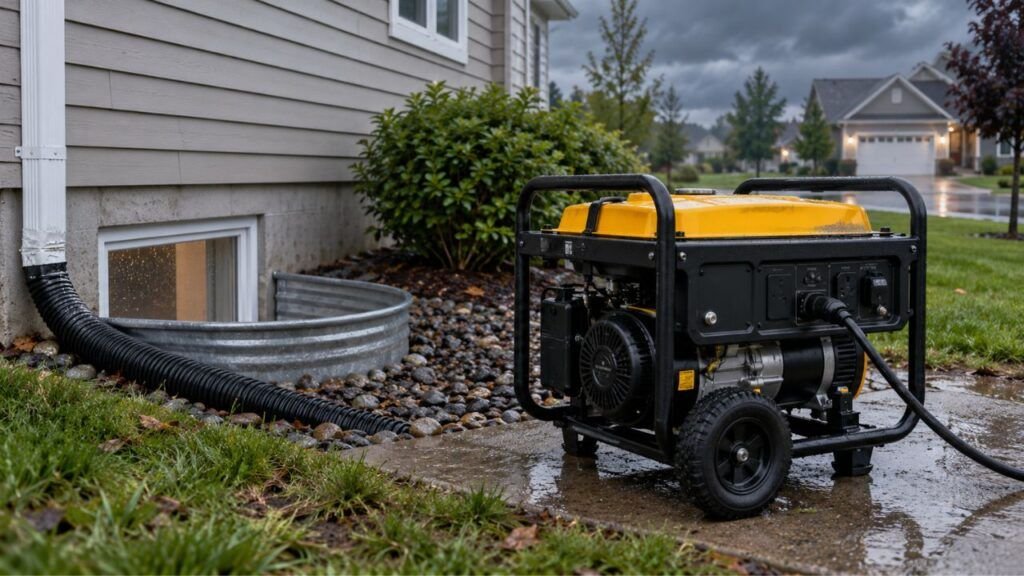
Most residential sump pumps need a generator with about 2,000 to 4,500 starting watts, depending on the pump size and motor. A 1/3 HP sump pump often works with a 2,000–3,000W generator. A 1/2 HP pump usually needs around 3,000–4,500W of available starting capacity.
However, horsepower alone cannot tell you the exact generator size. In this guide, I’ll show you how to check your pump, calculate its real power needs, account for startup surge, and choose enough generator capacity for other essential appliances.
Key Takeaways
- A 1/3 HP sump pump generally needs a 2,000–3,000W generator.
- A 1/2 HP pump often needs about 3,000–4,500W starting capacity.
- Larger 3/4 HP pumps may require around 4,000–5,500W.
- Starting watts usually determine the minimum generator size you need.
- Pumps with identical horsepower can have different electrical requirements.
- Always check your pump’s voltage, amperage, and manufacturer specifications.
- Add refrigerator, freezer, furnace, and lighting loads before sizing.
- Choose some extra generator capacity instead of operating at maximum output.
What Size Generator Do You Need for a Sump Pump?
The right generator depends mainly on your sump pump’s running and starting demand. The table below gives useful planning ranges for common residential pump sizes.
| Sump Pump Size | Typical Running Watts | Possible Starting Watts | Practical Generator Size |
| 1/4 HP | 400–600W | 1,200–2,000W | 2,000–2,500W |
| 1/3 HP | 500–800W | 1,000–2,900W | 2,000–3,000W |
| 1/2 HP | 700–1,100W | 1,300–4,100W | 3,000–4,500W |
| 3/4 HP | 1,000–1,500W | 2,500–4,500W | 4,000–5,500W |
| 1 HP | 1,500–1,800W+ | 3,500–5,400W+ | 5,000–6,500W+ |
These numbers are useful starting points, not universal specifications. Two pumps with identical horsepower can draw noticeably different amounts of electricity.
Your pump’s label and manual should always take priority.
Generator Size for a 1/3 HP Sump Pump
For most 1/3 HP sump pumps, I would look at generators offering roughly 2,000 to 3,000 starting watts.
Many 1/3 HP models use around 500–800 watts once running. However, the motor briefly draws considerably more electricity when starting.
That startup surge is where undersized generators usually struggle.
A small generator might technically run the pump after startup. However, it may overload when the float switch activates the motor.
Moving slightly above the minimum requirement gives you useful breathing room.
Generator Size for a 1/2 HP Sump Pump
A 1/2 HP sump pump commonly pairs better with a generator offering around 3,000 to 4,500 starting watts.
You may find some 1/2 HP pumps needing considerably less. Others can have much higher startup requirements.
That variation is why I would not automatically assume every 1/2 HP pump works with a 2,000W generator.
If basement flooding is your concern, a little extra capacity matters. You want the pump to start reliably every time water rises.
Generator Size for a 3/4 HP or 1 HP Sump Pump
Larger sump pumps require more careful generator sizing.
A 3/4 HP unit may need a generator around the 4,000–5,500W class. A 1 HP pump can push requirements toward 5,000–6,500W or higher.
Exact requirements depend on the motor and electrical design.
Before buying anything, check whether your larger pump uses 120V or 240V. Generator output must match the pump’s voltage requirement.
Why Starting Watts Matter More Than Running Watts
Sump pumps use electric motors, and motors need extra power during startup. That temporary surge often determines whether your generator can actually operate the pump.
What Are Running Watts?
Running watts are the power your pump consumes after reaching normal speed.
For example, your pump might consume approximately 800 watts while operating. Your generator must continuously supply at least that amount.
Running wattage is important, but it tells only half the story.
What Are Starting Watts?
Starting watts are the temporary power needed when the motor begins turning.
A pump drawing 800 running watts might briefly require 2,000 watts or considerably more during startup.
The surge normally lasts only a short time. However, your generator still needs enough capacity to handle it.
Why a Generator Can Run the Pump but Fail to Start It
This situation confuses many homeowners.
Imagine your sump pump needs 800 watts while running. You connect it to a 1,500W generator and expect everything to work.
Then the pump tries starting at 2,500 watts.
The generator cannot provide that temporary demand. Its breaker may trip, the engine may bog down, or the pump may fail to start.
So when choosing your generator, always check both ratings:
Running generator watts must cover continuous loads.
Starting generator watts must cover temporary motor surges.
How to Find Your Sump Pump’s Actual Power Requirement
Generic wattage charts are helpful when planning. Your specific pump specifications are much more reliable when choosing the final generator.
Check the Pump Nameplate
Start by inspecting the label attached to your sump pump.
Look for information such as:
- Horsepower
- Voltage
- Running amps
- Wattage
- Frequency
- Model number
- Starting amps, when provided
The amperage and voltage are especially useful when watts aren’t listed.
Take a photo of the label if access is difficult. This also makes generator shopping much easier later.
Check the Manufacturer’s Manual
If the pump label doesn’t provide enough information, check its manual.
Search using the exact manufacturer and model number. The technical specifications may provide electrical ratings unavailable on the pump label.
This step matters because horsepower does not equal electrical consumption.
Two 1/2 HP sump pumps may use different motors. Their running current and startup surge can therefore differ significantly.
Calculate Watts From Volts and Amps
When watts aren’t listed, you can estimate the electrical load using:
Volts × Amps = Volt-Amps
For a simple planning estimate, this often gives you a useful starting point.
Suppose your 115V sump pump lists 9 amps.
115 × 9 = 1,035 VA
You can treat that as roughly a 1,035-unit electrical load for basic generator planning.
However, there is an important limitation.
This calculation does not automatically tell you starting watts.
Motor startup current can be significantly higher than normal operating current. Check the manual for startup information whenever possible.
How to Calculate Generator Size for Your Sump Pump
You do not need complicated electrical calculations for basic generator sizing. Work through the pump and your other planned loads separately.
Step 1: Find the Pump’s Running Load
Start with the pump’s normal operating requirement.
Assume your sump pump needs 900 running watts.
Write that number down before adding anything else.
Step 2: Find Its Startup Requirement
Next, determine the pump’s starting requirement.
Suppose the pump needs 2,700 watts during startup.
Its additional starting surge becomes:
2,700W − 900W = 1,800W additional surge
That extra 1,800 watts must temporarily come from your generator.
Step 3: List Everything Else the Generator Will Power
Most homeowners do not run only their sump pump during outages.
You might also need:
- Refrigerator
- Freezer
- Furnace blower
- Basement lighting
- Wi-Fi equipment
- Phone chargers
- Television
- Small electronics
Write down the running requirements for every appliance you expect to operate together.
Avoid including appliances you realistically wouldn’t use simultaneously.
Step 4: Add the Largest Startup Surge
First, total all appliances’ normal running wattage.
Then add the largest additional startup surge expected at that moment.
A useful planning formula is:
Required peak output = combined running watts + largest additional starting surge
You do not necessarily need to add every appliance’s full starting wattage together.
Motors generally start at different times.
However, some appliances can cycle automatically. Extra generator capacity helps if two motor loads happen to overlap.
Step 5: Leave Generator Headroom
Avoid buying a generator whose maximum output exactly matches your calculation.
If your calculated peak requirement is 3,100 watts, I would not choose a generator rated for exactly 3,100 peak watts.
Moving into the 3,500–4,000W range gives you more breathing room.
Extra capacity helps with:
- Unexpected startup surges
- Automatic appliance cycling
- Generator performance changes
- Additional emergency loads
- Avoiding constant operation near maximum capacity
You do not need an enormous generator. You simply want reasonable operating margin.
Example: Sump Pump Plus Refrigerator and Lights
Let’s work through a realistic outage setup. Suppose you want your sump pump, refrigerator, and several LED lights operating together.
| Appliance | Running Watts | Starting Watts | Additional Surge |
| 1/2 HP sump pump | 900W | 2,700W | 1,800W |
| Refrigerator | 300W | 1,000W | 700W |
| LED lights | 100W | 100W | 0W |
| Combined Running Load | 1,300W | — | — |
Your normal running requirement is about 1,300 watts.
Now assume the sump pump produces the largest startup surge.
Add its additional 1,800W surge:
1,300W + 1,800W = 3,100W
Your generator therefore needs more than 1,300 running watts and roughly 3,100 watts of temporary output.
In this example, I would consider approximately a 3,500–4,000W generator or larger.
That gives the sump pump room to start without immediately pushing the generator to its limit.
Can a 2,000-Watt Generator Run a Sump Pump?
A 2,000-watt generator can run some sump pumps, especially smaller 1/4 HP and 1/3 HP models. However, it may not provide enough startup capacity for every pump.
Check whether the 2,000W rating means running watts or peak watts.
For example, a generator advertised as 2,000 watts might provide only around 1,600–1,800 continuous watts.
Your pump could fit comfortably within the running rating but exceed the generator’s surge capacity during startup.
A 2,000W generator becomes less attractive when you also need a refrigerator, freezer, or furnace.
Can a 3,500-Watt Generator Run a Sump Pump?
A 3,500-watt generator can handle many residential sump pumps.
It provides considerably more startup room than smaller generators, making it a practical size for many 1/3 HP and 1/2 HP pumps.
You may also have enough capacity for several essential loads.
However, check whether 3,500W represents continuous or peak output.
Suppose the generator provides 3,000 running watts and 3,500 starting watts. Your appliances must fit within both limits.
A particularly high-surge 1/2 HP pump may still require something larger.
Can a 5,000-Watt Generator Run a Sump Pump and Refrigerator?
Yes, a properly rated 5,000-watt generator can usually run a residential sump pump and refrigerator together.
It may also support several other emergency loads, including:
- Freezer
- LED lighting
- Wi-Fi equipment
- Television
- Phone chargers
- Small furnace blower
However, do not assume that 5,000 watts means whole-house backup.
Electric water heaters, central air conditioners, electric ranges, dryers, and large well pumps can dramatically increase generator requirements.
Calculate your essential loads before connecting them.
Does Sump Pump Horsepower Determine Generator Size?
Horsepower gives you a useful starting point, but it cannot determine exact generator size.
This is one of the most important points in this guide.
Two sump pumps rated at 1/2 HP can have very different electrical requirements.
Differences may come from:
- Motor design
- Motor efficiency
- Pump construction
- Voltage
- Starting current
- Manufacturer design
- Operating conditions
So think of horsepower as a general category.
Think of the pump’s electrical specifications as the numbers you actually use for generator sizing.
If your pump label conflicts with a generic internet wattage chart, trust the pump manufacturer’s specifications.
Do Submersible and Pedestal Sump Pumps Need Different Generator Sizes?
Submersible and pedestal pumps can have different electrical demands, but pump style alone does not determine generator size.
A pedestal model may consume less electricity than some submersible pumps. However, that is not guaranteed across every model.
The better approach is simple.
Check your pump’s voltage, running current, and starting requirement.
Then size your generator from those numbers rather than the pump’s physical design.
What Generator Features Matter for a Sump Pump?
Wattage comes first, but several other generator features matter during an outage. A sump pump must start reliably whenever rising water activates the float switch.
Look for:
- Enough continuous output for all planned appliances
- Enough starting output for the sump pump motor
- Correct 120V or 240V output when required
- Reliable voltage and frequency
- Adequate fuel runtime
- Overload protection
- Carbon monoxide safety features
- Suitable outlets
- Easy startup
- Enough capacity for essential secondary loads
Runtime deserves extra attention.
During heavy rainfall, your sump pump might cycle repeatedly for hours. A generator requiring constant refueling becomes inconvenient during a serious storm.
Consider both power and practical runtime.
Inverter Generator vs Conventional Generator for a Sump Pump
Both inverter and conventional generators can run a sump pump when correctly sized.
An inverter generator usually runs more quietly and efficiently under changing loads. It also produces clean, stable electrical output.
A conventional generator often provides more wattage for the money.
For a sump pump, however, generator type comes after capacity.
A 2,000W inverter generator is not automatically better than a 4,000W conventional generator when your pump needs 3,000 starting watts.
Choose enough output first.
Then compare noise, fuel efficiency, portability, runtime, and price.
What Happens If the Generator Is Too Small?
An undersized generator might appear to work until your sump pump actually tries starting. That’s exactly when problems usually appear.
Possible symptoms include:
- Generator breaker trips
- Pump motor fails to start
- Generator engine bogs down
- Lights dim suddenly
- Generator overload warning appears
- Voltage drops
- Other appliances shut off
- Pump repeatedly attempts startup
Do not repeatedly force the generator to start an oversized motor load.
Disconnect unnecessary appliances and try the pump by itself.
If the problem disappears, combined load or startup surge is probably exceeding generator capacity.
Can You Plug a Sump Pump Directly Into a Portable Generator?
A cord-connected sump pump can sometimes plug directly into a properly sized portable generator when both manufacturers allow that setup.
However, treat the connection carefully.
The generator must provide the correct voltage and sufficient current. Any extension cord must also be appropriately rated for the load and environment.
Never improvise a connection into your home’s wiring.
Do not plug a generator into a wall receptacle to energize household circuits. That practice can backfeed utility lines and create deadly electrical hazards.
If you want your generator connected through the home’s electrical system, use an approved transfer method installed correctly for the application.
Generator Safety When Running a Sump Pump During a Storm
Sump pumps commonly need backup power during severe weather. Unfortunately, those same conditions can make portable-generator operation more dangerous.
Follow these basic precautions:
- Never operate a fuel generator inside your basement.
- Never run one inside an attached or detached garage.
- Keep portable generators outside and away from your home.
- Maintain substantial distance from doors, windows, and vents.
- A 20-foot separation from the home is a strong safety target.
- Direct generator exhaust away from occupied buildings.
- Keep working carbon monoxide alarms inside your home.
- Never operate the generator where exhaust can collect.
- Protect the generator from rain using manufacturer-approved methods.
- Never handle electrical connections while standing in water.
- Never backfeed the home’s electrical system.
This deserves special attention during flooding.
Your sump pump protects the basement from water. The generator should never create a carbon monoxide or electrical emergency while doing it.
Generator vs Battery Backup for a Sump Pump
A generator and battery backup solve slightly different problems. Understanding that difference can help you build a stronger outage plan.
| Feature | Portable Generator | Battery Backup |
| Automatic operation | Usually no | Usually yes |
| Long outage potential | Good with available fuel | Limited by battery capacity |
| Indoor operation | Fuel generators: no | Usually yes |
| Runs other appliances | Yes | Usually limited |
| Refueling required | Yes | No |
| Engine maintenance | Yes | No |
| Immediate outage response | Requires startup | Automatic |
| Best use | Long outages | Immediate short-term backup |
A battery backup can start working immediately when utility power fails.
That matters because an outage can happen while you’re sleeping or away.
A portable generator becomes useful when the outage continues for hours or days.
For homes with serious basement-flooding risk, using both systems can provide better protection.
The battery handles the immediate interruption. The generator can then support extended operation.
How Long Can a Generator Run a Sump Pump?
Generator runtime depends on fuel capacity, generator load, pump cycling, and engine efficiency.
Sump pumps rarely run continuously under normal conditions.
Instead, the float switch activates the pump when water rises. The pump empties the basin, turns off, and waits for water to rise again.
During heavy rain, that cycle can happen frequently.
Because the pump doesn’t necessarily run nonstop, your generator may last much longer than a simple continuous-wattage calculation suggests.
However, other connected appliances also consume fuel.
A refrigerator, freezer, furnace blower, and lights can significantly increase total generator load.
Check the generator’s runtime rating at different load percentages before buying.
Should You Oversize a Generator for a Sump Pump?
Some extra generator capacity is useful, but excessive oversizing usually isn’t necessary.
You mainly want enough margin to handle:
- Motor startup
- Automatic appliance cycling
- Small load changes
- Additional emergency equipment
Suppose your calculated maximum requirement is around 3,100 watts.
Choosing a generator around 3,500–4,000 watts makes more sense than buying one rated exactly at 3,100 watts.
However, jumping immediately to a 10,000W generator may create unnecessary cost, weight, fuel use, and storage requirements.
Size around your actual emergency loads.
Should You Size the Generator Around the Sump Pump Alone?
Only if the sump pump will genuinely be your only connected appliance.
Most people also want at least several basic household loads during an outage.
For example, you may need your:
- Refrigerator
- Freezer
- Furnace
- Lights
- Internet equipment
- Phone chargers
That changes generator sizing considerably.
A generator perfectly sized for your sump pump alone may overload when your refrigerator compressor starts simultaneously.
Before choosing the generator, decide exactly what must remain powered.
Then calculate the entire emergency load.
Final Words
For most residential homes, a 2,000–3,000W generator can suit many 1/3 HP sump pumps, while a 3,000–4,500W unit provides better capacity for many 1/2 HP pumps.
Larger 3/4 HP and 1 HP pumps can require 4,000–6,500 watts or more, especially when startup demand is high.
Still, I would not choose a generator from horsepower alone.
Check your pump’s voltage, running amps, and starting requirements first. Then add every refrigerator, freezer, light, or furnace you expect to use.
Most importantly, give yourself some extra generator capacity.
When rain is pouring and your basement sump pit keeps filling, you want the pump to start immediately. That is not the moment you want to discover your generator is 500 watts too small.
Related FAQs
Can a 1,000-Watt Generator Run a Sump Pump?
A 1,000-watt generator might run certain small sump pumps after startup, but its surge capacity may be insufficient. Most homeowners should consider a larger generator unless their exact pump specifications confirm that 1,000 watts is enough.
Will a 2,000-Watt Generator Run a 1/2 HP Sump Pump?
Some 1/2 HP sump pumps can operate from a 2,000-watt generator, but others cannot handle startup within that limit. Check the pump’s starting requirement and the generator’s peak output before relying on this combination.
What Size Generator Runs a 1/3 HP Sump Pump?
A generator offering roughly 2,000–3,000 starting watts is a practical range for many 1/3 HP sump pumps. Your exact requirement can be lower or higher depending on the motor and manufacturer.
What Size Generator Runs a 1/2 HP Sump Pump?
Many 1/2 HP sump pumps are better matched with roughly 3,000–4,500 watts of available starting capacity. Check the pump’s label or manual because startup requirements vary considerably between models.
What Size Generator Runs a 3/4 HP Sump Pump?
A 3/4 HP sump pump may require approximately a 4,000–5,500W generator, particularly when startup surge is high. Confirm your specific pump’s voltage, running current, and startup requirement before choosing one.
What Size Generator Runs a Sump Pump and Refrigerator?
A 3,500–5,000W generator can often handle a residential sump pump and refrigerator together. The correct size depends on both appliances’ running loads and whichever motor produces the larger startup surge.
How Many Starting Watts Does a Sump Pump Need?
Starting wattage varies greatly by pump design and horsepower. Many residential pumps may require around two to several times their normal running load for a brief moment when the motor starts.
Does a Sump Pump Need a 120V or 240V Generator?
Most common residential sump pumps use approximately 115V or 120V power, but larger pumps may use different voltages. Check the pump’s nameplate before choosing a generator because the generator must supply the required voltage.
Can an Inverter Generator Run a Sump Pump?
Yes, an inverter generator can run a sump pump when its continuous and starting output meet the pump’s requirements. Inverter models can also offer quieter operation and better fuel efficiency at lighter loads.
Can a Portable Power Station Run a Sump Pump?
Yes, a sufficiently powerful portable power station can run many sump pumps. Its continuous AC output must cover normal operation, while its surge rating must handle the motor’s startup demand.
Can You Run a Sump Pump Continuously on a Generator?
Yes, provided the generator has adequate output, fuel, ventilation, and runtime capability. However, sump pumps normally cycle automatically rather than operating continuously unless water is entering the sump basin extremely quickly.
How Long Will a Generator Run a Sump Pump During an Outage?
Runtime depends on generator fuel capacity, total connected load, and how frequently the sump pump cycles. A lightly loaded generator can operate considerably longer than one simultaneously powering several large household appliances.

Brian Walker writes straightforward generator guides and reviews for homeowners and everyday users. His content focuses on solar, portable, and fuel-powered generators, with practical advice on choosing, using, and maintaining reliable backup power.















