
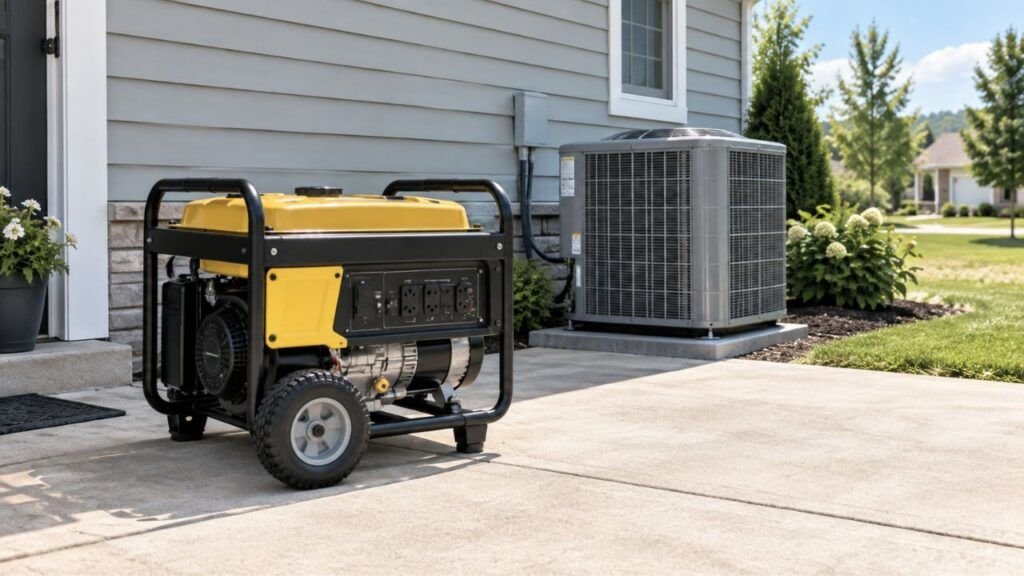
Yes, a generator can run an air conditioner successfully. However, the generator must supply enough running power, starting power, and correct voltage for your specific AC system.
The right setup depends on your AC type and size. Below, I’ll show you how to size the generator, handle compressor startup, connect everything safely, and troubleshoot common problems.
Key Takeaways
- A generator can run most air conditioners when correctly sized.
- Starting watts can be much higher than normal running watts.
- Small window AC units are easiest to power during outages.
- Central air conditioners commonly require 240-volt generator power.
- Central AC sizing must include the indoor blower or air handler.
- A soft starter can reduce compressor startup power considerably.
- Other appliances sharing the generator must also be considered.
- Never connect a generator directly into a household wall outlet.
- Actual AC nameplate specifications should guide final generator sizing.
Can a Generator Really Run an Air Conditioner?
A generator can absolutely run an air conditioner during an outage. The difficulty depends mostly on how much electricity the AC requires.
A small window AC may draw less than 1,000 watts. A large central air conditioner can require several thousand watts continuously.
However, normal operating power tells only part of the story.
An air conditioner contains motors and a compressor. These components can demand considerably more electricity during startup.
That brief surge is where undersized generators usually struggle.
Your generator therefore needs enough capacity for:
- Normal AC running power
- Compressor starting power
- Correct AC voltage
- Other connected household loads
A generator that handles the running load may still fail during startup.
That difference becomes especially important with central air conditioning.
What Size Generator Do You Need to Run an Air Conditioner?
Generator size depends on the AC’s electrical specifications rather than BTU capacity alone. The following ranges can help with initial planning, but always verify your actual equipment.
| Air Conditioner Type | Typical Size | Approximate Running Demand | Generator Planning Range |
| Small window AC | 5,000–6,000 BTU | 400–700W | 1,500–2,000W+ |
| Medium window AC | 8,000–12,000 BTU | 700–1,300W | 2,000–3,500W+ |
| Large window AC | 15,000–25,000 BTU | 1,200–2,500W | 3,000–5,000W+ |
| Portable AC | 8,000–14,000 BTU | 800–1,800W | 2,000–4,000W+ |
| Inverter mini-split | 9,000–18,000 BTU | Varies widely | Often 2,000–4,000W+ |
| 2-ton central AC | 24,000 BTU | Roughly 2,000–3,000W | Often 6,000–8,000W+ |
| 3-ton central AC | 36,000 BTU | Roughly 3,000–4,000W | Often 7,500–10,000W+ |
| 4–5 ton central AC | 48,000–60,000 BTU | Roughly 4,000–6,000W+ | Often 10,000W+ |
These figures are only general planning estimates. Two air conditioners with similar cooling capacity can have very different electrical requirements.
Older compressors may also need significantly more startup power.
Variable-speed systems can behave differently from traditional compressors.
Always check the AC nameplate, owner’s manual, and generator specifications before deciding.
Why Starting Watts Matter More Than Most People Expect
Air conditioners behave differently from simple loads like lamps or heaters. Their compressor motors create a temporary power surge whenever they start.
What Are Running Watts?
Running watts are the electricity your AC consumes during normal operation.
Imagine your AC uses about 1,200 watts while cooling. Your generator must continuously provide at least that amount.
However, other connected appliances also consume generator capacity.
That means a 1,200-watt AC should not automatically use a 1,200-watt generator.
You need room for startup demands and other loads.
What Are Starting Watts?
Starting watts describe the temporary power required when motors begin operating.
An AC compressor can briefly demand much more electricity than normal.
The surge usually lasts only a short time. Unfortunately, that short period can still overwhelm an undersized generator.
You might notice:
- Generator engine bogging down
- Lights becoming dim
- Generator overload alarm activating
- Circuit breaker tripping
- AC compressor failing to start
The AC may work perfectly on utility power while failing on generator power.
What Does LRA Mean on an Air Conditioner?
You may notice LRA printed on your outdoor AC nameplate.
LRA means Locked Rotor Amps.
It describes a very high current condition associated with compressor startup.
A larger LRA number generally indicates a demanding compressor-starting load.
However, avoid multiplying LRA by voltage and assuming that result equals your required generator size.
Generator motor-starting performance involves more than one simple calculation.
Use the manufacturer’s generator recommendations whenever they are available.
Why Running Watts Alone Can Give You the Wrong Generator Size
Suppose your central AC normally consumes around 3,000 watts.
You might assume a 4,000-watt generator provides enough capacity.
The problem appears when the compressor starts.
Its temporary electrical demand might exceed what that generator can supply.
The generator then experiences a sudden heavy load.
It may trip, slow down, or fail to start the compressor.
That is why generator sizing must account for both conditions.
How to Calculate Generator Size for Your Air Conditioner
You do not need to guess your generator size. A few checks can give you a much better estimate for your particular system.
Step 1: Check the AC Nameplate
Start with the information printed directly on your air conditioner.
For central AC, inspect the outdoor condenser data plate.
Look for information including:
- Voltage
- Rated amperage
- Minimum circuit ampacity
- LRA
- Model number
- Compressor information
For window or portable AC units, check the rear or side label.
The owner’s manual can provide additional electrical specifications.
Step 2: Confirm Whether Your AC Needs 120V or 240V
Voltage matters just as much as generator wattage.
Most smaller window and portable air conditioners use 120-volt household outlets.
Many central air conditioners operate on approximately 240 volts.
Therefore, a large 120-volt-only generator cannot power many central AC systems directly.
It might have enough total wattage but still lack the required voltage.
Check the generator outlets and specifications before buying anything.
Step 3: Find Running and Starting Requirements
Find the manufacturer’s running and starting requirements whenever possible.
Do not rely entirely on generic online AC wattage charts.
Two 3-ton air conditioners may have different compressors and electrical characteristics.
Equipment age can also change startup behavior.
Your actual equipment specifications provide the best starting point.
Step 4: Include the Indoor Blower or Air Handler
This part is easy to overlook.
Central air conditioning requires more than the outdoor condenser.
Your indoor blower must move cooled air through the ductwork.
Depending on your system, you may also need power for:
- Air handler
- Furnace blower
- Thermostat
- Control board
- Condensate pump
Sizing only for the outdoor condenser can leave your cooling system incomplete.
Step 5: Add Other Generator Loads
Now consider everything else you want powered simultaneously.
Common outage essentials include:
- Refrigerator
- Freezer
- Well pump
- Sump pump
- Lights
- Television
- Internet equipment
- Microwave
- Furnace blower
- Phone chargers
Pay special attention to appliances containing motors or compressors.
These appliances may also create startup surges.
Step 6: Leave Some Generator Headroom
Avoid choosing a generator that barely meets your calculated requirement.
Operating continuously near maximum capacity leaves little flexibility.
It also makes overlapping appliance startups harder to handle.
Additional generator headroom can provide smoother operation.
Simple Generator Sizing Example
Suppose your cooling system uses approximately 3,000 running watts.
Other household essentials consume another 1,500 running watts.
Your normal combined load would therefore be around 4,500 watts.
Now account for the largest expected starting event.
If the AC compressor causes a substantial temporary surge, your generator needs enough peak capacity to survive that event.
You generally do not need to add every appliance’s maximum starting load together.
Instead, consider which high-demand loads could start simultaneously.
This method produces a much more realistic generator estimate.
Can a Portable Generator Run Central Air Conditioning?
Yes, certain portable generators can run central air conditioning. However, central AC creates several challenges that smaller room units do not.
When a Portable Generator Can Run Central AC
A portable generator becomes a realistic option when it provides:
- Sufficient continuous wattage
- Sufficient motor-starting capability
- 120/240V output when required
- Proper household connection equipment
- Capacity for the indoor blower
- Capacity for necessary household loads
Larger portable generators commonly provide 120/240-volt service.
That makes them much better suited for central HVAC systems.
Your exact requirements still depend on the air conditioner.
When a Portable Generator Is Too Small
An undersized generator usually makes itself obvious.
You might hear the engine suddenly slow when the compressor starts.
The generator may also activate overload protection.
Other symptoms include:
- AC starts but immediately stops
- Compressor hums without starting
- Generator breaker trips
- Voltage drops significantly
- Lights flicker heavily
- Generator shuts itself down
Do not repeatedly force the compressor to start under those conditions.
Repeated failed starts can place unnecessary stress on your equipment.
Why 240V Output Matters
Many residential central air conditioners require approximately 240 volts.
Your generator must therefore provide the correct voltage configuration.
A 5,000-watt 120V generator and 5,000-watt 120/240V generator are not necessarily interchangeable for central air.
Always check your AC circuit voltage first.
When a Standby Generator Makes More Sense
A standby generator may make more sense for larger homes.
This becomes especially true when you want to operate:
- Large central AC systems
- Multiple HVAC zones
- Well pumps
- Electric water heaters
- Multiple refrigerators
- Other large household loads
Standby systems can also provide automatic outage protection.
A portable generator can still work well when loads are carefully managed.
Which Types of Air Conditioners Are Easiest to Run on a Generator?
Some cooling systems are much easier to operate during outages. Choosing the right cooling strategy can dramatically reduce generator requirements.
Window Air Conditioners
Window air conditioners are usually the easiest option.
Small models often consume relatively little electricity.
That makes them practical with compact portable generators.
Cooling one occupied room also saves fuel during extended outages.
A bedroom window AC can sometimes make more sense than central air.
Portable Air Conditioners
Portable room air conditioners can also work well with generators.
Their electrical demand varies considerably between models.
Always check actual input wattage rather than BTU rating alone.
Remember that portable AC compressors also create startup demand.
Mini-Split Air Conditioners
Mini-splits can be attractive during generator operation.
Many modern systems use inverter-driven variable-speed compressors.
These compressors may start more gradually than older fixed-speed equipment.
However, that does not mean every mini-split works with a tiny generator.
Voltage, maximum current, and manufacturer specifications still matter.
Central Air Conditioners
Central air conditioning is usually the most demanding option.
The outdoor compressor can create a substantial starting load.
The system may also require:
- 240V power
- Indoor blower power
- Thermostat power
- Additional HVAC controls
Central AC compressors also cycle repeatedly.
Your generator must successfully handle every restart, not just the first one.
Can a Soft Starter Help a Generator Run Your Air Conditioner?
A soft starter can make central AC much easier to operate from generator power. However, it does not magically remove the system’s normal electrical requirements.
What an AC Soft Starter Does
A soft starter controls how the compressor starts.
Instead of allowing a very large immediate current demand, it manages startup more gradually.
This can significantly reduce the generator’s required starting capability.
A generator that previously struggled may then start the compressor normally.
Soft starters are especially popular with:
- Portable generators
- RV air conditioners
- Backup power systems
- Smaller standby generators
Compatibility varies, so use equipment designed for your AC system.
Soft Starter vs. Hard-Start Capacitor
A soft starter and hard-start kit are not the same device.
A hard-start kit helps a compressor start more decisively.
It commonly adds starting components that provide additional starting torque.
A true electronic soft starter manages the compressor’s startup current differently.
Its purpose includes reducing the initial electrical demand.
Therefore, avoid assuming every “start kit” reduces generator requirements equally.
Can a Soft Starter Let You Use a Smaller Generator?
Sometimes it can.
Reducing compressor startup current can make generator sizing much easier.
However, the soft starter does not change everything.
Your generator must still support:
- Normal AC running power
- Required voltage
- Indoor blower load
- Other household appliances
A soft starter cannot make a severely undersized generator suitable.
Think of it as reducing startup difficulty, not eliminating electricity demand.
How Do You Safely Connect an Air Conditioner to a Generator?
The connection method depends on whether you have a plug-in AC or central system. Never improvise electrical connections simply because the generator has enough wattage.
Connecting a Window or Portable AC
A window or portable AC can often plug into the generator.
However, check the generator outlet rating first.
If an extension cord is necessary, use one rated appropriately for:
- AC current
- Cord length
- Outdoor use
- Generator operation
Long, undersized cords can cause excessive voltage drop and heat.
Keep connections protected from rain and standing water.
Connecting Central AC
Central air conditioners normally connect through your home’s electrical system.
That means the generator usually needs an approved transfer setup.
Common options include:
- Manual transfer switch
- Automatic transfer switch
- Properly configured generator interlock system
The exact arrangement depends on your electrical panel and local requirements.
Have a qualified electrician install or verify this connection.
Never Backfeed Your House Through an Outlet
Never plug a generator into a household outlet to energize your panel.
This dangerous practice is commonly called backfeeding.
It can send generator electricity onto utility lines.
That creates a potentially deadly hazard for utility workers.
It can also damage your generator, wiring, and connected equipment.
Use approved generator connection equipment instead.
Keep Portable Generators Outside
Never operate a portable fuel-burning generator inside your home.
That includes garages, basements, sheds, or enclosed porches.
Carbon monoxide can build up rapidly.
Place the generator outdoors and well away from:
- Windows
- Doors
- Air intakes
- Crawlspace openings
Keep the exhaust pointed away from occupied areas.
Never refuel a hot generator while the engine runs.
Why Won’t My Air Conditioner Run on My Generator?
Your generator can appear powerful enough while the AC still refuses to operate. These are some of the most common reasons:
- Insufficient starting power: The generator handles running watts but cannot start the compressor.
- Wrong voltage: Your central AC needs 240V while the generator provides only 120V.
- Too many connected loads: Refrigerators, pumps, and other appliances consume available capacity.
- Indoor HVAC load was forgotten: The blower or air handler adds additional demand.
- Generator overload protection activates: The combined load exceeds available output.
- Extension cord is undersized: Excessive resistance can cause voltage drop.
- Compressor restarted too quickly: Many compressors need time before restarting safely.
- Another motor starts simultaneously: Pumps or refrigerators can create overlapping surges.
- Generator voltage becomes unstable: Heavy loads can pull voltage or frequency outside acceptable ranges.
- AC has an existing electrical problem: Utility power may hide a weak capacitor or compressor issue.
- Soft starter has a problem: Incorrect installation or compatibility can prevent proper startup.
- Generator operates near maximum capacity: Very little reserve remains for compressor cycling.
If the generator repeatedly trips when the compressor starts, stop retrying.
Confirm the AC specifications and generator capacity before continuing.
Can You Run an Air Conditioner and Refrigerator on the Same Generator?
Yes, an air conditioner and refrigerator can share one generator when sufficient capacity is available.
The main challenge is that both appliances contain compressors. Either compressor can create a temporary starting surge.
Suppose the AC is already running when the refrigerator starts. Your generator must handle that additional temporary demand.
A similar problem occurs if both compressors start together.
When generator capacity is limited, stagger the loads.
Start the AC first and let it stabilize. Then reconnect other important appliances gradually.
This approach can prevent unnecessary overloads.
How Long Can You Run an Air Conditioner on a Generator?
There is no universal runtime because generator fuel consumption changes with load. Your operating time depends on several important factors.
- Generator fuel-tank capacity
- Gasoline, propane, diesel, or natural gas operation
- Air conditioner size
- Generator efficiency
- Outdoor temperature
- Thermostat setting
- Home insulation
- AC compressor duty cycle
- Other connected appliances
An air conditioner usually does not draw maximum power continuously.
Once the room reaches the target temperature, the compressor may cycle.
Hot weather can keep that compressor running much longer.
Fuel consumption therefore increases during extreme heat.
For extended outages, consider cooling only one occupied room.
A small window AC can dramatically reduce your fuel requirements.
Does Generator Power Quality Matter for an Air Conditioner?
Yes, voltage and frequency stability can matter, particularly with modern HVAC equipment.
Traditional compressor motors are generally robust electrical loads.
However, newer HVAC equipment can contain:
- Electronic control boards
- Variable-speed motors
- Inverter-driven compressors
- Digital thermostats
- Communication electronics
A well-regulated generator should maintain stable voltage and frequency.
Inverter generators are known for producing clean electrical output.
They can be particularly attractive for electronic equipment.
However, that does not mean conventional generators cannot run air conditioners.
Many quality conventional and standby generators power HVAC equipment successfully.
Generator quality, regulation, sizing, and installation all matter.
Is It Better to Run One Room AC Instead of Central Air During an Outage?
In many situations, yes.
Running central air can require a large generator and substantial fuel.
A small window AC can keep one important room comfortable instead.
You could cool:
- A bedroom
- Living room
- Home office
- Family gathering area
Close doors to unused spaces whenever practical.
Use curtains or blinds to reduce incoming heat.
Fans can also help distribute cool air.
This strategy can make a smaller generator much more useful.
It also preserves capacity for refrigerators, lights, and other essentials.
For a long outage, targeted cooling can be more practical than whole-house cooling.
Final Verdict
Yes, a generator can run an air conditioner, including many central AC systems. The key is matching the generator to the AC’s voltage, continuous power, and compressor starting demand.
For small window and portable units, generator operation is usually straightforward. Central air requires more careful planning because you must consider 240V power, compressor startup, the indoor blower, and other household loads.
If your generator nearly handles central air but struggles during startup, a compatible soft starter may help considerably.
Most importantly, use your AC’s actual electrical specifications instead of relying entirely on generic wattage estimates.
That gives you the safest and most reliable generator setup.
Related FAQs
Can a 2,000-Watt Generator Run an Air Conditioner?
A 2,000-watt generator can run many small window air conditioners if its surge capacity handles compressor startup. Larger portable or central AC systems usually require significantly more generator capacity.
Can a 3,500-Watt Generator Run an Air Conditioner?
A 3,500-watt generator can operate many window and portable AC units. Whether it can run a larger system depends on voltage, running watts, compressor startup demand, and other connected appliances.
Can a 5,000-Watt Generator Run Central Air?
A 5,000-watt generator may run some smaller central AC systems, particularly with reduced starting demand. However, many central systems require greater surge capacity and 240V output, so check the equipment specifications first.
Can a 7,500-Watt Generator Run Central Air?
A 7,500-watt generator can potentially operate some central air conditioners. Success depends on AC size, compressor startup demand, blower power, generator surge rating, and other household loads.
Will a 10,000-Watt Generator Run Central Air Conditioning?
A 10,000-watt generator can run many residential central AC systems when correctly configured. Large air conditioners may still require substantial starting capability or a compatible soft starter.
Can a Whole-House Generator Run an Air Conditioner?
Yes, a properly sized whole-house generator can run central air conditioning. The generator must support the AC startup demand while also supplying whatever household circuits remain active.
Can You Run Two Air Conditioners on One Generator?
You can run two air conditioners if the generator supports their combined running and startup requirements. Compressor starts should also be managed so both units do not create excessive surge simultaneously.
Does an AC Need More Generator Power When It Starts?
Yes, most traditional air conditioners temporarily require more electricity during compressor startup. Your generator therefore needs enough surge capability beyond the AC’s normal running wattage.
Can an Inverter Generator Run an Air Conditioner?
Yes, an inverter generator can run an air conditioner when its voltage, continuous output, and surge capability meet the AC’s requirements. Smaller inverter generators commonly pair well with room air conditioners.
Do I Need a Soft Starter to Run Central AC on a Generator?
Not always. A sufficiently large generator may start central AC without one. However, a compatible soft starter can reduce compressor startup demand and make generator operation easier.

Brian Walker writes straightforward generator guides and reviews for homeowners and everyday users. His content focuses on solar, portable, and fuel-powered generators, with practical advice on choosing, using, and maintaining reliable backup power.















