
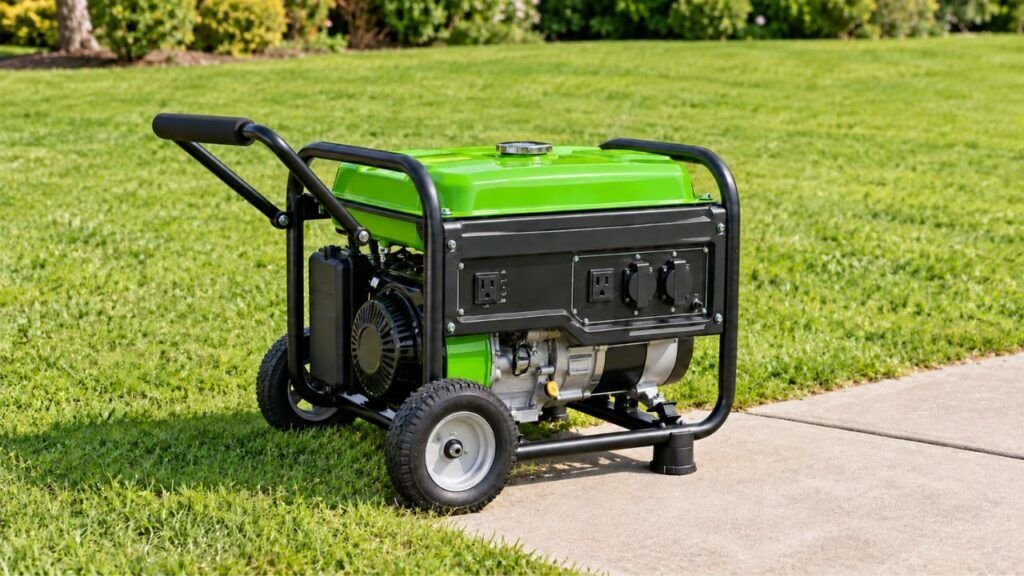
A 120/240V generator can supply both 120-volt and 240-volt electricity. It normally uses two 120V hot legs. Either hot leg provides 120V to neutral. Using both hot legs together provides approximately 240V.
That setup makes the generator useful for standard household appliances and larger equipment. Below, I’ll explain how 120/240V works, available amperage, outlets, load balancing, and home backup connections.
Key Takeaways
- A 120/240V generator can provide both common household voltages.
- Each hot leg supplies approximately 120V when measured to neutral.
- Measuring between both hot legs provides approximately 240V.
- The generator does not produce double its rated wattage.
- Large 120V loads can be limited by one generator leg.
- Balanced 120V loads help use generator capacity more effectively.
- 240V output is useful for pumps, HVAC equipment, and workshops.
- Home connections require suitable transfer equipment and proper wiring.
What Does 120/240V Mean on a Generator?
The 120/240V label tells you which AC voltages the generator provides. It does not mean the generator creates 120V and 240V independently.
Most North American 120/240V generators use a split-phase electrical arrangement. The system has two hot conductors, usually called L1 and L2.
Either hot conductor provides about 120 volts when referenced to neutral. Measure between L1 and L2, and you get approximately 240 volts.
That arrangement is similar to the electrical service entering many American homes.
The slash in 120/240V therefore describes two usable voltage relationships. It does not mean you add 120V and 240V together.
It also does not mean the generator produces twice its rated wattage.
A 7,200-watt generator remains a 7,200-watt generator regardless of voltage.
How Does a 120/240V Generator Produce Both Voltages?
A split-phase generator uses its alternator windings to create two electrical legs. Understanding those legs makes the 120/240V label much easier to understand.
The Two Hot Legs: L1 and L2
Inside the generator, the alternator produces AC power through connected windings.
A typical 120/240V setup creates two hot conductors:
- L1
- L2
These two hot legs are opposite each other electrically.
Each leg provides approximately 120 volts when measured against neutral.
The voltage between the two hot legs is approximately 240 volts.
Where the 120 Volts Comes From
A standard 120V load uses one hot leg and neutral.
For example:
L1 to neutral = about 120V
Or:
L2 to neutral = about 120V
Your refrigerator, lights, television, microwave, and chargers commonly use 120V power.
The generator may divide its 120V receptacles between both electrical legs.
That arrangement helps distribute household loads across the alternator.
Where the 240 Volts Comes From
A 240V load uses both hot legs rather than neutral.
The voltage is measured directly between L1 and L2.
L1 to L2 = about 240V
This higher voltage is commonly used by larger electrical equipment.
Examples include certain well pumps, air conditioners, welders, and compressors.
Some electric dryers and water heaters also operate from 240V circuits.
However, voltage compatibility alone does not guarantee successful operation.
The generator must also provide enough running and starting wattage.
What the Neutral and Ground Do
Neutral and ground perform different jobs in the electrical system.
Neutral provides a current return path for applicable 120V loads.
The equipment grounding conductor provides a safety path during electrical faults.
Generator neutral and grounding arrangements can vary between models.
That becomes especially important when connecting generators to transfer equipment.
Always follow the generator and transfer equipment manufacturer’s instructions.
120V vs 240V Output on a Generator
Both voltages serve different types of loads. Neither voltage automatically means the generator produces more total power.
| Feature | 120V Output | 240V Output |
| Electrical connection | One hot leg plus neutral | L1 plus L2 |
| Common use | Everyday household loads | Larger electrical equipment |
| Typical appliances | Refrigerator, lights, microwave | Well pump, HVAC, dryer |
| Current for equal wattage | Higher | Lower |
| Common outlets | 5-20R, TT-30R, L5-30R | L14-30R, 14-50R |
| Home backup flexibility | Basic loads | Better for split-phase panels |
The generator’s manual should always determine actual outlet capabilities.
Different generators can use different receptacles and internal configurations.
Can a 120/240V Generator Supply Both Voltages at the Same Time?
Many 120/240V generators can provide both voltages simultaneously.
You could run several 120V appliances while powering one 240V load.
For example, you might operate:
- A 120V refrigerator
- Several 120V lights
- A 120V television
- A 240V well pump
However, every connected load still counts toward generator capacity.
You must stay within both total wattage and individual circuit limits.
The generator’s operating mode matters as well.
Some generators include a voltage selector switch.
Certain selector positions may disable specific outlets or change their operation.
Always check the control panel and owner’s manual before connecting loads.
Does 120/240V Mean the Generator Has Twice the Power?
No. A 120/240V rating does not double generator wattage.
This is one of the most common misunderstandings with split-phase generators.
Suppose your generator provides 7,200 running watts.
At 240 volts:
7,200W ÷ 240V = 30A
That means 7,200 watts equals approximately 30 amps at 240 volts.
The generator still provides 7,200 watts total.
Changing how you use the voltage does not create additional power.
Think of voltage as one part of the electrical equation.
The basic formula is:
Watts = Volts × Amps
Higher voltage allows the same wattage with lower amperage.
It does not automatically increase the generator’s total wattage rating.
How Much Power Is Available on Each 120V Leg?
This is where 120/240V generators can become confusing. Total generator wattage does not always equal available power from one 120V leg.
Why Total Generator Watts Can Be Misleading
Imagine you own a 7,200-watt 120/240V generator.
At 240V, its output works out to:
7,200W ÷ 240V = 30A
In a typical split-phase arrangement, each 120V leg may support approximately 30 amps.
That gives:
120V × 30A = 3,600W
So one 120V leg could have roughly 3,600 watts available.
The other leg could provide another 3,600 watts.
Together, the two sides total approximately 7,200 watts.
However, your specific generator may have different limits.
Breakers, winding design, outlets, and manufacturer ratings all matter.
Example: 7,200W 120/240V Generator
Consider this simplified example:
| Measurement | Approximate Capacity |
| Total generator output | 7,200W |
| Current at 240V | 30A |
| L1 at 120V | Up to 3,600W |
| L2 at 120V | Up to 3,600W |
| Combined rated output | 7,200W |
Now imagine placing 5,000 watts entirely on L1.
Your total generator load remains below 7,200 watts.
However, L1 may already exceed its allowable capacity.
That is why total wattage alone cannot tell the whole story.
Why Load Balancing Matters on a 120/240V Generator
Balanced loads help both generator legs share the work properly. This becomes especially important when powering several 120V circuits.
What an Unbalanced Load Means
An unbalanced load happens when one leg carries significantly more power.
For example:
L1 loads
- Microwave: 1,500W
- Space heater: 1,500W
Total L1 load: 3,000W
L2 loads
- LED lights: 150W
- Internet equipment: 50W
Total L2 load: 200W
The generator is supplying only 3,200 watts overall.
However, almost everything is concentrated on one electrical leg.
Depending on generator design, that can restrict usable capacity.
What Happens If One Leg Is Overloaded?
Overloading one side may cause the generator breaker to trip.
You might also notice unstable voltage or poor appliance performance.
In some designs, excessive imbalance can increase alternator heating.
The exact tolerance depends on the generator’s internal construction.
You do not need perfectly identical loads on both legs.
However, avoiding major differences usually improves generator performance.
When powering a home panel, spreading larger 120V loads helps considerably.
What Outlets Are Used for 120/240V Generator Power?
Generator outlets can tell you plenty about available power. However, the outlet shape does not determine generator wattage by itself.
NEMA L14-30R
The L14-30R is common on many portable backup generators.
It is a four-wire locking receptacle commonly supporting 120/240V power.
Its conductors include:
- L1
- L2
- Neutral
- Ground
The receptacle is commonly associated with a 30-amp circuit.
It is frequently used with generator cords and home inlet boxes.
However, actual available power depends on the generator’s rating.
NEMA 14-50R
Larger generators may include a NEMA 14-50 style receptacle.
This four-wire connection can also provide 120/240V split-phase power.
However, seeing a 50-amp receptacle creates another common misunderstanding.
A 50-amp receptacle does not guarantee 50 amps from your generator.
For example, an 8,000-watt generator cannot suddenly provide 12,000 watts.
Its engine, alternator, and breaker ratings remain the actual limitations.
Always check the generator’s running watts and rated amperage.
Standard 120V Receptacles
Most generators also include ordinary 120V receptacles.
Common examples include 5-20R household-style outlets.
These receptacles use only one generator hot leg plus neutral.
Manufacturers may divide different 120V outlets between L1 and L2.
That helps distribute electrical loads across both alternator windings.
What Does a 120V/240V Selector Switch Do?
Some generators include a voltage selector switch. The switch changes how alternator output is configured for different applications.
120/240V Mode
In 120/240V mode, the generator supplies split-phase output.
This mode allows compatible 120V and 240V loads.
It is commonly used for home backup and 240V equipment.
The generator still has the same overall power limitations.
120V-Only Mode
Some models can reconnect their windings for 120V-only operation.
This can make the generator better suited for large 120V loads.
It may also help avoid severe imbalance between generator windings.
This feature can be useful for RVs or 120V equipment.
However, selector switch behavior varies greatly between generator models.
Never assume another generator works exactly like yours.
Does the Switch Increase Generator Wattage?
No. The selector switch does not create extra engine power.
It simply changes how electrical output is configured or distributed.
Your running and starting wattage ratings still apply.
What Can You Run With a 120/240V Generator?
A 120/240V generator can power a wide range of equipment. The deciding factors are voltage, running watts, and starting watts.
Common 120V Loads
Typical 120V loads may include:
- Refrigerator
- Freezer
- LED lighting
- Television
- Wi-Fi router
- Microwave
- Coffee maker
- Phone chargers
- Laptop chargers
- Small power tools
- Portable fans
- Sump pumps using 120V
Check individual appliance labels because wattage varies considerably.
Motor-driven equipment may also require additional startup power.
Common 240V Loads
Common 240V equipment may include:
- Well pumps
- Central air conditioners
- Heat pumps
- Electric water heaters
- Electric dryers
- Electric ranges
- Large air compressors
- Welders
- Workshop equipment
Having a 240V outlet does not guarantee these loads will run.
Large motors can require substantial starting wattage.
Some HVAC systems can exceed portable generator capabilities completely.
Always compare appliance requirements with generator specifications.
Is 240V More Powerful Than 120V?
240V is a higher voltage, but voltage alone does not equal power.
You also need amperage to calculate the actual wattage.
Remember:
Watts = Volts × Amps
Suppose a load requires 3,600 watts.
At 120V:
3,600W ÷ 120V = 30A
At 240V:
3,600W ÷ 240V = 15A
The appliance uses approximately the same power in either example.
However, the 240V circuit carries half the current.
Lower current can reduce conductor heating and voltage drop.
That is one reason larger equipment commonly operates at 240V.
It does not mean 240V power automatically costs less.
Can You Connect a 120/240V Generator to a House?
Yes, many 120/240V generators are designed for home backup. However, they need proper transfer equipment and a suitable connection method.
Why 120/240V Works Well for U.S. Home Backup
Most American homes receive 120/240V split-phase electrical service.
That makes a compatible generator especially useful during outages.
It can potentially supply circuits located across both panel legs.
It can also support compatible 240V loads when properly sized.
A generator must still have enough wattage for selected circuits.
Transfer Switch or Interlock
A home generator connection needs a safe way to isolate utility power.
A transfer switch is one common solution.
A properly installed interlock system is another option in many situations.
Both approaches are intended to prevent dangerous utility-generator interaction.
Installation requirements depend on the electrical panel and local rules.
A qualified electrician should handle permanent home generator connections.
Never Backfeed Through a Household Outlet
Never connect a generator to your home using an improvised backfeed cord.
A generator must not energize utility lines during an outage.
Backfeeding can seriously injure utility workers and nearby residents.
It can also damage the generator and household electrical equipment.
Use approved transfer equipment instead.
Is a 120/240V Generator Better Than a 120V-Only Generator?
Neither option is automatically better for everyone. Your appliances and backup goals should determine which voltage system you need.
| Situation | 120V-Only Generator | 120/240V Generator |
| Camping | Very suitable | Suitable |
| Refrigerator and lights | Suitable | Suitable |
| Basic emergency backup | Suitable | Suitable |
| 120V RV | Often convenient | Depends on operating mode |
| 240V well pump | Not suitable | Suitable if sized properly |
| Central HVAC | Usually not suitable | Possible if adequately sized |
| Home panel backup | More limited | More flexible |
| Large workshop equipment | Limited | Better option |
| 240V appliances | No | Yes |
Choose a 120V generator when all important loads use 120V.
Choose 120/240V when you need greater home backup flexibility.
It is also the better choice for genuine 240V equipment.
How to Tell Whether Your Generator Really Supports 120/240V
Do not rely only on the generator’s physical size. Check several specifications before assuming 240V output is available.
Look for:
- A 120/240V voltage rating on the generator label
- 120V and 240V specifications in the owner’s manual
- An L14-30R or similar split-phase receptacle
- A compatible 14-50 style outlet on larger generators
- A 120V/240V selector switch, when equipped
- Separate amperage ratings for 120V and 240V
- Appropriate double-pole circuit protection
- Manufacturer instructions covering 240V loads
- Home transfer equipment compatibility
Outlet appearance alone should never replace checking specifications.
Manufacturers can place similar receptacles on differently rated generators.
Common 120/240V Generator Mistakes
Understanding a few common mistakes can prevent nuisance trips and equipment problems.
- Assuming 120/240V means twice the generator’s wattage.
- Assuming a 50A outlet guarantees 50A generator output.
- Putting most 120V loads onto one generator leg.
- Ignoring each outlet’s individual breaker rating.
- Assuming every 240V appliance can run successfully.
- Forgetting motor starting or compressor surge wattage.
- Confusing 240V-only power with 120/240V split-phase power.
- Assuming every generator has the same selector switch behavior.
- Using undersized generator cords for high-current loads.
- Connecting a generator directly into a household receptacle.
- Ignoring manufacturer neutral and grounding instructions.
Most generator problems become easier once these limits are understood.
120/240V Generator Safety Tips
Electrical connections and generator placement both affect safe operation. Follow the generator manual along with applicable electrical requirements.
- Never connect 120V equipment directly to a 240V-only outlet.
- Match cords with the required voltage and amperage.
- Never exceed generator running or starting wattage limits.
- Keep plugs and connections protected from moisture.
- Use approved transfer equipment for home panel connections.
- Never use improvised backfeeding cords.
- Follow manufacturer neutral and grounding requirements.
- Let an electrician handle permanent panel connections.
- Keep gasoline, propane, and diesel generators completely outdoors.
- Position exhaust away from doors, windows, and air openings.
- Maintain safe clearance from the home while operating.
Carbon monoxide can become deadly before anyone notices symptoms.
Never operate a fuel-burning generator inside a garage or home.
Final Verdict
A 120/240V generator provides two useful household voltage options. One hot leg to neutral supplies approximately 120V. Both hot legs together provide approximately 240V.
The important part is understanding how generator capacity gets distributed. Total watts, per-leg amperage, outlet ratings, and starting loads all matter.
For basic lights and appliances, 120V may be enough. For home backup, well pumps, HVAC, or workshops, 120/240V offers much greater flexibility.
Before buying or connecting anything, list the loads you need. Check their voltages, running watts, and starting requirements. Then compare those numbers with the generator’s actual ratings.
Related FAQs
Can a 120/240V Generator Run 120V and 240V at the Same Time?
Yes, many 120/240V generators can supply both voltages simultaneously. However, total generator wattage, per-leg limits, and breaker ratings still apply.
Does 120/240V Mean Two-Phase Power?
No. Residential 120/240V power in the United States is generally single-phase split-phase power, not a true two-phase electrical system.
Is 120/240V the Same as 120V Plus 240V?
No. The slash identifies two available voltage relationships. It does not mean you add both voltage numbers together.
Can I Plug a 120V Appliance Into a 120/240V Generator?
Yes. Use a properly rated 120V receptacle on the generator. Never connect a 120V appliance directly to a 240V-only output.
Can a 120V Generator Run a 240V Appliance?
Normally, no. A true 240V appliance requires the correct 240V electrical supply unless its manufacturer specifically supports another voltage.
Can I Get 240V From Two 120V Generator Outlets?
Not by simply combining two ordinary outlets. The generator must provide properly configured opposite hot legs designed to create 240V line-to-line.
Is an L14-30 Outlet 120V or 240V?
An L14-30 connection commonly provides 120/240V split-phase power. It includes two hot conductors, neutral, and equipment ground.
How Many Watts Is 30 Amps at 120/240V?
At 240V, 30 amps equals 7,200 watts. At 120V, 30 amps equals 3,600 watts on that individual 120V circuit.
How Many Watts Is 50 Amps at 120/240V?
A full 50 amps at 240V equals 12,000 watts. However, generator wattage and breaker ratings may limit actual output below that amount.
Why Does My Generator Have 120V and 120/240V Outlets?
The 120V outlets serve ordinary household loads. The 120/240V outlet supports split-phase connections, 240V equipment, or compatible home backup systems.

Brian Walker writes straightforward generator guides and reviews for homeowners and everyday users. His content focuses on solar, portable, and fuel-powered generators, with practical advice on choosing, using, and maintaining reliable backup power.















