
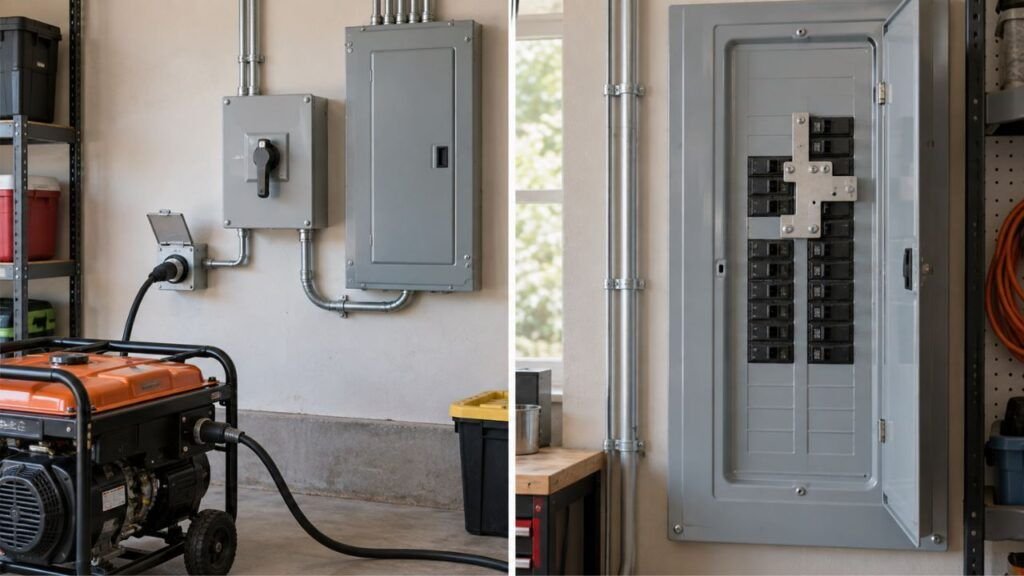
A generator interlock kit is usually better for homeowners wanting an affordable, flexible portable-generator connection. A transfer switch is often better when you want easier load control, dedicated backup circuits, or automatic operation. Both can safely isolate generator power from utility power when correctly selected and installed.
The better choice depends on your generator, electrical panel, budget, and backup needs. I’ll compare how each system works, what each costs, circuit flexibility, safety, installation, and which option fits different homes.
Key Takeaways
- Both systems prevent dangerous generator backfeeding when properly installed.
- Interlock kits usually cost less than transfer switch systems.
- An interlock can provide access to many panel circuits.
- You must carefully manage generator loads with an interlock.
- Manual transfer switches offer more structured backup power management.
- Automatic transfer switches work best with permanent standby generators.
- An interlock must properly match your electrical panel.
- Generator voltage, amperage, and neutral configuration also matter.
- Neither option increases the actual output of your generator.
- A qualified electrician should handle the final installation.
Transfer Switch vs Interlock Kit: Quick Comparison
Both options let generator power safely enter your home’s electrical system. However, the way they control circuits and power sources differs considerably.
| Feature | Interlock Kit | Manual Transfer Switch | Automatic Transfer Switch |
| Basic operation | Mechanical breaker interlock | Manual source switching | Automatic source switching |
| Best generator type | Portable generator | Portable or standby generator | Standby generator |
| Circuit flexibility | Usually very high | Depends on system design | Depends on system design |
| Operation | Manual | Manual | Automatic |
| Load management | Mainly homeowner controlled | More structured | May include automatic management |
| Equipment cost | Usually lowest | Moderate | Highest |
| Installation complexity | Usually simpler | More involved | Most involved |
| Panel compatibility | Very important | System dependent | System dependent |
| Automatic outage response | No | No | Yes |
| Best use | Flexible portable backup | Controlled manual backup | Hands-off home backup |
An interlock is often attractive because it uses your existing panel. A transfer switch creates a more dedicated way of controlling backup power.
Neither system is automatically better for every homeowner.
What Is a Generator Interlock Kit?
A generator interlock kit is a mechanical safety device installed on your electrical panel. It prevents the main utility breaker and generator breaker from operating together.
When utility power is connected, the generator breaker stays blocked. When generator power is used, the main breaker must remain disconnected.
This physical relationship prevents generator electricity from feeding backward into utility lines.
The generator normally connects through a dedicated outdoor generator inlet. Power then reaches a generator breaker installed inside the main panel.
One major advantage is circuit flexibility.
You can normally choose different household circuits during each outage. You might run the furnace during winter but prioritize cooling during summer.
However, the interlock does not manage your generator’s capacity.
You are still responsible for keeping loads within safe limits.
How Does an Interlock Kit Work During an Outage?
The actual switching process is manual. The mechanical interlock makes it impossible to intentionally operate both incoming power sources together when everything is installed correctly.
During Normal Utility Power
During normal operation, your home receives electricity from the utility.
The main breaker remains available while the generator breaker stays mechanically blocked. Your generator remains disconnected from the home’s energized electrical system.
Nothing changes during normal everyday electrical use.
When Generator Power Is Needed
During an outage, utility power must first remain isolated from generator power.
The interlock allows the generator breaker to become available only after the main utility breaker is placed in the required position.
Generator electricity can then enter the home’s panel.
You select the circuits needed during the outage.
This gives you considerable flexibility, but it also requires responsible load management.
When Utility Power Returns
The system must return from generator power to utility power.
The interlock prevents both power sources from being connected together during this process.
That mechanical protection is the main purpose of the kit.
The generator itself does not decide which circuits should operate.
What Is a Generator Transfer Switch?
A transfer switch is dedicated electrical equipment that changes a home’s electrical load between utility power and generator power.
Unlike an interlock plate, switching occurs inside dedicated transfer equipment.
Transfer switches come in several configurations.
Manual Transfer Switch
A manual transfer switch requires someone to physically change the power source.
When an outage occurs, you start the generator and manually place the transfer equipment into generator mode.
When utility service returns, you manually transfer back.
These systems work well when you want predictable backup circuits without automatic operation.
Some manual transfer switches serve only several essential circuits.
Others can support much larger portions of a home’s electrical system.
Automatic Transfer Switch
An automatic transfer switch, commonly called an ATS, performs the switching automatically.
It monitors incoming utility power.
When utility service fails, the system can signal a compatible standby generator and transfer the electrical load.
When utility service returns, the switch transfers the home back.
The standby generator can then shut down after its programmed cooldown.
This setup works well when backup power must operate without homeowner involvement.
Critical-Load vs Whole-House Transfer Equipment
Not every transfer switch works the same way.
Some systems feed a small critical-load panel containing selected circuits.
Those circuits might include:
- Refrigerator
- Furnace
- Well pump
- Sump pump
- Lighting
- Internet equipment
- Medical equipment
Other transfer equipment can serve a much larger electrical load.
Whole-home transfer systems are common with permanently installed standby generators.
So, saying transfer switches always limit you to six or ten circuits is inaccurate.
The limitation depends on the equipment and system design.
Interlock Kit vs Transfer Switch: The Main Differences
Both systems solve the same primary safety problem. However, they create very different experiences during an outage.
Circuit Flexibility
An interlock usually provides excellent circuit selection flexibility.
Generator power enters your existing electrical panel. You can then decide which circuits receive power.
Suppose you experience a winter outage.
You could prioritize:
- Gas furnace blower
- Refrigerator
- Kitchen lights
- Internet equipment
- Several outlets
During summer, your priorities might change.
You could reduce other loads and operate a window air conditioner instead.
A small critical-circuit transfer switch works differently.
Only circuits wired into that backup arrangement are available.
This creates less flexibility but makes power management simpler.
Whole-home transfer equipment does not necessarily have that restriction.
Load Management
This is one of the biggest differences.
An interlock gives you flexibility, but you manage the electrical load yourself.
Imagine your generator supports 7,500 running watts.
You might accidentally turn on:
- Electric water heater
- Well pump
- Microwave
- Refrigerator
- Electric range
The generator could become overloaded very quickly.
A manual transfer system with selected circuits reduces that possibility.
Automatic standby systems may go even further.
Some include load-management controls that temporarily prevent certain large appliances from operating together.
No switching method can create additional generator power.
Your generator’s capacity remains the limiting factor.
Ease of Operation
An interlock usually requires more homeowner involvement.
You need to decide which circuits should operate.
You also need to understand your generator’s available capacity.
A manual transfer switch can make the process easier.
The backup circuits are often already identified.
You simply operate the transfer equipment according to its instructions.
An ATS provides the easiest experience.
The system handles the transfer automatically when everything works correctly.
Installation Complexity
An interlock normally uses your existing electrical panel.
However, the project may still require:
- Compatible interlock hardware
- Generator breaker
- Generator inlet
- Proper wiring
- Correct breaker positioning
- Suitable panel space
- Required labels
A manual transfer switch requires additional transfer equipment.
A critical-load system may also require moving selected circuits into another panel.
An automatic system is usually the most involved.
It can require major electrical work and generator control wiring.
Space Requirements
Physical space can affect your decision.
An interlock normally adds little equipment beside the panel.
However, your existing panel needs the correct internal configuration.
There must also be suitable breaker positions.
A transfer switch usually requires additional wall space.
That can matter in crowded garages, utility rooms, and basements.
Older electrical panels may also complicate either installation.
Sometimes the existing panel determines your options before price does.
Automatic Operation
An interlock is manual.
A manual transfer switch is also manual.
An automatic transfer switch works automatically.
This distinction seems obvious, but it is commonly misunderstood.
Buying a transfer switch does not automatically give you automatic backup.
You specifically need compatible automatic transfer equipment and generator controls.
Which Is Safer: A Transfer Switch or Interlock Kit?
A properly selected interlock and a properly installed transfer switch can both provide safe generator isolation.
I would not choose one simply because someone claims it is automatically safer.
The bigger safety questions involve the complete installation.
That includes:
- Correct equipment
- Panel compatibility
- Proper installation
- Generator capacity
- Load management
- Neutral configuration
- Correct homeowner operation
A transfer switch can reduce some operating mistakes because power switching is more structured.
An automatic system reduces homeowner involvement even further.
However, a properly installed interlock also provides a physical safeguard against simultaneous utility and generator connections.
The dangerous option is bypassing approved generator connection equipment entirely.
Why Preventing Generator Backfeed Matters
Backfeeding happens when generator electricity travels into electrical wiring that should be isolated from the generator. This can create extremely dangerous conditions.
Backfeeding can:
- Energize utility lines during an outage.
- Put utility workers at serious risk.
- Damage household electrical equipment.
- Damage the generator when utility power returns.
- Create shock and fire hazards.
- Energize circuits in unexpected ways.
Never connect a generator to your home using a male-to-male extension cord.
Sometimes these are called suicide cords.
They are not substitutes for proper transfer equipment.
A generator should connect through equipment designed for that purpose.
Are Generator Interlock Kits Code-Compliant?
Generator interlock kits can be acceptable when the equipment and installation meet applicable requirements.
However, simply attaching a sliding metal plate to your panel does not automatically make an installation compliant.
Compatibility matters.
The kit should be suitable for your exact electrical panel and intended application.
The installation also needs to follow:
- Equipment instructions
- Electrical code requirements
- Panel requirements
- Local permit rules
- Local inspection requirements
Requirements can vary by jurisdiction.
The authority having jurisdiction, commonly called the AHJ, makes the final local determination.
That could involve your city, county, electrical inspector, or another authority.
This is another reason I would not buy a random universal-looking interlock online and assume it is suitable.
Does an Interlock Kit Have to Match the Electrical Panel?
Yes. Panel compatibility is one of the most important interlock requirements.
Two electrical panels may look almost identical from the outside.
That does not mean the same interlock fits both.
Compatibility can depend on:
- Panel manufacturer
- Panel series
- Main-breaker position
- Generator-breaker position
- Spacing between breakers
- Breaker type
- Panel cover design
- Approved accessory requirements
The interlock’s physical movement also matters.
It must properly block the conflicting breaker position.
A plate that almost fits is not good enough.
Before choosing an interlock, identify the exact panel model.
Then confirm the correct equipment for that panel.
Transfer Switch vs Interlock Kit Cost
An interlock is usually cheaper, but comparing kit prices alone can be misleading. Your total cost includes much more than the visible switching equipment.
| Cost Factor | Interlock Kit | Manual Transfer Switch | Automatic Transfer System |
| Switching hardware | Lowest | Moderate | Highest |
| Generator inlet | Usually needed | Often needed | Different system setup |
| Generator breaker | Usually needed | Depends on design | Depends on design |
| Wiring | Required | Required | Required |
| Electrician labor | Usually lower | Moderate | Highest |
| Permit or inspection | May apply | May apply | May apply |
| Panel modifications | Sometimes | Sometimes | Sometimes |
| Future maintenance | Limited equipment | Moderate | More system components |
A basic interlock kit itself can be inexpensive.
But that is not your complete project price.
You may still need a generator inlet, breaker, cable, conduit, wiring, labor, and permits.
A manual transfer switch costs more because additional equipment is involved.
An automatic transfer system usually costs considerably more.
Your final cost depends on:
- Generator amperage
- Wire distance
- Panel location
- Existing panel condition
- Local labor prices
- Permit requirements
- Transfer equipment type
A 50-amp project may also cost more than a smaller connection.
Get an installed estimate rather than comparing hardware prices alone.
Which Gives You Access to More Circuits?
An interlock usually gives homeowners more day-to-day circuit selection flexibility.
Generator power enters the primary electrical panel.
That means many breakers may become available for selection.
But there is an important distinction.
Having access to every circuit does not mean your generator can operate every circuit simultaneously.
Think of the panel as a menu.
The interlock may let you choose many items from that menu.
Your generator’s wattage determines how many you can actually run.
A critical-load transfer panel offers fewer choices.
However, those choices are predetermined and easier to manage.
For some households, that simplicity is more valuable than flexibility.
Can an Interlock Kit Power the Whole House?
An interlock can allow generator power into the main electrical panel. That does not automatically mean your generator can run the entire house.
This distinction causes plenty of confusion.
Suppose your interlock lets you access twenty household circuits.
Your generator may still only produce 7,000 running watts.
You cannot safely draw 15,000 watts simply because the breakers are available.
Large loads may include:
- Central air conditioner
- Electric clothes dryer
- Electric range
- Electric water heater
- Heat pump
- Well pump
- Electric vehicle charger
You may need to keep several of these breakers off.
The interlock controls source isolation.
It does not control available generator horsepower.
Does a Transfer Switch Limit Which Circuits You Can Use?
Some transfer switches limit your available circuits, but not all do.
A small critical-load transfer panel usually serves predetermined circuits.
If the refrigerator circuit is included, you can power it.
If the garage circuit is not included, generator power may not reach it.
This makes backup planning predictable.
However, larger manual transfer systems may serve broader loads.
Whole-house automatic transfer equipment can also serve the entire panel.
Your generator capacity still determines what can operate.
So the real answer depends on the transfer system design.
Avoid assuming every transfer switch works like a small emergency subpanel.
Generator Compatibility Can Change Your Choice
Your generator specifications matter just as much as the switching equipment. Check voltage, amperage, outlet configuration, and neutral design before planning the installation.
30-Amp vs 50-Amp Generator Connections
Portable generators commonly use 30-amp or 50-amp connections.
A larger connection can carry more current when the generator supports it.
But a 50-amp inlet does not increase generator output.
For example, a small generator cannot suddenly produce 12,000 watts because it connects to 50-amp equipment.
The complete system should be properly matched.
That includes the generator, inlet, breaker, conductors, and transfer equipment.
120V vs 120/240V Generators
This is another important compatibility issue.
Many residential electrical panels use 120/240-volt split-phase service.
Some small portable generators only produce 120 volts.
You should not assume every 120-volt generator can properly supply every panel arrangement.
A generator intended for panel connection should match the electrical system’s requirements.
This becomes especially important when you have 240-volt loads.
Examples include:
- Well pumps
- Electric water heaters
- Central air conditioners
- Electric dryers
- Electric ranges
Check generator output before choosing the connection system.
Bonded Neutral vs Floating Neutral
Generator neutral configuration can also affect system design.
Some generators have a bonded neutral.
Others use a floating neutral configuration.
Transfer equipment can also handle the neutral differently.
Some arrangements switch the neutral.
Others leave the neutral connected.
This affects whether the generator is treated differently within the electrical system.
I would leave this determination to a qualified electrician.
Do not experiment with neutral or grounding connections during an outage.
Interlock Kit Pros and Cons
An interlock offers excellent flexibility for many portable-generator owners. However, that flexibility also places more responsibility on the person operating it.
Advantages of an Interlock Kit
- Usually costs less than a transfer switch.
- Uses the home’s existing electrical panel.
- Provides flexible circuit selection.
- Requires little additional wall space.
- Works well with many portable generators.
- Lets you change outage priorities easily.
- Usually involves less additional equipment.
- Can support both 120V and 240V loads when properly designed.
Disadvantages of an Interlock Kit
- Requires manual operation.
- Load management is mainly your responsibility.
- Exact panel compatibility matters.
- Suitable breaker space may be required.
- It cannot automatically respond to outages.
- Household members need proper operating knowledge.
- Overloading is possible if too many circuits operate.
- Some panels may not support an appropriate interlock.
Transfer Switch Pros and Cons
Transfer switches provide a more structured backup arrangement. Their biggest advantages usually involve convenience, predictable loads, and automatic operation options.
Advantages of a Transfer Switch
- Provides controlled source switching.
- Can simplify outage operation.
- Manual and automatic versions are available.
- Critical circuits can be clearly organized.
- Whole-home configurations are available.
- Automatic systems require little homeowner intervention.
- Load-management options may be available.
- Works well with permanent standby systems.
Disadvantages of a Transfer Switch
- Usually costs more than an interlock.
- Installation can require more labor.
- Additional wall space may be required.
- Critical-load systems limit circuit flexibility.
- Changing backup circuits may require electrical work.
- Automatic equipment adds more components.
- Standby systems generally require more maintenance.
When an Interlock Kit Makes More Sense
An interlock is often ideal for someone who wants portable-generator backup without installing an expensive automatic system.
Consider an interlock when:
- You already own a portable generator.
- Your panel supports a suitable interlock.
- You want flexible circuit selection.
- You are comfortable managing generator loads.
- Power outages are occasional.
- Automatic backup is unnecessary.
- You want to keep costs reasonable.
- Your generator can support the intended loads.
- You understand which high-draw circuits should remain off.
For many portable-generator owners, this is an excellent balance.
You keep access to your existing panel without adding a separate critical-load panel.
When a Transfer Switch Makes More Sense
A transfer switch becomes more attractive when convenience or predictable backup loads matter more than maximum flexibility.
Consider one when:
- You want predetermined backup circuits.
- Several household members may operate the system.
- You want simple switching during an outage.
- You plan to install a standby generator.
- Automatic backup is important.
- Your panel cannot accept a proper interlock.
- You want integrated load-management features.
- You need whole-home standby capability.
An automatic transfer system also makes sense when outages may happen while nobody is home.
The system does not need someone standing beside the electrical panel.
What Should You Check Before Choosing Either One?
Do not choose based only on equipment price. Check the generator, electrical panel, loads, and local requirements together before making your decision.
Review these items:
- Generator running watts
- Generator surge watts
- 120V or 120/240V output
- 30-amp or 50-amp connection
- Generator receptacle type
- Generator neutral configuration
- Electrical panel manufacturer
- Electrical panel model
- Available breaker spaces
- Compatible interlock availability
- Essential household circuits
- Large 240V appliances
- Motor starting requirements
- Desired automatic operation
- Generator inlet location
- Wire distance
- Local permit requirements
- Local inspection requirements
Also think about who will use the system.
You may understand load management perfectly.
Other family members may not.
A simpler transfer system can sometimes be worth the additional cost.
Common Transfer Switch and Interlock Mistakes to Avoid
Most problems come from choosing incompatible equipment or misunderstanding what the generator can actually supply. Avoid these common mistakes before an outage exposes them.
Buying an Interlock That Simply Looks Compatible
Do not choose an interlock based only on appearance.
Panel model and breaker positioning matter.
The correct hardware should properly match your electrical panel.
Assuming a Bigger Inlet Gives You More Power
A 50-amp inlet cannot increase your generator’s wattage.
Generator output remains determined by the generator itself.
Everything downstream should be sized appropriately.
Turning On Too Many Circuits With an Interlock
This is one of the most common operating mistakes.
Your generator may let you access many circuits.
That does not mean you should energize everything.
Know your important loads before the outage begins.
Assuming Every Transfer Switch Powers Only a Few Circuits
Some do.
Others support much larger portions of the electrical system.
Always look at the actual transfer equipment configuration.
Ignoring Starting Watts
Motor-driven appliances can require extra power during startup.
Common examples include:
- Refrigerator compressors
- Freezers
- Well pumps
- Furnace blowers
- Air conditioners
- Sump pumps
Your generator needs enough short-term capacity for these startup loads.
Ignoring Neutral and Ground Configuration
Generator grounding and neutral arrangements are not interchangeable in every installation.
This becomes especially important with transfer equipment.
Have an electrician verify the correct configuration.
Backfeeding Through a Dryer or Wall Outlet
Never use an appliance receptacle as a generator connection point.
Never use a male-to-male cord.
Proper generator transfer equipment exists specifically to prevent dangerous backfeeding.
Transfer Switch vs Interlock Kit: Which Should You Choose?
The right option depends on how you want backup power to behave. This table gives you a practical starting point.
| Your Situation | Better Starting Point |
| Portable generator with lower installation budget | Interlock kit |
| Want flexible circuit selection | Interlock kit |
| Comfortable managing loads manually | Interlock kit |
| Want predetermined essential circuits | Manual transfer switch |
| Want easier manual operation | Manual transfer switch |
| Permanent standby generator | Automatic transfer switch |
| Want automatic backup when away | Automatic transfer switch |
| Existing panel cannot support an interlock | Transfer switch |
| Want automatic load management | Compatible transfer system |
| Want whole-home automatic backup | Automatic transfer switch |
For many portable-generator owners, I would start by checking interlock compatibility.
If your panel supports an appropriate kit, it can be a very practical setup.
If you prefer simplicity, predetermined loads, or automation, look closely at transfer equipment instead.
Final Verdict
A generator interlock kit is usually the better value for homeowners using a compatible portable generator. It costs less, takes little space, and gives you excellent control over which household circuits receive backup power.
A manual transfer switch makes more sense when you want simpler operation and more predictable load control. It can be especially useful when different family members may need to operate the backup system.
For permanent standby generators, an automatic transfer switch is normally the better solution. It provides the hands-off power transition most homeowners expect from a standby system.
Whichever route you choose, treat the generator, panel, inlet, wiring, and transfer equipment as one complete system. A properly designed backup setup is safer, easier to operate, and much less stressful when the lights actually go out.
Related FAQs
Is a Transfer Switch Better Than an Interlock Kit?
Not automatically. A transfer switch is better when you want structured loads or automatic operation, while an interlock usually offers lower cost and greater circuit-selection flexibility.
Is an Interlock Kit as Safe as a Transfer Switch?
A properly selected and installed interlock can safely prevent simultaneous utility and generator connections. Safety depends heavily on correct equipment, installation, compatibility, and operation.
Can I Use an Interlock Instead of a Transfer Switch?
You may be able to use an approved interlock when your electrical panel and generator setup support it. Local electrical requirements and equipment compatibility still need to be verified.
Are Generator Interlock Kits Legal?
Generator interlocks can be acceptable when they meet applicable equipment, installation, and local electrical requirements. Approval depends on the exact panel, kit, installation, and local authority.
Does an Interlock Kit Have to Match My Breaker Panel?
Yes. Interlocks depend on the specific panel layout, breaker locations, spacing, and equipment design. Do not assume a similar-looking interlock will work safely.
Can an Interlock Kit Power Every Circuit in My House?
It may provide access to many circuits, but generator capacity determines how many can operate simultaneously. Large appliances may need to remain off during generator use.
Can You Run a 50-Amp Generator Through an Interlock Kit?
Yes, when the generator, inlet, breaker, wiring, panel, and interlock arrangement are designed for the required connection. A 50-amp inlet alone does not determine generator output.
Can a Transfer Switch Power the Whole House?
Yes. Some transfer switches are designed for whole-home applications. Others serve only selected critical circuits, so the answer depends on the specific equipment.
Do I Need a Transfer Switch for a Portable Generator?
Not necessarily. A compatible generator interlock can also provide a safe panel connection. A transfer switch is another option when you prefer dedicated or predetermined backup loads.
Can You Use an Automatic Transfer Switch With a Portable Generator?
Typical portable generators are not designed for fully automatic standby operation. Automatic transfer normally requires compatible generator controls, automatic starting, and properly designed transfer equipment.
Do I Need a Generator Inlet With an Interlock Kit?
Most portable-generator interlock installations use a dedicated generator inlet. The inlet provides a proper connection between the generator cord and the home’s backup-power wiring.
What Happens If I Turn On Too Many Breakers With an Interlock?
The generator may become overloaded, causing voltage problems, breaker trips, or generator shutdown. Keep active loads within the generator’s running and surge limits.
Can I Install a Generator Interlock Kit Myself?
Installing generator equipment involves work inside an electrical panel and must meet local requirements. A qualified electrician is the safer choice for equipment selection and installation.
Is a Generator Interlock Kit NEC-Compliant?
A properly selected interlock installation can meet applicable electrical requirements when suitable equipment is used correctly. Local codes and the authority having jurisdiction determine final acceptance.
What Is the Cheapest Safe Way to Connect a Generator to a House?
For many compatible portable-generator setups, an approved interlock system is among the most affordable panel-connection options. Total cost still includes the inlet, breaker, wiring, labor, and permits.

Brian Walker writes straightforward generator guides and reviews for homeowners and everyday users. His content focuses on solar, portable, and fuel-powered generators, with practical advice on choosing, using, and maintaining reliable backup power.















