
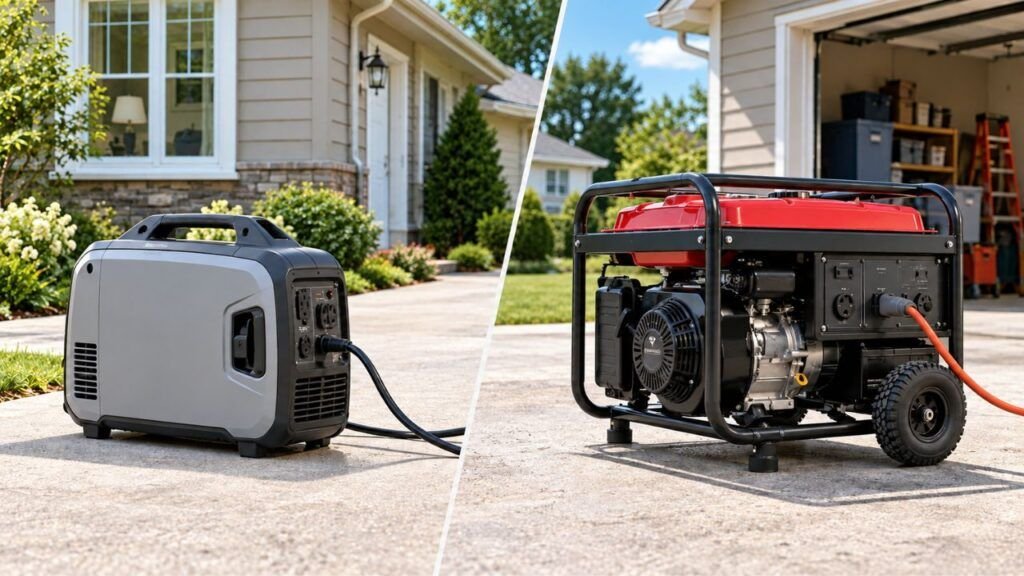
An inverter generator is usually better for home backup when you value quiet operation, lower fuel use, and clean power. A conventional generator often makes more sense when you need higher wattage at a lower upfront cost.
However, generator type is only part of the decision. You also need to consider wattage, starting surge, 120V or 240V power, fuel availability, outage length, and how you plan to connect the generator to your home.
Key Takeaways
- Inverter generators usually provide cleaner and more stable electrical power.
- Conventional generators often provide more wattage for your money.
- Inverter models generally use less fuel when electrical demand stays low.
- Larger inverter generators can now handle substantial home backup loads.
- Conventional generators are not automatically unsafe for sensitive electronics.
- Check THD, voltage, starting watts, outlets, and transfer-switch compatibility.
- Your actual home loads matter more than the generator label.
Inverter vs Conventional Generator for Home Backup: Quick Comparison
Both generator types can work well during a power outage. The better option depends on what you need to run.
| Feature | Inverter Generator | Conventional Generator |
| Power quality | Usually cleaner with low THD | Varies by generator design |
| Sensitive electronics | Usually an excellent choice | Check the generator’s THD rating |
| Engine operation | Adjusts speed with load | Usually operates near a fixed speed |
| Fuel efficiency | Usually better at partial loads | Usually lower at light loads |
| Noise | Generally quieter | Usually louder |
| Purchase price | Higher per watt | Lower per watt |
| Available output | Small to high-output models available | Very wide high-output selection |
| 120/240V models | Available on larger units | Common on larger generators |
| Starting heavy loads | Depends on surge rating | Often strong for the price |
| Portability | Usually better at smaller sizes | Larger models can be heavy |
| Repairs | Electronics can add complexity | Often somewhat simpler |
| Best use | Quiet, efficient essential-load backup | High-wattage budget-focused backup |
For many homeowners, an inverter generator provides the better overall experience. Conventional generators still make excellent sense when budget and high output matter most.
How Does an Inverter Generator Differ From a Conventional Generator?
Both machines burn fuel and turn an alternator. The biggest difference happens after that electricity gets generated.
How a Conventional Generator Produces Electricity
A conventional generator uses an engine connected directly to an alternator.
The engine burns gasoline, propane, or another supported fuel. It then spins the alternator, which produces AC electricity.
Most conventional generators maintain a relatively consistent engine speed. That helps them maintain the 60 Hz frequency used in U.S. homes.
This system is straightforward and proven. It also allows manufacturers to produce high-output generators relatively affordably.
The downside is efficiency at lighter loads. The engine may continue running quickly even when your home needs little electricity.
How an Inverter Generator Produces Electricity
An inverter generator takes a more controlled approach.
The generator first creates electrical power through its engine and alternator. Electronics then convert and condition that electricity before reaching your appliances.
The final output is stable AC power.
This electronic process also allows many inverter generators to change engine speed. The engine can slow when your electrical demand drops.
That reduces noise and often saves fuel.
Why This Difference Matters During an Outage
Home electricity demand constantly changes during an outage.
Your refrigerator compressor starts and stops. Your furnace blower may cycle. Lights get switched on and off.
A conventional generator keeps operating at roughly its designed engine speed. An inverter generator can often respond more efficiently to changing loads.
That difference becomes especially noticeable during overnight backup.
You may only need a refrigerator, router, furnace, and several lights. Running a large engine aggressively for those small loads wastes fuel.
An inverter generator can be more efficient in that situation.
Which Produces Cleaner Power for Home Electronics?
Modern homes contain more electronic components than many homeowners realize. That makes power quality worth considering when choosing a backup generator.
What Is Total Harmonic Distortion?
Total harmonic distortion, usually called THD, measures electrical waveform distortion.
Utility electricity normally has a smooth AC waveform. Sensitive electronics are generally designed around stable voltage and frequency.
A generator with low THD produces electricity closer to normal utility power.
Many inverter generators advertise THD below approximately 3% to 5%.
However, specifications vary between manufacturers.
Why THD Matters for Modern Home Appliances
You probably think about computers when hearing “sensitive electronics.”
They are only part of the picture.
Modern refrigerators may contain electronic control boards. Furnaces can use digital controls. Washing machines can have sophisticated electronic systems.
Your home may also contain:
Computers, televisions, routers, chargers, gaming systems, smart appliances, security systems, and electronic furnace controls.
Cleaner electricity reduces concerns about unstable voltage and waveform quality.
That is one reason inverter generators have become popular for modern homes.
Does a Conventional Generator Produce Dirty Power?
Not necessarily.
This is one area where generator comparisons often become too simplistic.
Some inexpensive conventional generators may produce less stable power. However, quality conventional generators can include sophisticated voltage-regulation systems.
Certain conventional models also advertise relatively low THD.
Therefore, you should not assume every conventional generator produces dangerous electricity.
Look at the specifications for the actual generator.
Pay particular attention to THD, voltage regulation, frequency stability, and manufacturer recommendations.
A well-designed conventional generator may work perfectly well with many home appliances.
Which Generator Is More Fuel Efficient?
An inverter generator normally has an advantage when your electrical load changes throughout the day.
Imagine owning a 7,000-watt generator.
During dinner, you might use 4,000 watts. Late at night, your house may only need 800 watts.
An inverter generator can usually reduce engine speed during that lighter period. That reduces unnecessary fuel consumption.
A conventional generator normally continues operating around its designed engine speed.
The difference can become meaningful during a multi-day outage.
However, do not compare generators by advertised runtime alone.
A generator with a larger fuel tank may advertise longer runtime. That does not necessarily mean its engine uses fuel more efficiently.
Compare fuel use at similar load percentages whenever possible.
A good comparison might examine consumption around 25% and 50% load.
For most households running essential circuits, partial-load efficiency matters greatly.
Inverter vs Conventional Generator Noise for Home Backup
Inverter generators are generally quieter than comparable conventional generators.
Several design differences contribute to this advantage.
Many inverter generators use enclosed housings that reduce engine noise. Their engines can also slow down when electricity demand falls.
Conventional generators often use open-frame designs.
That allows heat to escape easily and simplifies construction. Unfortunately, it also makes engine noise easier to hear.
Noise matters more during home backup than many buyers expect.
A loud generator may run for eight, twelve, or twenty-four hours. Your neighbors may also be dealing with the same outage.
An inverter generator can make overnight operation more comfortable.
Still, compare noise ratings carefully.
Manufacturers may measure sound from different distances or electrical loads. Two published decibel numbers are not always directly comparable.
Look for measurements taken under similar conditions.
Which Type Can Provide More Home Backup Power?
Conventional generators traditionally dominated higher-output portable backup power. That gap has become much smaller as inverter technology improves.
Conventional Generators Still Offer Excellent Watts per Dollar
Conventional generators remain attractive when you need substantial power.
Large portable models can support several important home loads simultaneously.
That may include a refrigerator, freezer, furnace blower, sump pump, microwave, lights, and other circuits.
You can also find powerful conventional generators without entering premium pricing.
That makes them appealing for homeowners who prioritize capacity.
Suppose you rarely experience outages.
Paying significantly more for quieter operation might not provide much value. A conventional generator can deliver dependable emergency power for less money.
Large Inverter Generators Are No Longer Just for Camping
Smaller inverter generators originally became popular with campers and RV owners.
That can create the impression that inverter generators are underpowered.
That is no longer always true.
Today, you can find inverter generators capable of producing several thousand watts. Some provide 120/240V output and home-backup-friendly connections.
That means an inverter generator can support serious household loads.
You do not automatically need a conventional generator just because you want more than 3,000 watts.
Compare actual specifications instead.
Running Watts vs Starting Watts
This distinction matters more than many generator buyers realize.
Running watts describe how much electricity an appliance needs while operating normally.
Starting watts describe the brief surge needed when certain appliances start.
Motor-driven equipment commonly needs extra startup power.
For example, your refrigerator may use modest power while running. Its compressor can briefly demand significantly more when starting.
Similar issues occur with sump pumps, well pumps, furnace blowers, and air conditioners.
Your generator must handle both demands.
A generator rated for enough running watts can still overload during startup.
Always leave enough surge capacity for your largest motor-driven load.
Does 120V vs 240V Matter More Than Generator Type?
For home backup, voltage can sometimes matter more than choosing inverter versus conventional. Your generator must produce the voltage required by your essential loads.
What Can You Run With a 120V Generator?
Many common emergency loads use 120V power.
That includes most refrigerators, freezers, lights, televisions, routers, computers, and small kitchen appliances.
Many gas furnaces also use 120V electricity for controls and blowers.
A large 120V generator can therefore support many household essentials.
However, high wattage does not turn 120V power into 240V power.
If an appliance requires 240V, you need compatible generator output.
When Do You Need 120/240V Output?
Many larger household appliances use 240V.
Depending on your home, examples can include well pumps, central air conditioners, water heaters, ranges, dryers, and other equipment.
You may not need those appliances during an outage.
However, your generator must support 240V if one becomes essential.
Check the appliance nameplate before planning your system.
Do not assume a high-wattage generator automatically supports both voltages.
Check the Outlet Before Assuming It Can Power Your Panel
The wattage number printed on the generator tells only part of the story.
You should also verify the available receptacles.
Check voltage, amperage, plug type, and generator configuration.
A generator may produce enough total watts but lack the connection needed for your planned setup.
This becomes especially important when connecting through an inlet and transfer equipment.
A qualified electrician can help confirm compatibility before installation.
Inverter vs Conventional Generator for a Transfer Switch
Both inverter and conventional generators can potentially work with a home transfer setup.
The generator type alone does not determine compatibility.
Instead, compatibility depends on its electrical output and connection options.
A transfer switch separates generator power from utility power. This prevents dangerous backfeeding into utility lines.
Some homes use a manual transfer switch.
Others may use an approved interlock system where local codes allow it.
Your generator may also connect through a dedicated outdoor generator inlet.
Before purchasing, verify the generator’s voltage and available receptacles.
You should also confirm amperage and neutral configuration requirements.
Never connect a portable generator to a wall outlet.
That practice can energize utility lines and create serious hazards.
Have home transfer equipment installed correctly for your electrical system.
Which Handles a Long Power Outage Better?
A long outage changes the comparison because fuel becomes extremely important. Comfort features also matter more after several days without utility power.
Inverter Generator During a Long Outage
An inverter generator can perform especially well when your load changes frequently.
During the day, you might use several appliances together. Overnight, your demand could drop considerably.
The inverter generator can often reduce its engine speed accordingly.
That may stretch your available fuel farther.
Lower noise is another meaningful advantage.
A quiet generator is much easier to tolerate overnight.
The biggest disadvantages are purchase price and repair complexity.
Some inverter models also have smaller fuel tanks than comparable open-frame generators.
Conventional Generator During a Long Outage
A conventional generator can be excellent for sustained heavy demand.
Large models often include substantial fuel tanks and high continuous wattage.
They are especially attractive when you need several heavy loads operating together.
The lower upfront cost can also allow you to purchase more capacity.
Fuel consumption can become the downside.
Running a large conventional generator lightly loaded for many hours may be inefficient.
During widespread outages, finding gasoline can also become difficult.
Your Average Load Determines the Better Choice
Look at what you will actually run.
Suppose your essential loads average only 1,500 watts most of the day.
A large inverter generator may provide excellent efficiency while still leaving surge capacity.
Now imagine your home regularly needs 6,000 watts during an outage.
A large conventional generator might offer substantially better value.
Match the machine to your real load profile.
Inverter vs Conventional Generator Cost: Which Gives Better Value?
Conventional generators usually cost less for similar rated wattage. However, purchase price is only one part of ownership cost.
| Cost Factor | Inverter Generator | Conventional Generator |
| Initial purchase price | Usually higher | Usually lower |
| Cost per watt | Usually higher | Usually lower |
| Fuel at light loads | Usually lower | Often higher |
| Routine engine service | Required | Required |
| Electronic repair complexity | Potentially higher | Usually lower |
| Noise reduction | Usually better | Usually lower |
| Long-outage fuel demand | Often lower with changing loads | Can be higher |
| Overall value | Excellent for frequent use | Excellent for budget backup |
Think about how often you expect to use the generator.
If outages occur once every few years, fuel savings may never recover a large price difference.
A conventional generator can therefore be the smarter financial choice.
Frequent outages change the calculation.
Fuel savings, lower noise, and smoother everyday operation may justify spending more upfront.
Value depends on how you use the generator.
Which Is Easier to Maintain and Repair?
Both generator types contain gasoline or multi-fuel engines that require regular maintenance.
Expect oil changes, air-filter inspection, spark-plug service, and fuel-system care.
Fuel storage also requires attention.
Old gasoline can create starting problems and carburetor issues.
An inverter generator does not eliminate these responsibilities.
The biggest maintenance difference appears when something electrical fails.
Inverter generators contain more sophisticated electronic components.
Those components can make certain repairs more expensive or complicated.
Conventional generators often use simpler electrical designs.
That can make troubleshooting easier in some situations.
However, brand support matters greatly.
A quality inverter generator with excellent service availability can be easier to own than a cheap conventional model with unavailable parts.
Which Generator Is Better for Different Home Backup Situations?
There is no universal winner for every house. The right generator changes depending on what you need during an outage.
Refrigerator, Freezer, Lights, Router, and Electronics
An inverter generator is usually my preferred choice here.
These loads are relatively modest but may operate for many hours.
Fuel efficiency becomes valuable.
Your computers, router, television, and smart appliances also benefit from stable electricity.
The quieter operation makes overnight use easier.
Sump Pump or Well Pump Backup
Either generator type can work well.
Focus first on voltage and startup requirements.
Pumps can demand several times their normal running power for startup.
A high-quality inverter generator can handle pumps when sized correctly.
A conventional generator may offer more surge capacity for your budget.
Check the pump specifications before choosing either type.
Furnace, Refrigerator, and Overnight Essentials
An inverter generator usually has a strong advantage.
These loads often cycle throughout the night.
Your total demand may stay relatively low most of the time.
Variable engine speed can reduce noise and fuel consumption.
That creates a more comfortable overnight setup.
Central Air Conditioner and Several Large Appliances
This depends heavily on generator size.
Central air conditioners can require substantial running and startup power.
A conventional generator may provide the needed wattage for less money.
However, larger inverter generators can also handle demanding home loads.
Do not choose by category alone.
Calculate your actual AC startup requirement first.
Budget Emergency Backup
A conventional generator is often the practical winner.
You can usually purchase more wattage for the same amount of money.
That makes sense when the generator will only operate during occasional emergencies.
You may accept more noise and fuel use to save upfront.
Noise-Sensitive Neighborhood
An inverter generator is usually easier to live with.
Lower engine noise helps both your household and nearby neighbors.
This becomes particularly important during overnight operation.
Still, you must follow all safe outdoor placement requirements.
Homes With Many Smart Electronics
An inverter generator makes choosing simpler.
Low-THD output is common throughout the category.
However, a conventional generator with verified low THD can also work well.
Check the specification instead of relying entirely on the generator label.
Can an Inverter Generator Run an Entire House?
Yes, some inverter generators can support a substantial portion of a house.
But the phrase “run the entire house” needs context.
Connecting a generator to your electrical panel does not mean every appliance can operate simultaneously.
Your home might contain an electric range, central air conditioner, water heater, clothes dryer, well pump, and dozens of smaller loads.
Their combined demand can easily exceed a portable generator’s capacity.
Instead, most homeowners manage selected circuits during an outage.
You might prioritize refrigeration, heating, water, lighting, internet, and several outlets.
A larger inverter generator can handle those loads when sized properly.
If you expect normal whole-home operation without managing loads, you may need a much larger backup system.
How to Choose Between an Inverter and Conventional Generator
Start with your home’s needs instead of shopping by generator type.
First, identify every appliance you consider essential.
Check the nameplate or manual for running wattage and voltage.
Next, identify your largest starting load.
Refrigerators, pumps, compressors, and air conditioners deserve special attention.
Then determine whether any critical appliance requires 240V.
This immediately removes incompatible generators from consideration.
Consider how long outages typically last in your area.
Short outages may make purchase price more important.
Multi-day outages make noise and fuel efficiency increasingly important.
Finally, compare actual generator specifications.
Look at continuous watts, starting watts, THD, voltage, receptacles, fuel type, fuel consumption, noise, and runtime.
A generator with the right numbers for your house is better than one belonging to the “better” category.
Generator Safety Matters With Both Types
An inverter generator still burns fuel.
That means it produces carbon monoxide just like a conventional generator.
Never operate either type inside your home.
Do not run one inside a garage, basement, shed, or enclosed porch.
Opening a garage door does not make indoor generator use safe.
Keep portable generators outdoors and well away from doors, windows, and vents.
A distance of at least 20 feet is commonly recommended when practical.
Direct the exhaust away from occupied areas.
Use properly rated extension cords when powering appliances directly.
Keep electrical connections dry and protected from weather.
For panel connections, use approved transfer equipment.
Never backfeed your home through a standard wall receptacle.
Also keep working carbon monoxide alarms inside your house.
Safety rules do not change because your generator uses inverter technology.
Final Verdict
For most homeowners backing up moderate essential loads, I would lean toward an inverter generator.
You get quieter operation, cleaner electrical output, and better efficiency when your load stays below maximum capacity.
That combination works particularly well for refrigerators, furnaces, electronics, lights, internet equipment, and other essentials.
A conventional generator becomes especially attractive when you need substantial wattage while controlling purchase cost.
It can be the better value for heavy pumps, multiple appliances, and larger emergency loads.
Just do not make your decision from the words “inverter” or “conventional” alone.
Start with your running watts, starting watts, voltage, THD, fuel plan, and connection method.
The generator that properly supports those requirements is the right generator for your home.
Related FAQs
Are Inverter Generators Better for Home Backup?
Inverter generators are often better for moderate home backup because they are quieter, fuel-efficient, and typically produce low-THD electricity. Conventional generators can still be better when higher wattage and lower purchase cost matter most.
Are Conventional Generators Safe for Sensitive Electronics?
A conventional generator can safely power sensitive electronics when it provides sufficiently stable voltage, frequency, and low THD. Check the manufacturer’s electrical specifications instead of assuming every conventional generator produces poor-quality power.
How Much THD Is Acceptable for Home Electronics?
Lower THD is generally preferable for sensitive electronics, and many inverter generators advertise less than 3% to 5%. Always check equipment requirements when powering particularly sensitive or specialized devices.
Is an Inverter Generator Worth the Extra Money?
An inverter generator is often worth the extra cost when you experience regular outages, value quiet operation, or run many electronics. Occasional emergency users needing maximum wattage may get better value from a conventional generator.
Can an Inverter Generator Power a Refrigerator and Sump Pump Together?
Yes, provided its running and surge ratings can handle both appliances. Pay particular attention to the sump pump’s startup demand because motor loads can briefly require significantly more power.
Can an Inverter Generator Run a Furnace?
Many inverter generators can run a gas or propane furnace blower when properly sized. Check the furnace voltage, running wattage, startup demand, and connection requirements before using generator power.
Can an Inverter Generator Run a Well Pump?
An inverter generator can run some well pumps, but voltage and startup wattage are critical. Many well pumps require 240V and strong surge capacity, so check the pump specifications before choosing a generator.
Do Inverter Generators Come in 240V?
Yes. Larger inverter generators are available with 120/240V output. Smaller portable inverter models may provide only 120V, so always confirm voltage before planning to power 240V household equipment.
Can an Inverter Generator Connect to a Transfer Switch?
Yes, many inverter generators can work with compatible transfer equipment. The generator must provide the correct voltage, amperage, outlets, and electrical configuration required by your home’s installation.
Which Type of Generator Uses Less Fuel?
An inverter generator generally uses less fuel during light or changing electrical loads because it can reduce engine speed. The exact difference depends on generator size, load percentage, engine design, and fuel type.
Are Inverter Generators Quieter Than Regular Generators?
Inverter generators are generally quieter because many use enclosed housings and variable-speed engines. A large inverter generator can still be loud under heavy load, so compare published noise specifications carefully.
Do Conventional Generators Last Longer Than Inverter Generators?
Neither type automatically lasts longer. Engine quality, operating hours, load, maintenance, storage conditions, and manufacturer quality usually matter more than whether the generator uses inverter technology.

Brian Walker writes straightforward generator guides and reviews for homeowners and everyday users. His content focuses on solar, portable, and fuel-powered generators, with practical advice on choosing, using, and maintaining reliable backup power.















