
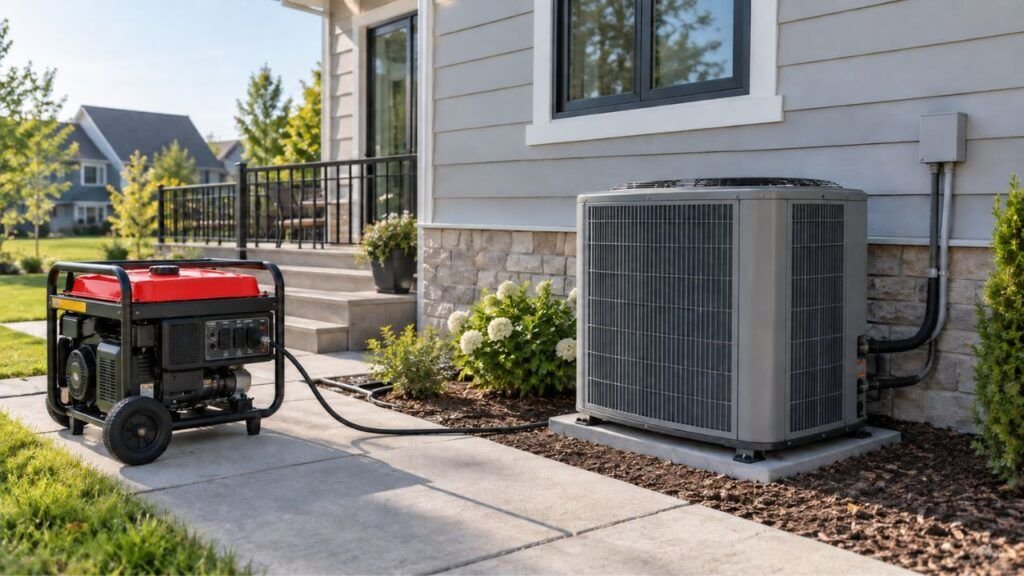
Yes, a generator can run a heat pump. However, the generator must supply enough continuous power, startup capacity, and the correct voltage. Fixed-speed heat pumps usually need more starting power than inverter or variable-speed systems.
The right generator depends on your heat pump, auxiliary heat, and other loads. Below, I’ll show you how to check your system, estimate generator size, and avoid the common problems homeowners run into.
Key Takeaways
- A properly sized generator can run most residential heat pumps.
- Many central heat pumps require a 240-volt generator connection.
- Fixed-speed compressors can demand substantial startup power.
- Inverter heat pumps are generally easier for generators to handle.
- Auxiliary electric heat strips can add thousands of watts.
- Generator size should come from actual equipment specifications.
- A soft starter may reduce startup demand on compatible compressors.
- Always use approved transfer equipment when powering home circuits.
Can a Generator Really Run a Heat Pump?
Yes. Both portable and standby generators can operate heat pumps.
The real question is whether your particular generator can handle yours.
A heat pump is different from a simple resistive appliance. Its compressor contains a motor that may need considerable power during startup.
Once running, its electrical demand can drop significantly.
You also need to consider the indoor air handler. The blower, controls, and other HVAC components need electricity too.
Another major factor is auxiliary electric heat.
Your heat pump might run comfortably from a generator until electric heat strips activate. Those strips can increase total electrical demand dramatically.
So, you need to look at the entire HVAC system.
What Size Generator Do You Need for a Heat Pump?
There is no universal generator size for every heat pump. Compressor design, voltage, capacity, auxiliary heat, and other household loads all affect the answer.
| Heat Pump Type | Generator Difficulty | Main Concern | General Generator Approach |
| Small inverter mini-split | Lower | Running load and voltage | Small or midsize generator may work |
| Larger inverter mini-split | Moderate | Maximum system input | Midsize generator may work |
| Fixed-speed central heat pump | Higher | Compressor startup surge | Large portable or standby generator |
| Variable-speed central heat pump | Moderate | Maximum electrical input | Often easier than fixed-speed |
| System with electric heat strips | Very high | Resistance heating load | Large generator often required |
| Dual-fuel heat pump | Varies | Selected heating source | Depends on operating mode |
You may see generator recommendations based only on heat pump tonnage.
I would not rely on those numbers alone.
Two 3-ton heat pumps can have very different electrical requirements. One could use a conventional single-stage compressor. Another could use modern inverter technology.
Their starting behavior may be completely different.
Use tonnage only for a rough starting point. Check the actual electrical information before selecting your generator.
Why Heat Pumps Can Be Difficult for Generators to Start
A generator must handle more than normal running power. The compressor’s startup behavior can become the biggest sizing challenge.
Running Power Is Only Part of the Story
Once operating normally, the heat pump has several electrical loads.
The outdoor unit powers the compressor and condenser fan. The indoor unit usually powers the blower and control electronics.
These loads must operate together.
Your generator therefore needs enough continuous output for the complete system.
You should also include other essential appliances running simultaneously.
Starting Current Can Be Much Higher
Conventional compressors often require considerably more current during startup.
This short surge occurs when the compressor motor begins turning.
The generator may handle the normal running load easily. However, it can still struggle during that initial startup event.
This is why running watts alone cannot determine generator compatibility.
Generator Voltage Can Drop During Compressor Startup
A heavy motor startup can temporarily pull generator voltage downward.
When that happens, you may notice several symptoms.
The generator could bog down. Lights might dim. The generator breaker could trip.
The compressor may also attempt to start and immediately stop.
Repeated failed starts are a strong sign you should investigate capacity.
Do not repeatedly force the equipment to start this way.
Fixed-Speed vs Inverter Heat Pumps on a Generator
Heat pump compressor technology makes a major difference here. A fixed-speed compressor and inverter compressor do not start the same way.
Conventional Fixed-Speed Heat Pump
A conventional single-stage compressor essentially operates on or off.
When your thermostat calls for heating or cooling, the compressor starts.
That startup can create a high momentary electrical demand.
The generator must tolerate this short surge without excessive voltage drop.
That often means choosing more generator capacity than running watts suggest.
Inverter or Variable-Speed Heat Pump
An inverter heat pump controls compressor speed electronically.
Instead of immediately jumping to full output, the compressor can ramp gradually.
That usually results in much lower startup stress.
For generator use, this can make a substantial difference.
A generator that struggles with a conventional compressor may handle an inverter-driven system more comfortably.
Which Is Easier for a Generator to Run?
An inverter or variable-speed heat pump is generally easier.
However, that does not mean every small generator will work.
You still need enough voltage and continuous power. The generator must also meet any manufacturer requirements for power quality.
Check the specific equipment rather than assuming inverter means low wattage.
Don’t Forget the Indoor Air Handler
The outdoor condenser is only part of your heat pump system.
Your indoor equipment also needs electricity.
The air handler usually contains the blower motor and control board. Some systems also contain zoning equipment and electric resistance heaters.
This is why checking only the outdoor unit can underestimate demand.
Look at both the outdoor heat pump and indoor air handler.
You want to understand what must operate simultaneously during an outage.
If you have electric auxiliary heat, pay particular attention to it.
Auxiliary Heat Strips Can Completely Change Generator Sizing
Electric auxiliary heat is one of the biggest generator-sizing problems. Your compressor may be manageable while the heat strips are not.
What Auxiliary or Emergency Heat Does
Heat pumps become less effective as outdoor temperatures drop.
Many systems include electric resistance heaters inside the air handler.
These are commonly called auxiliary heat, backup heat, or heat strips.
They can operate when your system needs additional heating capacity.
Emergency heat may also rely heavily on these resistance heaters.
Why Heat Strips Require So Much Generator Power
Resistance heating consumes a large amount of electricity.
For example, a 10-kW heater represents roughly a 10,000-watt load.
That is before adding your blower, refrigerator, lights, or other appliances.
Some residential systems contain even larger heater packages.
This can turn a manageable heat pump into an enormous generator load.
What Happens During Defrost
Heat pumps occasionally need to defrost their outdoor coils.
During defrost, the system temporarily changes operating conditions.
Some systems may use auxiliary heat to maintain indoor comfort.
That can create a much larger electrical load than expected.
A generator test during mild weather may therefore be misleading.
Cold-weather operation can place significantly more demand on the system.
Should You Disable Auxiliary Heat When Using a Generator?
Possibly, but do not simply disconnect wires yourself.
Some homeowners choose to prevent electric heat strips from operating during generator use.
That decision should depend on the system design and climate.
An HVAC technician can determine whether your controls support safe lockout.
An electrician can also determine how those circuits should be managed.
How to Calculate the Generator Size for Your Heat Pump
The best sizing method uses the specifications from your actual equipment. Work through each step rather than guessing from heat pump tonnage.
1. Find the Heat Pump’s Electrical Nameplate
Start with the label on your outdoor unit.
You may see electrical terms including:
- Voltage
- RLA
- FLA
- LRA
- MCA
- MOCP
You should also check your indoor air handler label.
Take clear photographs if the labels are difficult to read.
One important point deserves attention.
MCA does not equal actual running amperage.
Likewise, the circuit breaker rating does not tell you exact operating watts.
Those values are mainly used for wiring and circuit protection.
2. Find the Actual Running Requirement
Use the manufacturer’s electrical input data when available.
If you have reliable voltage and amperage information, you can estimate load.
A basic calculation is:
Volts × amps = volt-amperes
For simple homeowner planning, this can provide a rough load estimate.
However, manufacturer wattage or input-power data is preferable when available.
Remember to include the indoor blower.
3. Determine the Startup Requirement
This step matters especially with fixed-speed compressors.
Check for LRA information or manufacturer startup specifications.
LRA represents locked-rotor amperage.
It indicates the very high current associated with a stalled motor condition.
You should not automatically treat LRA multiplied by voltage as exact real starting watts.
Instead, use it as a clue about startup severity.
Generator motor-starting capability and voltage stability also matter.
For inverter heat pumps, manufacturer maximum-input information is usually more useful.
4. Add the Indoor Blower and Other HVAC Loads
Your compressor cannot heat or cool the house alone.
The indoor blower must move conditioned air through the ductwork.
Add its electrical demand to your calculation.
Also include pumps or controls required by your specific system.
5. Add Other Appliances You Need During an Outage
Most people will not run only the heat pump.
You might also need:
- Refrigerator
- Freezer
- Well pump
- Sump pump
- Lights
- Internet equipment
- Television
- Microwave
- Small kitchen appliances
Add the loads you realistically expect to use together.
Do not assume every appliance will operate separately.
6. Leave Reasonable Generator Headroom
Avoid planning to operate continuously at maximum generator output.
Some spare capacity helps with changing loads and motor starts.
However, do not simply add a percentage and assume everything works.
Motor-starting performance matters just as much as advertised wattage.
Use generator manufacturer specifications whenever possible.
A Simple Heat Pump Generator Sizing Example
Here is a hypothetical example to show the process. These numbers are for explanation only and do not represent every heat pump.
Suppose your HVAC system needs approximately:
- Heat pump while running: 3,000 watts
- Indoor blower: 500 watts
- Refrigerator: 200 watts
- Lights and internet equipment: 300 watts
Your approximate continuous load would be:
3,000 + 500 + 200 + 300 = 4,000 watts
However, that does not automatically mean a 4,000-watt generator works.
Suppose the conventional compressor requires a much larger startup burst.
Your generator must support that startup event while other loads remain powered.
That could push you into a significantly larger generator class.
The important lesson is simple.
Check both continuous capacity and starting capability.
Do not select a generator from running watts alone.
Can a Portable Generator Run a Heat Pump?
Yes, a portable generator can run many heat pumps.
Smaller systems are usually easier to support.
Inverter-driven heat pumps can also be more generator-friendly because startup demand is often lower.
Large conventional central systems require more caution.
You need enough generator capacity for both running and startup loads.
Voltage is equally important.
Many central heat pumps operate on approximately 240 volts.
A small 120-volt generator cannot power that system directly.
It does not matter whether its advertised wattage looks sufficient.
Make sure your generator actually provides the required voltage.
Can an Inverter Generator Run a Heat Pump?
Yes, an inverter generator can run a heat pump when properly sized.
However, two similar terms often confuse homeowners.
An inverter generator refers to generator technology.
An inverter heat pump refers to compressor-control technology.
They are not the same thing.
An inverter generator can supply stable power and operate efficiently under varying loads.
But it still needs the correct voltage and enough output.
A 120-volt inverter generator cannot power a 240-volt central heat pump directly.
Always check the generator’s receptacles and output specifications.
Does a Soft Starter Help a Generator Run a Heat Pump?
A soft starter can significantly improve generator compatibility on certain compressors. However, it must match the HVAC equipment and compressor design.
What a Soft Starter Does
A soft starter manages how a compressor motor starts.
It reduces the sharp current spike during startup.
This can make the load easier for a generator to handle.
A generator that previously bogged down may start the compressor more smoothly.
When a Soft Starter Makes Sense
Soft starters are commonly considered for conventional single-stage compressors.
They can be especially helpful when generator capacity is limited.
You might also consider one when startup repeatedly causes voltage dips.
Have compatibility confirmed before purchasing or installing one.
When You May Not Need One
Modern inverter heat pumps already control compressor startup electronically.
Adding an aftermarket soft starter may be unnecessary or incompatible.
Do not assume every HVAC system benefits from one.
Check your heat pump manufacturer’s requirements first.
Portable Generator vs Standby Generator for a Heat Pump
Both generator types can work with heat pumps. Your better choice depends on the HVAC load, outage frequency, and other circuits you want powered.
| Feature | Portable Generator | Standby Generator |
| Heat pump compatibility | Depends heavily on generator size | Usually better for larger HVAC loads |
| 240V output | Available on some models | Common |
| Automatic startup | Usually no | Usually yes |
| Whole-home backup | Limited on smaller models | Better suited |
| Fuel supply | Requires manual fuel planning | Often connected permanently |
| Installation | Transfer equipment required | Permanent professional installation |
| Best use | Selected essential circuits | Large loads or whole-home backup |
A portable generator makes sense when you only need selected circuits.
A standby system becomes more attractive when HVAC comfort is essential.
It also makes sense when you need multiple large loads simultaneously.
What Happens if the Generator Is Too Small?
An undersized generator usually gives you warning signs. Pay attention to them rather than repeatedly forcing the HVAC system to operate.
You may notice:
- The heat pump fails to start.
- The generator breaker repeatedly trips.
- Generator overload protection activates.
- The engine suddenly bogs down.
- Lights dim heavily during compressor startup.
- Voltage drops under load.
- Other appliances shut down.
- The compressor repeatedly attempts to restart.
- The generator becomes unstable when the HVAC starts.
If this happens, turn unnecessary loads off.
Then determine whether startup capacity is the actual problem.
Repeatedly attempting difficult compressor starts is not a good solution.
Can You Run the Heat Pump and Other Appliances Together?
Yes, assuming your generator has enough capacity.
You need to consider all loads operating at the same time.
Imagine your heat pump is already running.
Then your refrigerator starts.
A few seconds later, your well pump also tries starting.
Those overlapping motor loads can overwhelm an otherwise adequate generator.
Load sequencing can help.
For example, avoid starting the well pump while the heat pump compressor starts.
After the compressor stabilizes, you can add other circuits carefully.
A larger generator or automatic load management makes this easier.
Does a Heat Pump Need Clean Power From a Generator?
Modern heat pumps contain sensitive electronic components.
Control boards, inverter electronics, sensors, and variable-speed motors all depend on stable electrical power.
Your generator should maintain acceptable voltage and frequency.
Power quality becomes particularly important with inverter-driven HVAC systems.
Avoid assuming that any generator is automatically compatible.
Check the HVAC manufacturer’s generator guidance when available.
Also review the generator’s voltage regulation specifications.
For sensitive equipment, stable output is more important than raw wattage alone.
How to Connect a Generator to a Heat Pump Safely
A heat pump is normally connected through your home’s electrical system. That means your generator needs an approved connection method.
Transfer Switch
A transfer switch separates utility power from generator power.
Manual transfer switches require you to change power sources yourself.
Automatic transfer switches are common with standby generators.
Either way, the purpose is extremely important.
Utility power and generator power should not feed the home simultaneously.
Interlock Kit
A properly approved interlock can provide another connection method.
It mechanically prevents the utility breaker and generator breaker from operating together.
The equipment must match your electrical panel.
Installation should comply with local electrical requirements.
Never Backfeed Through a Household Outlet
Do not connect a generator through a standard household receptacle.
This practice can energize utility lines unexpectedly.
That creates a serious electrocution hazard for utility workers.
It can also damage equipment or create fire hazards.
Use a properly installed transfer system or approved interlock arrangement.
Keep Portable Generators Outdoors
Never operate a portable generator inside your home or garage.
Do not run one inside a basement, shed, or enclosed porch.
Generator exhaust contains carbon monoxide.
Place the generator outdoors and well away from the home.
A commonly recommended minimum distance is around 20 feet.
Point the exhaust away from windows, doors, and ventilation openings.
When a Standby Generator Makes More Sense
A portable generator works for many situations. However, larger HVAC loads can make standby power much more practical.
Consider a standby generator when:
- Your heat pump is large.
- Auxiliary electric heat is important.
- Several 240-volt loads need backup.
- You need a well pump during outages.
- Whole-home backup is your goal.
- Automatic startup is important.
- Power outages happen frequently.
- Manual generator setup becomes inconvenient.
Load-management equipment can sometimes reduce required generator capacity.
It temporarily prevents certain large appliances from running together.
That can be useful when several heavy loads share one generator.
How to Check Whether Your Existing Generator Can Run Your Heat Pump
If you already own a generator, you can do some basic homework before calling a professional.
Follow these steps:
- Check whether your heat pump requires 120V or 240V.
- Confirm your generator provides the required voltage.
- Find the generator’s rated continuous wattage.
- Check its surge or motor-starting capacity.
- Photograph your outdoor heat pump nameplate.
- Photograph your indoor air handler nameplate.
- Check whether electric heat strips are installed.
- List other circuits powered during an outage.
- Estimate which loads might operate simultaneously.
- Ask an electrician or HVAC technician about unclear startup requirements.
This process gives you a much better answer than guessing by tonnage.
It also helps a technician evaluate your system more quickly.
Common Mistakes When Running a Heat Pump From a Generator
Most heat-pump generator problems come from incorrect sizing or overlooked electrical requirements.
Avoid these common mistakes:
- Choosing generator size only from heat pump tonnage.
- Looking only at running watts.
- Ignoring compressor startup requirements.
- Forgetting the indoor air handler.
- Ignoring electric auxiliary heat.
- Assuming breaker size equals normal power consumption.
- Assuming every compressor has identical startup behavior.
- Ignoring the system’s 240V requirement.
- Installing a soft starter without confirming compatibility.
- Starting several motor loads at the same time.
- Running the generator continuously at maximum capacity.
- Connecting the generator without proper transfer equipment.
- Operating a portable generator inside a garage.
Taking a few minutes to check these details can prevent major problems.
Final Words
Yes, a generator can run a heat pump, but generator size matters.
The best choice depends on your heat pump’s actual electrical requirements. Compressor technology, startup demand, indoor equipment, and auxiliary heat all affect the final load.
Fixed-speed heat pumps usually create the biggest startup challenge. Inverter systems are often easier because their compressors start more gradually.
Electric heat strips are another major consideration. They can add thousands of watts and quickly overwhelm a portable generator.
Before buying or connecting anything, check both HVAC nameplates. Then compare those requirements with your generator’s voltage, continuous output, and motor-starting ability.
Doing that gives you a much safer and more reliable answer.
Related FAQs
Can a 5,000-Watt Generator Run a Heat Pump?
A 5,000-watt generator may run a smaller heat pump or inverter-driven system, but many conventional central units can exceed its startup capability. Check the heat pump’s actual electrical specifications and generator voltage before relying on it.
Can a 7,500-Watt Generator Run a Heat Pump?
A 7,500-watt generator can run some residential heat pumps, particularly when auxiliary heat is disabled and other loads remain limited. However, a fixed-speed compressor may still require more startup capacity than the generator can provide.
Can a 10,000-Watt Generator Run a Heat Pump?
A 10,000-watt generator can power many residential heat pumps, but compatibility still depends on startup demand, 240V output, auxiliary heat, and other connected appliances. Do not assume wattage alone guarantees reliable operation.
Can a Generator Run a 3-Ton Heat Pump?
Yes, a generator can run many 3-ton heat pumps. However, generator size cannot be determined accurately from tonnage alone because fixed-speed and inverter 3-ton systems can have very different electrical requirements.
Can a Generator Run a 4-Ton Heat Pump?
Yes, but a 4-ton central heat pump can require substantial generator capacity. Fixed-speed units may need significant starting power, while inverter-driven models can be easier to start from generator power.
Can a Generator Run a Heat Pump in Winter?
Yes, but winter operation deserves extra attention because auxiliary electric heat may activate. Heat strips can add several thousand watts and require a much larger generator than normal compressor operation.
Can You Run Emergency Heat on a Generator?
You can run emergency electric heat if your generator has enough capacity, but electric resistance heating uses enormous amounts of power. Many portable generators cannot support large heat-strip packages safely.
Will a Heat Pump Work With a Portable Generator?
Yes, many heat pumps can work with properly sized portable generators. The generator must provide the correct voltage, enough continuous output, and sufficient capacity for compressor startup.
Do You Need a Soft Start for a Heat Pump on a Generator?
Not always. A soft starter can help conventional compressors with high startup current, but inverter and variable-speed heat pumps already manage compressor startup differently. Confirm compatibility before adding one.
Does a Heat Pump Need 240 Volts?
Many central residential heat pumps operate on approximately 208/230 or 240 volts. Smaller mini-splits may use different voltages, so always check the equipment nameplate before choosing your generator.
Can a Generator Run a Mini-Split Heat Pump?
Yes. Many mini-split heat pumps are relatively generator-friendly because they use inverter compressors. Your generator still needs the required voltage and enough continuous output for the specific mini-split system.
Can a Heat Pump and Refrigerator Run on the Same Generator?
Yes, provided the generator can handle both continuous loads and their startup demands. Avoid allowing several motor-driven appliances to start simultaneously when generator capacity is limited.

Brian Walker writes straightforward generator guides and reviews for homeowners and everyday users. His content focuses on solar, portable, and fuel-powered generators, with practical advice on choosing, using, and maintaining reliable backup power.















