
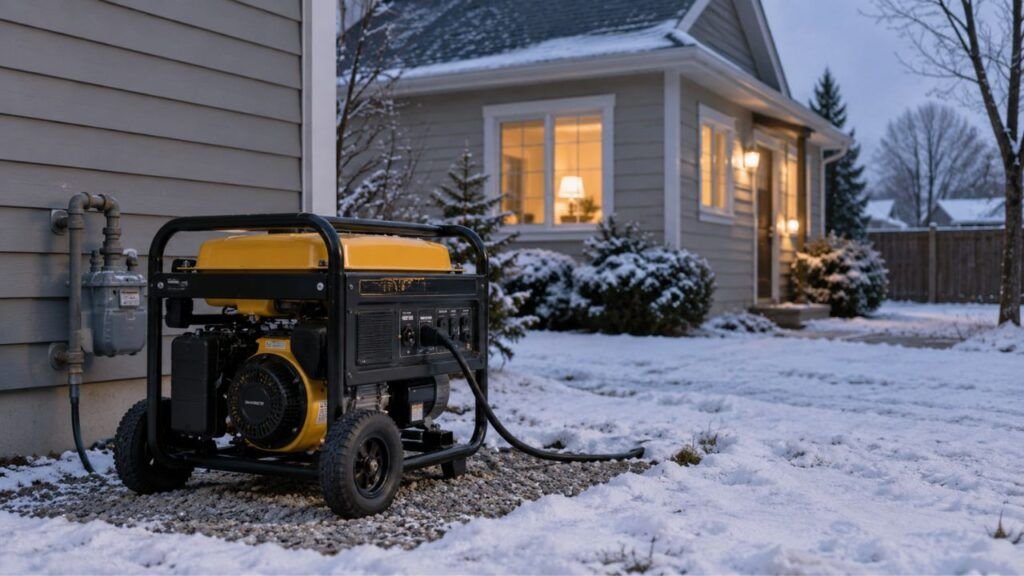
Most residential gas furnaces can run on a 2,500- to 3,500-watt generator when the furnace is the main load. Many furnace blowers use about 300 to 900 running watts and may need roughly 500 to 2,350 watts during startup. Larger blowers, older motors, and extra appliances can require more capacity.
The exact generator size depends on your furnace and other loads. I’ll show you how to check the numbers, calculate capacity, and avoid common sizing mistakes.
Key Takeaways
- A 2,500- to 3,500-watt generator works for many gas furnaces.
- Check both furnace running power and blower startup demand.
- Larger or older blower motors can require significantly more startup power.
- Furnace BTU rating does not directly determine generator wattage.
- Add every appliance you plan to run during an outage.
- Hardwired furnaces need a safe, approved generator connection method.
- A 3,500- to 5,000-watt generator offers better flexibility for essentials.
What Size Generator Do You Need for a Gas Furnace?
For many homes, you do not need a huge generator. The furnace’s blower motor usually creates the biggest electrical demand.
| Gas Furnace Setup | Typical Situation | Suggested Generator Size |
| Small efficient furnace | Furnace only | 2,000-2,500W |
| Typical residential furnace | Furnace only | 2,500-3,500W |
| Large or older furnace | Higher blower surge | 3,000-4,000W |
| Furnace + refrigerator + lights | Common outage essentials | 3,500-5,000W |
| Furnace + fridge + sump pump | Several motor loads | 5,000-7,500W+ |
| Furnace + many household loads | Extended home backup | Calculate total loads |
These numbers are practical planning ranges rather than fixed requirements.
Your own furnace could fall above or below these estimates.
The safest approach is checking its electrical specifications before buying anything.
For only the furnace, I would generally start around 2,500 watts.
Moving toward 3,000 to 3,500 watts gives you useful breathing room.
If you also want your refrigerator running, consider 3,500 to 5,000 watts.
How Many Watts Does a Gas Furnace Use?
A gas furnace uses surprisingly little electricity compared with electric heating. Natural gas creates the heat, while electricity operates the furnace components.
Gas Furnace Running Watts
Many residential gas furnace blowers use roughly 300 to 900 watts while running.
The exact amount depends mainly on the blower motor.
Other electrical components also consume smaller amounts of power.
These can include:
- Furnace control board
- Electronic ignition
- Draft inducer motor
- Thermostat circuit
- Condensate pump
- Humidifier or accessories
The blower is usually the largest continuous electrical load.
Larger furnaces may have more powerful blower motors.
Older equipment can also consume more electricity than newer systems.
Gas Furnace Starting Watts
Starting watts are especially important when choosing your generator.
An electric motor may briefly need extra power when starting.
Your furnace blower can therefore demand much more than its normal wattage.
For example, a blower using 600 watts continuously might need around 1,000 watts when starting.
A larger motor might require more than 2,000 watts temporarily.
The startup period is short, but your generator must handle it.
Otherwise, the furnace might fail to start properly.
The generator may also overload or trip its breaker.
PSC vs. ECM Blower Motors
Your blower motor type can affect its electrical demand considerably.
Older furnaces commonly use PSC motors, or permanent split capacitor motors.
They usually operate at fixed speeds and consume more electricity.
They may also create a noticeable startup surge.
Many newer furnaces use ECM motors, meaning electronically commutated motors.
ECM blowers are generally more energy efficient than PSC designs.
They can also adjust their speed according to airflow requirements.
Many ECM systems start more gradually than traditional blower motors.
However, you should never assume an ECM furnace needs little power.
Always check your specific furnace specifications before sizing the generator.
Gas Furnace Generator Size by Blower Motor
Blower motor horsepower provides a useful starting point for estimating demand. These figures are approximate and should not replace your furnace specifications.
| Furnace Blower Motor | Approx. Running Watts | Approx. Starting Watts |
| 1/8 HP | 300W | 500W |
| 1/6 HP | 500W | 750W |
| 1/4 HP | 600W | 1,000W |
| 1/3 HP | 700W | 1,400W |
| 1/2 HP | 875W | 2,350W |
Suppose your furnace has a 1/4 HP blower.
Around 600 running watts would be a reasonable planning estimate.
Startup demand could reach approximately 1,000 watts.
A 2,000-watt generator might technically handle that furnace.
However, I would still prefer additional capacity for reliable operation.
A 2,500- to 3,000-watt generator gives you better flexibility.
Now imagine your furnace has a 1/2 HP blower.
Its startup demand could approach 2,350 watts.
A generator barely rated for 2,000 watts would be undersized.
Moving toward 3,000 to 3,500 watts would make more sense.
Why Does a Gas Furnace Need Electricity?
Your gas supply creates heat, but electricity makes the furnace operate. Several furnace components depend on electrical power throughout each heating cycle.
Electricity usually powers:
- The circulating blower motor
- The draft inducer motor
- The electronic ignition system
- The main furnace control board
- The thermostat and controls
- Optional condensate pumps and accessories
That is why a gas furnace stops during a blackout.
Having natural gas available does not keep the furnace running automatically.
The good news is that electrical demand remains relatively modest.
You are powering motors and controls rather than electric heating elements.
That makes gas furnaces much easier to support with portable generators.
Does Furnace BTU Rating Determine Generator Size?
A furnace’s BTU rating does not directly tell you generator size.
This is an important distinction because these numbers are easily confused.
A furnace might be rated at 60,000, 80,000, or 100,000 BTUs.
That rating describes the furnace’s heating capacity.
Generator wattage measures its electrical power requirement.
A larger BTU furnace may have a bigger blower motor.
However, those two measurements do not convert directly between each other.
For generator sizing, focus on the furnace’s electrical specifications instead.
Pay attention to:
- Blower motor horsepower
- Voltage
- Current draw
- Running watts
- Startup requirements
- Furnace accessories
For example, two 80,000-BTU furnaces could use different blower motors.
One might use considerably less electricity than the other.
So avoid choosing generator size from BTU rating alone.
How to Find Your Furnace’s Actual Wattage
Generic wattage charts help you estimate generator capacity. Your furnace label and manual provide much more dependable information.
Check the Furnace Nameplate or Manual
Start by checking the electrical label on your furnace.
You may find it inside or beside the furnace cabinet.
Look for information showing:
- Voltage
- Amperage
- Motor horsepower
- Maximum current
- Electrical input
- Model number
You can also check the furnace owner’s manual.
Installation manuals often contain detailed electrical specifications.
The blower motor itself may have another identification label.
Use these numbers whenever possible instead of relying on averages.
What If the Furnace Shows Volts and Amps?
Sometimes you will find volts and amps instead of watts.
You can make a conservative power estimate using this calculation:
Volt-Amps = Volts × Amps
Suppose your furnace circuit shows 120 volts and 8 amps.
Your calculation would be:
120 × 8 = 960 VA
You can use roughly 960 VA when planning generator capacity.
However, AC motors have something called power factor.
Because of this, volts multiplied by amps may exceed actual wattage.
For generator sizing, that conservative estimate can still be useful.
Check Starting Current When Available
Your manual may provide additional information about motor startup current.
This information is especially helpful when choosing generator surge capacity.
Some motor labels may provide starting or locked-rotor information.
If the specifications seem confusing, contact an HVAC technician.
You can also ask a licensed electrician to measure the load.
That is especially worthwhile before buying an expensive backup system.
How to Calculate Generator Size for a Gas Furnace
You need enough continuous output for normal operation and enough surge output for motor startup. Let me walk you through several realistic examples.
Example 1: Generator for the Furnace Only
Suppose your furnace requires:
- Running power: 700W
- Total starting demand: 1,800W
Your generator needs more than 700 watts continuously.
Its surge output must also exceed the 1,800-watt starting requirement.
I would not choose a generator rated at exactly 1,800 watts.
That leaves almost no room for unexpected load changes.
A generator around 2,500 to 3,000 watts would be more comfortable.
You could also run a few small devices alongside it.
Example 2: Furnace, Refrigerator, and Lights
Now suppose you want several essentials running together.
Your loads might look like this:
| Appliance | Running Watts | Approx. Startup Demand |
| Gas furnace | 700W | 1,800W |
| Refrigerator | 200W | 1,200W |
| LED lights | 100W | 100W |
| Wi-Fi router | 20W | 20W |
Your normal running load would be about:
700 + 200 + 100 + 20 = 1,020 watts
Now account for the largest additional startup surge.
The furnace runs at 700 watts but reaches 1,800 watts starting.
Its additional startup requirement is therefore around:
1,800 – 700 = 1,100 watts
Estimated peak demand becomes:
1,020 + 1,100 = 2,120 watts
A 2,200-watt generator would leave almost no practical margin.
A 3,000- to 3,500-watt generator would be much more comfortable.
Example 3: Furnace, Refrigerator, and Sump Pump
A sump pump can dramatically change your calculation.
Suppose your running loads total about 1,700 watts.
Your sump pump then needs another 1,500 watts during startup.
Peak demand may approach:
1,700 + 1,500 = 3,200 watts
A 3,500-watt generator would be relatively close to its limit.
A 5,000-watt generator would provide more useful operating room.
This matters because motors can start unexpectedly during an outage.
You cannot always control when the furnace and sump pump cycle.
Don’t Add Starting Watts and Running Watts Twice
Generator calculations often become confusing because wattage terms get mixed together.
Suppose your furnace uses 800 watts while running.
It needs 2,350 watts total during startup.
You should not calculate:
800 + 2,350 = 3,150 watts
That would count the running demand twice.
Instead, the furnace needs approximately 2,350 watts total while starting.
Its additional startup surge is:
2,350 – 800 = 1,550 watts
This difference becomes especially important with multiple appliances.
A useful general approach is:
Peak generator load = Total running loads + largest additional startup surge
This method assumes large motors do not start simultaneously.
If several pumps or motors can start together, plan accordingly.
You can also manage loads manually during an outage.
For example, let your furnace start before running the microwave.
That simple habit can reduce the generator size you need.
Will a 2,000-Watt Generator Run a Gas Furnace?
A 2,000-watt generator can run some residential gas furnaces.
However, I would treat this size carefully.
A small furnace with an efficient ECM blower may work comfortably.
A larger PSC blower could exceed the generator’s startup capacity.
You also have very little room for additional appliances.
Check the generator’s continuous and surge ratings separately.
A unit marketed as 2,000 watts may provide less continuous output.
If your furnace approaches the generator’s limit, choose something larger.
For dependable home heating, 2,500 watts provides more breathing room.
Will a 3,000-Watt Generator Run a Gas Furnace?
Yes, a 3,000-watt generator can run many residential gas furnaces.
This size provides enough capacity for many blower startup surges.
You may also have room for several small electrical loads.
That could include LED lighting, chargers, or your internet equipment.
A refrigerator may also fit depending on its startup demand.
Still, check your actual furnace specifications before relying on averages.
A large blower motor can consume considerably more starting power.
Will a 3,500-Watt Generator Run a Gas Furnace?
A 3,500-watt generator is a comfortable choice for many households.
It can usually support a gas furnace without operating near maximum capacity.
You may also run several basic appliances at the same time.
Common additions include:
- Refrigerator
- LED lights
- Wi-Fi router
- Television
- Phone chargers
You still need to manage high-starting loads carefully.
For example, avoid starting a large sump pump unnecessarily.
A microwave or space heater can also consume substantial power.
Check total running watts before switching additional appliances on.
Will a 5,000-Watt Generator Run a Gas Furnace and Refrigerator?
Yes, a 5,000-watt generator can usually handle both comfortably.
It should also support several smaller household essentials.
The exact result still depends on each appliance’s startup requirements.
For many outage situations, 5,000 watts provides a useful balance.
You have enough capacity without moving into huge generator territory.
You might run:
- Gas furnace
- Refrigerator
- Freezer
- Lights
- Router
- Television
- Small electronics
Large pumps and heating appliances require more careful planning.
Do not assume every household appliance can operate simultaneously.
How Much Extra Generator Capacity Should You Leave?
Choosing a generator that barely meets your calculation creates unnecessary problems. A little unused capacity makes the system easier to manage.
I generally recommend leaving around 10% to 20% extra capacity when practical.
That additional room helps with:
- Temporary motor startup surges
- Voltage changes under load
- Small loads you forgot to calculate
- Future emergency equipment
- Reduced generator strain
- Fuel-related output differences
Suppose your expected peak load reaches 2,700 watts.
A 2,800-watt generator leaves almost no breathing room.
A unit around 3,200 to 3,500 watts makes more sense.
You do not need to oversize excessively either.
Huge generators generally cost more and consume more fuel.
The goal is comfortable headroom rather than maximum size.
Can Any Portable Generator Run a Gas Furnace?
Wattage matters, but generator compatibility matters too. Modern furnaces use electronic controls that expect proper electrical power.
Check the Generator’s Voltage
Most residential gas furnaces in the United States use 120V power.
However, you should confirm your furnace before making assumptions.
Your generator needs the correct output voltage for the connected circuit.
A 120V furnace should receive properly configured 120V power.
Having enough generator wattage does not fix incorrect voltage.
Check Generator Power Quality
Many newer furnaces contain sensitive electronic control boards.
Poor-quality power can sometimes cause unusual furnace behavior.
An inverter generator generally produces cleaner electrical output.
Some conventional generators also provide excellent power quality.
Check your furnace manual for any power-quality requirements.
You may see specifications involving harmonic distortion or voltage tolerance.
If your furnace specifically requires low-distortion power, follow that requirement.
Do not assume every furnace needs an inverter generator.
Correct Grounding and Polarity Matter
Some furnaces are sensitive to grounding and electrical polarity.
A generator may have enough wattage while the furnace still fails.
Possible symptoms include:
- Blower operates but burners never ignite
- Furnace starts and immediately shuts down
- Control board shows an error
- Ignition sequence repeatedly fails
Improper grounding or neutral configuration can sometimes cause these problems.
Do not randomly modify generator neutral or grounding connections.
Those changes affect electrical safety and depend on your system design.
Have a licensed electrician check the setup when needed.
How Do You Connect a Generator to a Gas Furnace?
Most furnaces are permanently wired into the home’s electrical system. That means connecting one is different from plugging in a lamp.
Hardwired Furnaces Usually Need a Transfer Method
Your furnace probably receives power through a dedicated branch circuit.
You generally cannot connect it with an ordinary extension cord.
A proper transfer arrangement allows generator power to reach that circuit.
It also isolates your home from the utility supply.
That isolation is extremely important during an outage.
Without it, electricity could backfeed onto utility lines.
Use an Approved Generator Connection
Common professionally installed solutions can include:
- Manual transfer switch
- Generator inlet with transfer equipment
- Approved panel interlock system where permitted
- Automatic transfer system for standby generators
The right solution depends on your electrical panel and local codes.
A licensed electrician can identify the appropriate setup.
Have the system installed before you actually need generator power.
Waiting until a winter blackout creates unnecessary complications.
Never Backfeed Through a Household Outlet
Never connect a generator to your house using a homemade backfeed cord.
This practice can energize wiring in dangerous ways.
It creates serious shock, electrocution, and fire hazards.
It can also send generator power toward utility equipment.
Use proper transfer equipment designed for backup power instead.
Where Should You Run a Portable Generator During a Winter Outage?
Portable generators produce carbon monoxide whenever their engines operate. Safe placement matters just as much as choosing proper wattage.
Always:
- Operate the generator outdoors
- Keep it well away from doors and windows
- Direct exhaust away from your home
- Never run it inside a garage
- Never run it inside a basement
- Never run it inside a shed
- Keep carbon monoxide alarms working indoors
A common safety recommendation is keeping portable generators at least 20 feet from the home whenever practical.
Do not move the generator into a garage because snow starts falling.
An open garage door does not make generator operation safe.
Use an outdoor generator shelter specifically designed for proper ventilation.
Always follow your generator manufacturer’s weather and placement instructions.
What Size Generator for a Furnace and Other Essentials?
Your furnace may be the priority, but most homeowners need several essentials. This table gives you practical planning ranges.
| Backup Loads | Suggested Generator Range |
| Gas furnace only | 2,500-3,500W |
| Furnace + lights + router | 3,000-3,500W |
| Furnace + refrigerator + lights | 3,500-5,000W |
| Furnace + refrigerator + freezer | 4,000-5,500W |
| Furnace + refrigerator + sump pump | 5,000-7,500W+ |
| Furnace + well pump + essentials | 5,000-8,000W+ |
| Most household circuits | Detailed load calculation required |
These are starting ranges rather than guarantees.
The actual number depends on your individual appliances.
Motor-driven equipment usually has the biggest effect on generator size.
That includes:
- Furnace blowers
- Refrigerators
- Freezers
- Sump pumps
- Well pumps
- Air conditioners
Heating appliances can also consume considerable continuous power.
For example, electric space heaters commonly draw around 1,500 watts.
Running several heaters can quickly overwhelm a smaller generator.
Use your gas furnace for heating instead whenever practical.
How to Reduce the Generator Size You Need
You may not need a larger generator if you manage loads properly.
Power management simply means avoiding every appliance running simultaneously.
During an outage, prioritize the most important equipment first.
You can:
- Start the furnace before other large motor loads.
- Avoid running the microwave during furnace startup.
- Cycle the refrigerator and freezer when necessary.
- Turn unnecessary lights and electronics off.
- Avoid electric space heaters on smaller generators.
- Run high-demand appliances separately when possible.
Suppose your furnace and refrigerator can each start separately.
You only need enough surge capacity for one startup event.
That may let a smaller generator support your essentials safely.
However, automatic loads complicate this approach.
A sump pump can start without warning during heavy rain.
Your furnace can also cycle automatically during cold weather.
Include those possibilities when planning your system.
Common Mistakes When Sizing a Generator for a Gas Furnace
Generator sizing becomes easier when you avoid a few common errors.
- Looking only at running watts: Blower startup demand also matters.
- Using furnace BTUs: BTUs measure heating capacity, not electrical demand.
- Ignoring generator surge output: Motor startup can overload undersized units.
- Double-counting starting watts: Total startup demand already includes running power.
- Forgetting other appliances: Refrigerators and pumps can change generator size.
- Using only peak generator wattage: Continuous output matters during normal operation.
- Ignoring power quality: Some modern furnace controls need stable electrical power.
- Assuming bigger always works: Voltage and connection method also matter.
- Using unsafe wiring: Never improvise a household generator connection.
- Running generators indoors: Carbon monoxide can become deadly very quickly.
A generator should match your entire backup plan.
Do not size it using one number from an online chart.
Gas Furnace vs. Electric Furnace Generator Requirements
Gas and electric furnaces have completely different generator requirements.
A gas furnace burns natural gas to create heat. Electricity mainly powers its blower, ignition, and control system.
An electric furnace creates heat with electrical resistance elements. Those elements can require thousands of watts continuously.
A portable generator suitable for a gas furnace may therefore be completely inadequate for an electric furnace.
Do not apply the generator recommendations in this article to electric heating.
Heat pumps also need separate sizing because compressor startup matters.
Is an Inverter Generator Better for a Gas Furnace?
An inverter generator can be an excellent choice for furnace backup.
It provides stable power and usually operates quietly at lighter loads.
That can be useful in residential neighborhoods during long outages.
An inverter generator may also provide cleaner power for electronic controls.
However, you do not automatically need an inverter model.
A properly designed conventional generator can also operate a furnace.
The most important factors remain:
- Enough continuous wattage
- Enough startup capacity
- Correct voltage
- Stable power output
- Safe electrical connection
Choose the generator that satisfies those requirements first.
Then compare fuel economy, noise, portability, and price.
Should You Choose a Portable or Standby Generator?
Your outage frequency can help determine the best generator type.
A portable generator usually makes sense for occasional outages.
It costs less and can easily support a furnace and essentials.
You will need to start it manually and manage fuel.
A standby generator provides a more automatic backup experience.
It can start when utility power fails.
A properly sized standby system can also power many home circuits.
Standby generators cost much more and require professional installation.
For furnace-only emergency power, a portable generator is often enough.
For frequent outages, standby power may be worth considering.
Final Words
For most residential gas furnaces, a 2,500- to 3,500-watt generator is a sensible starting range. That usually provides enough capacity for the blower’s normal load and short startup surge.
If you also want a refrigerator, lights, and other essentials, consider moving toward 3,500 to 5,000 watts. Homes with sump pumps, well pumps, or multiple motor loads may need 5,000 to 7,500 watts or more.
Most importantly, check your actual furnace specifications before buying. Match the generator’s continuous output, surge capacity, voltage, and connection method to your system.
A little careful planning now makes winter outages much easier later.
Related FAQs
Can a 2,000-Watt Generator Run a Gas Furnace?
A 2,000-watt generator can run some smaller gas furnaces, especially efficient models with lower-power blowers. However, larger blower startup demand can exceed its capacity, so check your furnace specifications first.
Is a 3,000-Watt Generator Enough for a Gas Furnace?
Yes, a 3,000-watt generator is enough for many residential gas furnaces. It may also support several smaller loads if the furnace’s blower surge stays within the generator’s starting capacity.
Can a 3,500-Watt Generator Run a Furnace and Refrigerator?
A 3,500-watt generator can often run a gas furnace and refrigerator together. Check both appliances’ startup demands because their motors can briefly require much more power.
Can a 5,000-Watt Generator Run a Gas Furnace?
Yes, a 5,000-watt generator should comfortably run most residential gas furnaces. It usually leaves enough capacity for a refrigerator, lighting, internet equipment, and several smaller loads.
Does a Gas Furnace Need Electricity During a Power Outage?
Yes. A gas furnace needs electricity for its blower, ignition, inducer motor, controls, and thermostat circuit. The furnace cannot normally provide heat during an outage without electrical backup.
Can an Inverter Generator Run a Gas Furnace?
Yes, an inverter generator can run a gas furnace when properly sized. Its stable power output can also be helpful for furnaces containing modern electronic control boards.
Does a Gas Furnace Need 120V or 240V Generator Power?
Most residential gas furnaces in the United States use 120V power. However, you should always check your furnace nameplate or manual because electrical requirements can vary between models.
Why Won’t My Gas Furnace Ignite on Generator Power?
A furnace may fail to ignite because of insufficient startup power, incorrect polarity, grounding issues, voltage problems, or incompatible power quality. An electrician or HVAC technician can diagnose the exact cause safely.
Do I Need a Transfer Switch to Run My Furnace From a Generator?
A hardwired furnace generally needs an approved transfer method for safe generator operation. A transfer switch or properly installed interlock prevents dangerous backfeeding into utility lines.
How Many Watts Does a Furnace Blower Use?
Many residential gas furnace blowers use roughly 300 to 900 running watts. Larger or older motors may consume more, while startup demand can temporarily reach well above normal running power.
Can I Run My Furnace and Sump Pump on One Generator?
Yes, but both appliances contain motors with significant startup demand. A 5,000- to 7,500-watt generator may be appropriate for many setups, but calculate your exact loads before choosing.
Can I Run My Furnace and Refrigerator Overnight on a Generator?
Yes, if the generator has enough continuous and surge capacity. Make sure you have adequate fuel, proper outdoor placement, functioning carbon monoxide alarms, and a safe electrical connection.
Does a High-Efficiency Gas Furnace Need a Bigger Generator?
Not necessarily. Many high-efficiency furnaces use ECM blowers that can consume less electricity. However, accessories such as condensate pumps and controls should still be included in your load calculation.

Brian Walker writes straightforward generator guides and reviews for homeowners and everyday users. His content focuses on solar, portable, and fuel-powered generators, with practical advice on choosing, using, and maintaining reliable backup power.















