
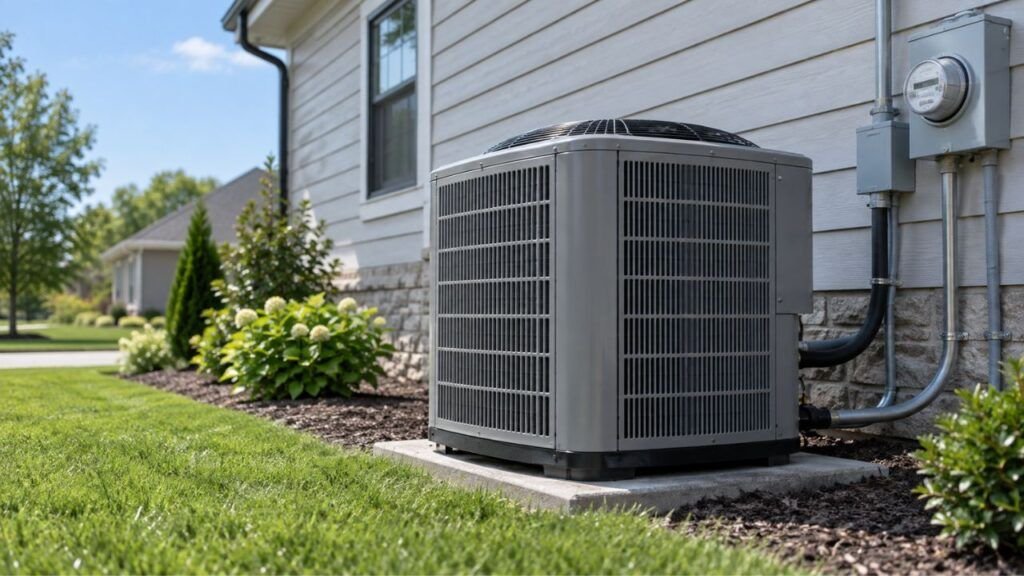
A typical residential central air conditioner needs about 2,000 to 5,000 watts while running. A common 3-ton system often uses roughly 2,500 to 3,500 running watts. However, startup demand can briefly rise much higher when the compressor turns on.
Your exact requirement depends on AC size, efficiency, compressor design, and indoor blower power. Below, I’ll help you estimate running watts, startup watts, energy use, and generator requirements.
Key Takeaways
- Most central AC systems use about 2,000–5,000 running watts.
- A 3-ton central AC commonly uses around 2,500–3,500 watts.
- Larger AC systems generally need more electrical power.
- Compressor startup demand can greatly exceed normal running power.
- The indoor blower adds to the complete HVAC system load.
- Most residential central AC condensers require approximately 240V power.
- Generator sizing must account for startup demand, not running watts alone.
- Your AC nameplate provides better guidance than general wattage estimates.
How Many Watts Does a Central Air Conditioner Need?
Central AC wattage mainly depends on cooling capacity and equipment efficiency. The table below gives practical estimates for common residential systems.
| Central AC Size | Cooling Capacity | Typical Running Watts | Possible Startup Demand |
| 1.5 ton | 18,000 BTU/h | 1,300–2,000 W | 3,000–5,000+ W |
| 2 ton | 24,000 BTU/h | 1,700–2,500 W | 4,000–6,000+ W |
| 2.5 ton | 30,000 BTU/h | 2,100–3,000 W | 5,000–7,500+ W |
| 3 ton | 36,000 BTU/h | 2,500–3,500 W | 6,000–9,000+ W |
| 3.5 ton | 42,000 BTU/h | 2,800–4,000 W | 7,000–10,000+ W |
| 4 ton | 48,000 BTU/h | 3,200–4,500 W | 8,000–12,000+ W |
| 5 ton | 60,000 BTU/h | 4,000–5,500+ W | 10,000–15,000+ W |
These numbers are estimates rather than fixed electrical requirements.
Two 3-ton air conditioners can have noticeably different power demands. Compressor type, SEER2 rating, outdoor temperature, and blower efficiency all matter.
Startup demand also varies considerably between different compressor designs.
That becomes especially important when you are choosing a generator.
Central AC Wattage Means More Than the Outdoor Unit
When someone says their central AC uses 3,000 watts, that number may not represent the complete cooling system. Central air conditioning normally has several electrically powered components working together.
Outdoor Condenser Power
The outdoor condenser normally creates the largest electrical load.
It contains the compressor and condenser fan motor. The compressor circulates refrigerant through the cooling system.
Because compressors require substantial power, the condenser usually accounts for most central AC wattage.
Some online wattage charts only estimate this outdoor unit.
That can make your complete household cooling load appear lower.
Indoor Blower or Air Handler Power
Your central AC also needs airflow throughout the house.
An indoor blower pushes conditioned air through your duct system. Depending on your setup, that blower may be inside:
- A gas furnace
- An electric furnace
- A dedicated air handler
- A heat pump air handler
Modern variable-speed blower motors can operate very efficiently.
Older blower motors may require considerably more electricity.
The blower can therefore add several hundred watts to your cooling load.
Total Central AC System Power
For backup-power planning, consider the complete operating system.
A simple way to think about it is:
Total AC load = outdoor condenser load + indoor blower load + related HVAC electrical loads
Suppose your condenser draws about 2,700 watts.
Your indoor blower might require another 400 watts.
Your complete cooling load could therefore approach 3,100 watts.
That difference matters when generator capacity is limited.
Running Watts vs Starting Watts for Central AC
Central air conditioners have two power requirements you should understand. Running watts tell you normal consumption, while startup demand determines whether certain power sources can successfully start the compressor.
| Power Measurement | What It Means | Why It Matters |
| Running watts | Normal power during operation | Determines continuous power needs |
| Starting watts | Brief power increase during startup | Important for generators and inverters |
| LRA | Locked Rotor Amps | Helps indicate compressor startup demand |
| RLA | Compressor rated-load specification | Helps evaluate compressor electrical requirements |
Starting and running power become especially important during outages.
A generator might handle your AC after startup successfully.
However, that same generator may fail when the compressor initially starts.
Why Compressors Need Extra Starting Power
A traditional AC compressor uses an electric motor.
Starting that motor from a stopped position requires additional current.
The surge normally lasts only a short period.
However, your generator or inverter must still supply it.
Otherwise, you may experience:
- Generator overload
- Breaker trips
- Low voltage
- Compressor startup failure
- Backup system shutdown
Never choose a generator using running watts alone.
Variable-Speed AC Systems Work Differently
Modern variable-speed systems can behave differently during startup.
Instead of immediately jumping to full operating capacity, these compressors can gradually increase their output.
That often reduces the dramatic startup surge associated with traditional fixed-speed compressors.
However, you should still check manufacturer specifications.
Do not assume every variable-speed AC has identical startup behavior.
How Many Watts Does a 3-Ton Central AC Need?
A 3-ton central air conditioner provides approximately 36,000 BTU of cooling per hour. It commonly needs roughly 2,500 to 3,500 watts during normal operation, although actual consumption can fall outside that range.
Three-ton systems are common in American homes, but tonnage does not determine exact wattage.
An efficient modern 3-ton unit may use less electricity.
An older 3-ton system may require considerably more.
The indoor blower can also add several hundred watts.
For example, suppose your outdoor condenser uses 2,600 watts.
If your blower requires 450 watts, the complete cooling load becomes approximately:
2,600 + 450 = 3,050 watts
That is the number that matters when estimating continuous backup power.
However, generator sizing also requires startup information.
A conventional 3-ton compressor may briefly require many thousands of watts during startup.
Never assume 3,050 running watts means a 3,500-watt generator will work.
Why Two Central AC Units of the Same Size Can Use Different Watts
Tonnage tells you cooling capacity, not exact electricity consumption. Several factors determine how much power your system actually needs.
SEER2 and Equipment Efficiency
SEER2 measures seasonal cooling efficiency.
A higher SEER2 rating generally means the system provides more seasonal cooling for each unit of electricity consumed.
That can reduce overall electricity consumption significantly.
However, SEER2 does not work like a live wattmeter.
You should not expect two systems with similar SEER2 ratings to draw identical wattage every second.
Actual power changes with equipment design and operating conditions.
Single-Stage vs Two-Stage vs Variable-Speed Compressors
Compressor design makes a major difference.
A single-stage compressor generally operates at full capacity whenever cooling starts.
It turns on, cools the home, and turns off afterward.
A two-stage compressor can operate at lower or higher capacity.
Lower-stage operation can reduce power consumption during mild conditions.
A variable-speed compressor can adjust output across a wider operating range.
It may use relatively little power during lighter cooling demand.
This makes one fixed wattage number difficult to assign.
Outdoor Temperature and Humidity
Weather also affects your cooling system.
A central AC has an easier job on an 82°F afternoon.
Cooling becomes harder during a 100°F summer heat wave.
Higher temperatures can increase compressor workload.
They also make the system operate for longer periods.
Humidity adds another cooling demand.
Your AC removes moisture while lowering indoor temperature.
Humid climates can therefore increase seasonal electricity consumption.
Filters, Coils, Refrigerant, and Airflow
Poor maintenance can reduce cooling performance.
A heavily clogged filter restricts airflow through the system.
Dirty coils can also reduce heat transfer.
Refrigerant problems may cause longer operating cycles.
These problems do not always increase instantaneous wattage dramatically.
However, they can make the system run much longer.
Longer runtime means greater total electricity consumption.
Home Cooling Load
Your house also determines how hard the AC works.
Important factors include:
- Insulation level
- Window size
- Window efficiency
- Air leakage
- Ceiling height
- Sun exposure
- Duct leakage
- Local climate
- Number of occupants
- Internal heat-producing appliances
This is why I would not choose AC tonnage using square footage alone.
Professional HVAC sizing uses a proper residential load calculation.
How to Find the Actual Wattage of Your Central AC
Generic wattage tables are useful starting points. Your own equipment specifications provide a much better answer.
1. Find the Outdoor Condenser Nameplate
Go outside and locate your condenser unit.
There should be a manufacturer’s data plate on its cabinet.
You may find information including:
- Voltage
- Compressor amperage information
- LRA
- Fan motor amperage
- Minimum Circuit Ampacity
- Maximum Overcurrent Protection
- Model number
- Serial number
Take a clear photo if the label is difficult to read.
You can then compare those values with manufacturer documentation.
2. Do Not Use Breaker Size as Running Amps
This mistake is extremely common.
Suppose your central AC uses a 40-amp breaker.
That does not mean your AC normally draws 40 amps.
Circuit breakers include electrical protection requirements.
The AC normally operates below the breaker’s maximum rating.
Likewise, Maximum Overcurrent Protection does not represent normal electrical consumption.
Minimum Circuit Ampacity also should not be treated as running amperage.
3. Check the Indoor Blower
Now locate your furnace or air handler.
The indoor blower uses electricity whenever central cooling operates.
If you want total system wattage, include that load.
Check the equipment documentation or motor specifications.
Modern electronically commutated motors can use relatively little power.
Older permanent-split capacitor motors can consume considerably more.
4. Check Manufacturer Specifications
Once you have your model numbers, find the official equipment specifications.
Manufacturer performance data can provide much better guidance than generic estimates.
This becomes especially important with:
- Variable-speed compressors
- Two-stage systems
- Heat pumps
- High-efficiency equipment
- Unusual voltage requirements
Model-specific information should always beat an online average.
5. Measure Actual Electricity Consumption
Another option is monitoring your real household electrical load.
Whole-home energy monitors can show how consumption changes when your AC starts.
They can also help you compare:
- Compressor startup
- Normal cooling
- Fan-only operation
- Different thermostat settings
- Hot versus mild outdoor conditions
However, installing electrical-panel monitoring equipment can expose dangerous voltage.
Use qualified professional help when panel access is required.
Can You Calculate Central AC Watts From Amps?
You can estimate AC wattage using voltage and current, but motor loads make the calculation slightly more complicated than many appliance calculations.
A common basic formula is:
Watts ≈ Volts × Amps × Power Factor
Suppose a load draws 12 amps at 240 volts.
The simple voltage-times-current calculation gives:
240 × 12 = 2,880 VA
However, motor loads have a power factor.
That means volts multiplied by amps does not always equal exact real watts.
For example, using a hypothetical 0.90 power factor:
240 × 12 × 0.90 = 2,592 watts
The real power factor depends on the equipment.
Therefore, use this method as an estimate rather than a guarantee.
Actual monitoring or manufacturer performance data gives better information.
Does Central AC Use 120V or 240V?
Most residential central AC outdoor condensers in the United States operate from a 208/230V or 240V-class electrical supply. They normally connect through a dedicated double-pole circuit.
That does not mean every HVAC component operates identically.
Your indoor blower, air handler, furnace, thermostat, and accessories may use different voltages depending on the system design.
For backup power, this distinction matters.
A generator producing enough total watts may still be unsuitable if it only provides 120V output.
If your condenser needs 240V, your backup system must provide compatible power.
How Much Electricity Does Central AC Use Per Hour?
Running watts tell you power demand. Kilowatt-hours tell you how much electrical energy gets consumed over time.
Use this formula:
kWh = Watts ÷ 1,000 × Operating Hours
Suppose your complete central AC system uses 3,000 watts.
Convert that into kilowatts:
3,000 ÷ 1,000 = 3 kW
If it runs continuously for one hour:
3 kW × 1 hour = 3 kWh
For four compressor-hours:
3 kW × 4 hours = 12 kWh
However, thermostat time and compressor runtime are different things.
Your thermostat might remain set to cooling all day.
That does not mean the compressor runs continuously all day.
Fixed-speed systems cycle on and off.
Variable-speed systems may continuously operate at reduced capacity.
So avoid calculating daily energy simply from thermostat hours.
How Much Does It Cost to Run Central AC?
Your cooling cost depends on power consumption, compressor runtime, and your electricity rate.
Use this basic formula:
Operating Cost = Electricity Used in kWh × Electricity Rate
Suppose your AC consumes 3 kWh during one full hour.
If electricity costs $0.18 per kWh:
3 × $0.18 = $0.54 per operating hour
Now suppose the compressor accumulates six operating hours daily:
$0.54 × 6 = $3.24 per day
Over 30 days:
$3.24 × 30 = $97.20 per month
This example only shows the calculation.
Your actual result could be much higher or lower.
Electricity prices vary substantially across the United States.
So use the rate printed on your own utility bill.
Your actual compressor runtime matters just as much.
What Size Generator Do You Need for Central Air Conditioning?
Running central AC from a generator requires more planning than simply matching its running wattage. You need enough continuous output, startup capability, correct voltage, and extra capacity for other household loads.
Generator Running Output
Start by calculating your total continuous load.
Suppose your central AC needs 3,000 running watts.
Then add other equipment you want during an outage.
For example:
| Appliance | Example Running Load |
| Central AC | 3,000 W |
| Refrigerator | 200 W |
| Lights | 300 W |
| Television and electronics | 200 W |
| Other small loads | 300 W |
| Total | 4,000 W |
A 4,000-watt generator would still provide very little headroom.
You also have compressor startup demand to consider.
Compressor Starting Demand
This is where many generator calculations fail.
Your compressor can briefly draw much more electrical current when starting.
A generator might support 3,000 running watts comfortably.
However, it could overload immediately when the compressor starts.
Startup requirements vary widely.
Traditional fixed-speed compressors may have substantial inrush current.
Check the condenser’s LRA and manufacturer specifications.
Do not automatically assume one universal surge multiplier.
Make Sure the Generator Provides 240V
Wattage is only one requirement.
Most central AC outdoor units need a 240V-class supply.
Therefore, your generator needs compatible 120/240V output.
A high-output 120V-only generator cannot directly supply a typical 240V condenser correctly.
Leave Generator Headroom
Avoid planning to operate your generator continuously at maximum output.
Leaving capacity available helps when another motor starts unexpectedly.
Your refrigerator, freezer, well pump, or sump pump may create additional startup loads.
For example, imagine your AC requires:
- 3,000 running watts
- 8,000 watts during startup
You also have 1,500 watts of other active loads.
Your generator must handle the combined electrical situation.
This could push practical generator requirements well beyond 8,000 watts.
Soft Start vs Hard Start
You may hear both terms when researching central AC generators.
They are not exactly the same thing.
A hard-start kit uses additional electrical components to help a compressor start more effectively.
It is commonly used when compressors struggle during startup.
A soft starter actively manages the compressor’s starting process.
Its main goal is reducing starting current and creating smoother startup.
For generator applications, soft-start systems can be particularly useful.
They may significantly reduce the startup demand seen by the generator.
However, compatibility depends on your specific HVAC equipment.
Have an HVAC professional confirm the proper device before installation.
Can a Portable Power Station Run Central AC?
Some large portable power stations can operate certain central AC systems. However, inverter wattage alone does not determine whether the setup will work.
You need to evaluate three separate specifications:
- Continuous inverter output
- Startup or surge capability
- Battery storage capacity
Suppose your AC needs 3,000 running watts.
A power station with 3,600 watts of continuous output might handle that running load.
But the compressor could still exceed its surge capability.
Battery capacity creates another limitation.
Imagine you have a 3,000Wh battery.
Your AC consumes around 3,000 watts while cooling.
Ignoring conversion losses, that represents roughly one hour of continuous operation.
Real-world runtime would normally be shorter because of inverter losses and usable battery limits.
A battery can therefore have enough power to start your AC but insufficient energy for long cooling periods.
Remember this difference:
Watts tell you how much power equipment needs.
Watt-hours tell you how long stored energy can support it.
How to Reduce Central AC Electricity Use
You cannot change your AC’s basic electrical design. However, you can reduce how hard and how long it works.
- Replace dirty filters regularly. Restricted airflow reduces system performance.
- Keep outdoor coils clean. Clear debris around the condenser.
- Keep supply vents open. Closed vents can create airflow problems.
- Seal duct leaks. Lost cooled air increases required runtime.
- Improve attic insulation. Less heat enters your living space.
- Seal unwanted air leaks. Keep hot outdoor air outside.
- Use reasonable thermostat settings. Lower settings increase cooling demand.
- Close blinds during strong afternoon sun. This lowers indoor heat gain.
- Maintain proper refrigerant charge. Incorrect levels hurt system performance.
- Schedule HVAC maintenance when needed. Small problems can increase runtime.
- Consider higher-efficiency equipment during replacement. Modern systems can use less energy.
- Choose the correct AC size. Oversized and undersized equipment both create problems.
Focus first on reducing unnecessary runtime.
That often matters more than chasing small wattage differences.
Common Central AC Wattage Mistakes
Central AC electrical requirements can seem confusing. Avoid these mistakes when estimating your system’s power needs.
- Using breaker size as actual running amperage. They are different measurements.
- Ignoring the indoor blower. The condenser is not your complete cooling load.
- Sizing generators using running watts alone. Compressor startup can exceed that number.
- Confusing watts with watt-hours. They measure different electrical quantities.
- Assuming every 3-ton system draws equal power. Efficiency and design matter.
- Using SEER2 as an exact wattage calculator. It measures seasonal efficiency.
- Choosing AC tonnage from square footage alone. Actual cooling load depends on many factors.
- Ignoring generator voltage. Most central condensers require approximately 240V.
- Treating generator surge watts as continuous watts. Peak output usually lasts briefly.
- Forgetting other household loads. Refrigerators and pumps also need generator capacity.
- Assuming starting current is always exactly twice running current. Compressor designs differ.
- Treating a soft starter and hard-start kit as identical. Their purposes and operation differ.
Final Words
Most residential central air conditioners need roughly 2,000 to 5,000 watts while actively cooling, although larger or older systems can exceed that range. A typical 3-ton system commonly falls around 2,500 to 3,500 running watts.
The best answer comes from your own equipment rather than an average chart. Check the outdoor condenser, indoor blower, equipment voltage, and compressor startup specifications.
If you are choosing backup power, pay special attention to startup demand. A generator needs enough capacity to start the compressor while supporting your other household loads.
Related FAQs
How Many Watts Does a 2-Ton Central AC Use?
A 2-ton central AC commonly needs about 1,700 to 2,500 running watts, depending on efficiency, compressor design, blower power, and outdoor conditions. Startup demand can be considerably higher.
How Many Watts Does a 3-Ton Central AC Use?
A 3-ton central AC generally uses around 2,500 to 3,500 running watts. Your complete system may vary because the indoor blower, compressor technology, efficiency, and operating conditions affect actual electrical consumption.
How Many Watts Does a 4-Ton Central AC Use?
A 4-ton central air conditioner commonly needs approximately 3,200 to 4,500 running watts. Older equipment or less-efficient systems may require more, while modern variable-speed equipment can use less under partial-load conditions.
How Many Watts Does a 5-Ton Central AC Use?
A 5-ton central AC may use around 4,000 to 5,500 watts or more during normal operation. Actual wattage depends heavily on efficiency, compressor technology, indoor blower requirements, and outdoor temperature.
How Many Starting Watts Does a Central AC Need?
Central AC starting demand varies widely by compressor design and equipment size. Traditional fixed-speed compressors can briefly require several times their normal running demand, so check LRA and manufacturer information before sizing backup power.
Can a 7,500-Watt Generator Run Central Air?
A 7,500-watt generator may operate some smaller central AC systems, but startup demand can make larger systems difficult to start. Generator voltage, surge output, other household loads, and compressor specifications must all be considered.
Can a 10,000-Watt Generator Run Central Air?
A 10,000-watt generator can operate many residential central AC systems when properly sized, but there is no universal guarantee. Compressor startup demand, 240V capability, other active appliances, and generator surge capacity determine compatibility.
Does Central AC Run on 120V or 240V?
Most residential central AC outdoor condensers in the United States use approximately 208/230V or 240V power. Indoor HVAC components may have different electrical requirements depending on furnace or air-handler design.
How Many Amps Does a 3-Ton Central AC Use?
There is no single amperage for every 3-ton AC system. Compressor efficiency and design make a major difference. Check your condenser’s electrical data plate rather than estimating amperage solely from tonnage.
Does a Higher SEER2 Rating Mean Fewer Watts?
A higher SEER2 rating generally indicates better seasonal cooling efficiency, meaning less electricity is needed for comparable cooling over time. However, SEER2 alone cannot tell you the exact real-time wattage of your AC.
Does the Furnace Blower Run With Central AC?
Yes. In many central AC systems, the furnace blower moves cooled air through the home’s ducts while the outdoor condenser operates. Its electrical consumption should therefore be included when estimating total cooling power.
Can a Solar Generator Run a Central Air Conditioner?
A sufficiently large battery power station can run some central AC systems if it provides the required 240V output, continuous wattage, startup capability, and battery capacity. Large central systems usually require substantial inverter and battery capacity.

Brian Walker writes straightforward generator guides and reviews for homeowners and everyday users. His content focuses on solar, portable, and fuel-powered generators, with practical advice on choosing, using, and maintaining reliable backup power.















