
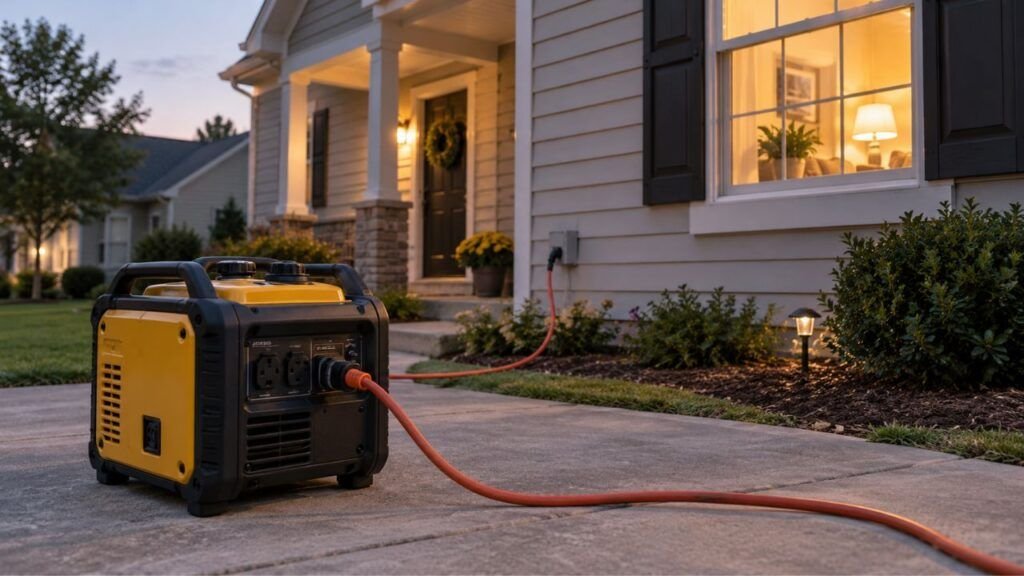
Yes, a 120V generator can power many essential parts of a house. It can run refrigerators, lights, routers, televisions, and other 120V loads. However, it cannot directly power normal 240V household appliances or fully replace standard 120/240V residential service.
The real answer depends on your generator size and connection method. Below, I’ll explain what you can run, what you cannot run, and how to use a 120V generator safely during an outage.
Key Takeaways
- A 120V generator can power many essential household appliances.
- It cannot directly operate appliances requiring 240V power.
- Generator wattage does not change its available output voltage.
- Refrigerators, lights, routers, and many furnaces can use 120V.
- Feeding household circuits requires proper generator transfer equipment.
- A 120/240V generator provides greater whole-home backup flexibility.
- Never backfeed a generator through an ordinary household wall outlet.
Can a 120V Generator Really Power a House?
A 120V generator can power enough equipment to keep many homes functional. However, there is an important difference between powering a house and powering everything inside it.
During an outage, you may only need essential electrical loads. Your refrigerator, freezer, lights, internet equipment, and television may all operate on 120V.
Some heating equipment and water pumps can also use 120V. Their exact voltage should always be checked first.
That means a properly sized 120V generator can provide useful emergency backup.
However, most American homes receive 120/240V split-phase electrical service. Large appliances commonly rely on the 240V portion of that service.
A 120V-only generator cannot reproduce that complete electrical supply.
So, I would consider a 120V generator an essential-load backup source. I would not consider it a normal replacement for full 120/240V house power.
Why a 120V Generator Cannot Fully Replace Normal House Power
Your house receives electricity differently from a basic 120V generator. Understanding that difference makes the limitation much easier to see.
How 120/240V Split-Phase Power Works
Most U.S. houses receive 120/240V split-phase electrical service.
The service contains two hot conductors, commonly called L1 and L2. There is also a neutral conductor.
Each hot leg provides roughly 120 volts to neutral.
Together, the two hot legs provide approximately 240 volts.
In simple terms:
- L1 to neutral provides 120V.
- L2 to neutral provides 120V.
- L1 to L2 provides 240V.
Your normal wall outlets usually use one 120V leg.
Large appliances often use both legs together for 240V power.
What a 120V-Only Generator Produces
A 120V-only generator supplies 120 volts rather than true split-phase 120/240V power.
That works well for equipment designed to use 120 volts.
However, the generator does not provide two opposite hot legs. Therefore, it cannot normally produce the 240V difference required by large household appliances.
This remains true even when the generator has substantial wattage.
More Watts Do Not Create 240 Volts
Wattage and voltage describe different parts of electrical power.
Suppose you have a powerful 5,000-watt 120V generator. It may run several refrigerators, lights, electronics, and other equipment.
However, it still provides only 120 volts.
A 240V water heater cannot suddenly run because enough watts exist. The appliance also requires the correct voltage.
Think of voltage as a compatibility requirement.
The generator must provide both enough watts and the correct voltage.
What Can a 120V Generator Power in a House?
Many common household loads operate on 120V power. Generator capacity and appliance starting requirements still determine what can operate simultaneously.
| Household Load | Typical Voltage | Can a 120V Generator Run It? | Important Note |
| Refrigerator | 120V | Yes | Compressor creates startup surge |
| Freezer | 120V | Yes | Starting watts should be considered |
| LED lights | 120V | Yes | Usually very low power demand |
| Wi-Fi router | 120V | Yes | Uses relatively little power |
| Television | 120V | Yes | Check actual rated wattage |
| Microwave | 120V | Usually | Can use substantial wattage |
| Coffee maker | 120V | Usually | Heating element creates high load |
| Gas furnace blower | Usually 120V | Often | Proper connection method is required |
| Sump pump | Often 120V | Often | Starting surge can be substantial |
| Window air conditioner | Often 120V | Possibly | Compressor surge must fit generator capacity |
| Well pump | 120V or 240V | Depends | Check the pump nameplate |
| Central air conditioner | Usually 240V | No | Requires proper 240V supply |
| Electric water heater | Usually 240V | No | Cannot run directly from 120V |
| Electric dryer | Usually 240V | No | Requires 240V |
| Electric range | Usually 240V | No | Requires 240V |
| Level 2 EV charger | Usually 240V | No | Requires 240V |
These are typical examples rather than universal rules.
Always check the appliance nameplate before planning your backup system.
How Much of a House Can a 120V Generator Run?
Voltage determines appliance compatibility, while wattage determines total capacity. You need to consider both before adding household loads.
Running Watts
Running watts describe how much electricity an appliance needs during normal operation.
For example, a refrigerator may consume relatively modest power once running. Lights and electronics generally require even less.
Your generator’s rated running watts represent its continuous usable capacity.
Add the running wattage of everything you expect to use together.
Do not exceed the generator’s continuous output rating.
Starting Watts
Motor-driven appliances often need extra electricity when starting.
A refrigerator compressor is a good example.
Its normal running demand may be relatively low. However, starting the compressor can briefly require much more power.
Similar startup surges occur with:
- Refrigerators
- Freezers
- Sump pumps
- Well pumps
- Furnace blowers
- Window air conditioners
Your generator must handle these short power spikes.
Otherwise, it may overload or shut down when equipment starts.
Generator Amps Also Limit Available Power
You can estimate electrical power using this basic formula:
Watts = Volts × Amps
For example:
120V × 20A = 2,400 watts
And:
120V × 30A = 3,600 watts
That does not mean every generator can continuously deliver those amounts.
Always follow the generator’s rated continuous output specification.
Its outlet ratings may also limit how much power one circuit provides.
Example 120V Emergency Load Plan
Imagine you want to keep several essentials operating during an outage.
Your list might include:
- Refrigerator: 200 running watts
- Freezer: 200 running watts
- Wi-Fi router: 20 watts
- LED lighting: 100 watts
- Television: 100 watts
- Furnace blower: 600 watts
That creates around 1,220 running watts.
However, the furnace and refrigeration compressors may need extra starting power.
A generator rated slightly above the running total gives you useful headroom.
You should avoid sizing your generator exactly at maximum demand.
A reasonable reserve helps the generator handle startup surges reliably.
Can a 120V Generator Power a House Electrical Panel?
It can sometimes power selected household circuits through appropriate equipment. However, connecting a 120V generator to house wiring requires careful planning.
Option 1: Power Appliances Directly
The simplest approach is powering individual appliances directly from the generator.
You can use properly rated extension cords for suitable equipment.
Common examples include:
- Refrigerator
- Freezer
- Lamps
- Television
- Wi-Fi router
- Phone chargers
- Small kitchen appliances
This method avoids connecting the generator directly to your breaker panel.
It works particularly well for smaller emergency backup systems.
Use outdoor-rated cords with adequate wire size for each load.
Never run undersized extension cords under heavy electrical loads.
Option 2: Power Selected 120V Circuits
A properly designed transfer setup can power selected household circuits.
This can be useful when appliances are hardwired.
A furnace blower is one common example.
Instead of running extension cords everywhere, selected circuits receive generator power through approved transfer equipment.
The exact setup depends on your panel and generator.
A qualified electrician should confirm compatibility before installation.
Option 3: Feed the Main Panel
Feeding a normal residential panel from a 120V-only generator gets complicated.
Your main panel normally receives two separate 120V hot legs.
A 120V generator does not naturally reproduce those two legs.
That means some ordinary panel connection arrangements designed for 120/240V generators may not work correctly.
You should never improvise a panel connection.
Improper generator wiring can damage equipment and create serious shock hazards.
Can a 120V Generator Power Both Sides of the Breaker Panel?
Some specialized installations can energize 120V circuits across both panel buses. However, this does not turn a 120V generator into a 240V generator.
Why Some People Talk About Bridging Both Legs
You may see discussions about supplying the same 120V source to both panel buses.
The idea is to make 120V circuits on both sides available.
However, both buses still receive the same 120V phase.
You do not create proper 240V power between them.
Therefore, normal 240V appliances still cannot operate.
Why Bridging the Two Legs Can Be a Problem
This approach should never be treated as a simple DIY shortcut.
Several electrical issues must be considered first.
These include:
- Existing panel wiring
- Shared neutral circuits
- Generator neutral configuration
- Transfer equipment design
- Breaker arrangements
- Grounding requirements
- Local electrical rules
A wiring setup that appears functional can still create unsafe conditions.
That is why an electrician should evaluate the panel first.
The Multi-Wire Branch Circuit Problem
Some homes use multi-wire branch circuits.
These circuits contain two hot conductors that share one neutral conductor.
Under normal split-phase power, the two hot conductors are on opposite legs. Their electrical relationship helps control current flowing through the shared neutral.
Supplying both incorrectly from the same phase changes that relationship.
The shared neutral could then carry more current than expected.
This is one reason DIY leg-bridging advice can become dangerous.
An electrician can determine whether your panel contains these circuits.
What 240V Appliances Will Not Work?
A 120V-only generator cannot directly operate appliances requiring 240V. These loads are common in many American homes.
Typical examples include:
- Central air conditioners
- Many heat pumps
- Electric water heaters
- Electric clothes dryers
- Electric ranges
- Electric ovens
- Many well pumps
- Electric baseboard heating
- Level 2 EV chargers
- Some large workshop tools
Never assume appliance voltage based only on appliance type.
For example, some well pumps operate at 120V.
Others require 240V.
Check the equipment label or electrical specifications before deciding.
Can a 120V Generator Run a Gas Furnace?
Yes, many gas furnaces can operate from a 120V generator.
Gas supplies the heat, but the furnace still needs electricity. The blower motor, ignition system, inducer, and control board require electrical power.
Many residential gas furnaces use a 120V electrical circuit.
Your generator must provide enough running and starting power.
There is another consideration, though.
Most furnaces are hardwired rather than plugged into regular outlets.
That means you need an approved method for supplying generator power.
A proper transfer arrangement is usually the cleaner solution.
Have an electrician evaluate the furnace connection before relying on it.
Can a 120V Generator Run a Well Pump?
It depends entirely on your well pump’s electrical requirements.
Some smaller well pumps operate on 120V power.
A sufficiently sized 120V generator may run those pumps.
However, many residential well pumps operate on 240V.
A 120V-only generator cannot directly run those pumps.
Starting surge is another important consideration.
Well pump motors can demand substantial power during startup.
Check the pump’s voltage and current rating before choosing generator size.
Can a 120V Generator Run a Refrigerator and Freezer?
Yes, most household refrigerators and freezers operate on 120V power.
A properly sized 120V generator can usually run both.
The main issue is compressor startup demand.
A refrigerator may use modest power while running. However, its compressor can require significantly more electricity when starting.
The same applies to your freezer.
If both compressors start simultaneously, generator demand can increase quickly.
Leave enough reserve capacity to handle these short surges.
That usually provides more reliable operation during longer outages.
Is a 120V Generator Enough for an Emergency?
For many households, it absolutely can be. A 120V generator works particularly well when your goal is keeping essential loads operating.
A 120V generator can be practical for:
- Refrigerator and freezer
- Essential lighting
- Wi-Fi equipment
- Phones and laptops
- Television
- Fans
- CPAP machines
- Compatible medical equipment
- Compatible sump pumps
- Compatible furnace blowers
- Small window air conditioners
You do not necessarily need every household appliance during an outage.
Keeping food cold, lights working, and communication available may be enough.
A smaller generator also generally consumes less fuel than a large unit.
That can become important during extended outages.
The limitation appears when your essential needs include 240V equipment.
When Should You Choose a 120/240V Generator Instead?
A 120/240V generator makes more sense when you need broader home backup. It provides both standard 120V power and true 240V output.
Consider 120/240V if you want to:
- Run a 240V well pump
- Power central air conditioning
- Operate a heat pump
- Run an electric water heater
- Use an electric range
- Operate a 240V dryer
- Supply both legs of a household panel normally
- Use conventional whole-home generator transfer equipment
- Support more appliances during extended outages
You still need enough wattage for those loads.
Having 240V output does not automatically mean unlimited capacity.
Generator voltage and generator size both matter.
120V vs 120/240V Generator for Home Backup
Both generator types can provide useful emergency electricity. The better option depends on which household systems you need to keep operating.
| Feature | 120V Generator | 120/240V Generator |
| Standard 120V appliances | Yes | Yes |
| 240V appliances | No | Yes, when adequately sized |
| Refrigerator and freezer | Yes | Yes |
| Lights and electronics | Yes | Yes |
| Central air conditioner | No | Potentially |
| Electric water heater | No | Potentially |
| 240V well pump | No | Potentially |
| Full-panel flexibility | Limited | Much better |
| Portability | Often better | Usually larger |
| Fuel use | Often lower | Usually higher under large loads |
| Best use | Essential-load backup | Broader home backup |
A 120V generator remains useful when your emergency needs stay modest.
For broader household operation, 120/240V provides considerably more flexibility.
How to Decide Whether Your 120V Generator Is Enough
Before replacing your generator, check what you actually need. Many homeowners discover their 120V unit can handle their most important loads.
Check the Generator’s Rated Voltage
Look at the generator identification plate or owner’s manual.
You may see:
- 120V
- 120/240V
- A voltage selector switch
Do not judge voltage from generator wattage alone.
A high-wattage generator can still be 120V-only.
List the Loads You Actually Need
Separate essential equipment from convenience appliances.
Your essential list may include refrigeration, lighting, communication, and heating controls.
Things like electric dryers can usually wait.
This approach can dramatically reduce your required generator capacity.
Check Appliance Voltage
Look at each appliance nameplate.
Make sure the appliance operates at 120V before adding it.
Pay particular attention to:
- Well pumps
- HVAC equipment
- Water heaters
- Cooking equipment
- Workshop machinery
These categories often include 240V models.
Add Running Watts
Write down the running wattage for each required appliance.
Then add the loads likely to operate simultaneously.
Your generator should comfortably handle that total.
Avoid planning continuous operation at the generator’s absolute maximum.
Account for Starting Surge
Identify appliances containing motors or compressors.
Their startup demand may exceed normal running consumption.
Your generator needs enough temporary capacity for those surges.
This is especially important for pumps and refrigeration equipment.
Decide How You Will Connect the Loads
Finally, decide whether you need household circuits energized.
For a few plug-in appliances, extension cords may be enough.
Hardwired equipment needs a proper generator connection arrangement.
Panel-fed backup should use approved transfer equipment.
Do not improvise your own backfeed connection.
Safety Rules for Using a 120V Generator at Home
Generator voltage matters, but safe operation matters even more. Follow these basic rules whenever using portable generator power.
- Never plug a generator into a normal household wall outlet.
- Never use a homemade double-male generator cord.
- Use approved transfer equipment for household wiring.
- Have panel equipment installed or checked by an electrician.
- Keep the generator outdoors while the engine is running.
- Position exhaust well away from windows and doors.
- Keep carbon monoxide alarms working inside the home.
- Use appropriately rated outdoor extension cords.
- Protect the generator from rain without enclosing the exhaust.
- Never exceed the generator’s rated electrical capacity.
- Turn loads on gradually after the generator stabilizes.
- Allow the generator to cool before adding fuel.
- Follow the generator manufacturer’s operating instructions.
Never run a fuel-powered generator inside a garage.
Opening the garage door does not make that safe.
Carbon monoxide can accumulate quickly and enter living areas.
Final Verdict: Can a 120V Generator Power a House?
Yes, a 120V generator can power many important parts of a house.
It can keep refrigerators cold, lights working, internet equipment running, and many 120V appliances operating. Depending on generator capacity, it may also handle a furnace blower, sump pump, or small window air conditioner.
What it cannot provide is normal 120/240V whole-house electrical service.
You will not directly run central air conditioning, a 240V water heater, electric dryer, electric range, or other 240V equipment from a 120V-only generator.
For basic emergency backup, a good 120V generator may be completely adequate.
For broader panel coverage and major household appliances, I would choose a properly sized 120/240V generator instead.
Related FAQs
Can You Connect a 120V Generator to a House?
Yes, but the connection method matters. Plug-in appliances can use suitable extension cords, while household circuits require approved transfer equipment that prevents generator power from feeding back into utility lines.
Can a 120V Generator Run a Refrigerator?
Yes. Most household refrigerators operate on 120V, so an adequately sized generator can run one. Just make sure the generator can handle the refrigerator compressor’s brief startup surge.
Can a 120V Generator Run a Furnace?
Many gas furnaces use 120V electrical power, so a suitable generator can often run them. Because furnaces are commonly hardwired, you usually need an approved transfer or connection method.
Can a 120V Generator Run a Sump Pump?
Many residential sump pumps operate at 120V and can use generator power. Check both pump voltage and startup wattage because the motor may require considerably more power while starting.
Can a 120V Generator Run a 240V Appliance?
No, a 120V-only generator cannot directly operate a normal 240V appliance. Even a generator with enough wattage still lacks the required 240V output.
Can You Get 240V From a 120V Generator?
A standard 120V-only generator does not natively provide 240V output. Specialized electrical conversion equipment exists, but that is different from having a generator designed for 120/240V split-phase power.
Can a 120V Generator Power Both Legs of a Panel?
Specialized configurations may energize 120V circuits across both panel buses, but they do not create real 240V power. Shared-neutral circuits and other wiring concerns make professional evaluation important.
Is a 120V or 240V Generator Better for Home Backup?
A 120V generator works well for essential appliances and smaller backup plans. A 120/240V generator is generally better when you need broader panel coverage or must operate 240V household equipment.

Brian Walker writes straightforward generator guides and reviews for homeowners and everyday users. His content focuses on solar, portable, and fuel-powered generators, with practical advice on choosing, using, and maintaining reliable backup power.















