
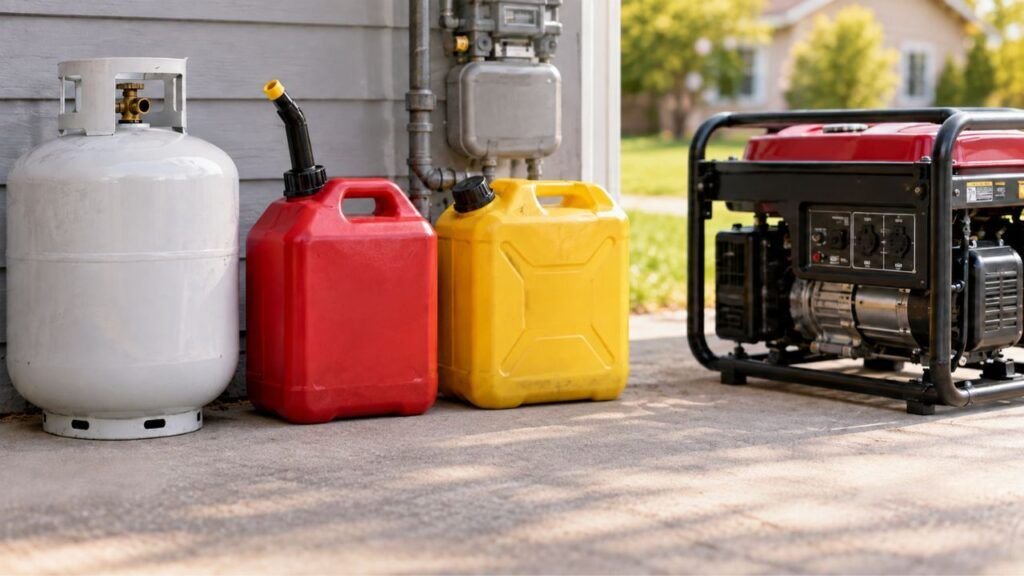
Propane lasts the longest in storage among common generator fuels. Properly contained propane does not normally become stale over time. Diesel generally stores better than gasoline but needs maintenance. Gasoline has the shortest practical shelf life and requires regular rotation.
Below, I’ll compare propane, gasoline, diesel, and natural gas. You’ll also learn what makes fuel degrade and how to store it properly.
Key Takeaways
- Propane offers the longest practical storage life for generator owners.
- Properly stored propane does not become stale like gasoline.
- Gasoline can start deteriorating surprisingly quickly during storage.
- Diesel stores longer but can develop water and microbial contamination.
- Natural gas usually arrives through pipelines instead of storage tanks.
- Fuel stabilizer can extend gasoline life but cannot preserve it forever.
- Fuel shelf life and generator runtime are completely different measurements.
- Storage temperature, moisture, containers, and fuel quality all matter.
Which Generator Fuel Has the Longest Shelf Life?
Propane is the clear winner when long-term fuel storage matters. Gasoline usually needs the most attention, while diesel falls somewhere between them.
Here is a simple comparison you can use.
| Generator Fuel | Typical Storage Outlook | Main Storage Concern | Stabilizer Needed? | Long-Term Storage Rating |
| Propane | Can remain usable indefinitely when properly contained | Tank, valve, and regulator condition | No | Excellent |
| Diesel | Often managed within roughly 6–12 months without special maintenance | Water, oxidation, microbes, sediment | Sometimes | Good |
| Gasoline | Can begin degrading within weeks or months | Oxidation, evaporation, moisture | Usually helpful | Fair to poor |
| Natural Gas | Normally supplied continuously through utility lines | Utility interruption | No | Not normally stored |
These timeframes should not be treated as exact expiration dates.
Storage temperature, fuel formulation, container quality, and maintenance can change everything. A properly managed diesel tank may remain usable longer than neglected diesel.
The same applies to gasoline treated with a quality stabilizer.
Why Does Propane Last So Long in Storage?
Propane behaves differently from gasoline and diesel during long-term storage. It remains inside a sealed, pressurized container rather than an open fuel system.
That makes propane especially attractive for occasional emergency generator use.
Propane Does Not Go Stale Like Liquid Fuel
Gasoline reacts with oxygen and gradually loses important volatile compounds. Diesel also changes chemically and can suffer contamination problems.
Propane does not experience those problems in the same way.
When properly contained, the fuel itself can remain usable indefinitely. You do not have to rotate it every few months.
That is extremely useful for emergency backup generators.
You might prepare for an outage today and wait two years. Your stored propane can still be ready when needed.
The Propane May Outlast the Container
There is an important distinction here.
The propane itself may remain usable for many years. However, the storage cylinder or tank still requires attention.
You should periodically check:
- Cylinder condition
- Tank corrosion
- Valves
- Regulators
- Fuel hoses
- Connections
- Required cylinder qualification dates
Portable propane cylinders used in the United States may require periodic requalification.
So, saying propane lasts indefinitely does not mean ignoring the container.
Think of propane as stable fuel inside equipment requiring maintenance.
Why Propane Works Well for Emergency Generators
Propane makes preparation much easier for occasional generator users.
Imagine you bought gasoline before hurricane season but never used it. Several months later, you may question whether that fuel remains reliable.
Propane removes much of that uncertainty.
You can keep approved cylinders ready without constantly replacing fuel. That makes emergency preparation simpler for many homeowners.
There are trade-offs, of course.
Propane-powered generators usually produce slightly less wattage than gasoline operation. Propane availability can also vary during widespread emergencies.
Still, its excellent storage stability remains a major advantage.
How Long Does Gasoline Last for a Generator?
Gasoline usually has the shortest storage life among common generator fuels. It begins changing soon after refining, especially under poor storage conditions.
That does not make gasoline a bad generator fuel. It simply requires better fuel management.
Untreated Gasoline Can Deteriorate Quickly
Gasoline does not suddenly become unusable on one exact date.
Instead, its quality gradually declines.
Several processes contribute to this deterioration:
- Oxidation
- Evaporation
- Moisture exposure
- Chemical changes
- Gum formation
- Varnish buildup
Problems can sometimes begin within about 30 days under unfavorable conditions.
That does not mean all gasoline becomes useless after one month. It means deterioration can already be underway.
Temperature makes a major difference.
Gasoline stored inside a hot garage can degrade faster. A tightly sealed approved container in cooler conditions usually performs better.
How Long Does Gasoline Last With Fuel Stabilizer?
Fuel stabilizer can significantly improve gasoline’s storage life.
However, I would not treat stabilizer like permanent fuel preservation.
Different products claim different effective storage periods. Conditions also affect how well those products work.
For the best results:
- Start with fresh gasoline.
- Add stabilizer before deterioration begins.
- Use the correct treatment ratio.
- Keep the container tightly sealed.
- Store it somewhere cool and appropriate.
- Follow the stabilizer manufacturer’s instructions.
Some treated gasoline may remain suitable for a year or longer.
But that should never become an excuse for forgetting stored fuel completely.
Regular rotation remains the safer approach.
Does Ethanol-Free Gasoline Last Longer?
Ethanol-free gasoline can be easier to store than ethanol-blended gasoline.
Ethanol attracts moisture, especially in humid environments. Enough moisture can contribute to phase separation and fuel-system problems.
Removing ethanol eliminates that particular concern.
However, ethanol-free gasoline can still oxidize.
It can still lose volatile components and become stale. Therefore, ethanol-free gasoline should also be rotated during long storage.
I would consider it more storage-friendly, not storage-proof.
How Long Does Diesel Fuel Last in Storage?
Diesel usually offers better storage potential than gasoline. However, diesel requires more active maintenance than propane.
For basic homeowner planning, six to twelve months is often discussed. But diesel does not have one universal expiration date.
Storage conditions can extend or shorten that period significantly.
Why Stored Diesel Degrades
Diesel has several enemies during long-term storage.
The biggest problems include:
- Oxidation
- Water contamination
- Condensation
- Microbial growth
- Sediment
- Tank corrosion
- Fuel breakdown
Water deserves special attention.
Temperature changes can produce condensation inside partially filled tanks. Water then settles at the bottom because it is heavier.
That water can support microbial growth.
You may eventually see sludge, clogged filters, or poor engine performance.
Why Diesel Shelf Life Is Not One Fixed Number
You will often see statements saying diesel lasts exactly one year.
Real-world storage is not that simple.
Diesel stored in a clean, dry, temperature-controlled tank behaves differently from fuel sitting inside a neglected outdoor tank.
Several factors influence usable life:
- Storage temperature
- Tank cleanliness
- Water exposure
- Biodiesel percentage
- Fuel turnover
- Filtration
- Air exposure
- Tank material
- Testing frequency
Large standby generator systems often use fuel testing instead of assumptions.
That is the better way to approach stored diesel.
Can Diesel Last Longer With Treatment and Fuel Polishing?
Yes, properly maintained diesel can often remain usable longer.
Depending on the storage system, maintenance may include:
- Fuel stabilizers
- Water removal
- Filtration
- Tank cleaning
- Fuel testing
- Fuel polishing
- Appropriate microbial treatment
Fuel polishing removes water, sediment, and contaminants from stored fuel.
This is more common with large standby systems than portable generators.
For a residential portable diesel generator, simpler fuel rotation is usually easier.
Biodiesel Blends May Need Extra Attention
Many diesel fuels now contain some percentage of biodiesel.
That can change long-term storage behavior.
Biodiesel blends can be more vulnerable to oxidation and moisture-related problems. Higher blend percentages can require closer attention during extended storage.
Check what fuel your generator manufacturer allows before filling the tank.
This becomes especially important when storing fuel for emergency use.
Does Natural Gas Have a Shelf Life?
Natural gas works differently from gasoline, diesel, and propane.
Most residential natural gas generators connect directly to utility pipelines. Homeowners therefore do not normally store large quantities themselves.
That makes shelf life mostly irrelevant.
There is no gasoline container becoming stale inside your garage. There is also no diesel tank requiring rotation.
Instead, the generator receives fuel whenever it needs to operate.
This arrangement can be extremely convenient during extended outages.
However, natural gas creates a different dependency.
Your generator relies on the utility’s gas distribution system. Severe disasters can occasionally affect that infrastructure.
Therefore, natural gas is not really the storage-life winner.
It simply removes most homeowner fuel-storage requirements.
What Makes Generator Fuel Go Bad Faster?
Fuel storage conditions can matter just as much as fuel type. Poor storage can shorten otherwise reasonable shelf life considerably.
Watch for these common problems:
- High temperatures: Heat speeds up many chemical reactions that degrade fuel.
- Air exposure: Oxygen encourages gasoline and diesel oxidation during storage.
- Moisture: Water creates serious problems, especially inside diesel tanks.
- Poorly sealed containers: Loose caps allow air and moisture inside.
- Temperature changes: Heating and cooling can encourage tank condensation.
- Direct sunlight: Sunlight can raise container temperatures significantly.
- Dirty tanks: Sediment and contamination affect stored diesel quality.
- Old fuel: Starting with aging fuel reduces your available storage window.
- Repeated mixing: Continually topping old fuel with fresh fuel hides deterioration.
- Improper containers: Unapproved containers may leak or allow excessive vapor loss.
The simplest rule is surprisingly effective.
Start with fresh fuel and store it correctly from day one.
Fuel Shelf Life vs Generator Runtime: They Are Not the Same
Shelf life tells you how long fuel remains suitable during storage.
Runtime tells you how long your generator can operate on available fuel.
Those measurements are completely different.
For example, propane inside a properly maintained cylinder might remain usable for years. However, one cylinder might power your generator for only several hours.
Gasoline provides another good example.
A five-gallon gasoline container could support several hours of generator operation. Yet that gasoline cannot remain forgotten indefinitely.
Generator load also changes runtime dramatically.
A generator operating at 25% load generally consumes less fuel. Running near full output consumes fuel much faster.
So, never use shelf life when estimating outage runtime.
Calculate runtime using your generator’s actual fuel consumption instead.
Should You Store Fuel Inside the Generator or Separately?
Storage practices depend heavily on the fuel and generator design. Always follow your owner’s manual before preparing equipment for long storage.
Here are the main differences worth knowing.
Gasoline Generators
Gasoline creates the most concern during generator storage.
Old gasoline sitting inside a carburetor can evaporate and leave deposits. Those deposits may clog tiny fuel passages.
That is why a generator can run perfectly today but refuse later.
For longer storage, some manufacturers recommend removing gasoline from the fuel system. Others provide specific stabilized-fuel procedures.
Do not assume every generator follows identical instructions.
Check your manual before storing the machine for several months.
Diesel Generators
Diesel generators may use built-in or external storage tanks.
Large standby units often keep fuel available continuously. That arrangement requires proper fuel-quality monitoring over time.
Portable diesel generators may be easier to manage through fuel rotation.
Either way, keeping moisture out remains especially important.
Propane Generators
Propane generators normally receive fuel from an external cylinder or tank.
The fuel does not sit inside a traditional gasoline carburetor bowl.
That can reduce many storage problems associated with stale gasoline.
You should still close valves and store cylinders properly.
Inspect hoses, fittings, and regulators before returning the generator to service.
How to Make Stored Generator Fuel Last Longer
You cannot stop every aging process, but good storage practices help considerably. Most steps are simple enough for ordinary homeowners.
Use these habits:
- Buy fresh fuel. Avoid starting emergency storage with unknown old fuel.
- Use approved containers. Never improvise with household containers or bottles.
- Keep containers tightly sealed. This limits oxygen and moisture exposure.
- Avoid excessive heat. Store fuel according to local safety requirements.
- Add stabilizer early. Stabilizer works best before gasoline becomes stale.
- Label every container. Include the purchase or treatment date.
- Rotate gasoline regularly. Do not rely on stabilizer indefinitely.
- Keep water away from diesel. Moisture causes several serious storage problems.
- Inspect propane equipment. Check cylinders, valves, hoses, and regulators.
- Follow local fire codes. Fuel-storage limits can vary between jurisdictions.
- Follow the generator manual. Manufacturer instructions should guide storage preparation.
- Test your generator periodically. Stored fuel means little if the generator will not start.
This last point is easy to overlook.
Emergency readiness depends on both good fuel and working equipment.
Which Generator Fuel Is Best If the Generator May Sit for Years?
Propane usually makes the most sense when a generator may sit unused for years.
The fuel itself does not normally become stale. That removes one major maintenance concern from emergency preparation.
A dual-fuel generator can make this setup even more flexible.
You can keep propane available for long-term readiness. Then gasoline becomes another option when fresh fuel is easily available.
This combination works particularly well for homeowners who rarely experience outages.
You are not relying entirely on frequently rotated gasoline.
However, fuel type should not be your only consideration.
Make sure the generator still provides enough wattage for your essential loads.
Which Fuel Should You Store for Different Backup Situations?
There is no single perfect generator fuel for every homeowner. Your outage pattern, generator size, and local fuel availability all matter.
This table gives you a practical starting point.
| Situation | Practical Fuel Choice | Why It Makes Sense |
| Generator may sit unused for years | Propane | Excellent long-term storage stability |
| Frequent short outages | Gasoline | Easy to buy and widely available |
| Large diesel standby system | Diesel | Efficient for heavy loads with proper maintenance |
| Home with natural gas service | Natural gas | No regular homeowner fuel rotation |
| Emergency preparedness | Dual-fuel or tri-fuel | Provides several fuel options |
| Rural property without gas service | Propane | Allows independent on-site fuel storage |
| Portable generator used frequently | Gasoline | Convenient and produces strong rated output |
| Long-term stored emergency supply | Propane | Minimal fuel-aging concerns |
Fuel availability during disasters also matters.
Gas stations can lose power or run out of gasoline. Propane suppliers can also become busy during widespread outages.
Having more than one usable fuel gives you greater flexibility.
Signs Your Stored Generator Fuel May No Longer Be Reliable
Old fuel does not always announce itself clearly. However, several warning signs should make you investigate before using it.
For gasoline, watch for:
- Unusual or sour odor
- Darkened fuel
- Visible contamination
- Difficult generator starting
- Rough engine operation
- Surging
- Carburetor problems after storage
For diesel, watch for:
- Cloudy fuel
- Visible water
- Sediment
- Sludge
- Dark contamination
- Clogged filters
- Unexpected engine performance problems
Appearance alone cannot always confirm fuel quality.
Large diesel backup systems may require professional fuel testing instead.
If you seriously doubt stored fuel, avoid gambling with outage readiness.
Replace or professionally evaluate questionable fuel before an emergency occurs.
A Simple Generator Fuel Rotation Schedule
A basic rotation plan prevents you from discovering bad fuel during an outage. Your manufacturer’s instructions should always take priority.
Here is a simple way to approach each fuel.
| Fuel | Practical Owner Approach |
| Gasoline | Label containers, stabilize when appropriate, and rotate regularly |
| Diesel | Monitor storage conditions and follow recommended testing schedules |
| Propane | No freshness rotation needed; maintain cylinders and tank equipment |
| Natural Gas | No stored-fuel rotation; maintain the generator and gas connection |
For gasoline, I prefer rotation over pushing storage limits.
Use the older gasoline appropriately before it becomes questionable. Then replace your emergency supply with fresh fuel.
This keeps your backup fuel dependable without complicated testing.
Which Generator Fuel Lasts Longer in Storage? Final Verdict
Propane is the best generator fuel for long-term storage. Properly contained propane does not normally become stale, making it especially useful for emergency generators used infrequently.
Diesel takes second place among fuels commonly stored on-site. It can remain dependable longer than gasoline, but water, microbes, oxidation, and tank conditions require attention.
Gasoline comes last for long-term storage. It is convenient and widely available, but frequent rotation gives you the best chance of reliable generator starting.
Natural gas belongs in a separate category. Most homeowners receive it directly through utility pipelines rather than storing it themselves.
For occasional home backup, I particularly like propane or dual-fuel flexibility. You can keep a stable emergency supply without constantly worrying about stale gasoline.
The important thing is preparing before the outage begins.
Fresh fuel, good storage, routine generator testing, and proper maintenance matter more than squeezing every possible month from an aging fuel supply.
Related FAQs
Does Propane Really Last Indefinitely?
The propane itself can remain usable indefinitely when properly contained. However, cylinders, tanks, valves, regulators, and hoses still require inspection and maintenance over time.
Does Gasoline Go Bad Sitting in a Generator?
Yes. Gasoline can oxidize, evaporate, and leave gum or varnish deposits while sitting inside a generator, especially during several months of inactivity.
How Long Can Gas Sit Before It Damages a Generator?
There is no exact universal limit. Gasoline deterioration can begin within weeks, and problems become more likely during longer storage without stabilizer or proper preparation.
Can Fuel Stabilizer Make Gasoline Last Two Years?
Some stabilizer products advertise extended storage periods, but results depend on fuel freshness and storage conditions. Always follow the specific product and generator instructions.
Does Ethanol-Free Gas Last Longer in Storage?
Ethanol-free gasoline can have storage advantages because it avoids ethanol-related moisture issues. However, it still oxidizes and should eventually be rotated.
Is Diesel Better Than Gasoline for Long-Term Storage?
Generally, yes. Diesel often handles storage better than gasoline, but it requires protection from water, microbial growth, oxidation, and tank contamination.
Can Diesel Fuel Go Bad in a Generator Tank?
Yes. Stored diesel can oxidize, collect moisture, develop microbial contamination, and create sediment. Larger standby systems may require regular testing and fuel maintenance.
Should I Keep My Generator Full of Gas During Storage?
It depends on the generator manufacturer’s storage procedure. Some recommend stabilized fuel, while others recommend draining certain fuel-system components before extended storage.
Can Propane Tanks Be Stored for Years?
Yes, properly maintained propane tanks can hold fuel for years. However, portable cylinders may require inspection or requalification depending on their age and type.
Does Natural Gas Ever Go Bad?
Residential generator users normally receive natural gas directly through utility pipelines. Therefore, homeowners generally do not face the same storage deterioration issues as gasoline or diesel.
What Is the Best Generator Fuel for Emergency Preparedness?
Propane is excellent for long-term preparedness because it stores extremely well. Dual-fuel or tri-fuel generators provide even more flexibility during fuel shortages.
Is a Dual-Fuel Generator Better for Long-Term Storage?
It can be. You can keep propane available for long-term readiness while retaining gasoline as another fuel option when fresh gasoline is readily available.

Brian Walker writes straightforward generator guides and reviews for homeowners and everyday users. His content focuses on solar, portable, and fuel-powered generators, with practical advice on choosing, using, and maintaining reliable backup power.















