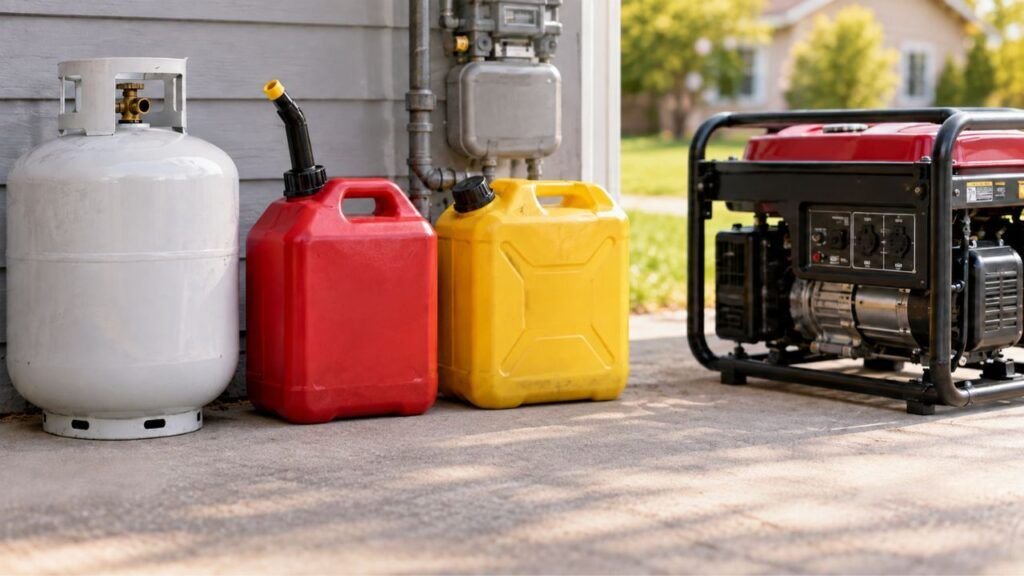
Yes, tri-fuel generators usually produce less power on propane and natural gas. Gasoline normally provides the highest available wattage. Propane produces slightly less, while natural gas usually delivers the lowest output.
That power difference matters when planning backup power for your home. Below, I’ll explain the actual wattage losses, why they happen, and how to size your generator correctly.
Key Takeaways
- Gasoline normally provides the highest generator power output.
- Propane usually produces slightly fewer watts than gasoline.
- Natural gas typically causes the largest wattage reduction.
- The exact power loss varies between generator models.
- Running watts and starting watts may decrease differently.
- Always check the manufacturer’s rating for each fuel.
- Size your generator using the fuel you expect to use.
- Leave extra wattage available for appliances with starting surges.
Do Tri Fuel Generators Produce Less Power?
Yes, but there is one important detail to understand.
A tri-fuel generator is not weaker simply because it supports three fuels. Instead, its available wattage changes depending on the fuel being burned.
Most tri-fuel generators follow this order:
Gasoline: Highest output
Propane: Slightly lower output
Natural gas: Lowest output
For example, a generator might provide 10,000 running watts using gasoline. The same generator might produce 9,000 watts on propane. Natural gas output could fall closer to 8,000 watts.
That difference becomes important during a home power outage.
You could comfortably run several appliances using gasoline. Switching to natural gas could reduce your available capacity significantly.
That is why you should never size a generator using only its largest advertised wattage.
How Much Power Does a Tri Fuel Generator Lose?
There is no single percentage that applies to every generator. Engine size, fuel system design, and manufacturer tuning all affect the difference.
Here are several real-world examples showing how output can change.
| Generator | Gasoline Running Watts | Propane Running Watts | Propane Loss | Natural Gas Running Watts | Natural Gas Loss |
| Champion 201445 | 4,000W | 3,600W | 10% | 3,240W | 19% |
| Westinghouse WGen11500TFc | 11,500W | 10,500W | 8.7% | 9,500W | 17.4% |
| DuroMax XP13000HXT | 10,500W | 9,500W | 9.5% | 8,500W | 19% |
| FIRMAN T07573 | 7,500W | 6,750W | 10% | 5,500W | 26.7% |
These examples reveal an important pattern.
Propane output is roughly 9% to 10% lower here. Natural gas shows a much wider reduction range.
However, you should not treat these percentages as universal rules.
Another generator could have a smaller or larger difference.
Always check the gasoline, propane, and natural gas ratings separately.
Why Does a Tri Fuel Generator Make Less Power on Propane and Natural Gas?
All three fuels can run the same generator engine. However, they do not behave identically inside that engine.
Several differences affect how much mechanical power reaches the alternator.
Gasoline Usually Provides the Highest Engine Output
Portable generator engines are commonly rated highest when using gasoline.
Gasoline carries substantial energy within a relatively small fuel volume. The engine’s gasoline system can also deliver fuel efficiently under heavy loads.
That usually allows the engine to produce its maximum rated horsepower.
More engine power allows the alternator to produce more electrical power.
This is why the largest number printed on many generator boxes represents gasoline output.
Propane Produces Slightly Less Power
Propane normally produces somewhat less generator output than gasoline.
Unlike liquid gasoline entering through a carburetor system, propane enters the engine as vapor.
The air-fuel mixture and combustion characteristics are therefore different.
Propane also contains less energy per gallon than gasoline.
However, the difference in fuel energy does not directly equal wattage loss.
Generator design, engine tuning, and fuel delivery also affect output.
For most homeowners, the practical takeaway is simple.
Expect somewhat less available wattage when operating with propane.
Natural Gas Usually Produces the Lowest Output
Natural gas generally produces the lowest output among all three fuels.
It enters the engine as gas and occupies part of the incoming air volume. This can reduce how much combustible mixture enters each cylinder.
The engine therefore develops less maximum horsepower under heavy loads.
That reduction eventually appears as lower generator wattage.
Some models lose less than 20% compared with gasoline. Others can lose more than 25%.
The generator’s specification sheet provides the number that matters most.
Does Tri Fuel Capability Itself Reduce Generator Power?
No. Having three fuel options does not automatically reduce generator output.
This point causes plenty of confusion.
Suppose a tri-fuel generator has these ratings:
- Gasoline: 10,000 running watts
- Propane: 9,000 running watts
- Natural gas: 8,000 running watts
When running gasoline, you still have the full 10,000-watt rating.
The propane and natural gas components do not automatically reduce gasoline output.
The available power changes when you select a different fuel.
Therefore, saying “tri-fuel generators are less powerful” is too broad.
A better statement would be:
Tri-fuel generators generally produce less power on propane and natural gas than on gasoline.
That distinction matters when comparing generator models.
Starting Watts vs Running Watts: Which Number Matters?
Generator specifications normally include both starting and running watts. You need to understand both before planning your backup loads.
They affect your generator differently during an outage.
Running Watts
Running watts describe continuous electrical output.
For example, imagine your generator provides 8,000 running watts.
Your combined continuous appliance load should remain within that available capacity.
Common running loads include:
- Refrigerators
- Freezers
- Lights
- Televisions
- Wi-Fi equipment
- Furnaces
- Sump pumps
- Well pumps
- Window air conditioners
Running watts tell you how much equipment can operate together.
Starting Watts
Some appliances briefly need much more electricity during startup.
Electric motors are the main reason.
A refrigerator may consume modest power while operating. Its compressor can temporarily require much more power when starting.
The same problem applies to:
- Well pumps
- Sump pumps
- Freezers
- Furnace blowers
- Window air conditioners
- Central air conditioners
That short surge must remain within your generator’s starting capacity.
Here is where fuel choice becomes particularly important.
Some generators reduce both starting and running watts on gaseous fuels. Others do not reduce them by identical percentages.
Never assume a 10% running-watt reduction means exactly 10% fewer starting watts.
Check both numbers for your specific generator.
What Does the Power Drop Mean for Home Backup?
Lower fuel-specific wattage does not necessarily make tri-fuel generators unsuitable for homes. You simply need to plan your loads around the correct rating.
Here is what reduced output can mean during an outage:
- You may run fewer large appliances simultaneously.
- Central air conditioning may require additional starting capacity.
- Well pumps can consume considerable startup power.
- Sump pumps also need room for motor surges.
- Electric water heaters can consume several thousand watts.
- Electric ranges can quickly use available generator capacity.
- You may need to switch certain appliances off temporarily.
- Natural gas operation may require more careful load management.
Imagine your generator supports your refrigerator, furnace, lights, and well pump.
Everything works comfortably using gasoline.
You then switch to natural gas and lose considerable output.
The same combination of loads might now approach the generator’s maximum rating.
That is why fuel-specific planning matters.
Example: How Fuel Choice Changes Your Available Backup Power
Consider a generator producing the following running wattage:
- Gasoline: 11,500 watts
- Propane: 10,500 watts
- Natural gas: 9,500 watts
Now imagine your household backup loads require 8,500 running watts.
Your remaining capacity would look like this:
| Fuel | Generator Output | Current Load | Remaining Capacity |
| Gasoline | 11,500W | 8,500W | 3,000W |
| Propane | 10,500W | 8,500W | 2,000W |
| Natural Gas | 9,500W | 8,500W | 1,000W |
Notice what happens when you switch fuels.
Your appliances still consume the same 8,500 watts. However, the generator’s available capacity becomes smaller.
Natural gas leaves only 1,000 watts of remaining capacity.
Now imagine your well pump suddenly starts.
Its temporary startup demand could exceed that remaining margin.
The generator might overload even though everything previously ran properly.
This is exactly why I recommend sizing from your lowest planned fuel rating.
How to Size a Tri Fuel Generator for the Fuel You Will Actually Use
The safest approach is sizing around real operating conditions. Do not base everything on the biggest number printed on the generator.
Follow these steps before deciding how much capacity you need.
Start With the Fuel You Expect to Use Most
Think about how the generator will operate during a real outage.
Will you mainly use gasoline?
And, Will propane be your stored emergency fuel?
Will you connect directly to your home’s natural gas supply?
If natural gas will handle long outages, use the natural gas rating.
That becomes your practical generator capacity.
Add Your Running Loads
List everything you expect to operate simultaneously.
For example:
- Refrigerator: 700W
- Freezer: 500W
- Furnace blower: 800W
- Lights: 300W
- Television: 150W
- Router: 30W
- Well pump: 1,000W
These example loads total 3,480 running watts.
Your actual appliances may consume different amounts.
Check appliance labels, manuals, or manufacturer specifications whenever possible.
Check Your Largest Starting Load
Next, identify appliances containing motors or compressors.
Your generator must handle their brief startup demand.
Suppose everything currently uses 3,500 watts.
Your well pump then needs another 2,500 watts while starting.
The generator may temporarily need around 6,000 watts.
Ignoring startup power is one of the easiest sizing mistakes.
Leave Some Extra Capacity
Avoid planning your generator at its absolute maximum continuously.
Extra capacity gives the system breathing room.
It can help with:
- Unexpected appliance startups
- Additional household loads
- Hot weather
- High altitude
- Engine wear
- Fuel supply variations
- Temporary power surges
You do not need an enormous unused reserve.
You simply want enough room for normal changes in demand.
Can Natural Gas Supply Problems Reduce Generator Power Further?
Yes. A natural gas generator needs enough fuel flow to produce its rated output.
The generator itself is only one part of that system.
Gas Pressure Matters
Natural gas generators require fuel within a specified pressure range.
If pressure becomes too low, the engine may struggle under heavy loads.
Possible symptoms include:
- Rough operation
- Low power
- Engine hesitation
- Generator shutdown
- Difficulty handling large loads
Follow the pressure requirements listed for your generator.
Pipe and Hose Size Matter
Natural gas must reach the generator through properly sized plumbing.
A small gas line may restrict fuel flow.
Long gas lines can also increase pressure losses.
The correct diameter depends on several factors.
These include generator demand, pipe length, supply pressure, and other appliances.
Do not assume an existing small gas outlet can support a large generator.
Other Gas Appliances Matter
Your generator might not be the only natural gas appliance operating.
Your home may also have:
- A gas furnace
- Water heater
- Gas range
- Clothes dryer
- Fireplace
Those appliances share the available natural gas supply.
During winter, your furnace could consume substantial fuel while the generator operates.
A qualified professional can check whether your gas service supports everything together.
Do Altitude and Temperature Reduce Generator Power Too?
Fuel type is not the only factor affecting generator output.
High altitude can reduce available engine power because the air becomes thinner. Less oxygen enters the engine during each combustion cycle.
As altitude increases, available generator wattage can decrease.
High temperatures can also influence engine performance.
Therefore, a generator already producing fewer watts on natural gas could lose additional capacity in demanding conditions.
Engine condition matters as well.
Dirty air filters, old spark plugs, poor maintenance, or incorrect fuel delivery can reduce performance.
Consider these conditions when operating close to maximum capacity.
Should You Use Gasoline, Propane, or Natural Gas for Maximum Power?
Every fuel has advantages and disadvantages. The right option depends on whether you prioritize maximum output, storage, or long-term convenience.
Here is how I would look at each choice.
Choose Gasoline When Maximum Wattage Matters Most
Gasoline normally provides your generator’s highest electrical output.
That can be useful when operating demanding loads.
Examples include:
- Large air conditioners
- Well pumps
- Multiple refrigeration appliances
- Power tools
- Several household circuits
Gasoline can also provide extra startup headroom.
The downside is storage.
Gasoline eventually degrades and requires careful storage and rotation.
Choose Propane When You Want a Good Balance
Propane offers an attractive middle ground.
You normally lose some generator wattage compared with gasoline.
However, propane stores much better for emergency preparedness.
A properly stored propane supply can remain available for long periods.
You also avoid some gasoline-related carburetor storage problems.
For many homeowners, that tradeoff is worth the modest power reduction.
Choose Natural Gas for Long-Outage Convenience
Natural gas normally provides the lowest generator output.
However, it offers one major advantage.
You do not have to keep refilling a portable fuel tank while utility gas remains available.
That can make a huge difference during extended outages.
You could operate essential loads without constantly handling gasoline containers.
Just size your generator according to its natural gas rating.
Is Losing Power on Propane or Natural Gas a Dealbreaker?
Usually, no.
The power reduction only becomes a problem when the generator was undersized initially.
Imagine comparing two generators.
Generator A provides 6,000 watts on gasoline only.
Generator B provides 10,000 watts on gasoline and 8,000 watts on natural gas.
And, generator B loses power while using natural gas.
However, its natural gas output still exceeds Generator A’s maximum output.
That is why percentages alone do not tell the complete story.
Focus on the actual fuel-specific wattage available to you.
If that rating comfortably supports your appliances, the reduction does not matter much.
The flexibility of having three fuel choices may actually become more valuable.
Final Verdict
Yes, tri-fuel generators usually produce less power when using propane or natural gas instead of gasoline. Gasoline typically delivers maximum output, propane produces somewhat less, and natural gas usually experiences the largest reduction.
However, there is no universal power-loss percentage for every generator. Some models lose around 10% on propane, while natural gas reductions can vary considerably more.
The easiest way to avoid problems is simple.
Size your generator according to the fuel you actually plan to use. If natural gas will provide most of your backup power, base your calculations on the natural gas running and starting watts.
That way, you will know exactly how much usable backup capacity you have before an outage begins.
Related FAQs
Does a Tri Fuel Generator Make the Same Watts on All Three Fuels?
No. Most tri-fuel generators provide their highest wattage on gasoline, slightly less on propane, and their lowest rated output when operating on natural gas.
How Much Power Does a Generator Lose on Propane?
Many current tri-fuel models lose around 9% to 10% of their running wattage on propane compared with gasoline. However, the exact reduction depends on the specific generator.
How Much Power Does a Generator Lose on Natural Gas?
Natural gas output can be roughly 17% to 27% lower than gasoline in some current tri-fuel generators. Always check your model’s published natural gas rating.
Why Does Natural Gas Produce Less Generator Power?
Natural gas enters the engine as a gaseous fuel and changes the available air-fuel mixture. Engine design and fuel-system calibration also influence the generator’s maximum output.
Will a Tri Fuel Generator Run My Whole House on Natural Gas?
Possibly, but it depends on your generator’s natural gas wattage and your home’s electrical demand. Large loads like central AC, pumps, and electric heaters require careful sizing.
Can I Switch to Gasoline When I Need More Generator Power?
Many tri-fuel generators let you change fuel sources, allowing gasoline when additional output is needed. Follow your generator’s manual because switching procedures vary between models.
Should I Size a Tri Fuel Generator Using Gasoline or Natural Gas Watts?
Use the rating for the fuel you expect to run most often. If natural gas will handle extended outages, calculate your home loads using the natural gas specifications.
Does Propane or Natural Gas Reduce Generator Starting Watts?
It can. However, starting watts do not always decrease by the same percentage as running watts. Check the fuel-specific starting and running ratings for your particular generator.

Brian Walker writes straightforward generator guides and reviews for homeowners and everyday users. His content focuses on solar, portable, and fuel-powered generators, with practical advice on choosing, using, and maintaining reliable backup power.