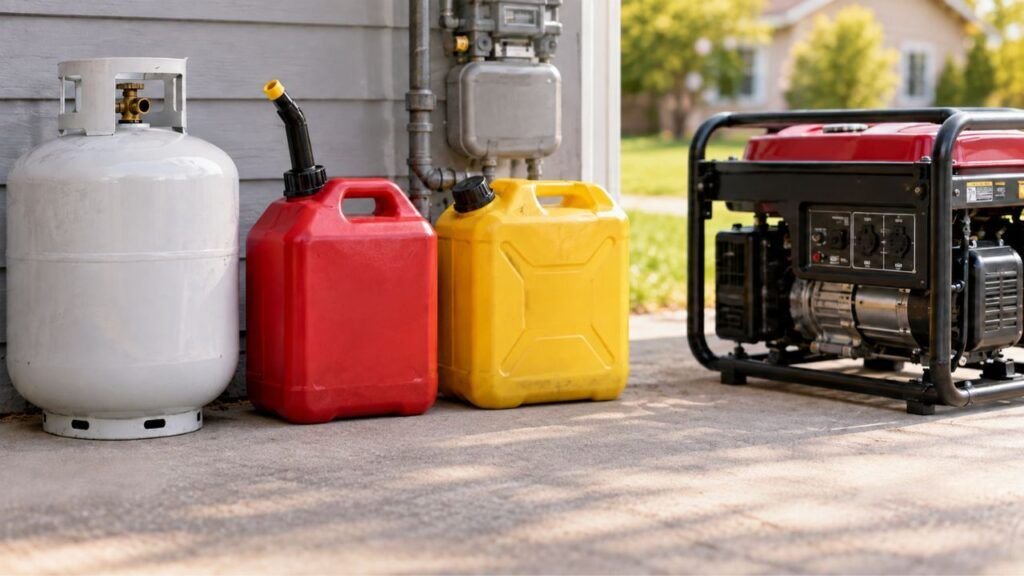
A dual fuel generator is usually better than a gas generator for home backup when you want more fuel flexibility during an outage. It can run on gasoline or propane, while a gas generator depends entirely on gasoline. However, gas-only generators often cost less and can provide slightly more power than the same dual-fuel generator running on propane.
The right choice depends on your outage length, power needs, fuel storage, and budget. Below, I’ll compare power output, runtime, storage, maintenance, cost, safety, and home backup performance.
Key Takeaways
- Dual fuel generators run on both gasoline and propane.
- Gas generators rely entirely on gasoline for power.
- Gasoline usually provides the highest available generator output.
- Propane is easier to keep stored for emergency use.
- Dual fuel models give you more options during fuel shortages.
- Gas generators usually have a lower initial purchase price.
- Generator wattage matters more than fuel type for appliance capacity.
- Both generator types must always operate safely outdoors.
Dual Fuel vs Gas Generator: Quick Comparison
Both generator types can provide dependable emergency power. The biggest differences involve fuel flexibility, storage, price, and outage preparedness.
| Feature | Dual Fuel Generator | Gas Generator |
| Fuel options | Gasoline and propane | Gasoline only |
| Initial cost | Usually higher | Usually lower |
| Fuel flexibility | Excellent | Limited |
| Gasoline output | Usually highest output | Full rated output |
| Propane output | Usually slightly lower | Not available |
| Long-term fuel storage | Excellent with propane | Requires gasoline management |
| Fuel rotation | Less important when using propane | Usually necessary |
| Emergency availability | Two possible fuel sources | One fuel source |
| Maintenance | Slightly more involved | Simpler fuel system |
| Long outages | Excellent | Good with enough gasoline |
| Short outages | Excellent | Excellent |
| Best for | Emergency preparedness | Simplicity and lower cost |
For most homeowners preparing specifically for unpredictable outages, dual fuel offers the stronger overall advantage.
What Is the Difference Between a Dual Fuel and Gas Generator?
A dual fuel generator has an engine designed to operate using two fuels. Most portable dual fuel generators sold in the United States use gasoline and propane.
A traditional gas generator uses gasoline only. In this article, “gas generator” means a gasoline-powered generator, not a natural gas standby generator.
Both machines use an internal combustion engine to turn an alternator. The alternator then produces electricity for your appliances or home circuits.
The main difference is what happens when your primary fuel becomes unavailable.
With a gas generator, no gasoline means no electricity.
With dual fuel, you can connect propane when gasoline becomes unavailable. You can also return to gasoline when you need it.
That second option can become surprisingly valuable during a major outage.
You should also avoid confusing dual fuel with tri fuel. A tri-fuel generator commonly adds natural gas as a third option.
Which Is Better for Home Backup: Dual Fuel or Gas?
For home emergency use, I generally prefer dual fuel. However, there are situations where a gasoline-only generator makes more sense.
Choose a Dual Fuel Generator If…
A dual fuel generator makes sense when emergency preparedness matters most.
Consider dual fuel when:
- Your area experiences hurricanes, tornadoes, or winter storms.
- Outages sometimes continue for several days.
- You want to keep propane stored for emergencies.
- You do not want complete dependence on gas stations.
- Your generator may sit unused for months.
- You already keep propane cylinders around your property.
- You want another fuel choice during supply shortages.
- You occasionally need gasoline for maximum available output.
Having two fuels does not guarantee unlimited power. However, it gives you another option when conditions change.
Choose a Gas Generator If…
A gasoline generator remains a practical choice for many households.
Consider a gas model when:
- Your outages usually last only several hours.
- Fresh gasoline is readily available nearby.
- Your purchase budget is relatively limited.
- You already store and rotate gasoline properly.
- You frequently use gasoline-powered outdoor equipment.
- You want the simplest possible generator setup.
- You need maximum gasoline-rated output for larger loads.
There is nothing inherently wrong with gasoline-only generators. You simply need a dependable plan for keeping fresh fuel available.
My Recommendation for Most Homeowners
If you are buying specifically for emergency home backup, dual fuel offers better flexibility.
You can store propane before storm season without continually rotating it. Gasoline remains available whenever you want the generator’s gasoline-rated performance.
That flexibility becomes valuable during longer and less predictable emergencies.
I would choose gasoline-only mainly when budget and simplicity matter more. It also makes sense if you already manage gasoline regularly.
Power Output: Does a Dual Fuel Generator Produce Less Power?
Dual fuel generators normally publish separate wattage ratings for each fuel. Always check both ratings before deciding whether the generator fits your house.
Gasoline Usually Provides More Power
A dual fuel generator typically produces its highest rated output on gasoline.
For example, imagine a generator rated for:
- 10,000 running watts on gasoline
- 9,000 running watts on propane
That same machine does not suddenly become a smaller generator. The engine simply produces less available output while operating on propane.
This difference becomes important when powering high-starting-watt appliances.
Those may include:
- Well pumps
- Sump pumps
- Air conditioners
- Refrigerators
- Freezers
- Furnace blowers
- Power tools
The actual difference varies between generator models.
Never assume every propane rating is exactly 10% lower.
Propane Output Depends on the Generator
Manufacturers design fuel systems differently.
One model might lose only a relatively small amount of output. Another generator could have a noticeably larger difference.
Always check these four specifications:
- Gasoline running watts
- Gasoline starting watts
- Propane running watts
- Propane starting watts
These figures tell you far more than general percentage estimates.
Size Your Generator Using Your Planned Fuel
This is where homeowners sometimes make an expensive mistake.
Suppose your essential appliances require around 7,500 running watts. You purchase an 8,000-running-watt dual fuel generator based on its gasoline specification.
However, the generator delivers only 7,000 running watts on propane.
If propane was supposed to be your main emergency fuel, you have potentially undersized your generator.
I recommend sizing around the fuel you expect to use most.
Calculate your essential running loads first. Then account for the largest motor starting surge you may encounter.
Finally, leave some operating headroom instead of running constantly at maximum capacity.
What Can Each Type Run During a Home Outage?
Fuel type itself does not determine which appliances your generator powers. The generator’s actual voltage, running watts, and starting capacity determine that.
| Home Load | Main Generator Consideration |
| Refrigerator | Compressor starting surge |
| Freezer | Compressor starting surge |
| LED lights | Low continuous load |
| Wi-Fi router | Small continuous load |
| Furnace blower | Motor starting surge |
| Sump pump | Significant startup demand |
| Well pump | Starting surge and voltage |
| Microwave | High short-term running load |
| Window AC | Compressor starting watts |
| Central AC | Very high starting demand |
| Electric water heater | High continuous demand |
| Electric dryer | High 240V demand |
| Electric range | Very high continuous demand |
A 7,500-watt dual fuel generator and 7,500-watt gas generator can support similar loads when both actually provide 7,500 usable watts.
The important part is checking the rating for your chosen fuel.
You should also verify voltage requirements.
Some household equipment requires 240V. Not every portable generator provides usable 120/240V output.
Fuel Availability During an Outage
Normal fuel availability can look very different during a major emergency. This is one area where dual fuel can provide a genuine preparedness advantage.
Gasoline Is Convenient Until Getting It Becomes Difficult
Gasoline is widely available across the United States.
Under normal conditions, filling several approved gasoline containers is easy.
A widespread outage can change things quickly.
Gas stations may experience:
- Power outages
- Long lines
- Supply disruptions
- Closed roads
- Increased demand
- Temporary shortages
None of these problems happen during every outage.
However, depending entirely on gasoline gives you only one supply chain.
Propane Gives You an On-Site Fuel Reserve
Propane is particularly useful for emergency storage.
The fuel itself does not degrade like stored gasoline. That makes it easier to keep propane available before an outage begins.
You can keep properly stored cylinders ready throughout the year.
Just remember that propane still requires responsible storage.
The cylinder, valve, regulator, and hose must remain in safe condition.
Follow applicable local storage requirements and manufacturer recommendations.
Dual Fuel Gives You a Backup Fuel Option
This is the biggest reason I like dual fuel for emergency backup.
Suppose you begin an outage using propane.
You could preserve gasoline until you need maximum generator output.
Later, you may switch fuels as supplies change.
Or perhaps propane becomes difficult to replace, while gasoline stations reopen.
The generator gives you another option.
However, never assume you can switch fuels while the engine runs.
Some generators support fuel switching differently than others. Always follow the procedure in your owner’s manual.
Gasoline vs Propane Storage for Emergency Backup
Fuel storage matters because generators often remain unused for months. Propane generally requires less fuel-rotation management than gasoline.
| Storage Factor | Gasoline | Propane |
| Fuel degradation | Yes | Fuel itself remains stable |
| Regular rotation | Recommended | Usually unnecessary |
| Fuel stabilizer | May be useful | Not needed for fuel degradation |
| Storage container | Approved gasoline container | Approved propane cylinder |
| Spill possibility | Liquid spills possible | Pressurized gas concerns |
| Long-term preparedness | Requires management | Very convenient |
| Equipment inspection | Fuel system and container | Cylinder, hose and regulator |
Gasoline Requires More Attention
Gasoline does not stay fresh forever.
Heat, moisture, fuel formulation, storage conditions, and container quality can affect deterioration.
Old gasoline can create:
- Hard starting
- Poor engine performance
- Carburetor deposits
- Fuel-system problems
For emergency preparedness, develop a rotation system.
You might use older stored gasoline in compatible equipment or vehicles before replacing it with fresh fuel.
Always follow generator and fuel-storage instructions.
Propane Is Easier for Long-Term Preparedness
Propane does not become stale like gasoline.
That makes it particularly appealing for generators used only during emergencies.
You could keep propane ready without worrying about fuel becoming gummy inside a carburetor.
Still, do not interpret this as maintenance-free storage.
Inspect cylinders and connections periodically.
Store propane according to local safety requirements and cylinder instructions.
Runtime: Which Generator Runs Longer During an Outage?
You cannot accurately say gasoline or dual fuel automatically runs longer. Generator runtime depends on several variables beyond fuel type.
Runtime Depends on More Than Fuel
Important factors include:
- Generator engine size
- Electrical load
- Gasoline tank capacity
- Propane cylinder size
- Engine efficiency
- Generator design
- Ambient conditions
- Fuel-specific output
A generator operating at 25% load can run significantly longer than one operating near maximum output.
That is why manufacturer runtime claims need context.
Compare Runtime at the Same Load
Suppose one generator advertises 12 hours on gasoline.
Another advertises nine hours on propane.
That comparison means very little unless both used comparable generator loads and fuel quantities.
A built-in gasoline tank might hold several gallons.
Meanwhile, the propane runtime might be measured using one 20-pound cylinder.
Instead, compare:
Runtime + electrical load + amount of fuel used
That gives you a much more useful comparison.
Calculate Your Total Emergency Runtime
For home backup, I care more about total stored runtime.
Ask yourself:
How many hours can this generator operate using the fuel I can realistically keep at home?
That question can completely change your decision.
A gasoline generator with excellent tank runtime still stops when your stored gasoline disappears.
A dual fuel generator gives you the combined potential of both fuel supplies.
Which Is Cheaper to Run: Dual Fuel or Gas?
Neither gasoline nor propane is always cheaper for generator operation.
Fuel prices change by location, season, supplier, and purchasing method.
Propane cylinder exchanges can also cost differently from bulk refills.
Instead of following a universal claim, calculate your actual operating cost.
Use:
Fuel Cost Per Hour = Fuel Cost ÷ Runtime at Your Expected Load
Suppose $30 worth of fuel operates your generator for ten hours.
Your approximate fuel cost would be $3 per operating hour.
Repeat the calculation using local gasoline and propane prices.
Also consider overall ownership expenses, including:
- Generator purchase price
- Fuel containers
- Propane cylinders
- Fuel stabilizer
- Oil changes
- Maintenance
- Extension cords
- Transfer equipment
- Electrical installation
A dual fuel generator might cost more initially.
Whether that extra cost pays off financially depends on how you operate it.
Its biggest benefit is usually flexibility rather than guaranteed fuel savings.
Maintenance: Is Dual Fuel More Complicated Than Gas?
Both generators contain gasoline-style engines requiring routine maintenance. Dual fuel adds propane-related components, but basic engine care remains similar.
Gas Generator Maintenance
A gasoline generator commonly requires attention to:
- Engine oil
- Air filter
- Spark plug
- Battery, when equipped
- Fuel system
- Carburetor
- Periodic test operation
- Stored gasoline
The fuel system creates the biggest storage concern.
Leaving untreated gasoline inside some generators for long periods can eventually cause operating problems.
Follow your owner’s manual when preparing the unit for storage.
Dual Fuel Generator Maintenance
A dual fuel generator needs the same fundamental engine maintenance.
You also need to inspect:
- Propane hose
- Pressure regulator
- Fuel fittings
- Fuel selector
- Connections for leaks or damage
That sounds like significantly more work, but usually it is manageable.
The tradeoff is gaining another fuel source.
Propane Can Simplify Long Storage
If you primarily operate your dual fuel generator on propane, you can reduce stale-gasoline concerns.
That does not eliminate engine maintenance.
You still need oil changes, air-filter care, spark-plug inspections, and periodic exercise runs.
Think of propane as solving one storage problem, not every maintenance problem.
Dual Fuel vs Gas Generator for Long Outages
Outage duration can strongly influence which generator makes more sense. The longer the emergency continues, the more valuable fuel flexibility becomes.
For Outages Lasting a Few Hours
Either generator works well.
You may only need enough power for:
- Refrigerator
- Freezer
- Internet
- Lights
- Television
- Phone chargers
- Furnace blower
If you already have fresh gasoline, a gas generator performs perfectly well.
For One to Three Days
This is where dual fuel starts becoming more attractive.
Instead of depending entirely on one fuel supply, you have two options.
You might operate on propane overnight and preserve gasoline.
Or you could use gasoline when heavier loads require more available output.
Your strategy depends on the generator and available fuel.
For Extended Regional Outages
Fuel planning becomes increasingly important during longer emergencies.
You should think about:
- How much gasoline you can safely store
- How many propane cylinders you have
- Local fuel availability
- Generator fuel consumption
- Your essential electrical load
- Whether resupply will be possible
A dual fuel generator only improves preparedness when you actually keep both fuels available.
Buying dual fuel while storing no propane gives you little emergency advantage.
Home Connection Matters More Than Fuel Type
Choosing fuel is only part of your backup plan. You also need a safe method for getting generator power into your appliances or home circuits.
Extension Cords for Individual Appliances
Heavy-duty generator-rated extension cords can power selected appliances directly.
This approach works well for basic backup loads.
You might connect:
- Refrigerator
- Freezer
- Lamps
- Router
- Small electronics
Use appropriately rated cords and follow the generator’s instructions.
Never run unsafe cords through wet areas or overloaded connections.
Transfer Switch or Approved Interlock for Home Circuits
If you want to energize selected circuits through your electrical panel, use approved transfer equipment.
A properly designed setup prevents generator electricity from feeding backward into utility lines.
Backfeeding can create deadly electrical hazards.
A qualified electrician can determine which connection method works with your home, generator, and local electrical requirements.
Never improvise a connection through a household outlet.
Check Whether You Need 120/240V Power
Wattage alone does not tell the entire story.
Some home equipment requires 240V.
Examples may include:
- Well pumps
- Central air conditioners
- Electric water heaters
- Electric dryers
- Range circuits
A generator advertising high wattage does not automatically support every 240V load.
Check the outlets, voltage specification, amperage, and electrical requirements before buying.
Safety: Dual Fuel and Gas Generators Have the Same CO Risk
Both generator types burn fuel and produce carbon monoxide. Treat either type with exactly the same level of caution.
- Always operate portable generators outside.
- Keep the generator well away from your home.
- Never operate one inside a garage.
- An open garage door does not make operation safe.
- Point generator exhaust away from doors and windows.
- Keep working carbon monoxide alarms inside your home.
- Never operate generators inside basements or sheds.
- Allow gasoline-powered equipment to cool before refueling.
- Inspect propane hoses and fittings before operation.
- Protect generators from rain without enclosing their exhaust.
- Never backfeed electricity into a household outlet.
A common recommendation is keeping portable generators at least 20 feet from the house when possible, with exhaust directed away.
Follow your generator manual and local safety requirements.
Does Propane Make a Dual Fuel Generator Quieter?
Running on propane does not automatically make every dual fuel generator significantly quieter.
Generator noise depends heavily on its overall design.
Important factors include:
- Engine size
- Engine speed
- Muffler design
- Electrical load
- Enclosure
- Inverter technology
A small enclosed inverter generator can be much quieter than a large open-frame dual fuel generator.
Do not buy dual fuel solely because someone says propane is quiet.
Instead, compare manufacturer noise ratings under similar testing conditions.
How Does Cold Weather Affect a Dual Fuel Generator?
Cold weather deserves extra consideration when propane is your primary emergency fuel.
As temperatures fall, propane cylinder pressure decreases.
A small cylinder supplying a high-demand generator can therefore have more difficulty delivering enough vapor during very cold conditions.
That does not mean propane becomes unusable every winter.
It means your propane storage setup should match:
- Generator fuel demand
- Cylinder size
- Outdoor temperature
- Manufacturer requirements
This is particularly important for homeowners preparing for winter storm outages.
Pros and Cons of a Dual Fuel Generator for Home Backup
Dual fuel gives you excellent emergency flexibility, but that flexibility comes with several compromises worth considering.
Advantages of a Dual Fuel Generator
- Runs on gasoline and propane
- Gives you two emergency fuel options
- Makes long-term propane storage practical
- Reduces dependence on gas stations
- Lets you use gasoline for maximum rated output
- Works well for occasional emergency use
- Provides more flexibility during long outages
- Makes fuel planning easier before storm season
Disadvantages of a Dual Fuel Generator
- Usually costs more initially
- Contains additional fuel components
- Often produces less power on propane
- Requires propane cylinders or another supply
- Still produces dangerous carbon monoxide
- Still needs routine engine maintenance
- Requires learning two fuel operating procedures
For many homeowners, those disadvantages are manageable.
The fuel flexibility can easily justify the extra complexity.
Pros and Cons of a Gas Generator for Home Backup
Gasoline-only generators remain popular because they are familiar, straightforward, and widely available.
Advantages of a Gas Generator
- Usually costs less upfront
- Has a relatively simple fuel system
- Offers many available model choices
- Provides strong gasoline-rated output
- Is easy to refuel during normal conditions
- Works well for short outages
- Makes sense for frequent generator users
Disadvantages of a Gas Generator
- Depends completely on gasoline
- Stored fuel needs regular attention
- Gasoline can deteriorate during storage
- Fuel stations may become difficult during emergencies
- Large gasoline supplies require careful storage
- Old gasoline may create carburetor problems
The biggest limitation is not generator performance.
It is depending on a single fuel supply during an unpredictable emergency.
Dual Fuel vs Gas Generator: Which Should You Buy?
Your household situation matters more than generic claims about either generator. Use this table as a practical starting point.
| Your Situation | Better Choice |
| Lowest purchase price | Gas |
| Simplest setup | Gas |
| Short occasional outages | Either |
| Hurricane preparation | Dual fuel |
| Winter storm preparation | Dual fuel |
| Multi-day outages | Dual fuel |
| Long periods between generator uses | Dual fuel |
| Already store propane | Dual fuel |
| Regularly rotate gasoline | Gas can work well |
| Need maximum gasoline output | Gas or dual fuel on gasoline |
| Want two fuel options | Dual fuel |
| Generator primarily for emergencies | Dual fuel |
| Tight purchase budget | Gas |
| Fuel availability is unpredictable | Dual fuel |
Do not let fuel type distract you from proper generator sizing.
A properly sized gasoline generator is more useful than an undersized dual fuel generator.
Check your household loads first.
Then verify:
- Running watts
- Starting watts
- Gasoline rating
- Propane rating
- 120/240V capability
- Outlet configuration
- Transfer equipment compatibility
Those details ultimately determine whether the generator can power your home effectively.
Is a Dual Fuel Generator Worth the Extra Cost?
For many homeowners, a dual fuel generator is worth paying more for when emergency preparedness is the primary goal.
You are essentially paying for another fuel option.
That becomes valuable when outages happen unexpectedly and gasoline availability becomes uncertain.
Dual fuel becomes especially worthwhile when your generator sits unused most of the year.
You can keep propane available without constantly worrying about stale emergency gasoline.
However, I would not automatically spend more on dual fuel.
A gas generator may offer better value when:
- Outages are usually brief.
- You already rotate gasoline regularly.
- Your budget is limited.
- You use the generator frequently.
- Propane storage is inconvenient.
- You do not plan to keep propane anyway.
Think about how you will actually use the generator.
Do not pay for fuel flexibility that you never intend to use.
Final Verdict: Dual Fuel or Gas Generator for Home Backup?
For most homeowners buying specifically for emergency backup, I would choose a dual fuel generator over a gasoline-only generator. Having gasoline and propane gives you more options when outages become longer or fuel supplies become unpredictable.
Gas generators still make excellent backup machines. They are often cheaper, simpler, and provide strong output. If you regularly manage gasoline and your outages stay short, paying extra for dual fuel may provide little practical benefit.
Whichever type you choose, focus on proper sizing first. Calculate your household load, check starting watts, verify your planned fuel rating, and confirm whether you need 120/240V power.
Finally, decide how you will safely connect the generator before an outage happens. A well-planned gas generator beats a poorly planned dual fuel setup every time.
Related FAQs
Is a Dual Fuel Generator Better Than a Gas Generator for Home Backup?
A dual fuel generator is generally better for emergency preparedness because you can use gasoline or propane. A gas generator can still be better when lower purchase cost, simple operation, and gasoline-rated performance matter most.
What Is the Main Disadvantage of a Dual Fuel Generator?
The main disadvantage is usually higher purchase cost and added fuel-system complexity. You may also get lower running and starting wattage when operating the generator on propane instead of gasoline.
Does a Dual Fuel Generator Produce Less Power on Propane?
Many dual fuel generators produce less running and starting power on propane. However, the difference varies by generator, so always compare the manufacturer’s separate gasoline and propane wattage ratings.
Is It Cheaper to Run a Generator on Propane or Gasoline?
It depends on local fuel prices, generator efficiency, electrical load, and how you purchase propane. Calculate your fuel cost per operating hour instead of assuming either fuel will always be cheaper.
Which Fuel Lasts Longer for Generator Storage?
Propane is generally more convenient for long-term emergency storage because the fuel itself does not degrade like gasoline. Gasoline requires proper containers, storage practices, and regular fuel management.
Can I Leave Gasoline in My Generator Between Outages?
Leaving gasoline inside a generator for extended periods can cause fuel-system problems. Follow your generator manufacturer’s storage instructions, which may recommend stabilizing, draining, or properly managing stored gasoline.
How Long Will a 20-Pound Propane Tank Run a Generator?
There is no single runtime because generator size and electrical load matter significantly. A heavily loaded large generator can consume propane much faster than a smaller generator operating at partial load.
Can a Dual Fuel Generator Run a Whole House?
Yes, a sufficiently large dual fuel generator can power many or all household loads. You must account for running watts, starting watts, 240V equipment, and the generator’s rating on the fuel you plan to use.
Can I Connect a Dual Fuel Generator to My Electrical Panel?
Yes, compatible generators can supply home circuits through properly installed transfer equipment. Have a qualified electrician determine the correct transfer switch or approved interlock arrangement for your electrical system.
Can You Switch a Dual Fuel Generator From Gas to Propane While Running?
Some generators have fuel-switching features, while others require shutdown procedures before changing fuels. Never assume yours supports live switching; follow the specific instructions provided by the generator manufacturer.
Does Propane Make a Generator Last Longer?
Propane can reduce problems associated with stale gasoline and fuel deposits, particularly during storage. However, it does not guarantee longer engine life because maintenance, loading, oil changes, and operating conditions also matter.
Is a Dual Fuel Generator Safer Than a Gas Generator?
Neither generator should be considered automatically safer. Both produce carbon monoxide and require outdoor operation. Gasoline introduces liquid fuel and spill risks, while propane requires safe cylinders, regulators, hoses, and connections.

Brian Walker writes straightforward generator guides and reviews for homeowners and everyday users. His content focuses on solar, portable, and fuel-powered generators, with practical advice on choosing, using, and maintaining reliable backup power.