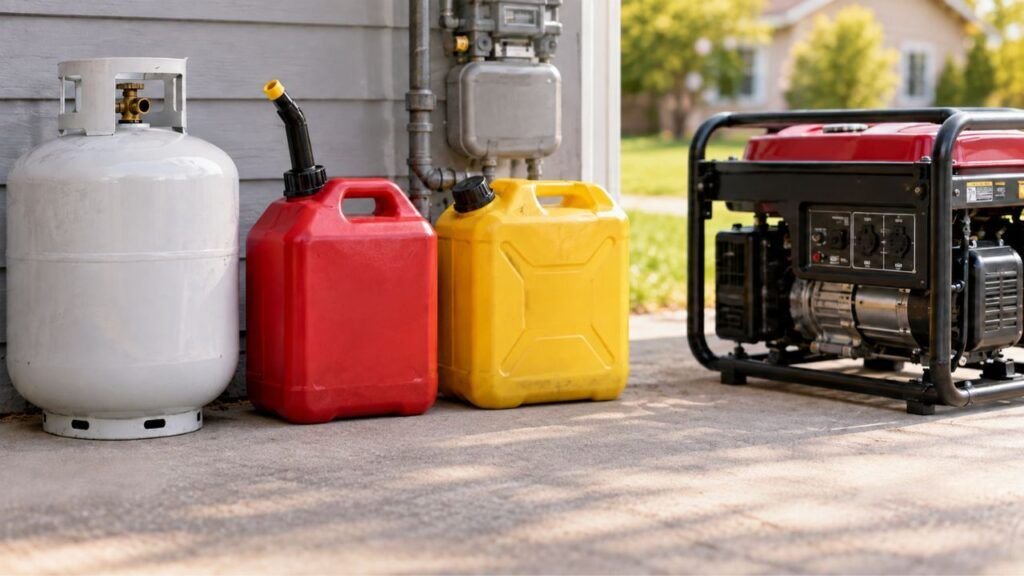
A dual fuel generator uses gasoline and propane, while a tri fuel generator adds natural gas. For home backup, tri fuel usually makes more sense when you already have natural gas service and expect longer outages. Dual fuel is often the simpler choice when gasoline and stored propane can handle your backup needs.
The right choice also depends on wattage, 120V or 240V requirements, outage length, and fuel availability. Below, I’ll help you compare both options based on how they actually work during a home power outage.
Key Takeaways
- Dual fuel generators typically run on gasoline or propane.
- Tri fuel generators add natural gas as a third option.
- Tri fuel is especially useful for homes with natural gas service.
- Gasoline usually provides the highest available generator output.
- Propane and natural gas may reduce running and starting watts.
- Dual fuel is often enough for shorter or occasional outages.
- Tri fuel can simplify fuel management during extended outages.
- Neither option automatically means it can power your whole house.
- Always size the generator using its rating for your intended fuel.
Dual Fuel vs Tri Fuel Generator: Key Differences at a Glance
Both generator types give you more flexibility than gasoline-only models. The main difference is whether natural gas will become part of your home backup plan.
| Factor | Dual Fuel Generator | Tri Fuel Generator |
| Typical fuels | Gasoline and propane | Gasoline, propane, natural gas |
| Fuel flexibility | Very good | Excellent |
| Natural gas capability | No | Yes |
| Maximum output | Usually on gasoline | Usually on gasoline |
| Propane output | Often lower than gasoline | Often lower than gasoline |
| Natural gas output | Not available | Often lowest of the three |
| Fuel storage | Gasoline or propane needed | NG can reduce stored-fuel needs |
| Long outage convenience | Good with enough stored fuel | Excellent when natural gas remains available |
| Setup complexity | Lower | Higher when connecting natural gas |
| Home gas connection | Not required | Required for NG operation |
| Upfront cost | Usually lower | Usually higher |
| Portability | Often simpler | Depends on generator size |
| Best use | Short-to-medium outages | Longer outages and NG-equipped homes |
| Whole-house ability | Depends on wattage | Depends on wattage |
The important point is that three fuels do not automatically mean more electrical power. Tri fuel gives you more ways to fuel the engine, not necessarily a larger generator.
What Is a Dual Fuel Generator?
A dual fuel generator is designed to operate on two fuels, usually gasoline and propane. You select whichever fuel makes the most sense based on availability, storage, and the amount of power you need.
Most models do not burn gasoline and propane simultaneously. Instead, you operate the generator using one selected fuel at a time.
Gasoline is useful when you want the generator’s highest available output. Propane becomes attractive for emergency preparation because you can keep cylinders available without dealing with the same storage concerns associated with old gasoline.
For a homeowner, that gives you a simple backup strategy. You can keep propane ready for outages while still having gasoline available when additional power or convenient refueling matters.
What Is a Tri Fuel Generator?
A tri fuel generator runs on gasoline, propane, or natural gas. It gives you the same two options found on most dual fuel units while adding a third fuel source.
That natural gas capability is what makes tri fuel especially interesting for home backup.
If your house already receives natural gas, a compatible generator may connect to an appropriately sized outdoor gas supply. This can reduce the need to repeatedly refill gasoline cans or replace propane cylinders during a long outage.
However, a tri fuel portable generator should not be confused with a permanently installed standby generator.
Most portable tri fuel units still require you to bring the generator outside, connect it properly, start it, and manage your household loads. They do not automatically start whenever utility power fails unless the system is specifically designed for automatic operation.
How Gasoline, Propane, and Natural Gas Affect Generator Performance
Fuel choice affects much more than convenience. It can also change available wattage, runtime, storage requirements, and how easily you can keep the generator running during an extended outage.
Gasoline Usually Provides the Highest Rated Output
Gasoline commonly gives portable generators their highest running and starting watt ratings.
That extra capacity can become important when you’re powering equipment with motors or compressors. Central AC units, well pumps, refrigerators, freezers, and sump pumps can briefly demand much more power when starting.
Gasoline is also widely available under normal conditions.
The downside is storage.
Gasoline should not simply sit untreated in a container indefinitely. If your backup plan depends heavily on gasoline, you need a sensible fuel rotation and storage routine.
Propane Works Well for Stored Emergency Fuel
Propane gives homeowners another useful option without relying entirely on gasoline.
You can keep approved propane cylinders or a larger compatible tank available for emergencies. This makes propane especially convenient when outages are occasional but you still want fuel ready.
The trade-off is power output.
Many generators produce fewer running and starting watts on propane than they do on gasoline. How much power changes depends on the individual generator.
You should therefore check the propane specifications before deciding what appliances the generator can support.
Natural Gas Reduces Refueling Work
Natural gas is where tri fuel becomes especially useful for longer home outages.
Instead of operating from a limited generator tank or portable cylinder, the generator can receive fuel from the home’s gas supply when the connection and supply are appropriate.
That can save you from repeatedly:
- Filling gasoline cans
- Waiting at operating gas stations
- Swapping propane cylinders
- Storing large amounts of fuel
However, natural gas should not be described as guaranteed unlimited fuel.
Gas service can occasionally be disrupted, and the generator still requires adequate pressure and fuel volume.
Natural gas also commonly produces less electrical output than gasoline on the same generator.
Generator Wattage Changes Depending on Fuel
A common mistake is buying a generator based on the large wattage number printed on the box.
Suppose a tri fuel generator is marketed around a gasoline rating of roughly 10,000 running watts. Its propane rating might be closer to 9,000 watts, while its natural gas output could fall closer to 8,000 watts.
Another generator may lose considerably less or more.
There is no universal percentage that applies to every model.
That leads to one of the most important rules in this comparison:
Size your generator using the running and starting watts specified for the fuel you actually expect to use.
If natural gas will be your primary emergency fuel, use the natural gas rating when planning your loads.
Dual Fuel vs Tri Fuel Generator for Home Backup: Detailed Comparison
Fuel count is only one part of the decision. Let’s look at the differences that actually affect you when the utility power goes out.
Power Output and Starting Watts
Both dual and tri fuel generators come in many sizes.
You might find a small dual fuel inverter designed for essential circuits and a much larger dual fuel generator capable of supporting substantial household loads. The same applies to tri fuel generators.
Instead of choosing by fuel type first, calculate the power you need.
Consider appliances such as:
- Refrigerator
- Freezer
- Furnace blower
- Well pump
- Sump pump
- Microwave
- Lights
- Internet equipment
- Window AC
- Central AC
Pay special attention to motor-driven loads.
A refrigerator that consumes several hundred watts while running may require considerably more power for a moment when its compressor starts.
The same issue applies to pumps and air conditioners.
If you plan around natural gas, leave additional headroom because the generator’s NG wattage may be lower than its gasoline rating.
Runtime During Short and Extended Outages
For a six-hour outage, fuel management may barely affect your decision.
You may be able to run either generator from stored propane or gasoline without inconvenience.
A three-day outage is different.
With dual fuel, you eventually need more gasoline or propane.
That means you must either have enough fuel stored beforehand or obtain additional fuel during the outage.
Tri fuel can make long outages easier when you have dependable natural gas service. Instead of managing portable fuel continuously, you can keep the generator connected to its gas supply.
This is one of the strongest reasons to consider tri fuel for home backup.
Fuel Availability During Emergencies
Emergencies can disrupt normal fuel availability.
After severe storms, gasoline stations may lose electricity, experience shortages, or develop long lines.
Propane gives you an alternative if you stored enough beforehand.
Natural gas gives a tri fuel generator another layer of redundancy.
However, no single fuel should be treated as completely guaranteed.
If emergency resilience is your main goal, think about how many realistic fuel options you would actually have during the type of outage common in your area.
Fuel Storage
Fuel storage is another area where these two setups feel different.
With gasoline, you need approved containers, safe storage, and sensible fuel rotation.
Propane can simplify long-term readiness because cylinders can remain available until needed when properly stored and maintained.
Natural gas removes the need to physically store that portion of your backup fuel at home.
For someone who dislikes keeping several gasoline containers around, this alone can make tri fuel attractive.
Home Natural Gas Requirements
Having a natural gas furnace or stove does not automatically mean your generator can simply connect to the nearest gas fitting.
The generator needs sufficient fuel flow at the required pressure.
Several factors can affect whether the existing system is adequate:
- Generator BTU requirement
- Gas pipe diameter
- Pipe length
- Other gas appliances
- Gas pressure
- Regulator configuration
- Connection location
A large generator operating near full load can require substantial fuel flow.
Before buying tri fuel specifically for natural gas, have the planned supply checked against the manufacturer’s requirements. A qualified gas professional can also determine whether modifications are needed.
Purchase Price and Installation Cost
Dual fuel generators are generally the simpler purchase.
You buy the generator, arrange the proper electrical connection, and prepare your gasoline or propane supply.
Tri fuel models frequently cost more than comparable dual fuel versions because of their additional fuel capability.
If you intend to use natural gas, you may also need to budget for:
- Gas connection work
- Approved hose or fittings
- Quick-connect hardware
- Gas-line changes
- Professional installation
The generator’s purchase price therefore should not be the only number you compare.
Consider the total cost of making the generator usable with your home.
Portability
Dual fuel generators are sometimes described as more portable than tri fuel generators, but that is not always accurate.
Generator size matters much more.
A large 12,000-watt dual fuel generator may be considerably heavier than a compact tri fuel inverter.
When portability matters, compare:
- Weight
- Wheel size
- Handles
- Dimensions
- Frame design
- Where the generator will be stored
If your generator will mostly remain at home, a little extra weight may not matter.
Maintenance
Maintenance requirements are generally similar because both systems still use internal combustion engines.
Typical maintenance can include:
- Oil changes
- Spark plug inspection
- Air filter maintenance
- Battery maintenance
- Fuel system inspection
- Hose inspection
- Periodic test operation
Follow the schedule in your generator manual rather than assuming propane or natural gas eliminates regular maintenance.
Noise and Power Quality
Dual fuel does not automatically mean noisy, and tri fuel does not automatically mean quiet.
Fuel type also does not tell you whether the generator is suitable for sensitive electronics.
Look instead at whether the generator is an inverter model and check its manufacturer’s noise and electrical specifications.
An inverter generator can generally provide cleaner power and quieter operation than many traditional open-frame generators, regardless of whether it uses two or three fuels.
Is Dual Fuel or Tri Fuel Better for Different Home Backup Situations?
There isn’t one winner for every house. Your existing fuel setup and outage pattern usually tell you much more than the number of fuel choices.
| Home Backup Situation | Better Starting Point | Why |
| Home without natural gas | Dual fuel | The third fuel provides little practical benefit |
| Home already using natural gas | Tri fuel | Adds a convenient additional fuel source |
| Outages usually last a few hours | Dual fuel | Stored gasoline or propane may be enough |
| Frequent multi-day outages | Tri fuel | Natural gas can reduce repeated refueling |
| Large propane tank already installed | Dual fuel may be enough | Existing propane capacity improves long-outage practicality |
| Refrigerator, lights, router and furnace | Either | Required wattage matters more |
| Well pump | Either with adequate 240V capacity | Voltage and starting watts are critical |
| Central AC | Either if properly sized | Output matters more than fuel count |
| Maximum fuel redundancy | Tri fuel | Gives three possible fuel options |
| Simplest portable setup | Usually dual fuel | Avoids natural-gas connection planning |
Can a Dual Fuel or Tri Fuel Generator Run a Whole House?
Yes, either type can potentially run a whole house, but dual fuel versus tri fuel does not determine whole-house capability.
The generator’s electrical capacity matters.
Before calling any portable generator a whole-house solution, check:
- Running watt capacity
- Starting watt capacity
- Fuel-specific output
- 120V/240V support
- Maximum generator amperage
- Home inlet capacity
- Transfer equipment
- Simultaneous appliance loads
A large tri fuel generator might power most household circuits with careful load management.
A smaller tri fuel generator may only handle essential loads.
The same applies to dual fuel.
For example, a generator may comfortably support your refrigerator, freezer, lights, furnace blower, internet equipment, and several outlets while still being too small to run a central air conditioner and electric water heater simultaneously.
Focus on the loads rather than the fuel label.
Do You Need 120/240V for Home Backup?
You do not necessarily need 240V if you’re only powering common 120V household essentials.
Refrigerators, freezers, lighting, televisions, routers, chargers, and many furnace blowers operate at 120V.
However, some household equipment may require 240V, including certain:
- Well pumps
- Central air conditioners
- Electric water heaters
- Electric ranges
- Clothes dryers
- Large workshop equipment
If those loads are part of your outage plan, look for a generator specifically designed to provide 120/240V power.
Do not assume a tri fuel generator supports 240V simply because it has more fuel choices.
Likewise, many dual fuel generators offer full 120/240V capability.
Fuel type and voltage are separate specifications.
How to Choose Between a Dual Fuel and Tri Fuel Generator
Choosing becomes much easier when you work through the decision in the right order. I recommend deciding what your house actually needs before worrying about whether two fuels or three sounds better.
Decide What Must Stay Powered
Make a list of your essential loads first.
For many households, that might include:
- Refrigerator
- Freezer
- Internet
- Several lights
- Furnace
- Sump pump
- Well pump
- Phone chargers
Then list optional equipment such as air conditioning, microwave ovens, televisions, or additional rooms.
This prevents you from buying a much larger generator than necessary.
Add Your Running Watts
Find the normal running watt requirement of each appliance you expect to operate simultaneously.
Add those numbers together.
This gives you a basic idea of how much continuous generator capacity you need.
Leave useful headroom rather than planning to operate constantly at the generator’s absolute maximum.
Account for Starting Watts
Now identify appliances containing motors or compressors.
They may briefly require additional power when starting.
That surge is often what causes an undersized generator to overload even when the combined running watts appeared acceptable.
Your generator needs enough surge capacity to handle those startup events.
Decide Which Fuel You Will Use Most Often
This step is frequently overlooked.
Maybe you’re buying a 12,000-watt tri fuel generator because you expect to use natural gas almost exclusively.
If that generator delivers noticeably less power on natural gas, its gasoline number is not the rating you should use for your home plan.
Base your calculations on the fuel you realistically expect to use.
Check Whether Your Home Needs 240V
Look at the appliances you want backed up.
If you need a 240V well pump or central AC system, confirm that the generator actually provides 120/240V output.
Do not discover this limitation after buying the generator.
Think About Outage Length
Imagine your realistic outage rather than the ideal one.
If electricity normally returns within four to eight hours, keeping enough gasoline or propane available may be easy.
If hurricanes, ice storms, tornadoes, or other events can leave your area without power for several days, fuel logistics become much more important.
That is where natural gas capability can substantially improve convenience.
Verify Your Natural Gas Setup Before Buying Tri Fuel
If natural gas is the reason you’re considering tri fuel, verify the gas supply before purchasing.
Check the manufacturer’s required:
- Gas pressure
- Fuel flow
- Hose requirements
- Regulator requirements
Then confirm that your home’s system can support those requirements.
This avoids buying a generator whose most important feature you cannot properly use.
Compare the Entire Backup Setup
The generator itself is only one part of the project.
Your total home backup cost may include:
- Generator
- Generator cord
- Power inlet
- Transfer switch or interlock
- Fuel containers
- Propane cylinders
- Natural gas connections
- Maintenance supplies
Comparing complete systems gives you a much more realistic picture than comparing generator prices alone.
Dual Fuel Generator Pros and Cons
Dual fuel works extremely well for many homeowners because it adds fuel redundancy without making the setup unnecessarily complicated.
Advantages of Dual Fuel Generators
- Gasoline and propane fuel flexibility
- Easy to use without natural gas service
- Good emergency fuel redundancy
- Propane can be stored for backup readiness
- Usually less expensive than comparable tri fuel models
- Good balance between portability and home backup capability
- Many sizes and 120/240V models are available
Disadvantages of Dual Fuel Generators
- No direct natural gas option
- Extended outages require stored or purchased fuel
- Propane may provide less output than gasoline
- Gasoline requires proper storage and rotation
- Propane cylinders eventually need replacement or refilling
Tri Fuel Generator Pros and Cons
Tri fuel adds another layer of flexibility, but it provides the most value when natural gas will actually be part of your emergency plan.
Advantages of Tri Fuel Generators
- Gasoline, propane, and natural gas capability
- Excellent fuel redundancy
- Natural gas reduces repeated manual refueling
- Very convenient during extended outages
- Less stored fuel may be necessary
- You can still switch to gasoline or propane when needed
Disadvantages of Tri Fuel Generators
- Usually more expensive
- Natural gas requires a suitable connection
- Gas-line work may add installation costs
- Natural gas output can be lower than gasoline output
- Utility gas service is not guaranteed during every emergency
- The extra fuel capability offers little value without usable natural gas
Home Connection and Generator Safety
No matter which fuel option you choose, safe setup matters more than convenience. Portable fuel-burning generators produce carbon monoxide and must also be isolated correctly from utility power when feeding household circuits.
Use Proper Transfer Equipment
If you’re connecting a portable generator to household circuits, use a properly installed transfer switch or an approved interlock arrangement that meets local requirements.
These systems help prevent generator electricity from flowing back toward utility lines.
Never try to power your electrical panel by connecting the generator to a normal wall receptacle.
If you’re unsure how your house should be connected, have the setup completed by a qualified electrician.
Never Run the Generator in a Garage
A portable generator belongs outdoors.
Do not operate it:
- Inside the house
- Inside a basement
- Inside an attached garage
- Inside a detached enclosed garage
- Inside a shed
- On an enclosed porch
Opening the garage door does not make indoor generator use safe.
Place the generator outdoors and well away from doors, windows, vents, and other openings where exhaust could enter the home.
Keep working carbon monoxide alarms inside the house as another layer of protection.
Make Sure Natural Gas Connections Match Generator Requirements
Natural gas needs to be treated differently from attaching a portable propane cylinder.
The generator requires the correct fuel pressure and sufficient gas flow.
Use the connection system specified by the manufacturer and have the gas supply evaluated when necessary.
Avoid improvised fittings, undersized hoses, or modifications not approved for the generator.
Common Mistakes When Choosing Dual Fuel vs Tri Fuel
Several buying mistakes can turn a seemingly powerful generator into an inadequate home backup system.
- Comparing only the gasoline wattage rating
- Assuming tri fuel automatically means more electrical power
- Assuming every tri fuel generator provides 240V
- Buying tri fuel without checking natural gas availability
- Ignoring motor starting watts
- Assuming natural gas can never be interrupted
- Choosing too small a propane supply
- Forgetting transfer equipment and the home power inlet
- Trying to run every household appliance simultaneously
- Ignoring generator amperage limits
- Buying based on fuel count instead of actual loads
- Running a generator too close to the home
Avoiding these mistakes will usually help you choose better than simply buying the generator with the largest wattage number on its product page.
Final Verdict
For most homeowners without natural gas service, a dual fuel generator is usually the more practical choice. Gasoline provides strong output when you need it, while propane gives you a convenient second fuel for emergency storage.
A tri fuel generator becomes particularly valuable when your home already has suitable natural gas service. It gives you the option to run from the utility gas supply during long outages while keeping gasoline and propane available as backups.
If extended outages are common where you live, that additional fuel source can significantly reduce the work involved in keeping your generator running.
However, I would not pay extra for tri fuel simply because three fuels sound better than two.
Start with your electrical requirements.
Determine your running watts, starting watts, 120V or 240V needs, and expected outage duration. Then compare those requirements with the generator’s output on the fuel you’ll actually use.
That approach will give you a much more reliable home backup system than choosing by fuel count alone.
Related FAQs
Here are short answers to some of the most common questions homeowners have when comparing dual fuel and tri fuel generators.
Is a Tri Fuel Generator Better Than a Dual Fuel Generator for Home Backup?
A tri fuel generator can be better for home backup when you have a suitable natural gas connection and expect extended outages. If you do not have natural gas or rarely experience long outages, a dual fuel generator may provide everything you need with a simpler setup.
Is a Tri Fuel Generator Worth the Extra Cost?
Tri fuel can be worth the extra cost when natural gas will become your primary outage fuel. If you cannot use natural gas, paying more for a third fuel option provides little practical benefit over a comparable dual fuel generator.
Can a Dual Fuel Generator Run on Natural Gas?
Normally, no. A typical dual fuel generator designed for gasoline and propane should only use the fuels approved by its manufacturer. Do not connect natural gas unless the generator is specifically designed and rated for natural gas operation.
Does a Generator Produce Less Power on Propane?
Many portable generators produce slightly less running and starting power on propane than gasoline. The exact difference varies by model, so use the manufacturer’s propane wattage rating when determining what appliances the generator can support.
Does a Generator Produce Less Power on Natural Gas?
Natural gas commonly provides lower running and starting wattage than gasoline on the same tri fuel generator. Because the reduction varies between models, always plan your household loads around the generator’s published natural gas rating.
Can a Tri Fuel Generator Run an Entire House?
A sufficiently large tri fuel generator can potentially run most or all household loads, but tri fuel capability alone does not make it a whole-house generator. Available wattage, surge capacity, voltage, amperage, and your home’s actual load determine what it can power.
Can You Run a Tri Fuel Generator Continuously on Natural Gas?
A tri fuel generator can operate for extended periods on natural gas when the manufacturer allows it and the gas supply remains adequate. You still need to follow maintenance intervals, oil-check requirements, and any operating limits listed in the owner’s manual.
Will Natural Gas Still Work During a Power Outage?
Natural gas service often remains available during electrical outages because the distribution system is separate from the electric grid. However, service can still be interrupted during disasters, infrastructure damage, maintenance problems, or other emergencies.
Do You Need a Natural Gas Line for a Tri Fuel Generator?
You only need a natural gas connection if you want to operate the generator on natural gas. A tri fuel generator can normally still operate on gasoline or propane without using its natural gas capability.
Can Dual Fuel and Tri Fuel Generators Power 240V Appliances?
Some dual fuel and tri fuel generators provide 120/240V output, while others only provide 120V. Check the generator’s voltage, receptacles, wattage, and amperage before planning to run a well pump, central AC, or another 240V appliance.
Do Tri Fuel Generators Use All Three Fuels at the Same Time?
No. Most tri fuel generators are designed to operate on one selected fuel at a time. The advantage is that you can choose gasoline, propane, or natural gas depending on availability and your backup plan.
Is Propane or Natural Gas Better for a Backup Generator?
Propane is useful when you want stored fuel that remains independent of utility service, while natural gas is more convenient for long outages because you do not have to continually replace portable fuel containers. The better choice depends on your existing fuel setup and outage risks.

Brian Walker writes straightforward generator guides and reviews for homeowners and everyday users. His content focuses on solar, portable, and fuel-powered generators, with practical advice on choosing, using, and maintaining reliable backup power.