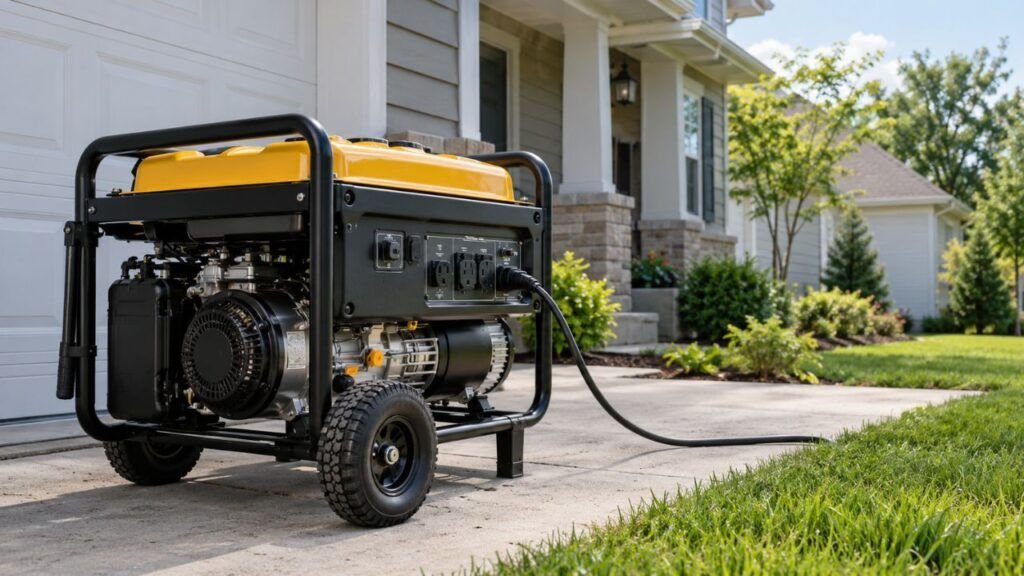
Yes, a 12,000-watt generator can run much of a typical house during an outage. A true 12,000-running-watt generator can handle essential appliances, pumps, lighting, electronics, and sometimes central air. However, it may not run every large electric appliance simultaneously.
The real answer depends on your generator’s running watts, appliance loads, and startup demand. Below, I’ll show you what 12,000 watts can realistically handle and where load management becomes necessary.
Key Takeaways
- A true 12,000-running-watt generator provides substantial home backup power.
- Some “12,000-watt” generators only provide 9,000 to 9,500 running watts.
- Refrigerators, pumps, lights, electronics, and furnaces are usually manageable.
- Central air may work if its startup demand fits the generator.
- Electric dryers and water heaters consume large amounts of available power.
- All-electric homes normally require more careful load management.
- House square footage alone cannot determine the correct generator size.
- A transfer switch or approved interlock provides safer panel connection.
Can a 12,000-Watt Generator Really Run a Whole House?
A 12,000-watt generator can provide near-whole-house backup for many homes. However, “running a whole house” does not necessarily mean running everything simultaneously.
That distinction matters more than the size of your house.
You might connect the generator to your entire electrical panel. Still, you may need to choose which larger appliances operate together.
For example, a 12kW generator could potentially run your refrigerator, freezer, sump pump, lighting, Wi-Fi, television, microwave, and central air.
The situation changes when you add several heavy electric appliances.
Running central air, an electric dryer, electric water heater, and range together can easily push demand beyond 12,000 watts.
Homes using natural gas or propane generally have an easier time. Their furnace, water heater, and stove usually place smaller electrical demands on the generator.
An all-electric house can require considerably more generator capacity.
So, I would describe a 12kW generator as powerful whole-house backup with sensible load management, rather than unlimited whole-house power.
First, Make Sure You Actually Have 12,000 Running Watts
Before adding appliance wattages, check your generator’s specification label. The number printed prominently on the generator may represent peak output instead.
Running Watts vs. Starting Watts
Generators normally have two important power ratings.
Running watts, sometimes called rated watts, represent continuous electrical output.
Starting watts represent short-term extra power available for motor startup.
This difference can completely change your home backup calculation.
For example, one generator might be advertised as:
12,000 starting watts / 9,500 running watts
Another generator could provide:
15,000 starting watts / 12,000 running watts
The second machine provides 2,500 additional watts continuously.
Yet someone casually referring to the first machine may still call it a “12,000-watt generator.”
Always find the running or rated wattage before calculating household loads.
Fuel Type Can Change Available Wattage
If you have a dual-fuel or tri-fuel generator, check each fuel rating.
The generator may produce its highest output using gasoline.
Output can decrease when switching to propane or natural gas.
For example, a tri-fuel generator might provide approximately:
- 12,000 running watts using gasoline
- 11,000 running watts using propane
- 10,000 running watts using natural gas
The exact difference depends on your generator.
This becomes important when your household load approaches maximum capacity.
A combination working comfortably on gasoline could become marginal using natural gas.
Always calculate using the rating for the fuel you actually plan to use.
How Many Amps Does a 12,000-Watt Generator Produce?
A true 12,000-watt output at 240 volts equals approximately 50 amps.
The basic calculation looks like this:
12,000 watts ÷ 240 volts = 50 amps
That does not mean your generator replaces a 200-amp utility service.
It means approximately 50 amps at 240 volts are available under ideal rated conditions.
For a 120/240V generator, household 120V loads are divided between two electrical legs.
The generator’s main breaker, outlet, inlet, wiring, and panel connection also matter.
So, check the actual generator specifications before assuming all 12,000 watts are available through one connection.
What Can a 12,000-Watt Generator Run in a House?
A 12kW generator can handle many common household appliances. The challenge comes when several high-demand loads operate simultaneously.
| Appliance | Typical Running Watts | Possible Starting Demand | Usually Practical on 12kW? |
| Refrigerator | 500–800W | 1,200–2,200W | Yes |
| Freezer | 400–700W | 1,000–2,000W | Yes |
| LED household lighting | 100–300W | Minimal | Yes |
| Wi-Fi router | 10–30W | Minimal | Yes |
| Television | 80–200W | Minimal | Yes |
| Microwave | 1,000–1,500W | Minimal | Yes |
| Coffee maker | 800–1,500W | Minimal | Yes |
| Furnace blower | 500–900W | 1,200–2,500W | Yes |
| 1/2 HP sump pump | 800–1,100W | 1,500–2,500W | Yes |
| Residential well pump | 700–1,500W | 2,000–4,000W+ | Usually |
| Electric water heater | 4,000–4,500W | Minimal | Yes, with load management |
| Electric clothes dryer | 4,500–5,500W | Additional startup load | Yes, with load management |
| Central air conditioner | 3,000–6,000W+ | Significant compressor surge | Depends |
| Electric range | 2,000–8,000W+ | Usually limited surge | Depends on burners/oven used |
| EV charger | 3,000–11,000W+ | Minimal | Usually poor priority during outages |
These numbers are only planning estimates.
Your refrigerator might consume less power, while your well pump consumes considerably more.
Always use the equipment nameplate or manufacturer specifications when available.
This becomes especially important with central air conditioners, pumps, and compressors.
Realistic 12,000-Watt Whole-House Load Examples
Individual appliance wattages only tell part of the story. Let’s look at realistic combinations you might actually use during an outage.
Scenario 1: Essentials Plus Central Air
Suppose your household is running approximately:
| Load | Example Running Watts |
| Central AC | 3,500W |
| Refrigerator | 700W |
| Sump pump | 900W |
| Lights | 200W |
| TV and Wi-Fi | 250W |
| Chargers and small electronics | 150W |
| Estimated running load | 5,700W |
Your normal running demand is comfortably below 12,000 watts.
However, the central AC compressor needs extra startup power.
If its additional startup demand were around 4,000 to 5,000 watts, temporary demand could approach 10,000 to 11,000 watts.
A generator with sufficient surge capacity could handle this example.
However, the actual AC startup requirement must be verified.
Scenario 2: Gas-Heat Home During Winter
A gas-heated house is usually easier to back up.
Imagine running:
- Refrigerator: 700W
- Freezer: 500W
- Furnace blower: 700W
- Sump pump: 900W
- Microwave: 1,200W
- Lights: 200W
- TV, internet, and electronics: 300W
Your combined running load is approximately 4,500 watts.
Even after allowing for motor startup, a true 12kW generator provides substantial headroom.
You could probably operate additional household loads without approaching capacity.
This is why fuel-heated homes often work particularly well with 12kW generators.
Scenario 3: An All-Electric Home
Now consider a house using several large electric appliances.
You could have:
- Central AC: 3,500W
- Electric water heater: 4,500W
- Electric dryer: 5,000W
- Electric cooking load: 3,000W
- Refrigerator: 700W
That already reaches approximately 16,700 running watts.
The generator is overloaded before considering lighting, pumps, or compressor startup.
However, that does not mean a 12kW generator is useless here.
You simply cannot run those loads together.
Turn off the water heater while using the dryer.
Avoid cooking with multiple electric elements while the dryer operates.
This type of load rotation can make 12kW surprisingly practical.
Scenario 4: Rural Home With a Well Pump
Homes with wells need special attention to pump startup demand.
Suppose you have:
- Well pump: 1,200W
- Refrigerator: 700W
- Freezer: 500W
- Furnace blower: 700W
- Microwave: 1,200W
- Lighting: 200W
- Internet and electronics: 250W
The running load is roughly 4,750 watts.
That’s easily inside a true 12kW generator’s continuous capacity.
However, your well pump might briefly require several thousand watts while starting.
Avoid starting other large motors during that same moment.
Scenario 5: A “12,000-Watt” Generator With 9,500 Running Watts
This scenario shows why generator ratings matter.
Imagine your generator advertises 12,000 watts but supplies only 9,500 running watts.
Now combine:
- Central AC: 3,500W
- Electric water heater: 4,500W
- Refrigerator: 700W
- Sump pump: 900W
You have already reached approximately 9,600 running watts.
That exceeds the continuous rating before the AC compressor starts.
A homeowner assuming they had 12,000 continuous watts could easily overload it.
Always calculate from rated running output.
Can a 12,000-Watt Generator Run Central Air Conditioning?
A 12,000-watt generator can run many residential central air systems. However, the AC compressor’s startup demand often determines whether the combination works reliably.
Check Running Amps and Compressor Starting Current
Your AC condenser has a data plate containing important electrical information.
Look for values such as:
- Rated load amps
- Minimum circuit ampacity
- Compressor current
- LRA, or locked-rotor amps
The LRA number helps indicate the compressor’s startup demand.
Your generator must handle both normal household loads and that temporary surge.
This is why looking only at AC running watts can be misleading.
Suppose an air conditioner consumes 3,500 watts while operating.
That sounds easy for a 12,000-watt generator.
However, the compressor could temporarily demand much more while starting.
Your generator’s surge rating becomes critical during those seconds.
Why AC Tonnage Alone Is Not Enough
You may hear statements like:
“A 12kW generator can run a 3-ton AC.”
That can be true, but tonnage alone cannot guarantee compatibility.
Two 3-ton air conditioners can have very different startup characteristics.
Age, compressor technology, efficiency, voltage, and system design all matter.
A newer variable-speed system may behave differently from an older compressor.
Instead of sizing from tonnage alone, check the actual electrical specifications.
That gives you a much safer answer.
Can an AC Soft Starter Help?
A properly matched soft starter can reduce compressor startup demand.
That can help when your generator comfortably handles AC running watts but struggles during startup.
Soft starters are especially useful for systems with high inrush current.
However, compatibility should be verified before installing one.
Your HVAC equipment, electrical system, and generator all need consideration.
How to Calculate Whether 12,000 Watts Is Enough
You do not need complicated engineering calculations for an initial estimate. A simple load calculation can tell you whether 12kW looks reasonable.
Step 1: List What You Actually Need During an Outage
Start by separating your appliances into three groups.
Essential loads: refrigerator, sump pump, well pump, furnace, medical equipment.
Important loads: microwave, internet, lighting, television, selected outlets.
Optional loads: dryer, electric water heater, range, pool equipment, EV charging.
This prevents unnecessary appliances from inflating your generator requirement.
Step 2: Add Simultaneous Running Watts
Now add the running wattage of everything operating together.
Suppose your total looks like this:
7,200 running watts
A true 12,000-running-watt generator has approximately 4,800 watts remaining.
That sounds comfortable, but you still need to check motor startup.
Step 3: Add the Largest Additional Starting Requirement
A useful planning formula is:
Required surge capacity = simultaneous running watts + largest additional startup requirement
Suppose your running load is 7,200 watts.
Your largest motor needs another 3,000 watts while starting.
Your temporary requirement becomes:
7,200W + 3,000W = 10,200W
A generator providing 12,000 running watts and sufficient surge capacity should handle that example.
However, multiple motors starting together can increase temporary demand further.
Step 4: Leave Some Extra Capacity
I would avoid planning to operate continuously at maximum output.
Extra capacity gives your generator room for changing household loads.
It also reduces the chance that one unexpected appliance causes an overload.
A practical planning target is keeping normal demand below maximum continuous output.
Around 20 percent of additional headroom is a useful starting point.
Your generator manufacturer may provide more specific sizing recommendations.
Step 5: Verify the Actual Generator Specifications
Before making your final decision, confirm:
- Rated running watts
- Maximum starting watts
- Output on each fuel type
- 120/240V capability
- Main breaker rating
- Available receptacles
- Maximum output through your home connection
This final check prevents unpleasant surprises after an outage begins.
Does House Size Determine Whether 12,000 Watts Is Enough?
House size can provide context, but it should not determine generator size by itself.
Two similarly sized houses can have completely different electrical demands.
Imagine a 2,500-square-foot home using natural gas for heating, cooking, and hot water.
Its major electrical loads might only include air conditioning, refrigeration, pumps, and normal outlets.
Now compare that with a 1,700-square-foot all-electric home.
That smaller house may have a heat pump, electric water heater, dryer, range, and well pump.
The smaller home could require considerably more generator capacity.
Climate matters too.
A house in Florida may prioritize large air-conditioning loads.
A northern home may prioritize furnace blowers and heating equipment instead.
So, don’t choose 12kW simply because your house falls below a certain square footage.
Calculate what actually needs electricity.
Which Appliances Should You Avoid Running Together?
A 12kW generator becomes much easier to use when you manage high-demand appliances. Several combinations can consume most available capacity quickly.
Try to avoid operating these combinations simultaneously:
- Central AC, electric dryer, and electric water heater
- Electric dryer and multiple electric range elements
- Heat pump auxiliary heat and other large resistance loads
- Electric water heater while several major motors are starting
- Central AC while a large well pump starts
- EV charging while major household appliances are operating
- Multiple portable electric heaters with other large appliances
These appliances may work perfectly well individually.
The problem is their combined demand.
A little load scheduling often prevents unnecessary overload trips.
How Load Management Makes a 12kW Generator More Useful
A generator does not need to power everything simultaneously to provide comfortable backup. Smart load management can stretch 12,000 watts much further.
Start Large Loads One at a Time
Motor-driven appliances require their largest power demand during startup.
Try starting major loads separately whenever possible.
For example, allow your central AC to start first.
After the compressor stabilizes, turn on another large appliance.
This reduces the chance of overlapping startup surges.
Prioritize Essential Circuits
Give essential household systems priority.
A reasonable order might look like this:
Refrigeration first, followed by pumps, HVAC, lights, internet, and convenience appliances.
You probably do not need your dryer during a brief outage.
Your refrigerator and sump pump are much more important.
Temporarily Shed High-Wattage Loads
Load shedding simply means turning something off temporarily.
For example, switch off your electric water heater before running the dryer.
When the dryer finishes, turn the water heater back on.
You still get both appliances without needing their full combined wattage.
Automatic Load Management
Some permanently installed systems can manage loads automatically.
Lower-priority circuits can temporarily switch off when generator demand becomes high.
Once capacity becomes available, those loads can reconnect.
This creates a more seamless whole-house experience without drastically oversizing the generator.
Can a 12,000-Watt Generator Run a 200-Amp House?
Yes, a 12,000-watt generator can provide backup power to a house with 200-amp electrical service.
Your 200-amp main panel rating does not mean the house constantly consumes 200 amps.
It only describes the maximum service capacity available from the utility.
A true 12,000-watt generator produces roughly 50 amps at 240 volts.
That’s much less than a 200-amp utility service.
However, your home may only need a fraction of its service capacity during an outage.
For example, refrigeration, lighting, pumps, internet, and HVAC might fit within 12kW.
The correct question is not:
“Is my panel 200 amps?”
The better question is:
“How much power will my selected circuits use simultaneously?”
That’s what determines whether 12kW is enough.
How Should a 12,000-Watt Generator Be Connected to a House?
If you want your generator powering household circuits, the connection method matters just as much as wattage. The system must prevent generator power from feeding back onto utility lines.
Transfer Switch
A transfer switch separates your home’s generator supply from utility power.
Manual transfer switches require you to change power sources yourself.
Automatic transfer switches are commonly paired with standby generators.
A transfer switch can serve selected circuits or broader panel loads.
The exact design depends on your home and generator.
Generator Interlock
A properly installed interlock kit can provide another safe panel connection method.
It mechanically prevents the utility main and generator breaker from remaining on together.
Not every electrical panel accepts the same interlock.
Local electrical requirements can also differ.
For that reason, panel connections should be evaluated by a qualified electrician.
Never Backfeed Through a Wall Outlet
Never connect a portable generator to your house through a regular receptacle.
This practice is commonly called backfeeding.
It can send dangerous voltage into utility lines and create electrocution risks.
It can also damage electrical equipment.
Use approved transfer equipment designed for generator connection.
Portable Generator Safety for Whole-House Backup
A 12kW portable generator produces dangerous exhaust and substantial electrical power. Safe placement and connection should never be treated as optional.
Follow these basic precautions:
- Operate portable generators outdoors only.
- Keep the generator at least 20 feet from occupied buildings when possible.
- Point exhaust away from doors, windows, and ventilation openings.
- Never run a generator inside an attached or detached garage.
- Do not assume an open garage door makes indoor operation safe.
- Keep working carbon monoxide alarms inside the home.
- Protect the generator from moisture according to manufacturer instructions.
- Keep combustible materials away from hot generator components.
- Turn the generator off before refueling.
- Allow hot engine components to cool before adding gasoline.
- Use correctly rated cords, inlets, breakers, and transfer equipment.
A large portable generator can make an outage much easier.
It still needs the same respect as any combustion engine and electrical source.
How Long Can a 12,000-Watt Generator Run a House?
There is no universal runtime for a 12,000-watt generator. Runtime changes dramatically with fuel capacity and electrical load.
A generator running at 25 percent load generally consumes less fuel than one operating near maximum output.
Several factors affect runtime:
- Fuel tank capacity
- Gasoline, propane, or natural-gas operation
- Household load
- Engine size and efficiency
- Generator design
- Outside temperature
- Maintenance condition
Suppose two generators both provide 12,000 running watts.
One may have a much larger gasoline tank.
Another may prioritize portability and use a smaller tank.
Their runtimes can therefore be very different.
Continuous natural-gas installations work differently again because they are not limited by a portable fuel tank.
Always check runtime specifications at comparable load percentages.
When Is a 12,000-Watt Generator Not Enough?
A 12kW generator offers plenty of emergency capacity for many homes. Some electrical setups simply demand more simultaneous power.
You may need a larger system when your home includes:
- Multiple central air-conditioning systems
- Large heat pumps with electric auxiliary heat
- Electric resistance heating
- Electric tankless water heaters
- Several large well or booster pumps
- Multiple electric water heaters
- Heavy workshop machinery
- Large pool or spa equipment
- High-current EV charging
- Extensive all-electric kitchen appliances
- Little willingness to manage loads manually
This does not automatically mean you need the largest generator available.
Oversizing increases purchase cost and can increase fuel consumption.
Your goal should be enough capacity for the loads that genuinely matter.
12,000-Watt Generator vs. Larger Whole-House Generator
A larger generator gives you more simultaneous appliance capacity. Whether you need that extra capacity depends mainly on your home’s electrical setup.
| Household Situation | 12kW | 15–18kW | 20–26kW+ |
| Refrigerator, lights, internet | Excellent | Excellent | Excellent |
| Gas-heated home | Usually excellent | Excellent | Often more capacity than necessary |
| Central AC plus essentials | Often workable | More headroom | Excellent |
| Well pump plus normal loads | Usually workable | Excellent | Excellent |
| All-electric home | Load management likely | Better | Often more suitable |
| Multiple HVAC systems | Limited | Depends on loads | More suitable |
| Dryer + water heater + AC | Often too much together | More workable | Easier |
| Minimal load management | Limited | Better | Strongest |
| EV charging during outages | Usually low priority | Possible on some setups | More practical |
Think of generator size as available simultaneous capacity.
A larger generator does not make individual appliances consume less electricity.
It simply gives you more room to operate them together.
Is a 12,000-Watt Generator the Right Size for Your House?
A 12kW generator makes sense when you want substantial backup without powering every heavy load simultaneously.
It can be particularly suitable when:
- Your home uses gas for heating or hot water.
- You need refrigeration, pumps, lighting, and normal outlets.
- You want to operate one central AC system.
- Your calculated running load stays comfortably below 12kW.
- Your generator has enough surge output for major motors.
- You are comfortable rotating large electric appliances.
Consider a larger generator when your household is heavily all-electric.
The same applies if you want every major appliance available without thinking about load management.
The most useful number is your calculated simultaneous demand.
That matters far more than square footage alone.
Final Verdict
So, can a 12,000-watt generator run a whole house? For many U.S. homes, yes, but with an important qualification. A true 12,000-running-watt generator can provide substantial whole-house backup and may handle refrigeration, pumps, lights, electronics, furnace equipment, and central air together.
However, you should not expect unrestricted operation of every large appliance. Central air, electric water heating, dryers, ranges, resistance heating, and EV charging can push demand beyond 12kW quickly.
Before buying or connecting anything, calculate your simultaneous running watts and largest startup load. Most importantly, confirm whether your “12,000-watt generator” actually supplies 12,000 running watts. When you size from real loads instead of house square footage, choosing the right backup setup becomes much easier.
Related FAQs
Will a 12,000-Watt Generator Run Central Air?
A 12,000-watt generator can run many central air conditioners, provided the generator has enough running and surge capacity. Check the AC condenser’s actual operating current and compressor startup demand before assuming compatibility.
How Many Amps Is a 12,000-Watt Generator at 240 Volts?
A true 12,000-watt generator produces approximately 50 amps at 240 volts because 12,000 divided by 240 equals 50. Actual usable output can still depend on breakers, receptacles, wiring, and the generator’s specifications.
Can a 12,000-Watt Generator Run a 200-Amp House?
Yes, a 12,000-watt generator can back up a home with 200-amp electrical service. It cannot supply the panel’s full 200-amp capacity, so you must keep simultaneous household demand within the generator’s output.
Can a 12,000-Watt Generator Run an Electric Water Heater?
Yes, many standard electric tank water heaters use around 4,000 to 4,500 watts. A 12kW generator can usually handle one, but you may need to avoid running other high-wattage appliances simultaneously.
Can a 12,000-Watt Generator Run a Well Pump?
A 12,000-watt generator can run many residential well pumps. However, pumps require additional startup power, so check the pump motor’s actual running and starting requirements before calculating available capacity.
Can a 12,000-Watt Generator Run an Electric Dryer?
Yes, many electric dryers can operate from a properly configured 12kW generator. Since dryers often consume roughly 5,000 watts, avoid combining them with central AC, water heating, or other major loads.
Will a 12,000-Watt Generator Run a 3-Ton AC?
A true 12kW generator can run many 3-ton central air conditioners, but tonnage alone cannot confirm compatibility. Check the unit’s running current and compressor startup demand before connecting it.
What Size House Can a 12,000-Watt Generator Run?
There is no reliable square-footage limit for a 12kW generator. A smaller all-electric home may require more backup power than a larger home using gas for heating, cooking, and hot water.
Do I Need a Transfer Switch for a 12,000-Watt Generator?
You generally need approved transfer equipment when using a generator to supply household panel circuits. A transfer switch or properly installed interlock prevents generator electricity from feeding back into utility lines.
Is 12,000 Starting Watts Enough for a Whole House?
Not necessarily. Starting watts are temporary surge capacity rather than continuous output. If a generator provides 12,000 starting watts but only 9,500 running watts, your household’s continuous load must remain within the lower rating.

Brian Walker writes straightforward generator guides and reviews for homeowners and everyday users. His content focuses on solar, portable, and fuel-powered generators, with practical advice on choosing, using, and maintaining reliable backup power.