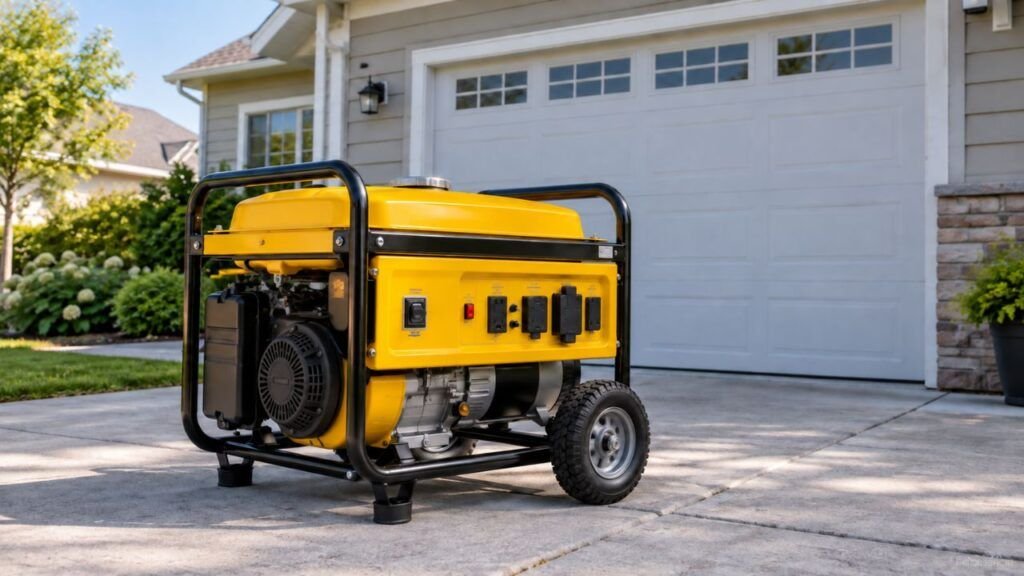
Yes, a 10,000-watt generator can run a house during an outage. It can usually power essential appliances, pumps, lighting, electronics, and selected HVAC equipment. However, it may not run every large electric appliance simultaneously.
The real answer depends on running watts, starting watts, and your home’s major loads. Below, I’ll show you what 10,000 watts can realistically handle and where you may need load management.
Key Takeaways
- A 10,000-watt generator can handle most essential home backup loads.
- Some 10,000-watt generators provide only 8,000–9,000 running watts.
- Refrigerators, lights, pumps, internet, and furnace blowers are usually manageable.
- Central air conditioning may work, depending on its size and startup demand.
- Electric dryers, water heaters, ranges, and HVAC can quickly consume capacity.
- House square footage alone does not determine the generator size you need.
- Running watts and starting watts should both be included when sizing.
- Hardwired home circuits require a safe, approved generator connection.
Can a 10,000-Watt Generator Run a Whole House?
A 10,000-watt generator can run many homes during an outage. However, “running the whole house” can mean two different things.
If you mean keeping your refrigerator, lights, internet, furnace blower, pumps, television, and several outlets working, 10,000 watts can provide plenty of useful backup power.
If you mean using everything normally, things become more complicated. Central air conditioning, electric dryers, electric water heaters, electric ranges, and other large appliances can consume thousands of watts each.
For that reason, I would consider a 10,000-watt generator a strong managed whole-house backup option rather than unlimited whole-house power.
Homes using natural gas or propane for heating, cooking, and water heating are especially good candidates. Those homes leave much more generator capacity available for electrical equipment.
An all-electric home usually requires more careful load management.
A 10,000-Watt Generator May Not Provide 10,000 Running Watts
The number printed on a generator can be misleading. Before calculating your household loads, check whether 10,000 watts refers to starting, maximum, or continuous output.
| Generator Rating Example | Starting/Maximum Watts | Running/Rated Watts | What You Can Use Continuously |
| 10,000W starting model | 10,000W | 8,000W | About 8,000W |
| 10,000W maximum model | 10,000W | 9,000W | About 9,000W |
| True 10kW running model | Higher surge rating | 10,000W | About 10,000W |
Starting watts provide temporary extra power when motors first turn on. Running watts are what the generator can continuously supply.
For example, a generator may advertise 10,000 starting watts while providing only 8,000 running watts.
In that case, you should calculate your household load around 8,000 watts. You should not assume 10,000 watts remain available continuously.
This is one of the most important specifications to check.
What Can a 10,000-Watt Generator Run in a House?
A 10kW-class generator can support a surprisingly large combination of household appliances. The table below provides practical planning ranges, but always check your equipment nameplates.
| Appliance | Approx. Running Watts | Approx. Starting Watts |
| Refrigerator | 150–400W | 800–1,200W |
| Freezer | 100–500W | 500–1,000W |
| Furnace blower | 300–800W | 800–1,600W |
| Sump pump, 1/2 HP | 800–1,050W | 1,300–2,150W |
| Well pump, 1/2 HP | 750–1,000W | 1,500–2,000W |
| Microwave | 600–1,200W | Usually minimal additional surge |
| Coffee maker | 600–1,200W | Minimal |
| Window AC | 900–1,500W | 1,800–2,500W |
| Central AC, around 3 tons | 3,000–3,500W | 5,000–6,000W |
| Central AC, around 4 tons | 4,000–5,000W | 6,500–8,000W |
| Electric water heater | 3,000–4,500W | Minimal |
| Electric dryer | 4,000–6,000W | Varies |
| Electric range burner | 1,200–2,400W | Minimal |
| Wi-Fi router/modem | 10–30W | Minimal |
| Television | 80–200W | Minimal |
| LED lighting | 8–15W per bulb | Minimal |
Actual wattage varies between models. Treat these numbers as planning estimates rather than fixed requirements.
Appliances a 10kW Generator Can Usually Handle Easily
A 10,000-watt generator normally has little trouble handling basic home essentials.
You can usually combine equipment such as:
- Refrigerator
- Freezer
- LED lighting
- Television
- Wi-Fi router
- Phone chargers
- Computers
- Furnace blower
- Garage door opener
- Microwave
- Coffee maker
- Sump pump
The exact combination depends on simultaneous usage and startup loads.
Appliances That Require More Planning
Large appliances are where your available generator capacity disappears quickly.
Pay closer attention when powering:
- Central air conditioning
- Large well pumps
- Electric water heaters
- Electric dryers
- Electric ovens and ranges
- Large space heaters
- Multiple air-conditioning units
- Workshop equipment
- EV charging equipment
A single appliance may work perfectly by itself. Problems often appear when several large loads operate together.
Realistic 10,000-Watt Generator Load Examples
Looking at appliance combinations is more useful than studying individual wattages. Here are several realistic situations you might encounter during an outage.
Scenario 1: Basic Home Essentials
Suppose your outage load includes:
- Refrigerator: 300W
- Freezer: 300W
- Furnace blower: 600W
- Sump pump: 900W
- Lighting: 200W
- Wi-Fi and electronics: 200W
- Television: 150W
Your normal running load would be around 2,650 watts.
Even after accounting for motor startup, a 10kW-class generator provides substantial remaining capacity.
You could probably add a microwave, coffee maker, or other small appliances without difficulty.
Scenario 2: Essentials Plus a Window Air Conditioner
Now add a window air conditioner using about 1,200 running watts.
Your running load could rise to approximately 3,850 watts.
That remains comfortably below the continuous capacity of most generators in this class.
You would still need to consider pump and compressor startup demand.
However, this is a realistic use case for a 10,000-watt generator.
Scenario 3: Essentials Plus Central Air Conditioning
Central air changes the calculation considerably.
Imagine your essential loads total 2,500 running watts. Your 3-ton central AC requires another 3,200 watts while operating.
You are now around 5,700 running watts.
That may appear comfortable on an 8,000–10,000W generator. However, the compressor could briefly require several thousand additional watts during startup.
If your sump pump starts simultaneously, the generator could experience a major power spike.
This is why running wattage alone never tells the full story.
Scenario 4: An All-Electric House
Consider this combination:
- Electric water heater: 4,500W
- Electric dryer: 5,000W
- Electric range burner: 2,000W
- Refrigerator: 300W
- Lighting and electronics: 500W
That already reaches about 12,300 running watts.
Central AC would increase the total substantially.
A 10,000-watt generator cannot comfortably support that combination.
You could still use the generator, but you would need to operate large appliances separately.
Can a 10,000-Watt Generator Run Central Air Conditioning?
A 10,000-watt generator may run central air conditioning, but AC size matters greatly. Compressor startup demand is often the deciding factor.
Can It Run a 2-Ton or 3-Ton Central AC?
A smaller 2-ton or 3-ton system may work with a capable 10kW-class generator.
A 3-ton system could require roughly 3,000–3,500 watts while running. Startup demand may briefly reach around 5,000–6,000 watts.
That still leaves usable capacity for basic household loads.
However, you should avoid starting another large motor simultaneously.
Can It Run a 4-Ton Central AC?
A 4-ton central AC becomes more challenging.
Some systems may consume around 4,000–5,000 running watts. Starting demand can climb significantly higher.
If your generator provides only 8,000 running watts, central AC could consume more than half its continuous capacity.
The compressor surge could also approach the generator’s maximum output.
A 4-ton AC may still work, but generator and AC specifications need careful checking.
Why AC Starting Watts Matter
An air conditioner does not always consume the same power.
When the compressor starts, it briefly draws much more electricity. After startup, power consumption drops to normal running levels.
Your generator must survive that initial surge without tripping.
That is why I would check both the AC electrical label and generator specifications before relying on a general wattage chart.
What Can’t a 10,000-Watt Generator Run at the Same Time?
A 10kW generator can run many large appliances individually. The real limitation appears when heavy loads operate simultaneously.
Combinations that may exceed available capacity include:
- Central AC with an electric dryer and water heater
- Electric dryer with an electric oven and central AC
- Large AC with an electric water heater and well pump
- Multiple central air-conditioning systems
- Electric resistance heating with major appliances
- EV charging while running several household appliances
This does not mean those appliances are completely unusable.
For example, your electric water heater may work perfectly on the generator. You simply may need to turn off the dryer first.
That is the idea behind load management.
How to Calculate Whether a 10,000-Watt Generator Is Enough
You do not need an advanced electrical calculation for an initial estimate. Start with the appliances you genuinely need during an outage.
Step 1: List Your Essential Appliances
Write down everything you want running during an outage.
Start with essentials such as:
- Refrigerator
- Freezer
- Heating equipment
- Water pump
- Sump pump
- Lights
- Internet
- Medical equipment
- Air conditioning
Then add comfort appliances you would also like available.
Step 2: Add the Running Watts
Find each appliance’s running wattage.
Check the manufacturer’s label or manual whenever possible.
Add the wattages of everything that could operate simultaneously.
For example:
3,800W + 700W + 900W + 500W = 5,900 running watts
Your generator must continuously handle at least that amount.
Step 3: Account for Starting Demand
Motor-driven appliances often need extra power when starting.
Suppose a pump uses:
- 900 running watts
- 2,000 starting watts
Its additional startup requirement is about:
2,000W − 900W = 1,100W
You could then estimate:
Required peak capacity = simultaneous running watts + largest additional startup demand
If your running loads total 5,900W, adding that 1,100W surge gives:
5,900W + 1,100W = 7,000W
An 8,000–10,000W running generator could potentially handle that example.
Step 4: Check Actual Generator Running Watts
Now look at the generator specification sheet.
Do not size your home around the largest marketing number.
If your generator says:
10,000 starting watts / 8,000 running watts
Treat it as an 8,000-watt continuous generator.
Step 5: Decide Which Loads Can Be Staggered
You rarely need every large appliance simultaneously.
For example, you could:
Run the water heater first, then turn it off.
Afterward, use the electric dryer.
Later, turn on another heavy appliance.
This simple strategy can make a 10kW generator much more useful.
Does House Size Determine Whether 10,000 Watts Is Enough?
House size can provide some context, but it does not determine generator demand.
Two 2,000-square-foot houses may need completely different amounts of backup power.
One home may have a gas furnace, gas stove, gas water heater, and city water. Electricity mainly powers the refrigerator, lights, electronics, and furnace blower.
Another home may have central AC, a heat pump, electric water heater, electric range, dryer, and well pump.
The second house can require dramatically more generator power.
That is why I would never choose a generator solely using square footage.
Your appliances and simultaneous electrical loads matter much more.
Can a 10,000-Watt Generator Run a 2,000-Square-Foot House?
Yes, a 10,000-watt generator can often provide strong backup power for a 2,000-square-foot house.
A gas-heated home with a gas water heater and gas cooking may run comfortably within this range.
You might keep refrigeration, lighting, pumps, internet, furnace controls, television, and several kitchen appliances operating.
An all-electric 2,000-square-foot home presents a different situation.
Electric water heating, clothes drying, cooking, HVAC, and well pumps can push demand beyond 10,000 watts.
In that case, the generator can still provide backup power. You simply need to control which large appliances operate together.
How Many Amps Does a 10,000-Watt Generator Provide?
Watts can also be converted into amps when you know the voltage.
For a true 10,000-watt continuous generator at 240 volts:
10,000 ÷ 240 = approximately 41.7 amps
If the generator provides 9,000 running watts:
9,000 ÷ 240 = 37.5 amps
If it provides 8,000 running watts:
8,000 ÷ 240 = approximately 33.3 amps
This helps explain why a 10kW-class generator does not equal your home’s 200-amp electrical service.
Your 200-amp panel describes the maximum electrical service capacity.
It does not mean your home continuously consumes 200 amps.
Most homes use only a fraction of their panel capacity at any moment.
Why the Generator’s 120/240V Output and Connection Matter
Wattage is not the only specification that matters. Your generator must also provide the correct voltage and connection for the equipment you intend to power.
Some Home Appliances Require 240 Volts
Many smaller household appliances operate on 120 volts.
Large equipment often uses 240 volts, including:
- Central air conditioners
- Electric dryers
- Electric water heaters
- Electric ranges
- Some well pumps
- Large workshop equipment
If you want to power these appliances, your generator needs compatible 240V output.
Your Generator Outlet Can Limit Available Power
A generator’s total wattage does not mean every receptacle can deliver all available power.
Individual outlets have their own voltage and amperage limits.
For example, a generator could provide several different 120V and 240V outlets.
Your home connection must be compatible with the generator’s intended output.
Household Loads Need Proper Distribution
A typical U.S. home uses a 120/240V split-phase electrical system.
Loads are distributed across both sides of the electrical panel.
When powering household circuits from a generator, proper load distribution helps prevent problems.
A qualified electrician can verify the connection, breaker sizing, and transfer equipment.
How to Use Load Management With a 10,000-Watt Generator
Load management simply means choosing when large appliances operate. It allows you to get much more useful backup power without buying an oversized generator.
- Start large motor-driven appliances separately.
- Avoid using several major 240V loads simultaneously.
- Let large pumps finish before adding another heavy appliance.
- Turn off the water heater while using another major load.
- Avoid running the electric dryer during heavy HVAC demand.
- Watch the generator’s load meter when available.
- Prioritize refrigeration, water, lighting, heating, and communications.
- Leave unnecessary loads switched off during an outage.
You do not need to spend the entire outage switching appliances.
Usually, controlling just two or three high-demand loads makes a major difference.
10,000-Watt Generator vs. Larger Whole-House Generator
A 10kW generator provides plenty of backup capacity for many households. A larger generator becomes more attractive when you want fewer restrictions during an outage.
| Backup Need | 10kW-Class Generator | Larger Whole-House Generator |
| Refrigerator and freezer | Easily | Easily |
| Lights and electronics | Easily | Easily |
| Furnace blower | Usually | Easily |
| Sump pump | Usually | Easily |
| Well pump | Usually | Easily |
| Window AC | Usually | Easily |
| Central AC | Depends on size and startup | More comfortable |
| Electric water heater | Possible with management | Easier |
| Electric dryer | Possible with management | Easier |
| Multiple large electric loads | Limited | Better |
| All-electric home | Requires management | Better suited |
| Minimal manual load control | Less suitable | Better |
The larger option is not automatically better.
A bigger generator generally costs more to purchase, install, maintain, and fuel.
If 10,000 watts already covers your realistic outage needs, extra capacity may provide little benefit.
When Is a 10,000-Watt Generator Not Big Enough?
A 10kW-class generator may feel restrictive when your home depends heavily on large electrical loads.
You may want more capacity if your house has:
- Electric resistance heating
- Multiple HVAC systems
- Large central air conditioning
- Electric water heating
- Electric clothes drying
- Electric cooking
- Large well or booster pumps
- EV charging
- Several large appliances operating simultaneously
You should also consider a larger system if you do not want to manage loads manually.
A properly sized whole-house generator can make outages feel much closer to normal utility operation.
How to Connect a 10,000-Watt Generator to Your House Safely
A generator powerful enough to supply household circuits needs a safe connection method. Never improvise the electrical connection simply because the generator has enough wattage.
Use Proper Transfer Equipment
A transfer switch or approved interlock arrangement prevents generator power from feeding utility lines.
This protects utility workers, your home’s wiring, and the generator itself.
It also gives you a controlled way to select household circuits during an outage.
A licensed electrician should install and verify permanent home connection equipment.
Never Backfeed Through a Wall Outlet
Never connect a generator to your house using a homemade male-to-male cord.
This dangerous practice can energize utility lines unexpectedly.
It can also cause fire, equipment damage, electrocution, or serious injury.
Use approved generator connection equipment instead.
Keep Fuel Generators Outside
Never operate a gasoline, propane, or other combustion generator inside your house.
Do not run one inside:
- Garages
- Basements
- Sheds attached to your home
- Enclosed porches
- Crawl spaces
Portable generators produce carbon monoxide.
Place the generator outdoors at least 20 feet from the home when practical. Direct exhaust away from windows, doors, vents, and occupied areas.
Use working carbon monoxide alarms inside your home.
Also follow the generator manufacturer’s instructions for rain and weather protection.
Should You Get a 10,000-Watt Generator for Home Backup?
A 10,000-watt generator makes sense when you need more than basic emergency power but do not necessarily need every appliance operating simultaneously.
It works especially well for homes using gas for heating, cooking, and water heating.
Those homes can reserve most generator capacity for refrigeration, pumps, HVAC blowers, lighting, electronics, and occasional kitchen appliances.
A 10kW unit can also work well for larger electrical loads when you manage them carefully.
However, you may want something larger if your house is mostly electric.
The same applies if you expect central AC, water heating, cooking, laundry, and other heavy loads to operate together.
The goal is not to buy the largest generator possible.
The goal is to choose enough capacity for the way you actually live during an outage.
Final Verdict
A 10,000-watt generator can run a house during an outage, and for many homeowners, it offers an excellent balance between capacity and practicality.
You can usually keep refrigerators, freezers, pumps, lights, internet, furnace blowers, televisions, and several other household appliances running. Central air conditioning may also be possible when the system size and startup demand fit your generator.
The limitation appears when several high-wattage appliances operate together. Electric dryers, water heaters, ranges, resistance heaters, and larger HVAC systems can quickly push demand beyond the generator’s capacity.
Most importantly, check the generator’s running watts, not just the large wattage number printed on its label.
If your loads fit its continuous output and you manage large appliances sensibly, a 10kW generator can provide very capable home backup power.
Related FAQs
Will a 10,000-Watt Generator Run a 3-Ton Central AC?
A 10,000-watt generator may run a 3-ton central AC if its continuous and surge ratings cover the compressor’s requirements. You also need enough remaining capacity for other household loads.
Can a 10,000-Watt Generator Run a Refrigerator and AC at the Same Time?
Yes, a 10kW generator can usually run a refrigerator and compatible air conditioner together. However, central AC startup demand should be checked before adding other high-wattage appliances.
Can a 10,000-Watt Generator Run an Electric Water Heater?
Yes, many 10kW generators can operate an electric water heater. A typical electric water heater may use 3,000–4,500 watts, leaving less capacity for other heavy appliances.
Can a 10,000-Watt Generator Run a 2,000-Square-Foot House?
Yes, it can often provide strong backup power for a 2,000-square-foot house. Appliance loads, heating type, pumps, and HVAC requirements matter more than square footage.
How Many Amps Does a 10,000-Watt Generator Produce at 240V?
A true 10,000-watt continuous generator provides about 41.7 amps at 240 volts. An 8,000-watt running model provides about 33.3 amps at the same voltage.
Is a 10,000-Watt Generator Enough for a 200-Amp House?
It can be enough for selected circuits in a 200-amp house. A 200-amp service rating shows the panel’s maximum capacity, not the home’s normal electrical consumption.
What Is the Difference Between 10,000 Starting Watts and 10,000 Running Watts?
Starting watts are temporary surge power used when motors begin operating. Running watts show how much electricity the generator can provide continuously during normal operation.
Do I Need a Transfer Switch for a 10,000-Watt Generator?
You need approved transfer equipment when connecting a portable generator to household wiring. A properly installed transfer switch or compatible interlock prevents dangerous utility backfeeding.
Is 10,000 Watts Enough for Whole-House Backup?
For many homes, 10,000 watts provides excellent managed whole-house backup. It may not support central AC, electric water heating, cooking, drying, and other large loads simultaneously.
Can I Run an Electric Dryer on a 10,000-Watt Generator?
Possibly. Many electric dryers use around 4,000–6,000 watts, so one can consume much of the generator’s available capacity. Avoid combining it with other major electrical loads.
Will a 10,000-Watt Generator Run a Well Pump?
Most residential well pumps can run from a properly equipped 10kW generator. The pump’s starting demand, voltage, horsepower, and other simultaneous household loads must still be considered.
Can a 10,000-Watt Generator Run Overnight?
Yes, if the generator’s manufacturer permits extended operation and you have adequate fuel. Keep it outdoors, monitor fuel and oil, and follow all maintenance and safety instructions.

Brian Walker writes straightforward generator guides and reviews for homeowners and everyday users. His content focuses on solar, portable, and fuel-powered generators, with practical advice on choosing, using, and maintaining reliable backup power.