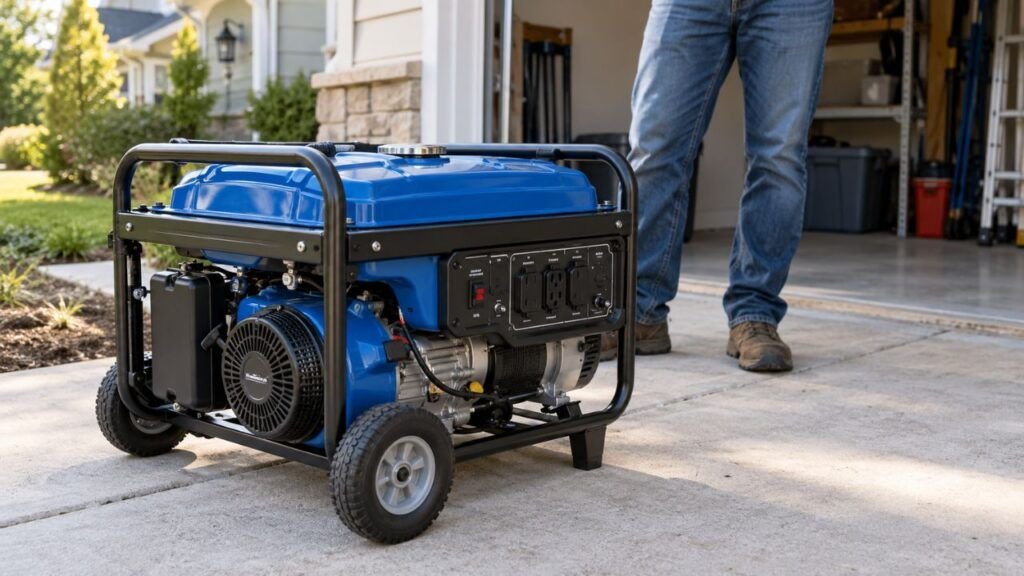
Yes, a portable generator can power a whole house if it produces enough running and starting wattage. However, powering your electrical panel does not mean you can run every appliance simultaneously. Most homes still require some load management.
In this guide, I’ll help you determine the generator size you need. We’ll also cover 120V and 240V loads, central AC, transfer switches, fuel options, runtime, and safe whole-house connections.
Key Takeaways
- A large portable generator can supply power through your home electrical panel.
- Around 7,500 to 10,000 running watts can cover many household essentials.
- Larger 10,000 to 15,000-watt models provide considerably more flexibility.
- Generator size should depend on appliances, not simply house square footage.
- Starting watts matter for refrigerators, pumps, and air conditioners.
- You need 120/240V output for many larger household appliances.
- A 30-amp connection can typically carry up to 7,200 watts at 240V.
- A 50-amp connection can support up to 12,000 watts at 240V.
- Transfer equipment prevents dangerous electricity from backfeeding into utility lines.
- High-draw appliances may require careful load management.
- Fuel type can change the available wattage of multi-fuel generators.
- Fuel-burning portable generators must always operate outdoors.
Can a Portable Generator Actually Power an Entire House?
Yes, but there is an important distinction you should know.
A portable generator can supply electricity to your home’s electrical panel. With the right setup, you can then use many normal household circuits.
That does not necessarily mean everything can operate simultaneously.
For example, imagine your generator is supplying 9,500 running watts. Your refrigerator, lights, furnace blower, freezer, television, internet equipment, and several outlets may operate without trouble.
Now turn on an electric water heater and central air conditioner. Add an electric dryer afterward.
You could suddenly exceed the generator’s available capacity.
That is why I prefer thinking about portable generators as whole-panel backup with load management rather than unlimited whole-house power.
A sufficiently large portable generator can keep your house remarkably functional. You simply need to prioritize which appliances operate together.
What Does Powering a Whole House Really Mean?
People often use “whole-house power” to describe several different situations. Knowing the difference makes generator sizing much easier.
Powering the Whole Electrical Panel
A portable generator can feed electricity into your main electrical panel through properly installed transfer equipment.
That gives you access to household circuits throughout the house.
You can decide which circuits remain active during the outage.
However, the total electrical load must remain within your generator’s limits.
Running Every Appliance at the Same Time
This requires considerably more generator capacity.
Your home might contain dozens of electrical loads, including:
- Central air conditioning
- Electric water heater
- Electric oven
- Clothes dryer
- Refrigerator
- Freezer
- Dishwasher
- Well pump
- Sump pump
- Lighting
- Electronics
- EV charger
You rarely operate everything simultaneously when utility power is available.
A portable generator does not need to match your home’s theoretical maximum load. It needs enough capacity for the appliances you realistically plan to run together.
Powering Essential Household Loads
This is the most practical approach for many homeowners.
Instead of trying to recreate normal utility service, prioritize important loads.
These might include your refrigerator, freezer, lights, internet, furnace blower, sump pump, television, and essential outlets.
A larger generator may also support an air conditioner or well pump.
Careful load management makes a portable generator much more capable.
What Size Portable Generator Can Power a Whole House?
There is no single generator size that works for every house. Two similarly sized homes can have completely different electrical requirements.
Here’s a practical starting point.
| Generator Running Output | Backup Capability | Typical Use |
| 3,000 to 5,000W | Basic backup | Refrigerator, lights, internet, electronics, selected outlets |
| 5,000 to 7,500W | Essential circuits | Refrigerator, freezer, furnace blower, sump pump, lights, outlets |
| 7,500 to 10,000W | Broad household backup | Most essentials plus selected larger appliances |
| 10,000 to 12,500W | High-capacity backup | Most household circuits with controlled 240V loads |
| 12,500 to 15,000W+ | Extensive home backup | Large portions of many homes with careful load management |
These ranges are planning estimates rather than guarantees.
Your appliance loads matter much more than house square footage.
A 3,000-square-foot home with gas heating and gas water heating might require less backup power than a smaller all-electric house.
That is why you should calculate your actual electrical loads.
How to Calculate How Much Generator Power Your House Needs
You do not need complicated electrical calculations for an initial estimate. Start by identifying what you actually want operating during an outage.
Add Your Running Watts
List every appliance you expect to operate simultaneously.
Then find its running wattage.
Your basic calculation looks like this:
Total Running Load = Running Watts of All Simultaneous Appliances
Suppose your outage setup looks like this:
| Appliance | Estimated Running Watts |
| Refrigerator | 700W |
| Freezer | 500W |
| Furnace blower | 800W |
| Sump pump | 800W |
| Lights | 500W |
| Television and internet | 300W |
| Microwave | 1,200W |
| Selected outlets | 500W |
| Total | 5,300W |
A generator providing only 5,500 running watts would leave very little room.
A larger unit gives you more flexibility.
Actual appliance wattage varies, so always check equipment labels whenever possible.
Account for Starting Watts
Motor-driven appliances often need extra power when starting.
Your refrigerator might normally consume several hundred watts. Its compressor can briefly demand considerably more during startup.
The same issue applies to:
- Freezers
- Well pumps
- Sump pumps
- Furnace blowers
- Air conditioners
- Heat pumps
Your generator must handle this temporary surge.
Otherwise, it may overload even when your normal running load appears acceptable.
Check the Largest Starting Load
You generally should not simply add every appliance’s maximum starting wattage together.
Most appliances will not start at exactly the same moment.
Instead, calculate your normal running load and account for the largest significant startup surge likely to occur.
You should also avoid intentionally starting multiple large motors together.
Leave Some Capacity Available
I would not plan a home backup system around continuously pushing the generator to its absolute maximum.
Extra capacity gives you breathing room when appliances cycle.
It also helps when compressors or pumps suddenly start.
A generator constantly operating near its maximum output also gives you little flexibility during changing household conditions.
Use Appliance Nameplates When Possible
Online wattage charts are useful for rough planning.
However, your actual appliances are better sources.
Look at equipment labels, manuals, breaker ratings, or manufacturer specifications.
This becomes especially important with air conditioners, well pumps, and other larger loads.
Running Watts vs. Starting Watts: Why It Matters
Running watts tell you how much power an appliance requires during normal operation.
Starting watts describe the temporary surge required when certain motors start.
Suppose a generator provides:
9,000 running watts
and
11,000 starting watts
You can continuously operate loads totaling roughly 9,000 watts within the generator’s rating.
However, the additional surge capacity helps start motors and compressors.
This is particularly important with air conditioners.
A central AC compressor can require a substantial burst of power during startup. Your generator might handle the AC while running but still fail during compressor startup.
The same problem occurs with pumps.
That is why looking only at running wattage can lead you toward an undersized generator.
Your Generator Must Support the Right Voltage
Wattage is only part of the equation. Your generator must also provide the voltage required by your household equipment.
120V Household Loads
Many common household loads operate on 120 volts.
Examples include:
- Refrigerators
- Freezers
- Lights
- Televisions
- Routers
- Computers
- Microwave ovens
- Coffee makers
- Standard wall outlets
- Many furnace blowers
These loads are relatively straightforward for appropriately sized generators.
240V Household Loads
Larger household equipment often uses 240 volts.
Examples can include:
- Central air conditioners
- Well pumps
- Electric water heaters
- Clothes dryers
- Electric ranges
- Heat pumps
- Certain workshop equipment
- EV chargers
If you want these circuits available during an outage, your generator needs the appropriate 120/240V output.
Why High Wattage Alone Is Not Enough
Imagine you have a generator producing plenty of total wattage but only 120V output.
It still cannot directly supply normal 240V household circuits.
That is why I recommend checking the generator’s voltage and receptacles before buying.
For whole-panel backup, larger portable generators commonly provide a 120/240V outlet intended for this type of connection.
30-Amp vs. 50-Amp Generator Connections
The generator’s total wattage rating is not your only limit. Your receptacle, cord, inlet, breaker, and transfer equipment also determine available capacity.
Here’s the basic difference.
| Generator Connection | Maximum at 240V | Typical Application |
| 30A | 7,200W | Moderate home backup |
| 50A | 12,000W | Higher-capacity home backup |
A 30-amp, 240-volt connection has a theoretical capacity of:
30A × 240V = 7,200W
A 50-amp, 240-volt connection provides:
50A × 240V = 12,000W
However, these numbers describe connection capacity.
They do not magically increase generator output.
For example, a 9,000-watt generator connected through 50-amp equipment still cannot suddenly produce 12,000 running watts.
The usable capacity is limited by the lowest-rated part of your system.
That includes the generator itself.
What Can a 7,500- to 10,000-Watt Portable Generator Run?
A generator in this range can provide substantial home backup power.
Depending on your appliances, you may operate:
- Refrigerator
- Freezer
- Lighting circuits
- Internet equipment
- Televisions
- Computers
- Gas furnace blower
- Sump pump
- Garage door opener
- Microwave
- Coffee maker
- Selected household outlets
- Window air conditioner
- Well pump in some installations
- Selected 240V equipment
However, this does not mean everything should run together.
You might comfortably run the refrigerator, freezer, lighting, furnace, internet, and several outlets.
Then you could temporarily avoid other large loads while using the microwave or pump.
That kind of load management makes a 7,500- to 10,000-watt generator surprisingly useful.
Which Appliances Can Overload a Portable Generator Quickly?
Certain appliances can consume a large portion of your available generator capacity.
Pay particular attention to:
- Central air conditioners
- Heat pumps
- Electric resistance heating
- Electric water heaters
- Clothes dryers
- Electric ranges
- Electric ovens
- Large well pumps
- Pool pumps
- Hot tubs
- EV chargers
One of these appliances might work perfectly on your generator.
The problem starts when several operate together.
For example, your generator might handle your central AC independently.
Adding an electric water heater and clothes dryer could push the system far beyond capacity.
This is why breaker management becomes important during an outage.
Can a Portable Generator Run Central Air Conditioning?
Yes, some large portable generators can run central air conditioning. The answer depends heavily on your AC system and generator specifications.
Central AC Needs Running and Starting Power
Once your AC compressor is operating, its electrical demand may be manageable.
Startup is usually the harder part.
Compressors can draw considerably more current for a brief moment when starting.
Your generator needs enough surge capacity to handle that event.
The Generator Usually Needs 240V Output
Most central air conditioning systems use 240V power.
That means a 120V-only portable generator generally cannot operate them through a normal residential setup.
Your generator must provide the correct voltage.
A Soft Starter Can Reduce Startup Demand
A properly selected soft starter can reduce compressor startup demand.
That can make certain air conditioners easier for generators to start.
However, a soft starter does not make generator capacity unlimited.
Your generator still needs enough running output for the AC and everything else operating.
If central AC is an important outage load, I recommend checking the condenser’s electrical specifications and having the system evaluated before choosing generator size.
Can a Portable Generator Run a Well Pump?
Yes, many portable generators can operate residential well pumps.
The challenge is usually starting demand.
Many well pumps operate at 240 volts and use powerful electric motors. These motors may briefly draw several times their normal operating current.
Before sizing your generator, check the pump’s:
- Voltage
- Running amperage
- Starting demand
- Motor horsepower
- Breaker size
You also need enough generator capacity for other appliances operating while the pump starts.
Can a Portable Generator Run an Electric Water Heater, Dryer, or Stove?
A sufficiently large 120/240V generator may operate some of these appliances individually.
However, these are usually poor loads to prioritize during an outage.
Electric water heaters commonly consume several thousand watts continuously while heating.
Electric dryers and ranges can demand even more.
Running these appliances can consume a huge portion of your portable generator’s available capacity.
If backup power is limited, I would prioritize refrigeration, heating equipment, pumps, lighting, and essential outlets first.
How Do You Connect a Portable Generator to the Whole House?
Connecting a portable generator to household wiring requires proper transfer equipment. This prevents generator electricity from reaching utility lines.
Manual Transfer Switch
A manual transfer switch isolates generator power from utility power.
When an outage occurs, you manually switch your home’s selected electrical loads from utility power to generator power.
Some transfer systems control selected circuits.
Others can supply an entire panel while you control loads using individual breakers.
Generator Interlock Kit
A properly installed generator interlock provides another common solution.
The interlock mechanically prevents your main utility breaker and generator breaker from being switched on simultaneously.
You manually turn the main breaker off before engaging generator power.
However, interlocks are panel-specific.
You should not assume a random aftermarket interlock is suitable for every electrical panel.
Equipment compatibility and local electrical requirements matter.
Outdoor Generator Power Inlet
A power inlet gives your generator a dedicated connection point outside the home.
The generator connects to the inlet using an appropriately rated generator cord.
The inlet then connects to your transfer equipment and electrical panel.
This is much safer and cleaner than running extension cords throughout your house.
Properly Rated Generator Cord
Your generator cord must match the electrical rating of your setup.
A 30-amp system requires appropriately rated equipment.
The same applies to a 50-amp setup.
Undersized cords can overheat and create serious electrical hazards.
Never Backfeed Through a Household Outlet
Never connect your generator to a normal wall outlet using a homemade male-to-male cord.
This dangerous practice is commonly called backfeeding.
It can energize utility lines unexpectedly and create electrocution hazards for utility workers.
It can also damage your generator, wiring, appliances, or electrical panel.
Use proper transfer equipment instead.
Transfer Switch vs. Interlock Kit for Portable Generator Backup
Both methods can safely separate generator power from utility power when properly selected and installed.
Here’s how they generally compare.
| Feature | Manual Transfer Switch | Generator Interlock |
| Circuit access | Selected circuits or whole-panel designs | Usually whole panel |
| Load management | Easy to organize | Managed using panel breakers |
| Prevents utility backfeed | Yes | Yes |
| Panel compatibility | Depends on equipment | Highly panel-specific |
| Operation | Manual | Manual |
| Installation | Professional installation recommended | Professional installation recommended |
| Flexibility | Moderate to high | High |
| Local approval | Must meet local requirements | Must meet local requirements |
Neither option is automatically better.
A transfer switch can make essential circuits easier to manage.
An interlock can provide broader access to panel circuits.
The better choice depends on your panel, generator, local codes, and backup strategy.
How to Manage Household Loads Without Overloading Your Generator
Load management is what allows a portable generator to power much more of your house safely.
During an outage:
- Turn unnecessary breakers off before transferring to generator power.
- Start essential circuits first.
- Add larger loads gradually.
- Avoid running several electric heating appliances together.
- Start large motors one at a time.
- Let one motor stabilize before starting another.
- Monitor generator load when a meter is available.
- Keep some capacity available for compressor startup.
- Turn unnecessary lights and appliances off.
- Prioritize refrigeration, heating, pumps, and medical equipment.
You may discover that normal life requires less simultaneous electricity than expected.
For example, your water heater does not need continuous power.
Your microwave only operates for several minutes.
Your well pump runs periodically.
Managing these loads allows you to stretch generator capacity much further.
Does Fuel Type Change How Much of the House You Can Power?
Yes. This is particularly important when choosing dual-fuel or tri-fuel generators.
The same generator can provide different wattage depending on its fuel source.
Gasoline
Gasoline commonly provides the highest advertised output on multi-fuel portable generators.
That makes it attractive when maximum generator capacity matters.
However, gasoline requires safe storage and periodic refueling.
Availability may also become difficult during widespread emergencies.
Propane
Propane stores much longer than gasoline and can be convenient for emergency preparedness.
However, generator output may be slightly lower on propane.
Check the exact manufacturer rating rather than assuming identical performance.
Natural Gas
Natural gas can eliminate frequent fuel-tank refilling when a compatible generator has a proper connection.
However, many tri-fuel generators produce their lowest rated wattage while operating on natural gas.
That difference can matter significantly.
A generator that comfortably powers your chosen appliances on gasoline might have less available headroom on natural gas.
Always size the generator using specifications for the fuel you actually plan to use.
How Long Can a Portable Generator Power a House?
Portable generators can supply a home for extended outages when fuel and maintenance needs are properly managed.
Runtime depends on several factors.
Fuel Tank Capacity
A larger fuel tank generally allows longer operation before refueling.
However, tank size alone does not determine runtime.
Engine efficiency and electrical load matter too.
Generator Load
Generators consume more fuel as electrical demand increases.
A generator operating at half load usually runs longer than one near maximum capacity.
That is why manufacturer runtime ratings should always be checked at the stated load percentage.
Available Fuel Supply
An eight-hour tank runtime is not a major limitation if you have safely stored fuel available.
The bigger issue during long outages can be finding more fuel.
Gas stations may lose electricity or experience heavy demand after major storms.
Propane storage can make extended backup easier.
Natural gas can provide another convenient option where service remains available.
Refueling Downtime
Gasoline generators should not be refueled while running or hot.
Turn the generator off and follow its manufacturer’s cooling and refueling instructions.
Planning short shutdown periods is safer than trying to maintain uninterrupted operation at all costs.
Is a Portable Generator Practical for Whole-House Backup?
Portable generators can be excellent home backup systems. Whether one makes sense depends on your home’s electrical setup and expectations.
When a Portable Generator Makes Sense
A portable generator is especially practical when your house has:
- Gas or propane heating
- Gas water heating
- Moderate electrical demand
- Occasional outages
- Manageable central AC requirements
- Several essential circuits to protect
- Homeowners comfortable with manual operation
It can also be attractive when you want substantial backup power without the expense of a permanently installed standby generator.
When It Becomes Less Practical
Portable backup becomes more challenging when your house has:
- Electric resistance heating
- Multiple central AC systems
- Large heat pumps
- Electric water heating
- Several large electric appliances
- Frequent multi-day outages
- Heavy 240V loads
- Critical equipment requiring automatic backup
It may also be inconvenient when nobody is available to move, start, fuel, and connect the generator.
In those situations, a standby system may provide a better experience.
Portable Generator vs. Standby Generator for Whole-House Backup
Both systems can provide serious home backup power. Their biggest differences involve convenience, capacity, installation, and price.
| Factor | Portable Generator | Standby Generator |
| Whole-panel capability | Yes, with proper equipment | Yes |
| Runs every home load | Depends on generator size | More likely when correctly sized |
| Automatic startup | Usually no | Yes |
| Load management | Usually manual | Manual or automatic |
| Fuel options | Gasoline, propane, natural gas | Usually natural gas or propane |
| Installation | Moderate | Permanent professional installation |
| Initial cost | Lower | Higher |
| Refueling | Often required | Usually connected to fixed fuel |
| Portability | Yes | No |
| Outage convenience | Moderate | High |
A portable generator makes sense when affordability and flexibility matter.
A standby generator makes more sense when you want automatic, hands-off backup.
If your goal is simply keeping your house comfortable and functional during occasional outages, a large portable generator can be very effective.
Portable Generator Safety for Whole-House Backup
Generator safety matters just as much as wattage. Fuel-burning generators produce carbon monoxide and high electrical currents.
Follow these precautions:
- Always operate portable generators outdoors.
- Keep the generator at least 20 feet from your home when possible.
- Point the exhaust away from doors, windows, and vents.
- Never operate one inside a house.
- Never operate one inside a basement.
- Never operate one inside an attached garage.
- Do not rely on an open garage door for ventilation.
- Keep working carbon monoxide alarms inside your home.
- Never backfeed electricity through a wall outlet.
- Use properly rated generator cords and inlets.
- Keep electrical connections protected from unsafe moisture exposure.
- Never refuel a hot or running gasoline generator.
- Follow manufacturer clearance requirements.
- Have permanent panel connections installed correctly.
- Follow applicable electrical codes and local requirements.
CO poisoning can happen quickly without obvious warning.
Generator placement is therefore something you should plan before an outage begins.
Final Verdict
So, can a portable generator power a whole house?
Yes. A sufficiently large 120/240V portable generator can supply your home’s electrical panel and operate a large portion of normal household equipment during an outage.
However, there is a difference between powering the whole house and running every appliance simultaneously.
A 7,500- to 10,000-watt generator can provide broad backup coverage for many homes when loads are carefully managed.
Moving into the 10,000- to 15,000-watt range gives you substantially more flexibility, especially when pumps, air conditioning, and other larger loads are involved.
But even a powerful portable generator can struggle when central AC, an electric dryer, electric water heater, range, and other high-demand appliances operate together.
Your best approach is to calculate your actual loads, choose appropriate 120/240V capacity, and connect the generator through properly installed transfer equipment.
If you want automatic backup with minimal load management, a standby generator may make more sense.
If you are comfortable managing circuits manually, a large portable generator can provide impressive whole-house backup without the cost of a permanent standby system.
Related FAQs
Can a 7,500-Watt Generator Run a Whole House?
A 7,500-watt generator can run many essential household circuits, including refrigeration, lights, outlets, a furnace blower, and pumps. However, you will probably need to manage large loads carefully rather than operating every appliance simultaneously.
Can a 10,000-Watt Generator Run a Whole House?
A 10,000-watt portable generator can provide broad backup power for many homes. It may operate most essential circuits and selected 240V equipment, but central AC, electric heating, dryers, and water heaters can still require careful load management.
Can a 12,000-Watt Portable Generator Run a Whole House?
A 12,000-watt portable generator can get fairly close to whole-house operation in many homes. However, all-electric homes or houses with large HVAC systems may still exceed its capacity when several high-demand appliances run together.
What Is the Minimum Generator Size for a Whole House?
There is no universal minimum generator size for a whole house. Many homeowners begin considering 7,500 to 10,000 running watts for broad backup, but your actual requirement depends on the appliances you plan to operate simultaneously.
Can a Portable Generator Run Central AC?
Yes, a sufficiently large 120/240V portable generator can run some central air conditioners. You must account for both normal operating wattage and compressor startup demand, which can be considerably higher.
Can You Plug a Portable Generator Into Your House?
You can connect a portable generator to household wiring through properly installed transfer equipment and an exterior power inlet. You should never connect a generator to a regular household outlet because dangerous backfeeding can occur.
Do I Need a Transfer Switch for a Portable Generator?
You generally need suitable transfer equipment when connecting a portable generator directly to household electrical wiring. Appliances powered individually with appropriately rated extension cords do not use the home’s electrical panel in the same way.
Can I Use an Interlock Kit Instead of a Transfer Switch?
A properly approved and panel-compatible interlock can be an alternative in many installations. It mechanically prevents utility power and generator power from feeding the panel simultaneously, but compatibility and local electrical requirements must be checked.
Can a Portable Generator Power a 200-Amp House?
Yes. A 200-amp electrical service does not mean your house continuously uses 200 amps. Generator size depends on the appliances operating during the outage, not simply the maximum rating printed on your electrical panel.
Can a Portable Generator Power a House Overnight?
Yes, provided the generator has sufficient capacity, fuel, safe outdoor placement, and appropriate operating conditions. Runtime depends heavily on generator load and fuel consumption, so plan refueling and shutdown periods before an extended outage.
Is a 30-Amp Generator Enough for a House?
A 30-amp 240V connection can provide up to about 7,200 watts through the connection. That can support essential household circuits in many homes, but large appliances may require significant load management.
Is a 50-Amp Generator Better for Whole-House Backup?
A 50-amp connection provides more potential capacity than a 30-amp setup and can support up to 12,000 watts at 240V. However, your generator must actually produce enough power to take advantage of that connection capacity.

Brian Walker writes straightforward generator guides and reviews for homeowners and everyday users. His content focuses on solar, portable, and fuel-powered generators, with practical advice on choosing, using, and maintaining reliable backup power.