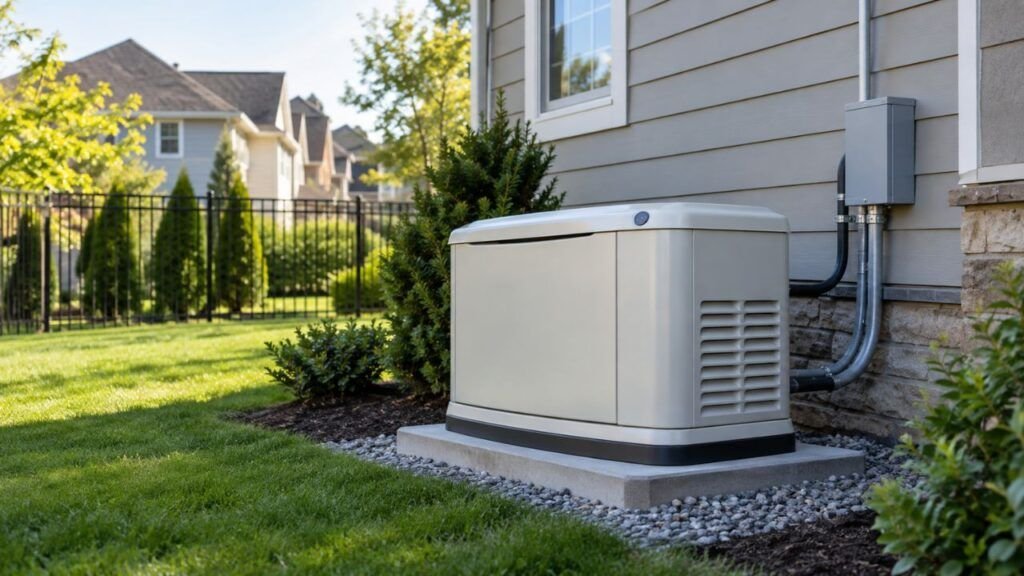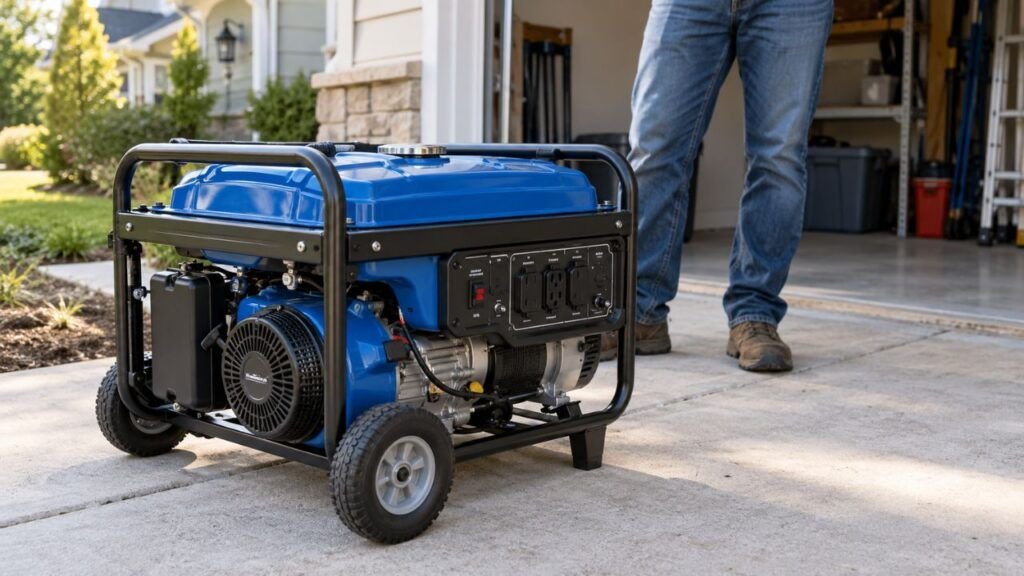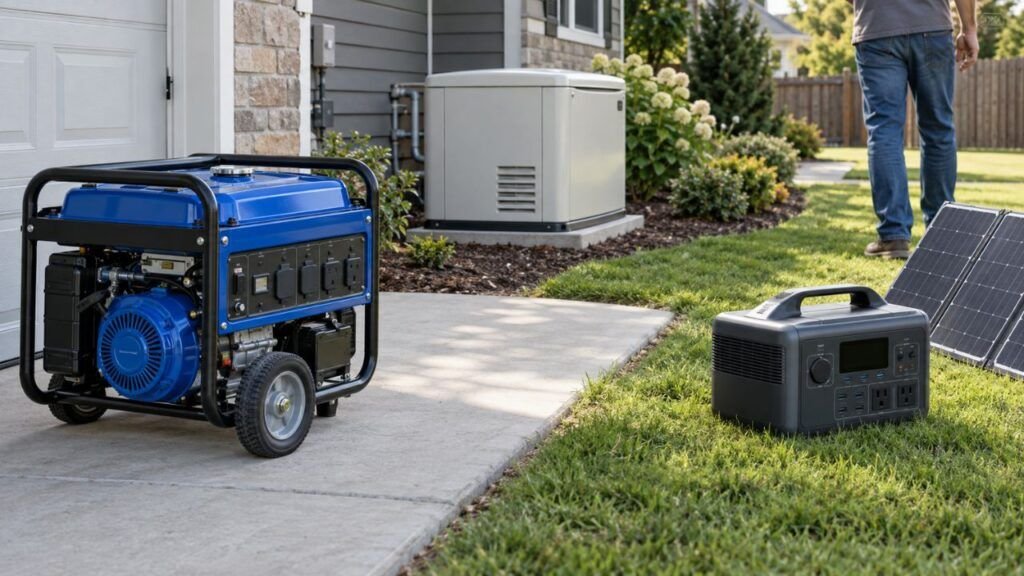
For most homes, a 5,000 to 7,500-watt generator can cover essential appliances during an outage. If you want broader or whole-house backup, you may need 14 to 26 kW or more, depending on your HVAC system, pumps, electric appliances, and other large loads.
However, generator sizing is not based on house size alone. I’ll show you how to calculate your actual power needs, handle starting watts, compare common generator sizes, and choose enough capacity without paying for power you may never use.
Key Takeaways
- A 5,000 to 7,500-watt generator often covers household essentials.
- An 8,000 to 12,000-watt unit supports more appliances together.
- Whole-house standby generators commonly range from 14 to 26 kW.
- Calculate both running watts and appliance starting requirements.
- Central AC, heat pumps, and well pumps can increase generator size.
- Square footage provides only a rough generator sizing estimate.
- Check whether your important appliances require 120V or 240V power.
- Load management may reduce the generator capacity you actually need.
What Size Generator Do I Need for My House? Quick Answer
The right generator depends mainly on what you want powered simultaneously. You can use the table below as a starting point before calculating your exact household load.
| Backup Goal | Typical Loads | Rough Generator Size | Common Generator Type |
| Minimum emergency backup | Refrigerator, lights, Wi-Fi, chargers | 3,000–5,000 W | Portable/inverter |
| Household essentials | Refrigerator, freezer, lights, furnace blower, sump pump | 5,000–7,500 W | Portable |
| Essentials plus larger appliances | Well pump, microwave, more circuits, small AC | 8,000–12,000 W | Large portable |
| Broad household backup | Essentials, several appliances, selected HVAC | 14–20 kW | Standby |
| Typical whole-house backup | HVAC, kitchen, pumps, household circuits | 20–26 kW | Standby |
| Large or all-electric home | Multiple HVAC units and high-demand electric appliances | 26–48+ kW | Large standby |
These numbers are useful planning ranges, not exact recommendations. Your actual electrical loads determine the generator size your house needs.
First Decide What You Want the Generator to Power
Before calculating watts, decide what you actually want during an outage. Someone keeping food cold needs much less power than someone expecting normal whole-house operation.
Essential Appliances Only
If your main goal is emergency backup, you can prioritize necessities.
Typical essential loads include:
- Refrigerator
- Freezer
- LED lights
- Wi-Fi router
- Phone chargers
- Laptop
- Gas furnace blower
- Sump pump
- Selected wall outlets
A 5,000 to 7,500-watt portable generator can often handle a combination of these loads.
However, the exact answer depends on their actual wattages. Pumps and furnace blowers may also need extra power during startup.
Essentials Plus Comfort Appliances
You may want more than basic survival-level backup.
You might also want to operate:
- Microwave
- Television
- Garage door opener
- Well pump
- Window air conditioner
- Coffee maker
- Additional household outlets
- Small kitchen appliances
Once you add these loads, an 8,000 to 12,000-watt generator often becomes more practical.
You still may need to manage which appliances run together.
Whole-House Backup
Whole-house backup usually means keeping most normal household systems available.
This can include central HVAC, refrigeration, kitchen appliances, pumps, lighting, outlets, and other regular circuits.
A typical home may fall somewhere around 20 to 26 kW for broad whole-house coverage. Some houses need less, while large all-electric homes can require considerably more.
Whole-house backup does not necessarily mean every appliance runs simultaneously. Smart load management can prevent several large appliances from operating together.
How to Calculate What Size Generator Your House Needs
The most reliable sizing method starts with your appliances, not square footage. Work through these four steps and you will get a much better estimate.
1. List Everything You Want to Run During an Outage
Start by making a realistic outage checklist.
I recommend dividing your appliances into three groups:
- Must-have: refrigerator, furnace, sump pump, medical devices, lighting
- Useful: microwave, television, internet, additional outlets
- Optional high-load: central AC, dryer, range, water heater, EV charger
This prevents you from accidentally sizing a generator for appliances you would rarely use during an outage.
Think about your normal outage routine as well.
If you can avoid running the dryer while your central AC operates, your generator may not need enough capacity for both simultaneously.
2. Find the Running and Starting Watts
Next, find the electrical demand of each appliance.
You need to understand two numbers.
Running watts are the watts an appliance continuously uses while operating.
Starting watts are the extra power some appliances briefly require when motors or compressors start.
A refrigerator may use relatively modest power once running. Its compressor can require much more power for a few moments during startup.
The same issue applies to:
- Central air conditioners
- Refrigerators
- Freezers
- Well pumps
- Sump pumps
- Furnace blowers
- Heat pumps
Check the appliance nameplate, owner’s manual, or manufacturer specifications whenever possible.
Generic wattage charts are useful for estimates. Your actual equipment specifications are more reliable.
3. Calculate Your Peak Generator Load
Now add the running watts of everything you expect to operate simultaneously.
Then account for the largest realistic startup requirement.
A useful planning formula is:
Required peak watts = total simultaneous running watts + largest additional starting watts
The words additional starting watts are important.
Suppose your appliances require 5,500 running watts together.
Your largest motor uses:
- 1,000 watts while running
- 3,000 watts during startup
Its additional startup requirement is:
3,000 – 1,000 = 2,000 watts
Your estimated peak load becomes:
5,500 + 2,000 = 7,500 watts
A generator rated for only 5,500 running watts would therefore be too close to your normal load.
You also should not blindly add the full starting wattage of every motor. Most appliances will not start at exactly the same moment.
4. Add Reasonable Headroom and Round Up
I would not choose a generator that barely matches your calculation.
Some extra capacity gives the generator room for changing loads. It also helps when another appliance cycles on unexpectedly.
For planning purposes, leaving around 15% to 25% headroom above your expected requirement can be sensible.
Just remember one important distinction.
That extra headroom does not replace calculating starting loads.
First calculate the realistic startup demand. Then leave reasonable operating room above that requirement.
Generator Sizing Example for a Typical House
Let’s walk through an example because this is where generator sizing becomes much easier. The numbers below are only estimates, so always check your actual appliances.
| Appliance | Approx. Running Watts | Approx. Starting Watts |
| Refrigerator | 700 W | 2,200 W |
| Freezer | 500 W | 1,500 W |
| Gas furnace blower | 800 W | 1,600 W |
| Sump pump | 800 W | 1,300 W |
| Microwave | 1,200 W | 1,200 W |
| LED lighting | 300 W | 300 W |
| Wi-Fi and electronics | 200 W | 200 W |
The combined running load would be about 4,500 watts.
The refrigerator has a running load of 700 watts and about 2,200 starting watts.
Its additional startup requirement is approximately:
2,200 – 700 = 1,500 watts
That creates an estimated peak requirement of:
4,500 + 1,500 = 6,000 watts
A generator around 6,000 watts would technically be near that calculated peak. However, I would give myself more operating room.
A generator around 7,000 to 7,500 watts would make more practical sense for this example.
That extra capacity also gives you some flexibility during an outage.
Typical Wattage of Common Household Appliances
Household appliance wattage varies by model, efficiency, and size. Use these numbers for initial planning, then check your equipment before buying a generator.
| Appliance | Typical Running Watts | Possible Starting Demand | Common Voltage |
| Refrigerator | 400–800 W | 1,200–2,200 W | 120V |
| Freezer | 400–700 W | 1,000–2,000 W | 120V |
| Sump pump | 800–1,500 W | 1,300–3,000+ W | 120V |
| Well pump | 1,000–2,500+ W | 2,000–5,000+ W | Often 240V |
| Gas furnace blower | 500–1,000 W | 1,000–2,000+ W | Usually 120V |
| Window AC | 500–1,500 W | 1,000–3,000+ W | Usually 120V |
| Central AC | 2,000–5,000+ W | Can be significantly higher | Often 240V |
| Microwave | 1,000–1,500 W | Usually similar | 120V |
| Electric water heater | 3,000–5,000 W | Usually similar | 240V |
| Electric range | 3,000–8,000+ W | Usually similar | 240V |
| Washing machine | 400–1,200 W | Higher during motor startup | 120V |
| Electric dryer | 4,000–6,000 W | Moderate motor surge | 240V |
| Dishwasher | 1,200–1,800 W | Varies | 120V |
| Wi-Fi router | 10–30 W | Minimal | 120V |
| Television | 50–200 W | Minimal | 120V |
| LED lighting | 5–20 W per bulb | Minimal | 120V |
These ranges are deliberately broad because equipment differs considerably.
For an accurate calculation, use the electrical information from your own appliances.
Why Starting Watts Can Change the Generator Size You Need
Motor-driven appliances create one of the biggest generator sizing mistakes. Their normal operating wattage may look manageable until the motor tries starting.
Running Watts vs. Starting Watts
Running wattage tells you how much power an appliance needs continuously.
Starting wattage represents a temporary surge needed to start certain motors or compressors.
Your generator needs enough running capacity for the normal load. It also needs enough short-term capacity for those startup events.
Ignoring either number can leave you with an undersized generator.
Which Appliances Have the Biggest Starting Loads?
Pay close attention to equipment containing larger motors or compressors.
Common examples include:
- Central air conditioners
- Heat pumps
- Well pumps
- Sump pumps
- Refrigerators
- Freezers
- Furnace blowers
- Some power tools
Central HVAC and well pumps deserve particular attention.
Either one can completely change the generator size needed for your house.
Do You Add the Starting Watts of Every Appliance?
Usually, no.
Adding every appliance’s full startup wattage together can exaggerate your required generator capacity.
Instead, consider what will actually be running simultaneously.
Then identify the largest startup event likely to occur while those loads operate.
For example, your refrigerator and furnace may already be running when the well pump starts.
Your generator needs enough temporary capacity for that realistic combination.
Your HVAC System May Determine Your Generator Size
Heating and cooling often become the deciding factors for whole-house generators. Two otherwise similar homes can need very different generators because of their HVAC systems.
Gas Furnace
A natural gas or propane furnace does not use electricity to create most of its heat.
However, it still needs electricity for components such as:
- Blower motor
- Ignition
- Control board
- Thermostat-related controls
That means a home with gas heating can have much lower electrical backup requirements than a home using electric resistance heat.
Check the actual furnace nameplate before calculating your generator load.
Central Air Conditioner
Central air conditioning creates a more complicated sizing challenge.
The compressor can demand substantial power when starting, even if its normal running wattage appears manageable.
That means you cannot confidently size a generator from AC tonnage alone.
A 3-ton air conditioner from one home can have different starting characteristics from another 3-ton system.
Check the unit’s electrical specifications whenever central AC matters during an outage.
Heat Pump
Heat pumps can significantly increase generator requirements.
The compressor itself may have a substantial starting load. Some systems also use electric auxiliary or emergency heat.
Electric resistance backup heat can require considerably more power than the heat pump operating normally.
That is why an all-electric home often needs closer evaluation.
Can a Soft Start Reduce the Generator Size Needed for AC?
A properly compatible soft-start device can reduce the startup demand of some air-conditioning compressors.
That can make central AC easier for a generator to start.
However, I would not automatically assume a soft start lets you purchase a specific smaller generator.
The final result depends on the HVAC equipment, generator, installation, and remaining household loads.
What Size Generator Do I Need by House Size?
Square footage can provide a quick reference, but it should never be your main sizing calculation. These ranges are rough planning estimates for standby backup.
| House Size | Rough Standby Range | What Can Increase the Requirement |
| Around 1,500 sq. ft. | 10–18 kW | Central AC, well pump, electric heat |
| Around 2,000 sq. ft. | 18–22 kW | HVAC, electric appliances, pumps |
| Around 2,500 sq. ft. | 20–26+ kW | Multiple high-demand appliances |
| Around 3,000 sq. ft. | 22–30+ kW | Multiple HVAC units, electric heat |
| 3,500+ sq. ft. | Often 26 kW+ | Multiple zones, pumps, EV charging |
Treat these numbers as general reference points.
A 2,500-square-foot house with gas heat and gas cooking may require less generator capacity than a smaller all-electric house.
Electrical load matters much more than floor area.
Why a Gas Home and an All-Electric Home May Need Different Generator Sizes
Fuel type can make a surprisingly large difference.
Imagine two 2,000-square-foot homes.
The first home uses:
- Natural gas furnace
- Gas water heater
- Gas range
- Electric refrigerator
The second uses:
- Electric heat pump
- Electric water heater
- Electric range
- Electric dryer
Their square footage is identical.
Their generator requirements can be completely different.
Large electric heating elements consume thousands of watts. Electric water heaters, ranges, and dryers can also create substantial loads.
That is why I recommend looking at your actual appliances before focusing on house size.
Don’t Ignore 120V and 240V When Choosing a Generator
Wattage tells only part of the story. Your generator must also provide the correct voltage for the equipment you want powered.
Common 240V household loads can include:
- Central air conditioners
- Heat pumps
- Well pumps
- Electric water heaters
- Electric dryers
- Electric ranges
- Some HVAC equipment
Suppose your calculated load requires 7,000 watts.
Buying any generator labeled 7,000 watts does not automatically guarantee compatibility with every household circuit.
You also need the proper voltage output and connection equipment.
This becomes especially important when supplying your home’s electrical panel.
Portable Generator vs. Standby Generator for a House
Both generator types can provide useful home backup, but they solve different problems. Compare your outage frequency, power demand, convenience needs, and budget.
| Factor | Portable Generator | Standby Generator |
| Typical capacity | Low to moderately high | Moderate to very high |
| Essential appliance backup | Excellent | Excellent |
| Whole-house operation | Limited on many models | Designed for it |
| Automatic startup | Usually no | Yes |
| Common fuels | Gasoline, propane, dual-fuel | Natural gas or propane |
| 240V output | Model dependent | Common |
| Transfer equipment | Usually manual | Usually automatic |
| Installation | Limited setup or connection work | Permanent professional installation |
| Best for | Occasional outages | Frequent or automatic backup |
A portable generator makes sense if you primarily want emergency essentials.
It can provide excellent value without requiring a permanent standby installation.
A standby generator makes more sense when you want automatic operation and broader household coverage.
It can start shortly after utility power fails and supply selected or whole-house circuits through its transfer equipment.
Can Load Management Let You Use a Smaller Generator?
Yes. Load management can sometimes reduce how much generator capacity you need.
Think about your biggest electrical loads.
You probably do not need the following operating simultaneously:
- Central AC
- Electric dryer
- Electric water heater
- Electric range
- EV charger
Without load management, you might size the generator for a very large theoretical peak.
A load-management system can temporarily prevent lower-priority equipment from operating when generator demand becomes too high.
For example, it might temporarily pause an electric water heater while the central AC starts.
Once available capacity increases, the lower-priority load can operate again.
This approach can make a properly sized system more efficient and economical.
However, load management must be designed around your actual electrical system.
Other Factors That Can Change the Generator Size You Need
Generator sizing involves more than simply adding refrigerator and lighting wattage.
- Central AC size: Larger compressors can create substantial starting loads.
- Heating type: Electric heating usually requires more generator capacity than gas heating.
- Well pump: Many well pumps create substantial startup demand and may require 240V.
- Sump pump: Homes depending on sump pumps should prioritize reliable startup capacity.
- Electric water heater: A conventional electric tank can consume several thousand watts.
- Electric range: Cooking equipment can create a significant continuous load.
- Electric dryer: A dryer heating element can add several thousand watts.
- Pool equipment: Pumps and heaters can considerably increase electrical demand.
- EV charging: Home EV charging can become one of your largest electrical loads.
- Multiple HVAC units: Larger homes may have two or more separate systems.
- Future appliances: Consider planned renovations or major new electrical equipment.
- Load management: Proper management can reduce simultaneous peak demand.
- Fuel rating: Generator output can vary depending on the fuel used.
- Simultaneous operation: Your real peak load matters more than every appliance added together.
What Happens If Your Generator Is Too Small?
An undersized generator may work normally until another large appliance starts.
Then you may experience:
- Generator overload
- Tripped breakers
- Automatic shutdown
- Appliances failing to start
- Engine struggling under excessive load
- Unstable operation during changing demand
- Constant manual appliance management
That does not mean you need the biggest generator available.
It means the generator should comfortably handle your realistic peak load.
Proper sizing creates a balance between reliability and unnecessary capacity.
Can a Generator Be Too Big for a House?
You can certainly buy more generator capacity than your home realistically needs.
A moderately larger generator is not automatically a problem. However, dramatically oversizing your system can create unnecessary expenses.
You may face:
- Higher generator purchase cost
- Higher installation costs
- Larger fuel requirements
- More expensive supporting equipment
- Capacity that rarely gets used
Suppose your realistic requirement is around 14 kW.
Automatically buying a 30 kW generator simply because it is bigger may offer little practical benefit.
A better goal is enough capacity for your actual needs, plus reasonable room for future changes.
Common Generator Sizing Mistakes to Avoid
Generator sizing becomes much easier when you avoid a few common mistakes.
- Sizing from square footage alone: Homes of equal size can have completely different electrical loads.
- Using only running watts: Motors and compressors may need substantial additional power during startup.
- Adding 20% and calling it surge capacity: A percentage buffer does not replace calculating actual starting requirements.
- Adding every starting watt together: Most appliances do not start simultaneously.
- Confusing total starting watts with additional starting watts: Avoid counting an appliance’s running load twice.
- Ignoring 240V equipment: Enough wattage does not guarantee compatibility with every household appliance.
- Assuming everything must operate together: Load management can reduce simultaneous demand.
- Ignoring HVAC startup: Central AC can become the largest startup load in your house.
- Forgetting the well pump: A well pump can significantly increase generator requirements.
- Buying according to a 100A or 200A service rating: Your electrical service capacity is not automatically your backup generator requirement.
- Ignoring fuel-specific output: Some generators have different power ratings depending on fuel.
- Using generic wattages as exact values: Always check your actual equipment before final sizing.
Do You Need a Transfer Switch to Power Your House?
If you want a generator to supply circuits through your home’s electrical system, you need an appropriate and code-compliant transfer method.
A transfer switch safely separates generator power from utility power.
Portable home-backup setups commonly use approved manual transfer equipment. Permanent standby generators normally use an automatic transfer switch.
Never attempt to energize household wiring through an improvised connection.
Improper connections can create dangerous backfeeding conditions and expose utility workers, homeowners, and electrical equipment to serious hazards.
Have a qualified electrician evaluate permanent household connections.
When Should an Electrician Size the Generator for You?
You can estimate generator capacity yourself, especially for portable emergency backup. Professional load sizing becomes more important as the system gets larger or more complex.
Consider professional sizing when you have:
- Central air conditioning
- Heat pumps
- Electric resistance heating
- Multiple 240V loads
- Well pumps
- Multiple HVAC zones
- EV charging
- Automatic standby equipment
- Load-management equipment
- A permanent transfer switch
- Large whole-house backup requirements
An electrician can evaluate the actual electrical loads instead of relying on generalized wattage charts.
That becomes especially valuable when you’re investing in a permanent standby system.
A Quick Safety Note for Portable Home Generators
Always operate portable combustion generators outdoors and well away from occupied buildings, doors, windows, and vents.
Never operate one inside a garage, basement, shed, or enclosed area.
Carbon monoxide can build up quickly without being visible or noticeable.
Also use working carbon monoxide alarms inside your home whenever operating fuel-burning backup equipment.
Final Verdict
For most homeowners who only want essential outage power, a 5,000 to 7,500-watt generator is a useful starting range. It can often support refrigeration, lighting, electronics, a furnace blower, and selected pumps.
If you want more normal household operation, consider roughly 8,000 to 12,000 watts. This range gives you more flexibility for pumps, kitchen appliances, additional circuits, and selected cooling loads.
For broader standby backup, many homes fall somewhere around 14 to 26 kW. Homes with central HVAC, electric heat, multiple pumps, EV charging, or several high-demand appliances may require more.
The most important step is still calculating your own load. Add your simultaneous running watts, account for the largest realistic startup demand, check 120V and 240V requirements, and leave reasonable operating headroom.
Do that before choosing a generator, and you are far less likely to buy something frustratingly small or unnecessarily large.
Related FAQs
Will a 7,500-Watt Generator Run a House?
A 7,500-watt generator can run many household essentials, including refrigeration, lights, a furnace blower, electronics, and selected pumps. Whether it can handle your house depends on appliance wattage and startup demands, especially from air conditioners and well pumps.
Will a 10,000-Watt Generator Run a Whole House?
A 10,000-watt generator can support substantial household backup, but it may not operate every appliance in an all-electric home simultaneously. Central AC, electric water heating, electric dryers, ranges, and large pumps can quickly increase your total load.
Will a 12,000-Watt Generator Run a House?
A 12,000-watt generator can provide strong backup for many homes when large loads are managed carefully. It may run refrigeration, lighting, pumps, heating controls, kitchen appliances, and selected HVAC equipment, depending on startup requirements.
Is a 20kW Generator Enough for a House?
A 20kW standby generator can provide broad backup for many average homes. However, houses with electric heat, multiple central AC units, EV chargers, large well pumps, or several high-demand appliances may need additional capacity or load management.
Will a 22kW Generator Run My Whole House?
A 22kW generator can provide whole-house or near-whole-house backup for many homes, particularly when heating and major appliances use natural gas. All-electric homes or houses with several large electrical loads may require careful load management or a larger generator.
What Size Generator Do I Need for a 1,500-Square-Foot House?
A 1,500-square-foot house may use roughly a 10 to 18 kW standby generator for broader backup, depending on its appliances and HVAC system. Essential-only backup may require much less, so calculate electrical loads rather than relying only on floor area.
What Size Generator Do I Need for a 2,000-Square-Foot House?
A 2,000-square-foot home may fall around the 18 to 22 kW range for broad standby backup, but this is only a rough estimate. A gas-heated house may need significantly less power than an all-electric home of identical size.
What Size Generator Do I Need for Central Air Conditioning?
Generator size for central air conditioning depends on the AC’s running wattage, compressor startup demand, and other household loads operating simultaneously. Check the HVAC equipment specifications instead of selecting generator size from cooling tonnage alone.
What Size Generator Do I Need for a 3-Ton AC?
There is no single generator size that works for every 3-ton air conditioner because compressor startup requirements vary. Check the unit’s electrical data and include its startup demand alongside your other required household loads before choosing generator capacity.
How Do I Calculate Generator Size From Volts and Amps?
For a simple single-phase load, watts can be estimated by multiplying volts by amps, although motors and AC equipment can require additional considerations. Appliance nameplates or manufacturer wattage specifications are usually better for accurate home generator sizing.

Brian Walker writes straightforward generator guides and reviews for homeowners and everyday users. His content focuses on solar, portable, and fuel-powered generators, with practical advice on choosing, using, and maintaining reliable backup power.